2023-12-05 19:11
The filing says the company has already sold $134.7 million of the securities. X.AI Corp., backed by Tesla CEO and X owner Elon Musk, is raising up to $1 billion in equity securities offering, according to a regulatory filing. The company has already sold $134.7 million of the securities, with another $865.3 million remaining to be sold, according to a filing made with the U.S. Securities and Exchange Commission (SEC). The minimum investment accepted from any outside investor is $2 million. The filing says that Musk, who took over Twitter and renamed it X, is an executive officer and director of X.AI. Also listed as an executive is Jared Birchall, a former Goldman Sachs, Merrill Lynch and Morgan Stanley executive who is reported to be the manager of Elon Musk's family office. CoinDesk previously reported that in April 2023, when Musk merged Twitter into X Corp., he also registered X.AI as an artificial intelligence startup. The executive then established xAI, his own company, to "understand the universe." The announcement prompted some crypto users to spin up scores of "X" tokens on multiple blockchains. Elon Musk, artificial intelligence and crypto Musk is closely followed in the crypto industry since Tesla was one of the first big corporate buyers of bitcoin (BTC) and since X is such a prominent venue for information exchange among blockchain companies. The billionaire entrepreneur has also posted frequently about dogecoin (DOGE), the Shiba Inu breed-themed meme token, prompting occasional speculation that the digital asset might somehow be adopted or promoted by Musk as a form of payment. The DOGE price jumped after CoinDesk reported the news. The token was up 7.4% in the past 24 hours as of press time. Listen: The Dichotomy Of AI: MIT Professor Sandy Pentland Examines Whether It Poses a Threat or Opportunity to Humanity https://www.coindesk.com/tech/2023/12/05/elon-musk-backed-xai-files-with-sec-to-raise-up-to-1b-in-equity-offering/

2023-12-05 18:34
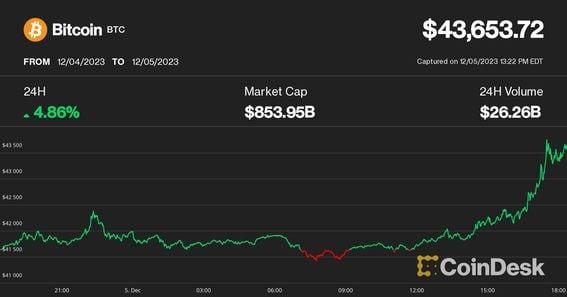
The sharp move higher from $42,000 Tuesday prompted $73 million in liquidations, mostly from leveraged positions betting on lower prices. A quick surge in bitcoin (BTC) early Tuesday afternoon lifted the price above $44,000 on some crypto exchanges, including Coinbase, for the first time since early April 2022 as the largest crypto extended its rally supported by declining interest rates and anticipation for a spot bitcoin exchange-traded fund in the U.S. The CoinDesk Bitcoin Index XBX, which gathers pricing data from multiple exchanges, rose from below $42,000 earlier in the day to hit a session high of $43,868. It's shed some of the gains since, retreating to around $43,500, still up nearly 5% over the past 24 hours. The volatile action liquidated $73 million of leveraged bitcoin derivatives trading positions, predominantly shorts betting on lower prices, Glassnode data shows. The bitcoin rally is supported by a confluence of growing institutional investor interest and anticipation of an imminent regulatory approval for listing spot-based BTC ETFs in the U.S., simplifying access to the asset for traditional players, Joel Kruger, market strategist at LMAX Group, said in an email. Kruger said BTC's upward price momentum has a clear path ahead until the area between $48,000 and $53,000, based on technical price levels – notably highs hit in March 2022 and September 2021. "There is a nice zone between those two levels with very little in the way of any meaningful resistance between the current price and that March 2022 high," Kruger explained. https://www.coindesk.com/markets/2023/12/05/bitcoin-blasts-to-44k-on-coinbase-and-could-run-towards-48k-resistance-lmax-analyst/
2023-12-05 17:19
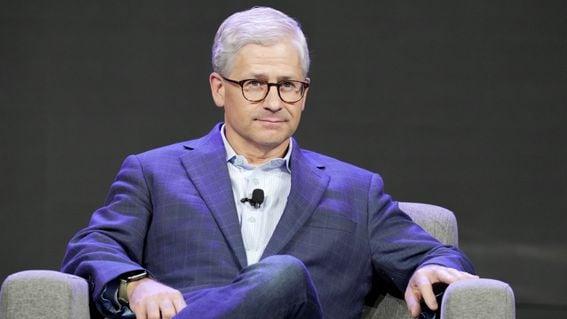
Rep. Patrick McHenry, the chairman of the House Financial Services Committee who has shepherded crypto legislation this year, said he's decided not to run again next year. Patrick McHenry, the chairman of the House Financial Services Committee that has been leading crypto legislation efforts in the House, said 2024 will be his final year in Congress. His departure leaves some uncertainty for two key crypto bills that are facing potential House floor votes, though McHenry will still be around next year when they're expected to be considered for approval. Rep. Patrick McHenry (R-N.C.), arguably the crypto industry's most important advocate in the U.S. Congress, has decided not to seek another term, he announced in a post on X on Tuesday. As McHenry, the chairman of the House Financial Services Committee, continues to shepherd two significant pieces of digital assets legislation toward floor votes in the House of Representatives, his decision could set a clock on getting that task accomplished. Rep. French Hill (R-Ark.), the chair of that panel's crypto-focused subcommittee, has already indicated that progress on the bills – one to regulate U.S. stablecoin issuers and one to establish rules for the wider crypto markets – will shift into the first months of next year. "I will be retiring from Congress at the end of my current term," McHenry said, confirming news first reported by Politico. "I believe there is a season for everything and – for me – this season has come to an end. I look forward to what comes next for my family and me." McHenry has been a central GOP negotiator for the stablecoin bill, which had nearly reached the finish line in talks with Rep. Maxine Waters (D-Calif.), the committee's ranking Democrat. Waters has indicated she's still willing to finish the work, and that legislation is widely seen as the most likely to win approval and potentially find success in the Democrat-controlled Senate. The coming departure of the influential North Carolina lawmaker, famous for his bowties and known for a willingness to make pragmatic deals across the aisle, marks another twist in a political career that in recent weeks saw him suddenly ascend to the role as the House's acting speaker after his colleagues fired Rep. Kevin McCarthy (R-Calif.). "We have appreciated McHenry's approach to coalition building, willingness to work in a bipartisan nature and constructive engagement with industry," said Sheila Warren, CEO of the Crypto Council for Innovation, in a Tuesday statement. "He will be noticeably missed in Congress." McHenry, who was facing the end of his tenure as committee chairman, will have until January of 2025 to complete his term. When a lawmaker announces he's leaving Congress, it can sometimes diminish his or her authority in negotiations. “Chairman McHenry is a stalwart champion of innovation and the digital asset industry," said Blockchain Association CEO Kristin Smith. "His bipartisan approach to commonsense rules that improve the status quo and ensure that this technology develops on American soil is a prudent model for Congress as it considers future crypto-specific legislation. While we’re sad to see such an industry champion leave the House, we’re pleased to be able to work closely with the congressman for another 13 months.” The industry still has a number of supporters among House Republicans, including Majority Whip Tom Emmer (R-Minn.) and Hill. But it also has powerful critics on the Senate side, such as Sen. Elizabeth Warren (D-Mass.) and Sen. Sherrod Brown (D-Ohio), the chairman of the Senate Banking Committee. Read More: Patrick McHenry Is Dragging Crypto Bills Through Congress https://www.coindesk.com/policy/2023/12/05/houses-mchenry-wont-seek-reelection-costing-crypto-a-top-ally-politico/
2023-12-05 16:55
BlackRock’s amended filing included clarifications on topics such as the Trust’s structure and potential regulatory impacts on it. Asset manager BlackRock and crypto investment firm Bitwise both filed amended S1 forms with the Securities and Exchange Commission (SEC) on Monday, answering further questions likely asked by the regulator in earlier conversations. While it is unclear what exact topics the SEC asked applicants to provide further information for, analysts had predicted that changes to the prior filings would be made following several meetings between the SEC and applicants last week. The filings signal that both parties are “working hard to iron things out,” Bloomberg Intelligence’s James Seyffart wrote on X. Amendments by the other 11 applicants, including Fidelity, Franklin and WisdomTree, will likely follow soon, he said. BlackRock’s updated filing included several changes, ranging from themes like security, risks, disclosures, to the structure of the Trust. In total, 21 notable amendments were made in the asset management giant’s latest update, CryptoSlate noted. Others include potential regulatory impacts on the ETF and how to navigate the regulatory landscape in other jurisdictions such as the UK and the EU. The SEC is set to make a decision on whether or not to approve one or more spot bitcoin ETFs between Jan 5th and Jan 10th, which is the next and final deadline. Bloomberg analysts predict there is a 90% chance that that scenario will indeed happen. https://www.coindesk.com/business/2023/12/05/blackrock-bitwise-file-updated-application-for-spot-bitcoin-etf/
2023-12-05 15:00
The low-latency oracle network's new "strategic partners" include Castle Island Ventures, Multicoin Capital and Wintermute Ventures. They could play a major role in shaping how the platform evolves. Pyth, an oracle service that provides low-latency pricing data to blockchains, distributed its new PYTH governance tokens to more than 90,000 crypto wallets in November. The token was introduced as a way to decentralize Pyth's governance process – a system that will allow token-holders to vote on how the platform evolves. As the result of a "strategic fundraising" round announced this week, some of the crypto industry's largest players – including some big-name venture firms and market makers – could soon have a loud voice in this new system. The Pyth Data Association, a Swiss non-profit focused on Pyth development, told CoinDesk this week that it has raised funds from crypto heavyweights including Castle Island Ventures, Multicoin Capital, Wintermute Ventures, Borderless Capital, CMT Digital, Bodhi Ventures, Distributed Global and Delphi Digital. Michael Cahill, the CEO of Pyth developer Duoro Labs and a director of the Pyth Data Association, said in an interview that the new partners all received allotments of PYTH tokens – the assets that double as votes in the protocol's governance system. Cahill declined to specify how much money the Data Association had raised in the round, but the Data Association's new funders could potentially use their PYTH tokens to influence how the platform develops moving forward. "This round expands the Pyth community to new stakeholders and individuals dedicated to advancing decentralized capital markets," the Pyth Data Association said in a statement. "New stakeholders will help the network grow through enhanced access to new capital sources, participation in governance and protocol improvements, and strategic guidance." The Data Association's new partners are "excited about being able to shape the direction of Pyth and being able to drive this from a truly decentralized perspective," Cahill said in the interview. Pyth, which launched on the Solana blockchain in 2021 and has since expanded to 45 blockchains, currently services 25% of all applications that use oracles, according to Cahill. Oracles are critical pieces of blockchain infrastructure that shepherd real-world data (in Pyth's case, price data for stocks, commodities and currencies – both fiat and the crypto kind) onto blockchains. Unlike Chainlink, the current leader in oracles, Pyth sources its data directly from first-party financial firms (and many Pyth contributors rank among the biggest firms in trading) rather than third parties. This direct-from-the-source data gathering, combined with other elements of Pyth's architecture, is designed to give the protocol a leg up in terms of overall speed – a key differentiator that could help Pyth eat away at Chainlink's dominant market position, and could bring sluggish crypto markets further-in line with the demands of modern finance. Pyth was incubated by Jump Crypto, the crypto arm of Jump, a major Chicago-based trading firm. It spun out into an independent entity mid-year with the establishment of Duoro Labs, which is currently exclusively focused on the development of the Pyth protocol, according to Cahill. https://www.coindesk.com/tech/2023/12/05/pyth-oracle-network-brings-industry-heavyweights-into-governance-post-airdrop/

2023-12-05 10:46
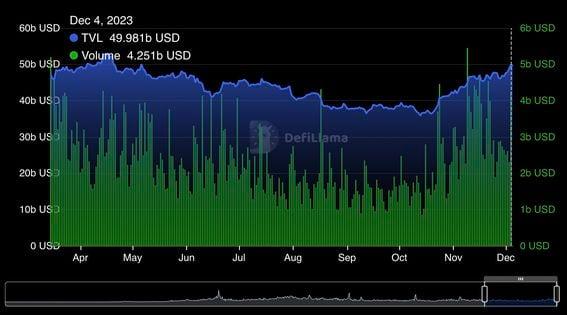
An uptick across Solana-based protocols coupled with more than $700 million in deposits to Blast has fueled growth of the value locked in decentralized finance. DeFi's TVL has gained more than $15 billion in six weeks. Rising asset prices coupled with fresh inflows have contributed to the increase. Value on some Solana-based protocols has risen by as much as 120% and newly announced layer-2 platform Blast received more than $700 million in deposits. The total amount of capital locked or staked across all decentralized finance (DeFi) protocols reached $50 billion on Tuesday for the first time in six months as the value of underlying assets surged and investors sought to secure a yield on their crypto holdings. Data from DefiLlama shows that since Oct. 13, when the sector was at multiyear lows, the figure has increased by $15 billion. The search for yield was illustrated last week, when Blast, a newly announced layer 2 project that hopes to go live next year, received more than $700 million in deposits from traders and investors who were unperturbed by the fact that assets cannot be withdrawn until at least March. Since Oct. 13, ether (ETH), the primary asset used across the DeFi market, has risen by 42%, outpacing the whole DeFi market, which increased by 41%. It's worth noting that a significant portion of DeFi protocols offer yields on stablecoins, which are pegged to traditional fiat currencies like the dollar, euro or sterling. Transactional volume has also risen: More than $5.4 billion changed hands on a single day last month, the most since March. The sector experienced a boost earlier this year as a result of Ethereum's shift to a proof-of-stake blockchain, which meant holders could stake ether to become a network validator and receive rewards. The transition spurred the liquid staking market, led by the likes of Lido and RocketPool, which combined are responsible for 45% of DeFi's total value locked (TVL). Lido currently offers an annual yield of 3.7% whilst RocketPool offers 3.92%. Liquid staking is a form of derivative that allows investors to generate a yield from staking ether whilst receiving a token that can be used elsewhere across the DeFi ecosystem. TVL on Solana-based protocols marginfi, Jito and Marinade Finance has jumped by between 60% and 120% in the past 30 days as institutional interest around Solana continues to mount. Grayscale's Solana Trust traded at an 869% premium last month, demonstrating significant demand from the institutional market. Jito, Solana's liquid staking protocol, offers stakers a yield of 6.96%, a level that led to $327 million in inflows since Oct. 13. https://www.coindesk.com/business/2023/12/05/defi-market-rebounds-to-50b-as-speculators-hunt-for-yield/