2023-11-30 10:40
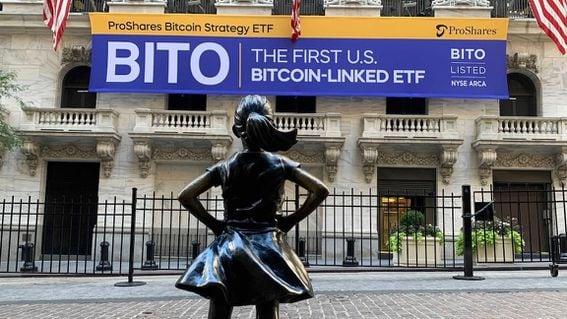
ProShares' BITO now has $1.47 billion in holdings, as a flurry of bitcoin ETF applications in the U.S. seemingly spurs institutional interest in the asset. ProShares’ Bitcoin Strategy ETF (BITO) – a bitcoin futures fund offered in the U.S. – hit a high of $1.47 billion in assets under management (AUM) this week, surging past a record set in December 2021. The surge indicates renewed institutional demand for bitcoin (BTC) from regulated and accredited investors, as a flurry of bitcoin spot ETF applications were filed in the U.S. BITO, listed on the Chicago Mercantile Exchange (CME), allows investors to gain exposure to bitcoin-linked returns via a regulated product. “Investor demand for BITO remains strong, as shown by the ETF reaching a new high in assets under management,” Simeon Hyman, global investment strategist at ProShares, said in a statement to CoinDesk. “We believe this speaks to the demand for a familiar, accessible and regulated way to target the returns of bitcoin.” “BITO’s average daily trading volume of $160M since inception puts it in the top 5% of all U.S. ETFs,” Hyman added. Unlike some other bitcoin futures ETFs, BITO closely tracks the asset's spot prices, which has likely added to its allure among traders. In June, investors poured in more than $65 million in a single week, making it the largest inflow in a year and breaking a previous 2023 high of just over $40 million in April. Bitcoin prices have rallied in the past several months as various investment giants, such as BlackRock (BLK) and Fidelity, are waiting for U.S. regulators to approve the offering of bitcoin spot ETF to clients – a move widely expected to drive buying pressure for the asset. Bitcoin traded at just over $37,600 as of Thursday morning, down 1.6% in the past 24 hours. https://www.coindesk.com/markets/2023/11/30/worlds-largest-bitcoin-futures-etf-breaks-2021-record-highs-for-assets-under-management/
2023-11-30 10:38
BitMEX is internally transferring its bitcoin holdings to a newer wallet type, according to on-chain firm CryptoQuant. A new wallet address that went from zero to holding over 10,000 bitcoin (BTC) since the start of November has been identified as belonging to crypto exchange BitMEX. The rapid accumulation led to speculation it could be a new entity buying bitcoin, especially amid a flurry of spot bitcoin exchange-traded fund (ETF) filings in the U.S. On-chain analytics firm CryptoQuant told CoinDesk in a Thursday note that the address, bc1qchctnvmdva5z9vrpxkkxck64v7nmzdtyxsrq64, was a new one for the BitMEX exchange’s cold wallet, or a type of custody that isn’t connected to the internet. A 566 BTC transfer was the biggest single transfer. The address appears on BitMEX’s latest proof-of-reserves holdings published on Nov. 28. CryptoQuant has previously labeled the sending addresses as belonging to BitMEX. “This new address received the Bitcoin from a total of 450 addresses,” CryptoQuant said. “These addresses also appear on BitMEX’s Proof-of-Reserves report and have the characteristic bc1qmex prefix.” BitMEX was probably conducting an internal transfer because it is migrating most of its bitcoin holdings from the 3BMEX format to addresses with format bc1qmex, the firm said. There are also Bitcoin addresses that start with “bc1q” that support SegWit, a type of bitcoin transaction, natively, allowing more efficient transactions that can pay lower fees. As of Thursday, the wallet was the 74th largest holder of bitcoin, according to Bitinfocharts. https://www.coindesk.com/markets/2023/11/30/mysterious-address-that-added-10k-bitcoin-is-just-a-new-bitmex-wallet/
2023-11-30 10:07
Ether is up 70% year-to-date, but NFT indexes are still down 16% in dollar terms and 50% when denominated in ether. Ether, and crypto broadly, have posted gains of more than 10% since the start of the year, while NFT prices are trailing. Stakeholders and analysts say utility and technological development are needed to bring growth Crypto is inching toward bull-market territory, but non-fungible tokens (NFTs) have failed to benefit from the market euphoria. While ether (ETH) is up approximately 70% year-to-date, NFT valuations aren't following. Nansen's NFT-500 index, which measures the valuation of the top 500 NFTs, has dropped 50% year-to-date when denominated in ether and 16% in dollar terms. The Blue-Chip 10 index, which measures the valuations of the most prominent NFTs, such as CryptoPunks and the Bored Ape Yacht Club, is down 44% in ether terms, 1.7% in dollars. OpenSea, the largest NFT marketplace, hasn't fared much better. At the height of NFT mania in January 2022, the platform was clearing $387.48 million in fees every month and $120.45 million in revenue, according to data from DeFiLlama. Now, fees have slumped to $6 million a month and revenue to $1.39 million. "NFTs have survived their first market cycle and have yet to take on a new jumping point in technology to usher in more user interest, like DeFi had with Uniswap's AMM," Nick Ruck, the COO of ContentFi, a decentralized IP-focused content financial ecosystem, said in an email interview. "Many new innovations are still being built to increase the use cases of NFTs, but it's also partly due to the fact that NFT prices are generally negatively correlated with the USD price of ether." There are some signs of growth in the market, however, including a growing market of NFTs based on utility rather than monkey JPEGs, applying the technology to things like ticketing and loyalty programs. Bitcoin ordinals also continue to grow in popularity, with miners appreciating the fees. Sora Ventures' Jason Fang attributed their success to them being a hub for the growing development of something similar to a layer-2 for the Bitcoin blockchain. "Bitcoin ordinals is not only a breakthrough for bitcoin utility, but also a hub that brings communities together," he said in an interview by email. "Communities like Stacks, BSV, Rootstock, and even Starkware, which don't usually interact with each other, are all exploring ways to get involved and build on Ordinals Protocol – everyone found a common ground and wants a piece of it." David Mirzadeh, Ecosystem Finance Lead of Taiko, says this utility is also the narrative driving the NFT rebound. “I see NFTs recovering some of the ground they have lost once they move beyond just speculative JPEGs to assets with utilities in areas such as games, music, and social," he said. "Until then, their price performance will largely depend on speculative hype and mania.” https://www.coindesk.com/markets/2023/11/30/nft-prices-are-still-lagging-behind-ethers-gains/
2023-11-30 09:26
The sale of 38,668 COIN shares from the Ark Fintech Innovation ETF follows a similar offload on Monday. Cathie Wood's investment management firm ARK Invest sold a further $5 million worth of Coinbase (COIN) stock on Wednesday while buying $2 million of shares in trading platform Robinhood (HOOD) and $1.5 million of online bank SoFi Technologies (SOFI). The sale of 38,668 COIN shares from the Ark Fintech Innovation ETF (ARKF) follows the offload of 43,956 shares on Monday. COIN was largely static on Wednesday, closing down 0.35% at $127.82. The HOOD purchase was ARK's seventh of the month, and coincides with the firm starting to offer stocks trading in the U.K., its third attempt at international expansion. ARK has spent some $13.5 million on Robinhood this month, based on closing prices. The shares rose 3.24% to $8.92 on Wednesday. SoFi Technologies, meanwhile, said it was exiting the crypto business, handing its customers over to Blockchain.com. SOFI fell 0.14% to $7.35. Read More: Cathie Wood Speculates Gary Gensler's Political Ambitions Are Affecting Spot BTC ETF Judgement https://www.coindesk.com/markets/2023/11/30/ark-invest-sells-another-5m-of-coinbase-shares-buys-robinhood-sofi/
2023-11-30 06:25
The licence will allow Fasset to serve institutional investors, qualified investors and retail investors. Fasset, a digital asset investment platform, has won a license to operate in Dubai as a Virtual Asset Service Provider (VASP), allowing it to serve institutional, qualified, and retail investors, Dubai's public register shows. Receiving a full license involves three stages: a provisional permit, a preparatory license, and an operating license. Fasset FZE has completed the third stage and will be in a position to provide broker-dealer services and provide tokenized bonds and stocks in close collaboration with Dubai's Virtual Asset Regulatory Authority (VARA) in the future. Read More: Dubai: Launching a Crypto Regulatory Arm to Become a Global Financial Power In 2020, Fasset announced it would offer zero-fee trades to users in six countries in the Gulf Region and launched what it called the world’s first operating system built on the Ethereum blockchain dedicated to the ethical financing of sustainable infrastructure. Since then, it has focused on prioritizing real-life use cases for a wide range of customers and creating compliant remittance corridors. It has secured licenses and authorizations to operate in the European Union and launched in Indonesia in August, where it partnered with Mastercard Indonesia. "As one of the most progressive regulatory frameworks in the world, the VARA approval is a crucial link in our global licensing portfolio, connecting places like Indonesia, Malaysia, Bangladesh, Pakistan and Turkey," said Fasset CEO Mohammad Raafi Hossain. Fasset's founding team previously worked at the United Arab Emirates Prime Minister’s Office, starting the initial conversations for crypto regulation. During the COVID-19 pandemic, Fasset was headquartered in London but it has since become dual-headquartered in Indonesia and Dubai. https://www.coindesk.com/policy/2023/11/30/digital-asset-investment-platform-fasset-wins-operational-licence-in-dubai/

2023-11-29 23:54
With hot competition between layer-2 technology providers like Optimism, Polygon and Matter Labs, Celo's choice is being closely watched by the blockchain industry. The Celo blockchain's primary developer laid out a "framework" for choosing a technology provider for its new layer-2 network atop Ethereum, proposing to wrap up the evaluation by mid-January in what has become a surprisingly intense competition between some of the blockchain industry's most prominent teams. The developer, cLabs, published the "Framework for selecting an L2 stack" Wednesday on its discussion forum, inviting community feedback on the document by mid-December, and plans to assess the various suitors over the ensuing month. The community behind Celo approved the plan to transition to a layer-2 blockchain in July, essentially an acknowledgment that the project was more likely to thrive as a part of the dominant and fast-growing Ethereum ecosystem than remaining as a lesser, standalone network. Initially, CLabs had named OP Stack from the Optimism ecosystem – the technology underpinning the U.S. crypto exchange Coinbase's new layer-2 network, Base – as the default provider for its new layer-2 network. But over the following several months, rival teams Polygon and then Matter Labs, which stands behind the zkSync project, offered competing proposals aiming to woo Celo's business. Celo ranks as the 27th-biggest blockchain in decentralized finance, with a total value locked, or TVL, of $102 million, according to the website DeFiLlama. That's a tiny fraction of the $26.2 billion in the Ethereum ecosystem, and still well behind Solana's $656 million. But because the teams are at pains to establish dominant layer-2 ecosystems – with first-mover benefits at stake such as the wherewithal to set industry standards and aggregate liquidity – Celo's choice has evolved into a surprisingly competitive proxy battle. "Note that we are selecting codebases and sub-components here, so we feel it is less useful to directly compare metrics like TVL, transaction count, users, except as indicators of what a closer collaboration and/or shared bridge between the two ecosystems could look like in future," cLabs wrote. "This exercise is not to select a 'best L2 stack.' It's to figure out which is the best fit for the specific technical and non-technical needs of the Celo L2 project." Priorities laid out in the new CLabs proposed framework include "simple migration, with minimal downtime," preserving low gas fees and Ethereum compatibility. The document makes no mention of the ongoing debate between optimistic rollups versus ZK rollups, a key design choice that experts say brings important tradeoffs between operating cost and speed. What's clear is the desire of the cLabs team to get on with it – perhaps a nod to how fast the blockchain landscape is evolving. "Our objective is to deliver CEL2 as soon as possible, minimizing implementation risk," according to the proposal. "We favor projects that have been audited and deployed and proven in production, vs. projects whose designs are subject to ongoing change or whose implementations are not yet proven." https://www.coindesk.com/tech/2023/11/29/celo-developer-proposes-mid-january-timeline-for-evaluating-closely-watched-layer-2-move/