2023-11-29 21:30
The changes involve the fee structure, and how assets can be custodied for smoother share creation and redemptions. Grayscale, the manager of the Grayscale Bitcoin Trust (GBTC), is updating the trust’s agreement for the first time since 2018, according to a filing on Wednesday. The aim is to optimize GBTC’s structure for an anticipated uplisting to a spot bitcoin exchange-traded fund (ETF) and level the playing field when it comes to other applicants such as asset management giant BlackRock. The GBTC update, which will be put out for shareholder vote, involves two proposed modifications to the trust agreement. The first allows fees – which had been collected by Grayscale on a monthly basis – to be payable daily. This is a structural tweak and not part of any type of fee reduction – something Grayscale has committed to, but which has not been finalized as of yet, a company spokeswoman said. Grayscale currently charges a 2% management fee for GBTC; the typical range for firms awaiting approval for spot bitcoin ETFs is 0.7%-1%, according to an analyst report by Matrixport. The second update allows assets to be commingled in an omnibus account manner, which will enable a more frictionless creation and redemption of shares – the core processing mechanism of the ETF. This is an innovation comprising part of Coinbase Custody’s service. The BlackRock iShares product, along with a number of other spot ETF applicants, will also employ Coinbase Custody. Analysts expect the U.S. Securities and Exchange Commission (SEC) will likely approve several spot bitcoin (BTC) ETFs in quick succession. This makes for a febrile atmosphere among applicants, especially since the winner in this race is expected to have a sizable first-mover advantage in hoovering up a large portion of everyday investors. “Today, Grayscale has outlined proposed amendments to GBTC’s Trust Agreement that are intended to provide operational efficiencies that we believe are beneficial to both Grayscale and GBTC," a Grayscale spokeswoman said via email. "Importantly, this is in our normal course of business, and GBTC remains ready to uplist as a spot Bitcoin ETF to NYSE Arca upon appropriate regulatory approvals." The amendments will come at no extra cost to Grayscale shareholders and neither are essential to make the conversion to an ETF, the filing said. Shareholders have 20 days from Wednesday's filing to vote on the update proposals. https://www.coindesk.com/business/2023/11/29/grayscale-gears-up-for-etf-updating-trust-agreement-for-sake-of-operational-efficiencies/
2023-11-29 19:57
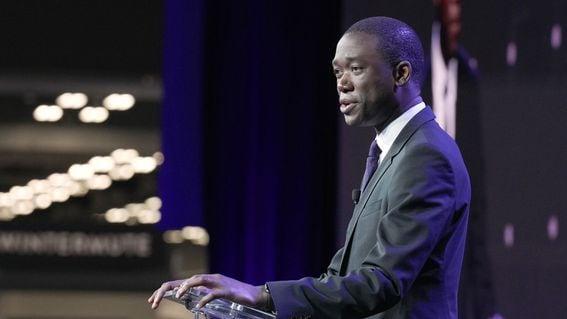
A top official has asked members of Congress for new laws to extend the Treasury's crypto reach beyond its existing enforcement and sanctions abilities. The U.S. Department of the Treasury has been pushing for lawmakers to grant it extended powers to battle illicit finance using crypto. One of the government's requests is for special jurisdiction over non-U.S. stablecoin issuers, such as Tether. The U.S. Department of the Treasury is pressing lawmakers for a new set of powers that would give the government unprecedented enforcement and sanctions authority over the crypto sector, including the ability to roam well beyond American borders and get involved with transactions that don't involve its citizenry. Deputy Secretary of the Treasury Wally Adeyemo has lobbied senior members of Congress with a proposal – mapped out in writing – that he called "a set of common-sense recommendations to expand our authorities and broaden our tools and resources to go after illicit actors in the digital asset space," according to excerpts from a speech he's set to deliver on Wednesday in Washington. "Modes of raising and moving money continue to evolve and many of our authorities have not been updated in decades," according to the Treasury document sent to lawmakers and obtained by CoinDesk. Terrorist groups – including Hamas – "use new virtual methods to move, store and obfuscate their funding streams. These methods often include the use of evasive cryptocurrency networks and services, including mixers." Congress should grant the Treasury "a new secondary sanctions tool" against exchanges that support terrorism, according to the proposal. It could give the government similar powers when targeting virtual asset providers as its long had over correspondent banking accounts and "would account for the technological changes that have rendered highly effective tools in the traditional payments context less effective against cryptocurrencies." Sanctions tool Adeyemo said it "will not only cut off a firm from the U.S. financial system, but will also expose any firm that continues to do business with the sanctioned entity to being cut off from the U.S. financial system." Lawmakers should also beef up the department's powers under the Bank Secrecy Act (BSA), allowing for the "targeting of cryptocurrency entities and services that facilitate funding for terrorists," the proposal said. It calls for a new category of financial institutions under the BSA that would include "cryptocurrency exchanges, Virtual Asset Service Providers (VASPs), virtual asset wallet providers, certain blockchain validator nodes and decentralized finance services," requiring them to meet certain anti-money-laundering demands. As the crypto industry has repeatedly argued: Many of these entities, such as wallet providers and decentralized finance (DeFi) entities may not be in any practical position to meet those kinds of requirements, and a law could effectively snuff them out. Austin Campbell, the founder of Zero Knowledge Consulting, noted on X that the proposal has some reasonable points but is also asking for "the broadest expansions of powers since the Patriot Act, and in a way that makes a mockery of some of the technical details of modern communication with the side benefit of probably causing major geopolitical conflict due to the overreach." Tether The government is also apparently looking for power over Tether, the issuer of the biggest stablecoin, USDT, and its ilk. "Legislation could explicitly authorize OFAC to exercise extraterritorial jurisdiction over transactions in stablecoins pegged to the USD (or other dollar-denominated transactions) as they generally would over USD transactions," the proposal suggested, giving a reach into transactions that the document notes "involve no U.S. touchpoints." Adeyemo doubled down on that idea in his Wednesday remarks, saying that non-U.S. stablecoin issuers shouldn't be able to use the U.S. dollar without "procedures to prevent terrorists from abusing their platform." This Treasury campaign cites reports on the crypto funding efforts from Hamas – made especially relevant in the context of that group's recent attacks on Israel – but the brief mention doesn't note that aspects of those reports had later been discredited by an analysis firm that was originally cited, leaving the extent of Hamas' crypto involvement uncertain. Meanwhile, the Treasury Department is fresh off of an earth-shaking $4.3 billion settlement with Binance, which among fines to various agencies included the Treasury's largest-ever corporate penalty. The agreement saddled the biggest global exchange with monitors to report the company's ongoing behavior to U.S. government watchdogs. And also on Wednesday, the department announced its latest action against a crypto mixing service, Sinbad. "As terrorists and criminals innovate their approach to illicit finance, we need tools to be able to keep up with them," Adeyemo said. Read More: Stablecoins Such as Tether May Be in U.S. Sights, Top U.S. Treasury Official Warns https://www.coindesk.com/policy/2023/11/29/us-treasury-campaigning-for-amplified-powers-to-chase-crypto-overseas/
2023-11-29 18:44
The exchange announced earlier this year that it would “gradually” end support for the stablecoin. Binance said it will end support for its BUSD stablecoin on Dec. 15, following the exchange's August announcement that it would “gradually” do so after Paxos, the company that actually issued it, was ordered to stop minting the coin in February. Users will still be able to redeem their BUSD until February 2024, Binance said in a blog post Wednesday. However, Binance said it would halt withdrawals on Dec. 31 and any remaining BUSD balances will at that point be automatically converted to FDUSD, a stablecoin issued by FD121 Ltd. BUSD’s current 24-hour trading volume is just under $400 million, according to data by CoinMarketCap. It was around $900 million in August. Binance’s stablecoin came under regulatory scrutiny in February after the New York Department of Financial Services (NYDFS) ordered Paxos to stop issuing it. Shortly after, Binance was sued by the Commodity Futures Trading Commission (CFTC) for allegedly offering unregistered crypto derivative products in the U.S. and violating federal law. The exchange’s new CEO, Richard Teng, who succeeded founder Changpeng “CZ” Zhao earlier this month as part of a $4.3 billion settlement with the U.S., recently wrote in a blog post that he is committed to working with regulators and ensuring that the exchange complies with American laws. https://www.coindesk.com/business/2023/11/29/binance-will-cease-support-for-its-busd-stablecoin-on-dec-15/
2023-11-29 18:21
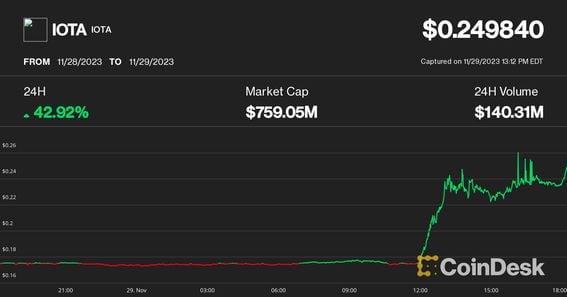
The IOTA Ecosystem DLT Foundation claims to be the first foundation to be registered under the emirate's regulatory framework for blockchain foundations, the press release said. The IOTA token jumped 43% after registering an ecosystem development foundation in Abu Dhabi. The IOTA Ecosystem DLT Foundation will be funded by $100 million worth of tokens vested for four years. Native token of the IOTA ecosystem (IOTA) jumped 43% Wednesday on news about registering a development foundation in Abu Dhabi, the capital of United Arab Emirates. The IOTA Ecosystem DLT Foundation claims to be the "first" foundation being registered under the regulatory framework called the DLT Foundations Regulations, set up by the city's financial watchdog Abu Dhabi Global Market (ADGM), according to an IOTA press release. The new organization will be funded by $100 million worth of IOTA tokens, locked up for four years, the press release added. The cryptocurrency's price surged to 25 cents from 17 cents immediately after the announcement, hitting its highest level since February. The development came after IOTA unveiled plans in September to establish a regulated entity in Abu Dhabi to foster the network's global expansion. Iota is one of several crypto-adjacent firms that clinched approvals from Abu Dhabi's regulators recently. Paxos also received a go-ahead to operate in the Emirati city Wednesday. Liminal, a digital asset custody and wallet infrastructure provider also secured an in-principle approval from ADGM earlier this month. The rash of approvals comes as Abu Dhabi amps up its efforts to establish itself as a crypto-friendly hub. Earlier this year, the emirate announced it would pour roughly $2 billion into web-3 and blockchain startups to attract builders to its economic free zone. "Working with companies like IOTA, ADGM aims to move towards a future characterized by setting global benchmarks in the ever-evolving blockchain and Web3 landscape," Hamad Sayah Al Mazrouei, CEO of the Registration Authority of ADGM, said in a statement. https://www.coindesk.com/markets/2023/11/29/iota-jumps-43-after-registering-ecosystem-foundation-in-abu-dhabi/
2023-11-29 17:39
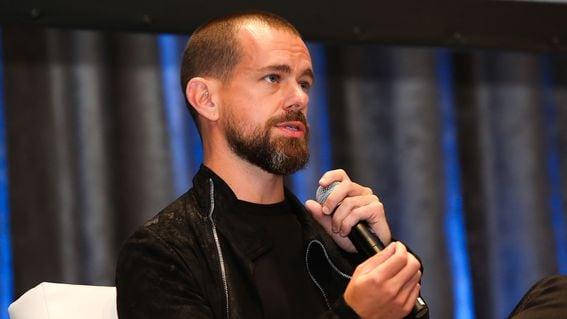
The company said has it created "only non-custodial" mining pool where miners get the new bitcoin block reward directly from the network. Bitcoin (BTC) startup Mummolin, has raised $6.2 million in seed funding led by Jack Dorsey, among others, as it aims to give miners control over their block rewards from the network. The capital will support the start of a decentralized mining pool - OCEAN. The new non-custodial pool will be the first of its kind as it will pay the miners their block rewards directly, without meddling by a centralized entity, unlike some of the existing pools, according to a statement. Long-time Bitcoin core developer and Mummolin co-founder Luke Dashjr said, "We are launching as the most transparent pool and also the only non-custodial pool where miners are the recipients of new block rewards directly from Bitcoin." A Bitcoin mining pool is where operators working to confirm transactions on the network join together to coordinate their efforts and then share any resulting rewards with the miners. The traditional bitcoin mining pool can act as a centralized entity such that it takes custody of the rewards paid by the network and then distributes them among miners, Mummolin's co-founder and president Mark Artymko said in the statement. "This gives them the ability to withhold payment from individual miners, whether by their own choice or by legal requirement," he added. "OCEAN’s non-custodial payouts directly to miners from the block reward remove this risk and the pool's undue influence over miners." The new pool has received social media praise from industry observers. "It's a mining pool with more decentralization built into it at the foundation, which in my opinion is good for the Bitcoin network," said Lyn Alden, the founder of Lyn Alden Investment Strategy. The new venture is essentially a re-start of Dashjr's previous zero-fee pool Eligius with updated code, said Dashjr in an X post. "The old code has already been updated and tested with support for the latest Bitcoin addresses and mining machines," he said in a follow-up post. Barefoot Mining is Ocean's first customer, and the pool expects to roll-out additional phases of Bitcoin decentralization improvements and upgrades in 2024. The funding is led by Bitcoin advocate and former Twitter CEO Jack Dorsey and includes Accomplice, Barefoot Bitcoin Fund, MoonKite, NewLayer Capital, the Bitcoin Opportunity Fund, and other strategic partners. Bitcoin's censorship problem Ocean's debut comes as some legacy mining pools have been the subject of controversy for censoring certain transactions, as "censorship resistance" is considered by many Bitcoiners to be a cardinal principle of the largest and original blockchain. Most recently F2Pool - the third biggest Bitcoin mining pool - drew drew ire on social media after a report that it might be censoring transactions from an address subject to U.S. government sanctions. “OCEAN is solving a problem for Bitcoiners that I think all of us feel—further centralization of pools and mining pools that could plague Bitcoin, and how that risks a bunch of Bitcoin attributes that we hold dear," said Dorsey. https://www.coindesk.com/business/2023/11/29/jack-dorsey-aims-to-create-anti-censorship-bitcoin-mining-pool-with-new-startup/
2023-11-29 17:02
Blockchain.com President Lane Kassleman said in an interview that his firm’s SoFi partnership equates to hundreds of thousands of users and hundreds of millions of dollars. SoFi is handing its crypto customers to Blockchain.com, a move possibly tied to SoFi's decision to become a bank. In an interview, Blockchain.com President Lane Kassleman said the partnership equates to hundreds of thousands of users and hundreds of millions of dollars. SoFi Technologies (SOFI), an online bank and financial-services company, is exiting the cryptocurrency business, telling customers they can transfer their digital assets to Blockchain.com's platform or liquidate them. The closure takes effect on Dec. 19, according to an email it sent customers Wednesday. SoFi's transition away from directly offering crypto services may be tied to its decision to become a bank holding company. The U.S. Federal Reserve, as part of that approval, told the company that its crypto activities were not permissible under banking rules, though it would be allowed to continue them for two years, with the possibility of extensions, according to a regulatory filing. (Bloomberg reported on SoFi's decision to close and the link to banking regulation earlier Wednesday.) Blockchain.com President Lane Kassleman said SoFi still wants to offer crypto services to its customers, hence the Blockchain.com partnership. "So you'll still be able to link out to crypto products from the SoFi app," Kassleman said in an interview on Wednesday. "You just won't be able to access them within the SoFi domain. This is not dissimilar to how they offer insurance products, for example." Kassleman said the partnership equates to hundreds of thousands of users and hundreds of millions of dollars. "It's also not something that happened overnight. You can imagine the complexity of moving over all these users and so this partnership has been in preparation for over a year," he said. Crypto has been a smart part of SoFi's business, with digital assets held totaling $139.4 million as of Sept. 30, according to a regulatory filing. The migration to Blockchain.com's wallets will be facilitated for users in some U.S. states by crypto-focused broker-dealer Bakkt (BKKT), with which Blockchain.com has an agreement, Blockchain.com said in a blog post. https://www.coindesk.com/business/2023/11/29/digital-finance-firm-sofi-hands-its-crypto-business-to-blockchaincom/