2024-09-03 10:28
The divergent monetary policy paths of the BOJ and the Fed mean potential for yen strength and pain for risk assets, including cryptocurrencies. Kazuo Ueda reiterated the commitment to raise Japanese interest rates further. The yen rallied, while BTC and S&P 500 futures registered moderate losses. BOJ-Fed policy divergence points to continued yen strength and pain for risk assets, including BTC. Bank of Japan Governor Kazuo Ueda reiterated that the central bank will raise interest rates further if the economy and inflation develop as expected, according to Bloomberg. In a document filed with a government panel led by Prime Minister Fumio Kishida on Tuesday, Ueda said the economic environment remains accommodative, with inflation-adjusted interest rates negative even after a late July increase in the benchmark borrowing cost. That was the first in decades and triggered an unwinding of yen carry trades, destabilizing risk assets, including cryptocurrencies. Ueda's comments drew bids for the yen, pushing the USD/JPY pair to 145.85 from 147, according to charting platform TradingView. Futures tied to the S&P 500 slipped by 0.5% and bitcoin (BTC) by 0.4% to $58,920, according to CoinDesk data. The BOJ's plan to tighten monetary policy poses a challenge for risk assets because the U.S. Federal Reserve is likely to start cutting rates in September and other central banks are expected to do the same in the months ahead. That means the yen could be solidly bid against most currencies, including the dollar, potentially forcing traders to sell riskier investments and pay back their yen-denominated loans. The unwinding of the so-called yen carry trade rocked the global markets early last month and was partly responsible for BTC's slide to $50,000 from $70,000. "The initial positive market reaction [to Fed's impending rate cuts] is justified because investors believe that if money is cheaper, assets priced in fiat dollars of fixed supply should rise,"Arthur Hayes, a co-founder and former CEO of crypto exchange BitMEX and the chief investment officer at Maelstrom, wrote in a recent blog post. "I agree; however … we are forgetting that these future anticipated rate cuts by the Fed, BOE, and ECB reduce the interest rate differential between these currencies and the yen." "The danger of the yen carry trade unwind will reappear and could derail the party unless 'real food' in the form of central bank balance sheet expansion, aka money printing, raises the quantity of money," Hayes said. Interest rates in Japan were stuck at zero for over two decades, leading investors to borrow yen and invest in high-yielding assets. According to Deutsche Bank, the Japanese government accounted for $20 trillion in carry trade as of October last year. https://www.coindesk.com/markets/2024/09/03/bank-of-japan-governor-hints-at-more-rate-hikes-btc-drops-04/

2024-09-03 08:30
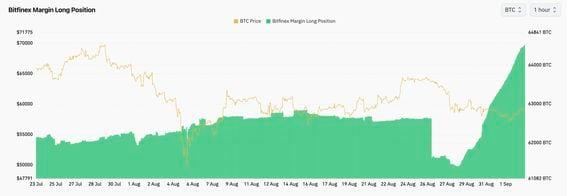
The number of bullish bets raised with the help of borrowed funds has steadily increased since late August. On crypto exchange Bitfinex, traders are borrowing funds to set up bullish bets, one analyst said. Perpetual funding rates have flipped positive. Over-the-counter desks are witnessing demand for higher strike call options. Activity on a crypto exchange known to host whales, or holders of large amounts of crypto, is defying concerns about bearish seasonal trends in bitcoin's (BTC) price. Since 2009, bitcoin has dropped 4% on average in September, according to Bitcoinmonthlyreturn.com. In six of the past seven years, September has seen bears lead the action, so it's no surprise some observers are feeling defensive about the immediate price prospects for the largest cryptocurrency. However, traders from the Bitfinex crypto exchange, which has a history of influencing market trends, seem to be setting up bullish bets. Since Aug. 28, the number of margin longs on Bitfinex, which involve using borrowed funds to purchase BTC in the spot market, has increased by a net 3,000 BTC to nearly 64,350 BTC, according to data sources Greeks.Live and Coinglass. Meanwhile, the annualized interest rate charged on borrowed funds has surged to over 20% in the past 10 hours. In other words, traders are borrowing money to buy more BTC, betting that this year, the cryptocurrency will defy its bearish September seasonality. "Greens lending rates and long positions have always been an over-the-top indicator for bulls; the previous two major spikes were preceded by significant rises in rates and long positions," crypto block trading service provider Greeks.Live told CoinDesk in a Telegram chat. A green lending rates is an interest rate that's above zero. Activity in bitcoin perpetual futures listed worldwide is also showing a renewed bullish bias. That's evident from the positive shift in the open interest-weighted global average funding rates. Positive rates indicate perpetual futures are trading at a premium to the spot price, indicating the dominance of bullish bets. Meanwhile, over-the-counter (OTC) desks are witnessing renewed demand for bitcoin call options offering asymmetric payoffs during price uptrends. "Options market has started to see a large number of block calls, accounting for 30% of the day's total and the whales are laying out long positions across the board," Greeks.Live said. Elsewhere, call spread strategies were recorded on the OTC network Paradigm on Monday. "OTM's [out-of-the-money] were in focus today, with an 80K/100K Dec call spread and an ETH 27 Dec/28 Mar calendar spread. There was also another noteworthy SOL print," Paradigm said in a Telegram broadcast. https://www.coindesk.com/markets/2024/09/03/bitcoin-margin-longs-on-bitfinex-defy-bearish-seasonality/
2024-09-03 02:49
"This is a show," Tigran Gambaryan says in the video. "I'm a f*cking innocent person." Tigran Gambaryan, the Binance executive who has been detained in Nigeria since February, limped into an Abuja courtroom on Monday, dragging his left leg behind him, after prison authorities denied his request for a wheelchair. In a video uploaded to X (formerly Twitter) on Monday afternoon, a distressed Gambaryan pleads with a prison guard escorting him into the courtroom for help walking. "I'm not okay, this is f*cked up," Gambaryan said in the video, as he clutched the guard's wrist for support. When the guard stepped away, leaving Gambaryan with only a single crutch to lean on, Gambaryan turned to a small crowd of onlookers and said: "He was told not to help me. He said there's instruction – this is f*cked up. Why couldn't I use a goddamn wheelchair? This is a show. I'm a f*cking innocent person. Why are you doing this to me?" After several visibly painful steps, Gambaryan reached again for the guard's arm for support, but the guard snatched his arm away, telling Gambaryan: "Don't hold me, please. You can walk." "I can't f*cking walk, my spine is – this is f*cked up. I'm a f*cking human," Gambaryan said in the video. "I'm not f*cking okay." Gambaryan's lawyers filed a new application for bail on medical grounds on Monday, urging the judge to release him so he can receive medical care for conditions he has developed in prison, including malaria, pneumonia, tonsillitis, and complications from a herniated disc in his back – the latter of which has left him in severe pain and nearly unable to walk, according to a spokesperson for his family. A prosecutor for the Economic and Financial Crimes Commission (EFCC) – the entity prosecuting Gambaryan for money laundering – reportedly opposed the bail application, arguing that Gambaryan was not, in fact, in ill health and claiming he was refusing treatment. Gambaryan's previous bail application was denied in May. Authorities of Kuje prison, where Gambaryan has been held since March, have previously refused to turn over Gambaryan's health records but, according to a family spokesperson, some of his records were given to the court during Monday's bail hearing. The medical records indicate a need for immediate surgery, the spokesperson said, but "key elements of the record including an MRI scan were missing." In addition to being denied adequate medical care, Gambaryan has also been denied proper access to his lawyers and U.S. embassy staff, the spokesperson said. "This situation is entirely unjust," Gambaryan's wife Yuki said in a statement. "The U.S. Government must do more to help Tigran. I urge them to use every available tool to free an innocent American who is at risk of permanent damage…This entire situation is inhumane and degrading, and I am fed up. There must be consequences for this disregard of law and human rights." Scapegoat for Binance Gambaryan, a former U.S. Internal Revenue Service (IRS) agent and Binance's head of financial crime compliance, was detained in Abuja seven months ago, shortly after voluntarily traveling to Nigeria's capital city at the government's invitation. At first, Gambaryan and his colleague Nadeem Anjarwalla, Binance's regional manager for Africa and a dual Kenyan-British national, were placed under house arrest. But when Anjarwalla escaped under mysterious circumstances in March, Gambaryan was transferred to the notoriously dangerous Kuje prison and charged with tax evasion and money laundering – seemingly as a scapegoat for his employer, which Nigerian officials have accused, without evidence, of tanking the value of the national currency, the naira. The tax evasion charges were later dropped, but Gambaryan's money laundering trial has been ongoing since June. He has pleaded not guilty to all charges. So far, the U.S. government has failed to make any public statement about Gambaryan's situation. The State Department told CoinDesk it was "aware of reports" of his detention in March, but did not mention Gambaryan by name. A White House spokesperson referred CoinDesk to the State Department two months later, after multiple requests for comment. https://www.coindesk.com/policy/2024/09/03/why-are-you-doing-this-to-me-detained-binance-exec-begs-prison-guard-for-help-in-new-court-footage/
2024-09-03 02:32
The Indian crypto exchange was hacked for over $230 million in July, and a restructuring process is underway in Singapore. The hacker stole $230 million from WazirX and began transferring funds through Tornado Cash. The hacker started moving nearly $4 million worth of ether to obscure the transaction trail. WazirX is undergoing restructuring after the hack and customers are expected to recover only 55%-57% of their funds. The hacker entity that stole over $230 million in user assets from Indian crypto exchange WazirX started to move funds using Tornado Cash early Tuesday, beginning a move that allows them to obfuscate the trail of funds. Tornado Cash allows crypto users to exchange tokens while masking wallet addresses on various blockchains. The service, by itself, is not nefarious but is commonly used by crypto criminals to clean an online trail that could lead to the identity of those moving stolen funds. The attacker moved nearly $4 million worth of ether (ETH) in 16 transactions on the Ethereum network, data tracked by Arkham shows, to a Tornado Cash router. The address holds over $155 million worth of various tokens - with a majority in ether at $150 million - and has previously not moved any funds to Tornado. In July, WazirX was hit by a security breach in one of its multisig wallets, causing over $100 million in shiba inu (SHIB) and $52 million in ether, among other assets, drained from the exchange. The stolen funds accounted for over 45% of the total reserves cited by the exchange in a June 2024 report – and the exchange has since filed for a restructuring process to clear liabilities. WazirX’s legal advisers said on Monday that customers are unlikely to be made whole in crypto terms, with the best-case scenario being a return of anywhere between 55% and 57% of the funds. North Korean hacking unit Lazarus is believed to be behind the attack, as previously reported. The group is estimated to have laundered over $1 billion in stolen funds through the service before OFAC sanctions in 2022, per estimates. https://www.coindesk.com/markets/2024/09/03/wazirx-hacker-starts-to-move-stolen-ether-using-tornado-cash/

2024-09-02 14:48
Metaplanet said it was adopting bitcoin as a reserve asset in May and had accumulated a total of 360 BTC by mid-August. Metaplanet said it is partnering with SBI VC Trade to utilize its corporate custody service which offers the potential to use BTC as collateral for financing. "This aligns with our vision of a modern financial service provider and adds flexibility to our corporate strategy, complementing our ongoing efforts in equity and debt financing," Metaplanet said. Japanese investment adviser Metaplanet (3350), which adopted bitcoin (BTC) as a reserve asset earlier this year, said it tapped SBI VC Trade to provide custody services. SBI VC Trade, a unit of Tokyo-based SBI Holdings, prioritizes tax efficiency and offers the potential to use BTC as collateral for financing, Metaplanet said on Monday. SBI Holdings is a financial services company that manages around 27.2 trillion yen ($185 billion). SBI VC Trade is a crypto exchange regulated by Japan's Financial Services Agency. "This aligns with our vision of a modern financial service provider and adds flexibility to our corporate strategy, complementing our ongoing efforts in equity and debt financing," Metaplanet said. In May, Metaplanet said it was adopting bitcoin as a reserve asset to hedge against the volatility of the yen. As of Aug. 20 it held 360.4 BTC ($21 million). The reserve-asset strategy mimics software developer MicroStrategy (MSTR), which has been buying bitcoin since 2020 and now holds over 226,000 BTC, more than 1% of all the bitcoin that will ever exist. Metaplanet shares fell 12.4% to 1,220 yen ($8.30) on Monday. Read More: Attention Bitcoin Traders, the Japanese Yen Is Strengthening Again https://www.coindesk.com/business/2024/09/02/metaplanet-teams-up-with-sbi-vc-trade-for-bitcoin-custody/

2024-09-02 11:32
This week's slew of U.S. economic data will determine whether the dollar continues to weaken, offering a tailwind to BTC and other risk assets. Tuesday's U.S. manufacturing data is likely to show continued contraction, signaling weakness in the dollar index and strength in bitcoin. Traders should watch out for an August-like growth scare in risk assets. Friday's U.S. jobs data could extend the dollar weakness, according to ING. Bitcoin (BTC), the leading cryptocurrency by market value, fell over 10% in the seven days to Sept. 1, reversing the preceding week's price bounce as the decline in the dollar index stalled. The slew of U.S. economic data due this week will likely determine whether the dollar resumes the two-month weakening trend, offering a tailwind for risk assets, including cryptocurrencies. The economic releases start Tuesday with the Institute of Supply Management's (ISM) manufacturing purchasing managers' index (PMI) for August. According to ForexLive, the consensus is that the index will rise to 47.5 from July's 46.8, which signaled the sharpest contraction in factory activity since November 2023. A weak reading will strengthen the case for the Federal Reserve to cut interest rates, sending the dollar lower and boosting demand for riskier assets. Interest-rate markets are already pricing a 70% chance of a 25 basis point cut and a 30% chance of a 50 basis point cut in September, according to CME's FedWatch tool. "Rate cuts are good for BTC, as it is particularly sensitive to monetary liquidity conditions (seen as a risk asset, with no cash flow or margins to get hit in a slowdown)," Noelle Acheson, author of the popular Crypto Is Macro Now newsletter, said in last week's edition. "A weaker U.S. dollar is good for BTC, as it tends to boost monetary liquidity by lowering the cost of capital. Plus, expectations of continued dollar weakness highlight the utility of a dollar hedge and should boost spending power (and hedge interest) in other jurisdictions. And, the dollar is the denominator of the most-quoted pair (BTC/USD)," Acheson wrote. That said, July's weaker-than-expected ISM PMI, released Aug. 1, triggered recession fears, weighing on risk assets even as the dollar dropped. BTC fell 3.7% to $62,300 that day. Traders, therefore, should watch out for a "growth scare" should the PMI come in worse than expected. "This is a key metric as risk assets moved sharply lower the last time," Markus Thielen, founder of 10x Research, said in a weekly preview note. Nonfarm payrolls due Friday ForexLive analyst Giuseppe Dellamotta's weekly preview note echoed the sentiment. "The main culprit might have been the employment sub-index falling to a new 4-year low ahead of the NFP report, which eventually triggered another wave of selling [in risk assets] as it came out weaker than expected across the board," Dellamotta said, referring to the U.S. nonfarm payrolls release. Later this week, the focus will shift to the JOLTS job opening data, due Wednesday, ISM services PMI, ADP and weekly jobless claims on Thursday, and the main event of the week – the August nonfarm payrolls (NFP) report on Friday. "If the consensus is right about Friday's jobs report (165,000 job gains and a drop in the unemployment rate back to 4.2%), then market pricing will firm up just a 25bp cut as the start to the Fed easing cycle on 18 September," analysts at ING said in Monday's morning note. However, according to ING's U.S. economists, the payrolls could show additions of just 125,000 and an uptick in the jobless rate to 4.4%, resulting in a continued drop in the U.S. dollar. From a technical analysis view point, BTC is on the defensive ahead of the key data releases, with indicators like the MACD histogram pointing to a strengthening of the downside momentum. "Technical indicators suggest that the bearish momentum may persist," Valentin Fournier, an analyst at research firm BRN, said in an email. "The MACD is showing increasingly negative momentum, while the RSI is at a neutral level. The lower band of the Bollinger Bands remains around $56,000, indicating potential further declines toward this level." https://www.coindesk.com/markets/2024/09/02/key-week-for-bitcoin-and-the-dollar-index/