2023-11-29 06:57
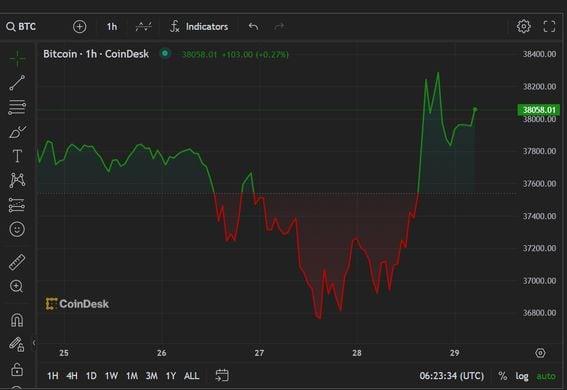
Crypto market capitalization rose 2.3% in the past 24 hours. Bitcoin broke above the $38,000 level in Asian morning hours on Wednesday as hopes around a spot exchange-traded fund (ETF) approval were revived earlier this week, and traditional market watchers expected rate cuts. Solana’s SOL tokens led gains among layer-1, or base, blockchains, jumping some 8% in the past 24 hours to reverse losses from the past week. Avalanche’s AVAX bumped 6.6%, while Cardano’s ADA and Tron’s TRX rose over 5%. The CoinDesk Market Index (CMI), a broad-based index that tracks the crypto market, rose over 2.5%. Bitcoin momentum started to rise late Tuesday as Federal Reserve governor Chris Waller said recent data suggested a slowdown in the economy and continuing moderation in inflation showed current policies were in the “right spot.” Waller also said that if inflation were to continue to decline, there's a good argument to be made for rate cuts within a few months. Interest rate decisions have the tendency to move markets. Higher rates usually mean risk assets such as stocks and cryptocurrencies take a hit as investors could take profits and invest in bonds. Elsewhere, global bank Standard Chartered double-downed on its April forecast that bitcoin (BTC) would reach $100,000 by the end of 2024. Analysts reasoned the expected approvals of several spot bitcoin ETFs “are likely to come sooner than expected,” which could act as catalysts for an uptrend. https://www.coindesk.com/markets/2023/11/29/solana-leads-layer-1-token-gains-as-bitcoin-crosses-38k/
2023-11-28 19:28
Armstrong said the recent enforcement action against bad actors such as Binance or former crypto exchange FTX could “close the chapter” on that part of crypto’s history. Coinbase (COIN) CEO Brian Armstrong says the industry can finally close the chapter of bad actors after the recent settlement between Binance and the U.S. Department of Justice. “There certainly have been a few bad actors in crypto and I think we’ve had a moment recently with the enforcement action against Binance that’s allowing us to turn the page on that and close that chapter of crypto’s history,” Armstrong said in an interview with CNBC International Monday at the Global Investment Summit in London. He also said that the criminal enforcement actions against Binance and the once-popular but now bankrupt crypto exchange FTX show that taking your business offshore doesn’t work. While Binance is a Hong Kong-based company, mostly focused on business in the Asia Pacific region, FTX was headquartered in the Bahamas. “Sometimes it’s easy to get big fast by skirting the rules but you’ll always come crashing back down to reality,” he said, arguing that it’s time for U.S.-based companies that have complied with regulation from the beginning to grow. Though different from Binance’s legal struggles in the U.S., Coinbase is still battling with U.S. regulators on allegations that the exchange operated an unregistered broker, exchange and clearing agency simultaneously. Armstrong said he feels good about the case's outcome and that it will help with regulatory clarity in the U.S. The company remains focused on its commitment to its U.S. business despite its efforts to grow in other jurisdictions, including the U.K., which Armstrong said is Coinbase’s second biggest market. “We started the company in the U.S. and we’re committed to staying there and we’re going to grow there because it’s a big market.” Armstrong also said the race to launch a spot-bitcoin ETF is “monumental” for the industry. “It’ll bring in new sources of capital into crypto that aren’t able to participate directly today and I think it’d be a legitimizing outcome for the industry,” he said. https://www.coindesk.com/business/2023/11/28/coinbase-ceo-brian-armstrong-looks-ahead-after-binance-settlement/

2023-11-28 18:46
Expert witnesses answered lawmaker questions on holding limits, impact on banking systems and privacy for an EU central bank digital currency. European Union lawmakers questioned four expert witnesses on the implications of a potential digital euro as they consider legislative proposals. Lawmakers have opposed European Central Bank plans for a digital euro. Experts answered questions on holding limits, closeness to cash and privacy concerns of a central bank digital currency but seemingly diverged on key issues. A digital euro is complicated, as evidenced by a two-hour public hearing hosted by members of the European Parliament on Tuesday. The EU’s plans for a retail central bank digital currency (CBDC) from earlier this year faced opposition from lawmakers who questioned the need to have one in a jurisdiction where payments are pretty efficient, whether citizens’ privacy will be preserved, and – more controversially – whether it could be used to expand state control. The hearing was meant to help lawmakers understand the subject better as they consider legislative proposals. But the invited experts diverged on practically every issue – from whether cash is on the decline to individual holding limits for a digital euro. “The arguments on balance today would not favor such a decision to issue a CBDC in my view,” said Italian economist Ignazio Angeloni, who wrote a paper for the Parliament this year titled “Digital Euro: When in doubt, abstain (but be prepared).” “An invasive form of public intervention like this one would be justified only if clear evidence were to emerge of malfunctioning in the present system. But this is not in sight at the moment,” he added. Angeloni was immediately countered by former Bank of Spain Governor Miguel Fernández Ordóñez, who not only praised a potential digital euro as a safer asset than bank deposits but went on to say a CBDC could help deregulate the banking sector because a lack of deposits would negate the need for deposit insurance and prudential measures. Holding limits Vicky Van Eyck, executive director of Positive Money Europe, assured lawmakers the destruction of banks was not the goal. She advocated for gradually removing the proposed 3,000 euro CBDC holding limit in legislative plans to curb the mass abandoning of deposits. "We don't think that we can jump from bank deposits to suddenly central bank digital currency with no limits. We have no interest in seeing the banking system crash,” said Van Eyck. “But we do think that a temporary holding limit that is gradually lifted through stress tests and research is the correct way to go.” The movement of funds from commercial banks to the central bank would put the banks in danger and put the financial system in peril, Angeloni said, adding that a digital euro bringing more safety to financial systems is “an illusion.” He added that a CBDC would have a “contractionary effect” on bank deposits, but how much will depend on the holding limit. Bigger banks would suffer more from mass exodus because they’ll have to bear more outflows, said Marieke Van Berkel, head of retail banking, payments and digitalization at the European Association of Cooperative Banks (EACB). “The more customers you have, the bigger the problem becomes, which is also the case of cooperative banks,” Van Berkel said. Van Eyck noted that although the EU proposed a 3,000 euro limit on individual CBDC holdings, banks initially pushed for a 60 euro ($66) limit. Privacy, crypto and the death of cash One of the biggest questions the ECB has faced is whether a digital euro would replace cash. The central bank has tried all sorts of campaigns to dispel those concerns, including with a Kahoots! Quiz. Naturally, much of Tuesday’s hearing was spent discussing whether cash is doomed – something Ordóñez affirmed but Angeloni called a “myth.” “What we're seeing is this gradual decline of the physical euro and people shifting to risky, private digital currency, and that's one more reason why … it's useful to have a public currency,” Ordóñez said. Angeloni said countries like Norway and Sweden – where cash use is low – are exceptions to the rule. “It's true that U.S. networks like MasterCard and Visa have high market shares in Europe, but their dominance is far from established in Germany and in Italy, for example,” he said. But a digital euro similar to cash – particularly one used for offline payments – could enhance users’ privacy, according to Van Eyck. “The offline version of the digital euro is crucial as it is most able to mimic the anonymous nature of cash today. The design and choice of technology for the offline version need to be carefully chosen…” she said. As for crypto, they’re no threat to traditional payments, according to Angeloni. “Crypto and stablecoins are very different assets. They're not used and they will not be used in the foreseeable future for payments. That's impossible. They are too volatile. They are too costly... So there is no danger, in my view, that crypto-assets may compete with payments,” he said. https://www.coindesk.com/policy/2023/11/28/fiery-public-hearing-on-digital-euro-sees-experts-diverge-on-key-issues/

2023-11-28 17:24
An earlier-than-expected spot bitcoin ETF in the U.S. could be the key catalyst, said the bank. Things are going as expected, according to Standard Chartered Bank, reiterating its April forecast that bitcoin (BTC) would reach $100,000 by the end of 2024. The next catalyst, wrote the bank's Geoff Kendrick and team, will be the approvals of several U.S.-based spot bitcoin ETFs, which they expect “are likely to come sooner than expected." “We think a number of spot ETFs will now be approved in Q1-2024 for both BTC and ETH, paving the way for institutional investment,” they said. The team also reminded that the next Bitcoin ‘halving’ – a mechanism to limit supply and currently expected to take place in late April 2024 – will be another source of price upside. Standard Chartered initially made its $100,000 prediction in April, arguing then that the cryptocurrency had benefited from its status as a branded safe haven. “Put simply, everything is working as expected," said the bank in its reiteration today. "BTC’s dominance remains intact – its share of overall digital assets market cap has increased to 50% from 45% in April." There is also a chance that the cryptocurrency will climb to the $100,000 mark before the end of the year, the bank said. “We now expect more price upside to materialize before the halving than we previously did, specifically via the earlier-than-expected introduction of U.S. spot ETFs. This suggests a risk that the USD 100,000 level could be reached before end-2024.” https://www.coindesk.com/markets/2023/11/28/bitcoin-remains-on-track-for-100k-by-year-end-2024-standard-chartered/

2023-11-28 16:39
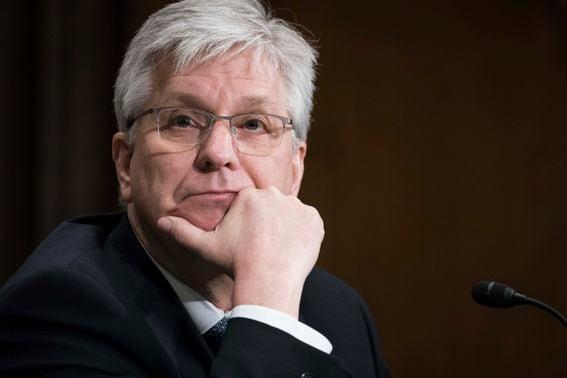
The typically hawkish Fed governor said rate cuts could be on the agenda if inflation continues to decline. Recent data suggesting a slowdown in the economy and continuing moderation in inflation means U.S. Federal Reserve policy is in the right spot, said Fed Governor Chris Waller, speaking at an event in Washington, D.C. "Something appears to be giving, and it's the pace of the economy," said Waller, noting October data and current forecasts for the rest of the fourth quarter as indicating an easing in activity. Inflation data, he said is also moving in the right direction. Taking questions after his prepared remarks, Waller also said that if inflation were to continue to decline, there's a good argument to be made for rate cuts within a few months. Waller is rated the third-most hawkish member of the Federal Open Market Committee (FOMC) by InTouch Capital Markets, so any dovish lean by him is of notable import. Already higher on the session, the price of bitcoin (BTC) rallied more than another 1% on the heels of Waller's comments, even as his colleague Michelle Bowman – speaking at another event – said she believes rates will have to move higher to bring inflation to heel. At press time, bitcoin was changing hands at $37,700. Traditional markets are also taking note, with the 10-year Treasury yield down four basis points to 4.35%, the dollar index lower by 0.4% and gold ahead 1.3% to $2,038 per ounce. https://www.coindesk.com/markets/2023/11/28/bitcoin-pushes-above-377k-on-dovish-comments-from-feds-waller/
2023-11-28 16:11
CZ will transfer his voting shares to a proxy, the U.S. affiliate of the global exchange said. Binance founder and former CEO Changpeng 'CZ" Zhao is stepping down as chairman of the global exchange's U.S. affiliate's board. Binance.US announced in a tweet Tuesday that while it is not a part of last week's massive multibillion-dollar settlement between Binance and various U.S. regulators and law enforcement entities, Zhao will transfer his voting rights to a proxy. "That said, as CZ transitions to life after Binance, he has decided to step down from his role as Chairman of our Board of Directors and transferred his voting rights through a proxy arrangement, whereby his interest in the company is purely economic and he will no longer be involved in our governance," the tweet said. Binance was accused of operating in the U.S. without registering with any appropriate entities, ultimately allowing U.S. crypto investors to transact with Binance customers from sanctioned regions. The company agreed to pay $4.3 billion, make a "complete exit" from the U.S. as part of its settlement, and accept Zhao's resignation as CEO. A senior Treasury official told reporters that Binance.US was not part of Binance's settlement as it was a registered business. While Binance.US is not part of last week's settlement, it's still facing a U.S. Securities and Exchange Commission enforcement action over offering what the regulator deemed are unregistered securities to U.S. investors. That case, which also includes Binance and Zhao, is ongoing. "Binance.US continues to be led by Norman Reed and our existing, experienced management team. We are well capitalized to continue to build and grow our platform and to do so with renewed clarity and momentum, while maintaining the same customer first commitment," the tweet concluded. https://www.coindesk.com/policy/2023/11/28/changpeng-cz-zhao-steps-down-from-binanceus-board/