2023-11-27 22:07
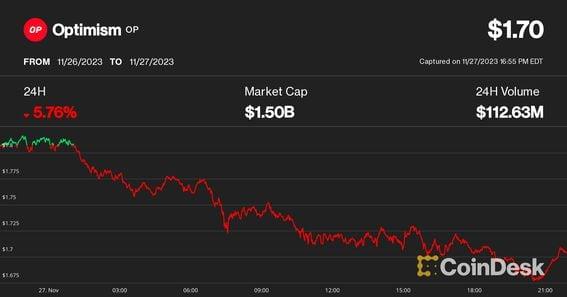
Large unlocking events usually lead to price declines as the increase in supply outpaces investor demand for the asset, The Tie reported earlier this year. Crypto tokens DYDX, OP, SUI dropped sharply ahead of their large token unlocks, underperforming the broader Coindesk Market Index. Unlocks increase a digital asset's supply and allow early investors to sell tokens. Several major alternative cryptocurrencies including native tokens of dYdX (DYDX), Optimism (OP) and Sui (SUI) dropped Monday as massive token unlocks weighed on prices amid a generally negative day on the broader crypto market. Altcoins face almost $650 million worth of increase in their supply through this week, according to data from Token.Unlocks and CryptoRank. DYDX will see roughly $480 million worth of tokens added to its circulating supply, almost doubling the current amount of tokens on the market. OP, SUI, Axelar (AXL), Immutable X (IMX) and 1inch (1INCH) and Hedera (HBAR) also have large unlocks scheduled in coming days. Token unlockings translate to an increase in the asset's supply, releasing coins from a vesting period including to early investors. Large unlocking events usually lead to price declines due to the supply increase outpacing investor demand for the asset, a study by crypto analytics firm The Tie found earlier this year. Axelar (AXL) dropped 10% in the past 24 hours as about $18 million worth of tokens – some 5% of its market capitalization – were added to its supply Monday during its scheduled monthly token unlock, including to early investors, according to CryptoRank data. DYDX was down 7% during the same period ahead of the release of $480 million worth of tokens on Dec. 1. OP declined nearly 6%, with an unlock of $40 million in tokens looming on Nov. 30. SUI plunged 8.8% during the day as its supply will increase by $48 million over the course of the week. 1INCH fell over 4% with its supply set to increase by almost 10%, or $33 million, on Dec. 1. HBAR and IMX endured 2%-3% declines with each facing $11 million tokens being unlocked this week. Meanwhile, bitcoin (BTC) was down 0.7% during the same period, while the broad-market crypto index CoinDesk Market Index (CMI) declined 1.5%. https://www.coindesk.com/markets/2023/11/27/altcoin-rally-cools-as-massive-650m-worth-of-token-unlocks-loom-over-crypto-market/
2023-11-27 19:45
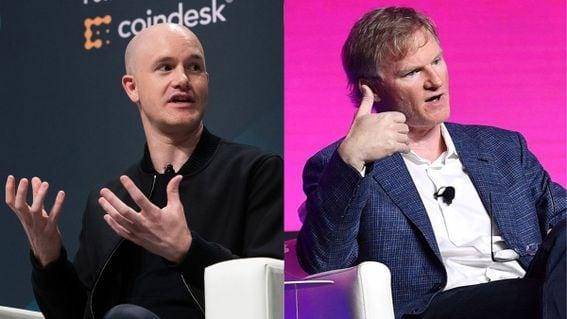
Brian Armstrong's exchange is way ahead in being the custodian for ETF applications, and a famous name in custody, BitGo, has been missing from the conversation. Custody services are a vital part of bitcoin ETF applications, and Coinbase has been picked by nine out of the 12 prospective issuers. BitGo, a large crypto custodian, has been left out. But BitGo CEO Mike Belshe says he's been in talks with ETF issuers. The race to provide a key bit of infrastructure for bitcoin (BTC) ETFs – custody services – hasn't actually been much of a race so far. Crypto exchange Coinbase (COIN) has dominated so far, winning the job from nearly every firm that wants to list an ETF, including BlackRock, Franklin Templeton and WisdomTree. That's left a giant player in the space, BitGo, on the sidelines – an eye-catching omission. Only one company that wants to create a bitoin ETF in the U.S., Hashdex, has yet to pick a custody partner. BitGo CEO Mike Belshe confirmed in an interview with CoinDesk that his company is working with "many" of the applicants, opening the possibility – albeit a slim one now – BitGo might show up yet. "I think Coinbase is the obvious solution on the custodian side and it makes sense that they're the most common," Bloomberg Intelligence ETF analyst James Seyffart said. "But there are some others," he added. Seyffart said he wouldn't be surprised to see BitGo appear on someone's bitcoin ETF application eventually. Crypto exchange Gemini recently became the first third-party custody partner on an application, appearing in VanEck's. Custody is an important part of the effort to bring a spot bitcoin ETF to the U.S. market. Custodians hold onto assets on behalf of someone else. In this case, that means safekeeping the (presumably billions of dollars worth of) bitcoin that ETFs will own, keeping hackers and any other bad actors at bay. Coinbase, run by CEO Brian Armstrong, currently is the custodian for nine of the 12 proposed bitcoin ETFs in the U.S., a level of concentration that makes some uneasy. With Fidelity deciding to custody their own assets and VanEck picking Gemini, that leaves only one application that lists no custodian. "Having so much bitcoin concentrated in one custodian is not exactly ideal, and I think it would be beneficial for other quality exchanges to participate as custodians for ETFs," said Brian D. Evans, founder and CEO of BDE Ventures. But it's tough to find other contenders, given the lack of regulatory clarity in the U.S., so the list of suitable companies is short, he said. "While I do think it's notable to have a majority of the products choosing Coinbase, and I understand why people might be concerned, I don't think it's a problem as long as the security at Coinbase is sound," Seyffart said. "We probably need to see how things play out over the coming months and years." CORRECTION (Nov. 27, 2023, 21:11 UTC): The story initially didn't note that VanEck had picked Gemini as a custody partner and neglected to mention several other applications in which Coinbase was named as custodian. https://www.coindesk.com/business/2023/11/27/coinbase-is-dominating-a-key-bitcoin-etf-service-can-anyone-else-join-the-race/
2023-11-27 19:05
Changpeng Zhao was set to return to the UAE, where his wife and children live, but a district judge stayed this part of his bond release for now. Binance founder Changpeng "CZ" Zhao must remain in the U.S., at least for the moment, as a federal judge considers a U.S. Department of Justice motion that would require him to remain in the country until he is sentenced early next year. Zhao pleaded guilty to violating the Bank Secrecy Act last week and resigned as CEO of Binance, the world's largest crypto exchange by volume. The exchange itself pleaded guilty to charges of violating sanctions and money transmission laws, agreeing to pay a $4.3 billion fine and embed compliance monitors who can report back to the U.S. government. After Zhao pleaded guilty, a magistrate judge granted his release on a $175 million personal recognizance bond. Zhao put $15 million in a trust account and had three guarantors put up over $5 million in collateral to secure the bond. Under the terms of the bond release, he was free to return to the UAE, where his wife and children also reside. District Judge Richard Jones stayed this part of the ruling on Monday. However, attorneys with the U.S. Department of Justice moved to keep Zhao in the U.S., arguing he could be a flight risk if he leaves the country, noting that he still has a vast amount of wealth and that there's no extradition treaty between the U.S. and the UAE. They are not pushing to put him in jail ahead of his Feb. 23, 2024 sentencing. Judge Jones did not indicate if he would schedule a hearing or when he might otherwise rule on the motion in Monday's hearing. Zhao's attorneys argued that he had already demonstrated his intent to take responsibility by coming to the U.S. to plead guilty in the first place. His wife and children cannot relocate for a few months just for sentencing, they said. Zhao faces anywhere from a few months to as many as 10 years in prison, the DOJ said, though Zhao can appeal any sentence longer than 18 months. He also agreed to pay a $50 million fine as part of his plea agreement. https://www.coindesk.com/policy/2023/11/27/binance-founder-cz-stuck-in-us-for-the-moment/

2023-11-27 18:28
Pro-market digital assets regulation and growing interest from large institutions are among the factors behind the success so far, said Hashdex's CEO. As investors continue to await approval of a spot bitcoin exchange-traded fund (ETF) in the U.S., a check of Brazil finds hefty demand for such vehicles which have been trading in that country for more than two years. Together, those ETFs have $96.8 million of assets under management (AUM) as of November 21, led by Hashdex's Nasdaq Bitcoin Reference Price FDI (BITH11) with $57.8 million in AUM as of November 21, or a market share of about 60%. As comparison, the largest ETF in the nation, iShares Ibovespa Index (BOVA11), has $2.41 billion in AUM and the second largest, the iShares BM&FBOVESPA Small Cap (SMAL11), has $1.19 billion in AUM. For reference, the largest U.S. ETF, the SPDR S&P 500, has roughly $430 billion in AUM. According to Marcelo Sampaio, CEO and founder of Hashdex, the success of bitcoin ETFs in Brazil is the result of pro-market digital assets regulation and growing interest from large institutions for said products. “There is a growing positive sentiment across the most sophisticated investors and we’ve been seeing increasing interest from some of the largest institutions whether that be either allocating or considering adding crypto soon to their portfolios,” said Sampaio in an interview with CoinDesk. Hashdex’s spot bitcoin ETF started trading on August 1, 2021. Hashdex also offers a crypto index ETF that includes BTC, ETH and other cryptos and which garners a lot more investment than the spot bitcoin ETF, said Sampaio. Combined, Hashdex’s crypto-related ETF AUM is currently around $500 million. Hashdex is also among those with outstanding applications for spot bitcoin ETFs with the U.S. Securities and Exchange Commission (SEC). The agency – as it's done with other applicants of late – last week delayed any decision on the Hashdex filing. Other spot bitcoin ETF providers in Brazil include Itau ́ Asset Management, which teamed up with Mike Novogratz's Galaxy Digital to launch a fund last year, and an offering from QR Capital, which launched in 2021, has $36 million in AUM, according to data from Hashdex. There has traditionally been a lot of interest in crypto ETFs from the Brazilian public, said Gui Silva, a managing partner at Tagus Capital, and the number of investors in digital asset ETFs will only continue to grow. “There are about 4 million investors with accounts at the B3 stock exchange in Brazil and around 700,000 of these invest in ETFs," he said. "About one-third of those investors allocated funds to crypto ETFs last year." A reason for the strong appetite in ETF investing in Brazil might be due to the low fees, according to Silva. “ETF fees in Brazil range from 0.5% to 1.5% - which is considered relatively low compared to other products in the market,” he added. https://www.coindesk.com/markets/2023/11/27/spot-bitcoin-etfs-have-almost-100m-in-aum-in-brazil-led-by-hashdex-offering/

2023-11-27 16:29
Ether funds enjoyed over $100 million of inflows in a four-week positive run, "marking a decisive turnaround in sentiment," CoinShares said. Digital asset funds attracted net inflows of $346 million last week fueled by anticipation for a spot bitcoin ETF, CoinShares reported. Bitcoin fund inflows surpassed $1.5 billion this year amid signs of short-seller capitulation. Ether and Solana led among altcoins fund inflows. Crypto investment funds last week attracted their largest net inflows this year, extending their strongest run since the 2021 bull market as anticipation for a spot bitcoin (BTC) exchange-traded fund (ETF) continued to entice investors, digital asset fund management firm CoinShares reported Monday. Digital asset-focused investment vehicles saw net inflows of $346 million in the week ended Nov. 24, the largest amount in what's now been nine consecutive weeks of inflows, according to the report. "This run, spurred by anticipation of a spot-based ETF launch in the US, is the largest since the bull market in late-2021," CoinShares head of research James Butterfill said. Bitcoin funds enjoyed most of the inflows ($312 million), similar to the previous weeks' trend and bringing yearly net inflows to over $1.5 billion. Meanwhile, short BTC funds – which seek to profit from declining prices – saw their third week of outflows in a sign of "short-sellers continuing to capitulate," the report said. Assets under management (AUM) of short funds are now down 61% from their peak in April 2023. Turnaround for ether (ETH) funds Funds holding ether (ETH) experienced $34 million of net inflows last week, extending the positive trend to four consecutive weeks and surpassing $100 million of net inflows during this period. ETH funds now have almost nullified their dismal run of outflows earlier this year, which marks "a decisive turnaround in sentiment" towards the second largest cryptocurrency, CoinShares added. Solana (SOL) funds attracted the largest inflows among the rest of the altcoins with a $3.5 million influx. Polkadot (DOT) and Chainlink (LINK) investment products also enjoyed $0.8 million and $0.6 million inflows, respectively. https://www.coindesk.com/markets/2023/11/27/crypto-funds-attract-largest-weekly-inflow-in-2023-as-bitcoin-short-sellers-capitulate-coinshares/

2023-11-27 11:32
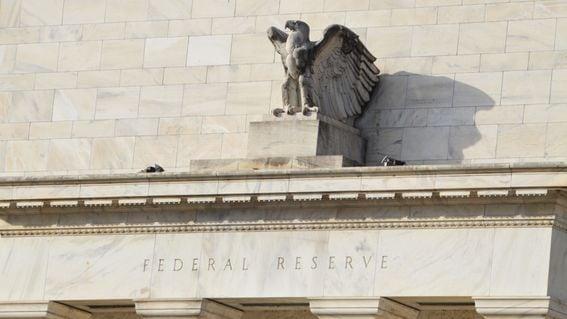
Traders expect the Fed to cut rates by 100 basis points next year, weakening the dollar and incentivizing risk-taking in crypto and traditional markets. The Fed is expected to cut rates by 100 basis points next year, becoming the most dovish among advanced nations' central banks. The stance will probably weigh on the dollar. A weaker greenback often incentivizes risk-taking in crypto and traditional markets. If there is one thing that both crypto and traditional markets love unconditionally, it is cheap fiat liquidity. The U.S. Federal Reserve, the world's most powerful central bank, is likely to take steps in that direction next year. The Fed is priced to be the most dovish among advanced nation central banks in 2024, with traders anticipating at least 100 basis points – or 1 percentage point – of interest-rate cuts from the current 5.25% to 5.5% range, according to Deutsche Bank Research. That will dent the U.S. dollar's appeal as a relatively high-yielding asset. According to ING, the U.S. economy and the inflation rate are expected to slow next year, allowing the Fed to pursue a looser monetary policy. Bank of America, in its Nov. 19 World at Glance report, said the tide is turning for the greenback and "it can start to adjust broadly lower towards equilibrium" next year. "While we still envision the U.S. performing relatively well next year vis-à-vis other major economies, the prospect of an eventual economic landing and corresponding Fed easing, even alongside easing elsewhere, should provide broad relief to currencies across the globe," Bank of America's strategists said. A weaker dollar often becomes a tailwind to risk assets, including bitcoin, as occurred in the second half of 2020 and early 2021. The greenback is a global reserve currency, playing an outsized role in global trade and non-bank borrowing. When the dollar strengthens, it causes financial tightening worldwide, disincentivizing risk-taking. The opposite is true when it weakens. The chart shows that most advanced national central banks, led by the Fed, are expected to cut rates next year, having lifted them rapidly in the past 18-20 months to tame inflation. The coordinated easing could compensate for potential rate hikes by the Bank of Japan, which has been touted as a significant source of uncertainty for crypto and traditional markets. The Japanese central bank has been slowly moving away from its ultra-easy monetary policy this year, although its benchmark rate remains below zero. Note that heightened expectations for easing mean there's scope for disappointment and a sharp dollar rally should inflation rebound. "There are several 'known unknown' scenarios that in aggregate imply a notable risk to our base-case of weak USD," Bank of America's strategists said. "We identify an upside growth/inflation driven rate shock originating in the U.S., a supply-driven upward oil price shock, and a downward growth shock from China as the most visible among them." https://www.coindesk.com/markets/2023/11/27/fed-likely-to-be-most-dovish-central-bank-in-2024-research-shows/