2023-10-31 21:20
Bankman-Fried's lawyers argued the jury should be instructed on English law because it governed FTX's terms of service. "I apply the law of New York," Judge Lewis Kaplan said. NEW YORK – Sam Bankman-Fried's criminal fraud trial is entering the home stretch, with federal judge Lewis Kaplan set to explain to jurors how the law applies to the seven charges against the FTX founder. Both the Department of Justice and the defense team rested their respective cases on Tuesday after the one-time crypto exchange heavyweight completed his testimony. If convicted on all counts, Bankman-Fried could spend decades in prison (and theoretically up to 115 years). His trial, which kicked off at the beginning of October, now moves into a new phase, one more focused on the jury specifically rather than the evidence. This began Tuesday afternoon, when the parties discussed the proposed jury instructions drafted by the judge. While Judge Kaplan didn't quite lose his patience immediately, he soon found himself asking the various attorneys to explain their arguments clearly and quickly. Early on, the question of what laws govern FTX's terms of service – and the instructions surrounding these terms – came up. "In our view, the legal terms are significant," defense attorney S. Gale Dick told the court. As usual, Judge Kaplan sounded unimpressed by the defense argument, which Bankman-Fried's team had made before (including late Monday night). In short, the defense team has tried to argue that the terms of service are governed by English law, and therefore the jury should be instructed on it. "I apply the law of New York," the judge said. Tuesday's charge conference sometimes saw the lawyers debate just one or two words in a sentence of the 60-something page document, arguing those words would change the meaning of the charge presented. The prosecution got an early win when the judge ruled that he would instruct the jury that they should find Bankman-Fried guilty of one count of wire fraud if they find there was either misrepresentation or misappropriation in how he marketed FTX to customers. On another part, a "conscious-avoidance charge," Assistant U.S. Attorney Thane Rehn argued that Bankman-Fried tried to avoid direct knowledge of some of the problems at FTX and its sibling company Alameda Research, pointing to the defendant's testimony from earlier in the day. Rehn's colleague, AUSA Danielle Sassoon, had asked Bankman-Fried repeatedly if he had asked any questions of his lieutenants after learning about an $8 billion hole in Alameda's balance sheet. Closing arguments will kick off Wednesday with the DOJ and defense each estimating they'll need two to three hours to present their competing narratives, and the DOJ maybe needing another 45 minutes for a rebuttal. The judge estimated he'll need some time to read the entire charge instructions to the jurors but deliberations could begin as soon as Thursday. Read all of CoinDesk's coverage here. https://www.coindesk.com/policy/2023/10/31/as-sam-bankman-fried-fraud-trial-nears-close-a-terse-judge-sets-jury-instructions/
2023-10-31 21:00
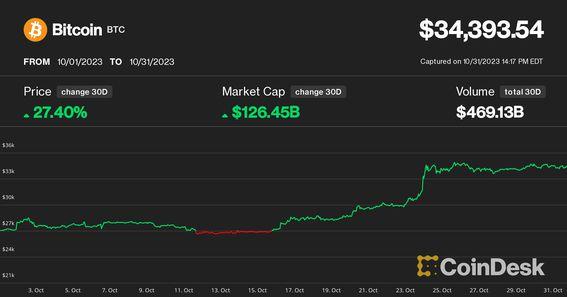
The crypto rally was broad, as all CoinDesk sector indexes posted 7% to 32% advances. BTC has advanced 27% in October, its strongest showing since January, as the crypto rally widened. Sentiment hit an "exuberant" level as many traders "panic bought" amid the rally, Matrixport noted. BTC could still run higher, targeting $40,000 in the coming weeks, an LMAX strategist said. The boredom ended in October as cryptocurrency prices zoomed higher, with the biggest of them all, bitcoin (BTC), posting the strongest monthly rally since January as investors were abuzz with optimism that bitcoin ETFs will soon get approved in the U.S. BTC gained more than 27%, springing to a 17-month high of $35,000 after hovering around the $27,000 level during the first half of October. It has recently resided just above $34,000 ahead of the Federal Reserve's interest rate decision on Wednesday, with market participants largely expecting policymakers to leave rates unchanged. The rally spread across the broader crypto market, a bullish sign, The CoinDesk Market Index (CMI), which tracks a broad basket of tokens, advanced 22% in October. The market capitalization of all cryptocurrencies jumped nearly 19% to $1.255 trillion, according to TradingView data, the biggest increase in crypto wealth since the 33% jump in January. ETFs would be a big deal for bitcoin because they're far easier for the average investor to buy than the cryptocurrency itself or existing bitcoin investment products, like the Grayscale Bitcoin Trust (GBTC) with $21 billion assets under management. The U.S. Securities and Exchange Commission rejected GBTC's conversion into one, but courts have eviscerated that decision, boosting the odds the SEC will have to approve that shift – and likely also bless ETF applications from the likes of BlackRock, the world's largest asset manager. Despite the fact that it was a broad crypto rally in October, not all sectors benefited equally. The CoinDesk DeFi Index (DCF), which encompasses tokens related to the decentralized finance sector such as decentralized exchanges, lending and staking protocols, gained only 7% in October. Key DeFi tokens such as curve (CRV), maker (MKR), uniswap (UNI) and compound (COMP) declined 3% to 7%. Ethereum's ether (ETH) posted a modest gain of 7%. Its valuation sank to a level versus BTC that was also seen in June 2022, which preceded ETH outperformance. Meanwhile, the CoinDesk Computing Sector (CPU), an index that tracks protocols focused on building and supporting Web3 infrastructure and distributed computing, jumped almost 32% in October. Among alternative cryptocurrencies, solana (SOL) was a notable outperformer with over 70% monthly return amid increasing network activity and subsiding concerns about FTX dumping tokens in a fire-sale. Why did cryptocurrencies rally in October? Investors are excited about the potential for bitcoin ETFs in the U.S. "A spot bitcoin ETF could bring in as much as $50 billion to $100 billion in inflows over the next five years" and "could have an outsize impact on the price of bitcoin," Ryan Rasmussen, analyst at asset manager Bitwise, said Tuesday in an interview with CoinDesk TV. He said he expects the SEC to green light ETF applications as soon as December, before the holidays. Bitwise is one of the firms that wants to list one. Crypto investment services firm Matrixport said that elevated funding rates on the BTC derivatives market suggest that many traders "panic bought" on the way up in a fear of missing out of the rally. On top of the ETF hype, sector specific momentum, short liquidations and macroeconomic headwinds also contributed to the price increase, crypto analytics firm CoinMetrics said in a report Tuesday. "This market movement suggests renewed confidence and indicates a potential shift in the dynamics around digital asset markets," CoinMetrics analyst Tanay Ved said. Highlighting a shifting sentiment, investment legend Paul Druckenmiller said at a Robin Hood fireside chat Monday with hedge fund manager Paul Tudor Jones that he "likes" bitcoin and gold as an investment and store of value asset. He said he owns gold because it's a "5,000-year-old brand," but young people prefer to own BTC because it's "easier to do stuff with." "I don't know any bitcoin, but to be frank, I should," he added. What's next for bitcoin (BTC) price? After its blockbuster month, bitcoin hasn't run out of steam and could run further, analysts suggested. "The October breakout to a fresh yearly high has opened the door for this next major upside extension, targeting a measured move objective in the $40,000 area over the coming weeks," Joel Kruger, market strategist at institutional crypto exchange LMAX Group, said in an email. Matrixport analysts noted that the firm's Bitcoin Greed & Fear Index sits at 97%, signaling "exuberant" sentiment. Still, they argued that BTC is likely to "squeeze higher and could target $40,000 as the next significant resistance level." https://www.coindesk.com/markets/2023/10/31/bitcoin-saw-27-october-surge-as-traders-panic-bought-amid-bitcoin-etf-enthusiasm-is-40000-next/
2023-10-31 18:11
The action represents a move towards main competitor Tether's practice to limit access for retail users. USDC issuer Circle Internet Financial said Tuesday it is curbing service for individual accounts to mint stablecoins. "Circle is phasing out support for legacy consumer accounts and has notified individual consumers of this decision," a Circle spokesperson told CoinDesk in an email. "Account closures do not apply to business or institutional Circle Mint accounts." Circle currently accepts qualified institutional clients only, not individual retail customers, as the company "does not serve retail consumers directly," the spokesperson explained. Retail users may access USDC via brokerages, crypto exchanges and digital asset wallet services, the spokesperson added. Screenshots of a customer email shared on social media platform X (Formerly Twitter) showed Circle notifying an individual account holder with zero balance that the company will discontinue wiring and minting abilities on November 30, prompting speculations about a crackdown on accounts. Circle's curb for retail investors represents a move towards its main competitor, Tether's practice, which limits USDT minting and redemptions at a $100,000 minimum threshold. USDC is the second largest stablecoin offering with a $25 billion supply, but its market share significantly declined throughout this year. USDC lost 43% of its market capitalization year-to-date, while USDT soared to a new all-time high of over $84 billion. https://www.coindesk.com/business/2023/10/31/circle-curbs-stablecoin-minting-for-retail-users-moving-closer-to-tethers-practice/
2023-10-31 15:57
Amid the crypto crackdown, a BTC ETF, if approved, would open a new pathway for U.S.-based firms to get a piece of the crypto action – in a way that plays to their conventional strengths. Some of the world's largest market-making firms are in the mix to potentially provide liquidity for BlackRock's eagerly awaited bitcoin ETF if regulators approve the product, according to a person with knowledge of the matter. Trading giants Jane Street, Virtu Financial, Jump Trading and Hudson River Trading have held talks with BlackRock about a market-making role, according to a BlackRock slide deck reviewed by the person familiar with the matter. BlackRock, Jane Street, Virtu and Jump declined to comment. Hudson River Trading, also known as HRT, didn't respond to a request for comment. The U.S. regulatory crackdown on crypto this year – a seeming reaction to FTX's implosion and other 2022 scandals – has persuaded some U.S. firms to curtail their activity in the space. Bloomberg reported earlier in May that Jane Street and Jump had curtailed their crypto trading amid that crackdown. Assuming the U.S. Securities and Exchange Commission approves some or all of the dozen or so applications for bitcoin ETFs (including the one from BlackRock, the world's largest asset manager), that would open a new pathway for U.S.-based firms to get a piece of the action in crypto – in a way that plays to their conventional strengths. Being a market-maker for ETFs, which trade on exchanges just like stocks, requires a level of sophistication and automation that only a relatively few companies can achieve. Market makers are vital to ETFs. They are responsible for creating and redeeming new shares of an ETF, a role designed to keep its price tethered to the price implied by the value of the ETF's holdings. One of the best examples of why such a create-and-redeem structure is important actually comes from crypto. Grayscale Investments offers a product called the Grayscale Bitcoin Trust (GBTC) whose price has over the past few years wandered dramatically far away from the billions of dollars worth of bitcoin (BTC) that it owns. Unlike an ETF, shares of this trust cannot be redeemed for BTC. Grayscale (which, like CoinDesk, is owned by Digital Currency Group) has applied to convert GBTC into an ETF. Grayscale's initial application for the conversion was rejected by the SEC, but a court in August excoriated the regulator's rationale. The SEC decided in October not to appeal that ruling, a move widely seen as boosting the odds bitcoin ETFs will become a reality in the U.S. "Several market makers were pulling back and being quite cautious because there was some heavy cracking down on exchanges," said James Butterfill, head of research at CoinShares, a provider of crypto exchange-traded products. "But since the Grayscale ruling, we've seen a very real change in stance from the SEC." https://www.coindesk.com/business/2023/10/31/blackrocks-bitcoin-etf-might-have-trading-support-of-heavyweights-like-jane-street-jump-and-virtu-source/
2023-10-31 14:37
Celestia has released its mainnet beta after issuing tokens to 580,000 users. Modular blockchain Celestia has rolled out its mainnet beta following the issuance of its native TIA token to 580,000 users. Described as a "modular data availability network that securely scales with the number of users," Celestia aims to solve scalability and stability issues that are common with monolithic blockchains like Ethereum and Solana. "It's the start of a new era," the Celestia Foundation, which supports development on the network, wrote in a blog post. "The modular era." As of about 2:30 ET (6:40 UTC), the TIA tokens were changing hands around $2.29, according to CoinMarketCap. "Based on current market prices, the Celestia airdrop is estimated to distribute about $120 million in on-chain value, targeting users in the Cosmos (ATOM) and Ethereum (ETH) layer 2 ecosystems," Sean Farrell, an analyst at FundStrat, wrote in a note to subscribers on Tuesday. "This could either stimulate on-chain activity or flow into related assets, benefitting asset prices." Modular blockchains are designed to solve scalability issues by using specific channels for speed and execution, unlike monolithic blockchains, which can scale only at the expense of decentralization or security. Celestia also uses data availability sampling (DAS), a way of verifying all data that is available on a blockchain. The combination helps increase the speed at which data is transferred. "Celestia’s mainnet beta launch marks the arrival of the first live modular data availability network with data availability sampling," said Ekram Ahmed, a spokesperson at the Celestia Foundation. "Celestia mainnet is a giant leap in our mission to make deploying chains as easy as smart contracts.” The beta enables rollups and other modular chains to use Celestia as a data availability and consensus layer. The blockchain will initially have 2MB blocks with support for up to 8MB blocks, with upgrades due to be made after an on-chain governance process. The company hopes to support 1GB blocks to "provide abundant data availability for the modular ecosystem" in the future. The company raised $55 million in a combined Series A and B last year at a valuation of $1 billion. https://www.coindesk.com/business/2023/10/31/celestia-mainnet-goes-live-as-580000-users-receive-airdrop/

2023-10-31 14:30
"So, it's your testimony that your supervisees told you to stop asking questions?" asked a prosecutor. "Did you call in your lieutenants and ask 'who spent $8 billion?'" NEW YORK — Facing pointed questions from prosecutors on Tuesday, Sam Bankman-Fried seemed to struggle to find the words he wanted to say, especially when questioned about his apparent nonchalance about an $8 billion hole in Alameda Research's balance sheet – money allegedly pilfered from customers of his FTX crypto exchange. It was the defendant's fourth – and final – day testifying in his criminal fraud trial over the collapse of FTX, which was once valued at $32 billion. Bankman-Fried was the last witness from either the defense or the prosecution. Just before Judge Lewis Kaplan released the jury for the day, Mark Cohen, Bankman-Fried's lawyer, mounted a brief rebuttal, giving time for the defendant to clarify certain answers he gave to the government's questions. Whether those clarifications will be enough to sway the jury could be seen as soon as Friday. Closing arguments in Bankman-Fried's trial are set to begin on Wednesday and are expected to take around a day. Then, the jury will finally be ready to deliberate – something that could take several days given the complexity of this case, which has already stretched into its fifth week. Grilling SBF again Assistant U.S. Attorney Danielle Sassoon began her second day questioning the FTX founder on Tuesday by touching on his close relationship with the government of the Bahamas, where FTX was based, and its prime minister, Philip Davis. The prosecutor also zeroed in on FTX's use of Alameda subsidiaries like "North Dimension" to access banking services – a relationship that, in the view of prosecutors, gave Alameda improper access to FTX users' funds. Sassoon took particular aim at what she characterized as Bankman-Fried's "cozy relationship" with Bahamian regulators, noting that Davis and his wife received tickets to a game at the FTX Arena in Miami (now known as the Kaseya Center). Bankman-Fried said he recalled the couple visiting a game, but not how they got the tickets or where they sat. Sassoon then pulled up a message from a chat in which Bankman-Fried said they used FTX's seats. Sassoon appeared to insinuate that this relationship was improper: She pulled up Bankman-Fried's correspondence with a Bahamian regulator where Bankman-Fried offered to open up withdrawals to Bahamian customers. The offer, which he ultimately followed through on, took place while withdrawals were frozen for customers from other countries. Getting pedantic about FTX customers' money In a particularly testy exchange toward the close of her cross-examination, Sassoon asked Bankman-Fried if he ever informed FTX customers that their funds were going to Alameda, the hedge fund he founded before starting FTX, or that they were being spent. "I don't recall giving directions," he replied multiple times. Later in the line of questioning regarding Alameda's alleged spending of FTX customer assets, Bankman-Fried said he wouldn't say the funds were spent, so much as they were used. Sassoon rejoined by asking if that meant they were being used to fund investments. He said that was correct. Read all of CoinDesk's SBF trial coverage here. Bankman-Fried also continued to claim a fuzzy memory about the details of the last few years. When asked what he said to FTX engineers (and key government witnesses) Gary Wang and Nishad Singh after he learned $8 billion had gone missing as the result of a computer bug, Bankman-Fried said they told him they were busy and that he should stop asking questions. "So, it's your testimony that your supervisees told you to stop asking questions?" Sassoon shot back at him. Another time she asked, "Did you call in your lieutenants and ask 'who spent $8 billion?'" Sassoon eventually moved to FTX's November 2022 collapse, when the exchange and Alameda filed for bankruptcy because FTX didn't have enough money to satisfy customers' withdrawal requests. Earlier in his testimony, Bankman-Fried defended a tweet thread from Nov. 7 – a few days before FTX filed for bankruptcy – in which he told users "assets are fine." This was technically accurate, he reasoned, because he believed Alameda still had enough money on hand to refund FTX customer deposits. But Sassoon challenged a key piece of this claim. She asked about FTX's token, FTT, which formed a large portion of Alameda's balance sheet. Sassoon tried to force a confession from Sam: Didn't he know, by November 2022, that FTT was illiquid (meaning it wasn't worth nearly as much as Alameda accounted for)? "I don't think I would've said that," he responded. In response, Sassoon pulled up a text from a "small group chat" on the Signal messaging app in which he told colleagues, including former Alameda CEO Caroline Ellison and Singh, the former FTX engineering director, that if they sold their FTT, "there wouldn't be a huge amount of liquidity." Bankman-Fried has so far tried to present an alternative explanation of how one of the world's better-known trading platforms collapsed, suggesting it grew too quickly and without sufficient oversight or risk planning. However, prosecutors – led by Sassoon – have sought to puncture that narrative, grilling Bankman-Fried about his involvement in FTX and its sibling (Alameda), his public statements and whether he was permitted to use FTX customer funds, a key issue at the heart of the criminal case. CORRECTION (Oct. 31, 2023, 16:41 UTC): Fixes spelling of Bahamian Prime Minister Philip Davis's name. https://www.coindesk.com/policy/2023/10/31/sam-bankman-fried-ftx-fraud-trial/