2024-08-21 13:00
The SEC-registered crypto platform is expanding its custody operation beyond Ethereum's ETH, and that means it would be holding UNI and ARB as securities. Registered securities firm Prometheum intends to take custody of customers' UNI and ARB as securities when it gets rolling, adding them to its existing plans for Ethereum's ether. While the crypto industry fights the Securities and Exchange Commission's stance on tokens as securities, Prometheum is still seeking a road to comply with the agency's view. The company intends to open its custodial doors in earnest in September. Prometheum is forging ahead with its strategy to comply with the U.S. Securities and Exchange Commission's view on cryptocurrency transactions by letting two more tokens into its custody operation for crypto securities, whether the rest of the industry agrees or not. The U.S. firm's custodial business will accept tokens issued by Uniswap (UNI) and Arbitrum (ARB) in addition to its earlier announcement it would custody Etherium's ether (ETH), company officials told CoinDesk. Treating these tokens as securities is meant to put Prometheum in line with what the SEC insists is the law for U.S. digital assets transactions: that the vast majority of tokens should be treated as securities under the agency's jurisdiction. "Prometheum Capital views the federal securities laws as the regulatory framework that provides established, tried, and tested investor protections," said Benjamin Kaplan, CEO of subsidiary Prometheum Capital, in an emailed response to questions. "Providing a regulated mechanism to allow investors to responsibly participate in the digital asset space has always been our goal." As the firm moves toward fully opening its doors to institutional customers by the end of next month, according to its own estimate, much of the industry is battling the SEC in federal courts. Some of the most prominent U.S. crypto firms are arguing (with occasional success) that digital assets shouldn't necessarily be treated as investment contracts that count as securities. Bitcoin (BTC) is well-established as a commodity, for instance, which leaves it outside the SEC's reach. Prometheum is a unique creature in the industry, because it's the first and only company to set up formally as a special-purpose broker-dealer for crypto assets. It's registered as a custodian and to clear and settle digital asset trades. Company officials' past predictions for when it would become a one-stop shop for crypto transactions have proven overly optimistic, and Kaplan is now only willing to say that'll happen sometime "after the full launch of its custodial offering." The company's stance that the SEC is correct puts it at odds with most of its counterparts in the sector. SEC Chair Gary Gensler has more than once referred to the company as a potential example of crypto done correctly. So far, the regulator hasn't openly pushed back on Prometheum's business model, but the firm has only proceeded to date with a "soft launch" in May, though Kaplan wouldn't offer details about what that meant and whether the company is earning revenue. He also declined to say whether the company has received any reinforcement from the SEC about its business model, only that it engages with the regulator "in the normal course of business." If institutional customers do knock on its door later this year, the company contends that the type of blockchain-backed custody it's offering is more transparent and saves the costs of intermediaries, such as transfer agents. Its earlier announcement about custodying ETH for clients raised questions among some of the company's critics, and Commodity Futures Trading Commission Chairman Rostin Behnam acknowledged in a congressional hearing that a securities firm handling ETH could run afoul of his agency's decision to treat that token as a commodity. The SEC has signaled that UNI may be a security, as well, when it threatened an enforcement action. Uniswap Labs contends the arguments for UNI being a security are unfounded. "The SEC’s aggressive theories are an effort to expand its jurisdiction beyond exchanges to communications technology – and beyond securities to all markets. Their legal arguments are weak and have been refuted by courts," the Uniswap Labs argued in a May blog post. ARB is the native token of the Arbitrum network, billed as a faster and cheaper blockchain for transacting on Ethereum. When asked why Prometheum selected UNI and ARB, Kaplan responded, "Prometheum Capital intends to provide investors access to the top digital assets over time, as well as tokenized assets, debt, equities, [exchange traded funds], mutual funds, options, money market funds and other investment contract products that are issued and transferred on a blockchain." Read More: Prometheum, the Only U.S.-Registered Crypto Platform, Picks Ether as Its First Product https://www.coindesk.com/policy/2024/08/21/controversial-crypto-firm-prometheum-to-treat-uniswap-and-arbitrums-tokens-as-securities/

2024-08-21 12:58
ETHA holds over $860 million in net assets. Only Grayscale’s mini ether trust (ETH) and Ethereum trust (ETHE) have more. Its net inflows are more than the next three highest ETF inflows combined. BlackRock's iShares Ethereum Trust (ETHA) has surpassed $1 billion in cumulative net inflows, making it the first among 11 issuers to reach this milestone. Ethereum ETFs as a whole have seen cumulative net outflows of over $440 million, underperforming compared to bitcoin ETFs, with BlackRock's bitcoin fund even ranking among the top five ETFs for 2024 inflows. BlackRock’s iShares Ethereum Trust (ETHA), its spot ether exchange-traded fund (ETF), on Tuesday became the first among a cohort of 11 issuers to cross the landmark $1 billion in net inflows, data shows. ETHA holds over $860 million in net assets, surpassed only by Grayscale’s mini ether trust (ETH) and Ethereum trust (ETHE). ETHA’s net inflows are more than the next three highest ETF inflows combined, SoSoValue data shows. Fidelity’s FETH has taken on a total of $367 million since the funds went live July 23, Bitwise’s ETHW has taken $310 million and Grayscale’s ETH has taken on $227 million. Other ETFs have recorded less than $60 million in net inflows, the data shows. Meanwhile, Grayscale’s ETHE – converted from an institutional-only trust product – has been the biggest loser, with $2.7 billion in net outflows since going live. The various ETFs have underperformed their bitcoin counterparts with over $440 million in cumulative net outflows. In comparison, the first month of spot bitcoin exchange-traded funds saw daily net inflows of about $125 million, as reported, accumulating over $11 billion worth of bitcoin (minus outflows from the Grayscale’s trust-converted GBTC). BlackRock’s bitcoin fund even made it in the top five of all ETFs, even non-crypto ones, based on 2024 inflows, putting it on similar levels with industry-leading indexing giants like the iShares Core S&P 500 ETF (IVV) and the Vanguard S&P 500 ETF (VOO). https://www.coindesk.com/markets/2024/08/21/blackrocks-etha-becomes-first-ethereum-etf-to-cross-1b-in-net-inflows/
2024-08-21 12:06
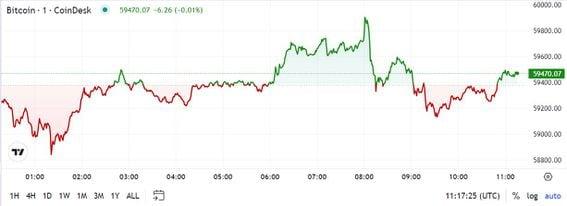
The latest price moves in crypto markets in context for Aug. 21, 2024. Latest Prices CoinDesk 20 Index: 1,915 −1.8% Bitcoin (BTC): $59,471 −1.9% Ether (ETH): $2,586 −2.5% S&P 500: 5,597.12 −0.2% Gold: $2,547 +1.4% Nikkei 225: 37,951.80 −0.29% Top Stories Bitcoin traded little changed below $60,000 during much of the Asian and European mornings. BTC had retreated from its brief rally to $61,000 on Tuesday, trading at around $59,350, a fall of nearly 2.5% over 24 hours. The U.S. Bureau of Labor Statistics is set to publish a data revision that some observers expect to show job growth in the year to March was slower than previously estimated. Mt. Gox-related selling pressure may also be rearing its head after a wallet associated with the defunct exchange moved $784 million worth of BTC early on Wednesday, according to data tracking platform Arkham Intelligence. Bitcoin metrics indicate weak demand, reflecting increased selling amid weeks of muted price action. CryptoQuant's demand indicator, which tracks the difference between the daily total bitcoin block rewards and the daily change in the number of bitcoin, has not moved in a year or more. Inflows to spot bitcoin ETFs have also waned from a monthly pace of 6% in March to just 1% now, CryptoQuant has said. Still, a few metrics have remained strong. Long-term holders – or wallets that hold the for more than six months – have continued accumulating bitcoin at “unprecedented levels,” with the total balance reaching a record-high monthly rate of 391,000 BTC earlier this week. The aggregate number of institutional investors holding bitcoin ETFs in the second quarter rose 14% from the first quarter, according to Bitwise. These investors' share of total assets under management (AUM) of bitcoin ETFs grew to 21.15% from 18.74%, Bitwise said, adding that institutions ended the quarter holding $11 billion in BTC ETFs. This took place amid a 12% slide in the price of bitcoin during the quarter. Bitwise noted criticism that bitcoin ETFs are predominantly owned by retail investors, an assertion it says is simply untrue. It observed that these ETFs have been adopted by institutions "at the fastest rate of any ETF in history." Chart of the Day The chart shows the combined market capitalization of the top two stablecoins, tether (USDT) and USD Coin (USDC), has increased nearly 3% to a record $152 billion this month. The increase in the so-called dry powder often breeds bullish trends in the broader market. Source: TradingView - Omkar Godbole Trending Posts Tether Plans to Develop UAE Dirham-Pegged Stablecoin Alongside Phoenix Group Trump Tops Harris On Polymarket; Tron, Cardano in Green as Bitcoin Sinks Crypto-backed Candidate Ansari Narrowly Wins Arizona Primary by 39 Votes https://www.coindesk.com/markets/2024/08/21/first-mover-americas-bitcoin-holds-below-60k-before-us-jobs-data-revision/
2024-08-21 11:16
The deal comes weeks after Riot Platforms dropped a bid to buy Bitfarms, choosing to try and overhaul the company's board before pursuing a takoever again. The offer equates to $6.02 per share for Stronghold versus its close last of $2.93. Stronghold said in May it was considering its strategic options, while Bitfarms is itself dealing with unwanted attention from Riot Platforms. Bitcoin miner Bitfarms (BITF) said it agreed to buy rival Stronghold Digital (SDIG) for $175 million in stock and assumed debt as it looks to diversify its revenue sources beyond the production of cryptocurrency. The offer comprises $125 million in stock based on 2.52 Bitfarms shares for each one of Stronghold, a premium of 71% to Stronghold's 90-day volume-weighted average price on Nasdaq as of Aug. 16, Bitfarms said in a statement. It equates to $6.02 per share versus SDIG's close last night of $2.93. Shares are currently higher by 64% premarket to $4.80. BITF is lower by 7% to $2.19. Bitcoin miners have been coming to terms with April's 50% cut in the reward they receive for adding blocks to the blockchain. The reduction puts pressure on the industry to cut costs, particularly power usage, and replace older equipment with more energy-efficient rigs. While the event was no surprise – it occurs roughly every four years and companies had plenty of warning to prepare for it – it was still expected to unleash a "survival of the fittest" battle and send the miners looking for alternative income streams such as high-performance computing (HPC) and processing for artificial intelligence (AI) applications. “After three years of ongoing discussions, I am proud to announce this transformative acquisition, which is a decisive step in securing a strong future for Bitfarms," CEO Ben Gagnon said in the statement. "By vertically integrating with power generation, expanding our energy trading capabilities and securing two high potential sites for HPC/AI with significant multi-year expansion potential, we are executing our strategy to diversify beyond Bitcoin mining to create greater long-term shareholder value.” Bitfarms is itself fending off an approach by Riot Platforms (RIOT), which in June abandoned an attempt to buy the company in favor of overhauling the board and building its stake in the Toronto-based company before engaging in further takeover attempts. It now owns almost 19% of Bitfarms. Stronghold in May said it was exploring strategic alternatives that could include the sale of the company. https://www.coindesk.com/business/2024/08/21/bitcoin-miner-bitfarms-to-buy-rival-stronghold-digital-for-175m-in-stock-debt/

2024-08-21 10:17
Apparent demand has slowed considerably since early April and even dipped into negative territory this month, the firm noted. On-chain data indicates a significant slowdown in bitcoin demand since early April, with metrics like CryptoQuant's demand indicator showing negative growth, reflecting increased selling. Despite the bearish signals, some metrics remain robust. Long-term holders are accumulating bitcoin at record levels. The total market cap of stablecoins has hit an all-time high, suggesting increased liquidity which historically precedes price surges. However, the growth in ETF inflows and large investor holdings has notably slowed down. Demand metrics using on-chain patterns and holding behavior show weakening sentiment for bitcoin (BTC), drawing bearish views to the largest token amid weeks of sideways price action. “Apparent demand has slowed considerably since early April and even dipped into negative territory this month,” on-chain analytics firm CryptoQuant shared in a Wednesday note to CoinDesk. “Bitcoin demand growth still needs to pick up before we can see a sustainable recovery in price and the possibility of new highs,” the firm said. CryptoQuant cited its demand indicator, which tracks the difference between the daily total bitcoin block rewards and the daily change in the number of bitcoin that has not moved in one year or more. Bitcoin rewards earned by miners are typically sold to cover operations, but an increase in selling from large holders indicates a waning demand for the asset. Bitcoin price action has largely remained muted. In the past months, billions of dollars worth of selling pressure have flooded the market, denting optimism from the January launch of several spot ETFs. The start of ETF trading in January and the Bitcoin halving event in May saw some bulls target the $80,000 level by June, citing a boost in demand, but prices are down 20% since May's lifetime highs. Bitcoin ETFs have attracted $17.5 billion in net inflows since launch, but skeptics say that flow could be arising for capturing a carry trade instead of representing outright bullish bets. And the initial flows for the ETFs are slowly decreasing. “The growth in the total holdings of large Bitcoin investors has also slowed, from a monthly pace of 6% in March to just 1% currently,” the firm said. “This slowdown in Bitcoin demand coincided with smaller purchases from spot ETFs in the USA." “The average daily purchases from bitcoin spot ETFs in the USA have declined from 12.5K in March, when bitcoin was trading above $70K, to an average of 1.3K Bitcoin last week,” the firm added. However, a few metrics have remained strong during this period of weak prices, CryptoQuant noted. Long-term holders—or wallets that hold the asset longer than six months—have continued accumulating bitcoin at “unprecedented levels,” with this cohort's total balance reaching a record-high monthly rate of 391,000 BTC earlier this week. Elsewhere, the total market capitalization of stablecoins has surged to a fresh record high of $165 billion, a historically bullish sign that indicates increasing liquidity in the crypto market that typically leads to higher prices. https://www.coindesk.com/markets/2024/08/21/bitcoin-metrics-signal-weak-demand-as-btc-etf-hype-slows-cryptoquant/

2024-08-21 08:35
The number of institutional investors holding bitcoin ETFs rose 14% in the second quarter of the year to 1,100, the report said. The biggest question in crypto at the moment is whether institutional investors will allocate to the asset class in a big way, the report said. Bitwise noted that the total number of institutional investors holding bitcoin ETFs rose 14% in the second quarter. Bitcoin exchange-traded funds have been adopted by institutions at the fastest rate of any ETF in history, the asset manager said. Bitcoin's (BTC) price fell 12% in the second quarter, but this didn't stop institutional investors from significantly increasing their allocation in BTC exchange-traded funds (ETFs), asset manager Bitwise said in a report on Monday. "The biggest question in crypto right now is whether institutions and professional investors will allocate to crypto in a major way," wrote Bitwise chief investment officer Matt Hougan. The aggregate number of institutional investors holding bitcoin ETFs in the second quarter rose 14% from the first quarter, to 1,100 from 965, the report noted. These investors' share of total assets under management (AUM) of bitcoin ETFs also grew to 21.15% from 18.74%, Bitwise said, adding that institutions ended the quarter holding $11 billion in BTC ETFs. "This is a great sign," Hougan wrote, "if institutions will buy bitcoin when prices are volatile, imagine what could happen in a bull market." Bitwise noted criticism that bitcoin ETFs are predominantly owned by retail investors, an assertion it says is simply untrue. It observed that these ETFs have been adopted by institutions "at the fastest rate of any ETF in history." Most ETFs build momentum over time, and bitcoin ETF inflows are expected to be bigger in 2025 than 2024, and larger in 2026 than 2025, the note said. "The institutions are coming, and they're coming in size," the report added. Wall Street giant Goldman Sachs (GS) disclosed that it held positions in seven out of the eleven bitcoin ETFs in the U.S., according to a 13F filing earlier this month. https://www.coindesk.com/markets/2024/08/21/institutions-are-still-buying-bitcoin-etfs-bitwise-says/