2024-08-15 12:33
Eigen Labs circulated a list of team members' wallet addresses to EigenLayer ecosystem projects that were preparing to issue tokens. Some teams asked for it. At least one didn't. Eigen Labs, the developer of "restaking" juggernaut EigenLayer, distributed a list of employee wallet addresses to ecosystem projects preparing to launch crypto tokens. Some teams said they asked Eigen Labs for the list, but one said it didn't and felt pressured by the company to send its employees tokens. Experts and insiders say the payouts – worth nearly $5 million at peak prices – raise conflict-of-interest concerns. Eigen Labs and the nonprofit Eigen Foundation have since banned such payouts to employees. Transparent blockchains were pitched as an antidote to Wall Street-style backroom deals. They've instead paved the way for a new class of insiders. Many regard EigenLayer as one of the most promising projects in the sprawling Ethereum blockchain ecosystem. The app provides what it calls a "credibly neutral" platform for building blockchain apps and keeping them safe from theft and cyberattacks. Such neutrality, however, comes with a major caveat: Employees at Eigen Labs, the company behind EigenLayer, have accepted millions of dollars in payouts from some of the other projects that rely on its technology, raising the question of potential conflicts of interest, a CoinDesk investigation found. One team told CoinDesk that it sent each Eigen Labs employee a portion of its new cryptocurrency as a “thank you.” Each employee’s allocation was eventually worth $80,000. Another team said it was sent a list of wallet addresses by Eigen Labs and felt pressured to pay up – or risk imperiling the relationship with a company that could make or break its business. Eigen Labs employees ultimately claimed payouts worth nearly $5 million at peak values – just under $1 million at press time – amid the crypto market's summer slump. Some of the highest-ranking employees who claimed tokens now work at the Eigen Foundation, a non-profit that awards grants to projects that use EigenLayer's technology. Eigen Labs and the Eigen Foundation quietly banned payouts to their employees this year, acknowledging the practice might create conflicts of interest, or at least the impression of them. "Eigen Labs and its Foundation are stated to be 'credibly neutral,' implying a responsibility to avoid any appearance of bias or preferential treatment," said Cessiah Lopez, a crypto research fellow at the nonprofit VentureESG and affiliate researcher at the Minderoo Centre for Technology & Democracy at the University of Cambridge. "Actions that could be interpreted as contradicting this principle might raise concerns, even if they were undertaken without any malicious intent." Airdrop assistance Founded by Sreeram Kannan, an associate professor of electrical and computer engineering at the University of Washington, EigenLayer helped spark crypto’s most recent boom cycle in 2023 when it pioneered "restaking,” a new kind of blockchain security technology that doubled as a lucrative investment opportunity. The platform raised more than $100 million in venture funding and racked up $15 billion worth of user deposits in under a year – massive sums even in the big-money world of blockchain. More than a dozen blockchain apps rushed to launch on EigenLayer in early 2024 – things like cloud compute services and data storage platforms. Also joining the wave were "liquid restaking" services that made depositing into EigenLayer more user-friendly. The new apps chewed up millions of dollars in venture funding and spat out cryptocurrencies with sometimes billion-dollar valuations. They held airdrops to distribute their new tokens. As this was happening, Eigen Labs was helping its employees get access to the airdrops. It sent around a list of their wallet addresses – crypto's answer to the bank account. The company insists it did so only when asked by those projects. "For projects interested in airdropping to Eigen Labs, we provided a list of addresses for all Eigen Labs employees," the company said in a statement to CoinDesk. Eigen Labs only sent the list "to teams that had reached out about airdropping to Eigen Labs or its employees," reiterated Alan Curtis, the company's chief commercial officer. But one team told CoinDesk that Eigen Labs sent it the list even though it had not asked for it. Eigen Labs requested that its employees be rewarded with airdrops, said the developer of this project, who spoke on condition of anonymity for fear of retribution. The request was difficult to ignore given Eigen Labs' influence, the person said. Eigen Labs said it helped many teams coordinate sending airdrops to others in the restaking ecosystem by amassing wallet address lists and making introductions. "This was (and is) very much aligned with our vision of a coordination engine where projects help each other, reward each other, and partner to build an EigenLayer ecosystem that is greater than the sum of its parts," the company said in a statement, though it banned the payouts to its own employees in May. Following the money CoinDesk reverse-engineered the wallet list by compiling a list of all Eigen Labs employees and pairing them with wallets and non-fungible token-holdings they had disclosed on social media. A pattern began to emerge. These wallets – and other "burner" addresses that often only interacted with crypto exchanges – were collecting the same number of tokens from three respective airdrops: Ether.Fi, Renzo and AltLayer. CoinDesk later verified a majority sample of this reverse-engineered list with insiders familiar with the actual Eigen Labs list. According to CoinDesk's analysis, AltLayer allocated 46,512 ALT to each Eigen Labs employee. Ether.Fi followed with 10,490.9 ETHFI per person. Then came Renzo, at 66,667 REZ apiece. At peak prices these three airdrops were worth around $30,000, $80,000, and $16,666, respectively. On-chain records indicate Eigen Labs employees claimed a total of 487,928 ETHFI (peak value $3.5 million), 1,733,342 REZ (peak $433,300), and 1,539,563 ALT (peak $1.02 million) between late January and mid-June 2024. 'A very weird crypto thing' Some industry sources who spoke to CoinDesk said the airdrops to Eigen Labs employees amounted to business as usual in crypto: a common, albeit seldom openly discussed perk of working for a well-connected blockchain startup. "It's a very weird crypto thing where, like, people just give out free money every once in a while," said Mike Silagadze, CEO of Ether.Fi. Ether.Fi airdropped tokens to employees of many companies, including Eigen Labs, as a "thank you," he said. Silagadze said Ether.Fi preferred to airdrop tokens to individuals at those companies "because it's more personal" than sending them to the firms. He said he asked Eigen Labs for a list of its employees so they could get airdrops. It sent him a list of 50 wallet addresses, no names. "They did specifically say that Sreeram did not participate in this," Silagadze said, referring to Kannan, Eigen Labs' CEO. "Given the size of the team it was probably everyone else." (Bullish, the parent company of CoinDesk, is an investor in Ether.fi) Others said the payments by various teams to Eigen Labs employees were improper. One crypto protocol founder who was aware of the Eigen Labs payments, but spoke on the condition of anonymity, said they amounted to an “abuse of power.” “If a company gives another company tokens for business reasons, that’s one thing, but giving tokens to individual team members is completely out of the norm — even in crypto,” said the founder. In this person's view, Eigen Labs' outsized influence in the restaking world means it can selectively promote or privilege projects that pay tokens to team members. Eigen Labs frequently highlights projects on its social media channels and has hosted invitation-only networking events – like a Colorado ski weekend after this year's ethDenver conference – for ecosystem founders. The Eigen Foundation controls 15% of all EIGEN tokens and rewards grants to projects in the EigenLayer ecosystem. CoinDesk found no evidence that Eigen Labs or Eigen Foundation used its power to privilege projects that paid tokens to its employees. A lack of norms Compared to government-regulated public companies, private crypto startups have a lot of leeway in deciding how they disclose critical information such as token ownership percentages. When a crypto project issues tokens, it often publishes a rough breakdown of beneficiaries. No one's requiring there to be a pie chart; the crypto industry lacks consistent reporting standards, leaving investors with incomplete or even misleading information about digital assets. "Token holders are functionally the public [equity] market here," said Christos Makridis, who is conducting research on airdrops as a digital fellow at Stanford University's Digital Economy Lab. In stock markets "there are reporting requirements" designed to keep investors safe, he pointed out. In crypto, none of this is codified. AltLayer was the only project to proactively disclose its distribution to the Eigen Labs team in a January blog post. AltLayer Head of Communications Aparna Narayanan told CoinDesk the allocations were a "token of appreciation.” By contrast, Renzo and Ether.fi disclosed in their tokenomics web pages that some of their airdrops were reserved for ecosystem “partners.” Neither mentioned Eigen Labs employees. Kratik Lodha, an authorized representative for the RestakeX Foundation, which conducted Renzo's airdrop, said "there was an allocation for ecosystem partners which was not solicited by anyone from EigenLayer." CoinDesk subsequently asked Lodha if EigenLayer proactively sent an unsolicited list of blockchain addresses to Renzo ahead of its airdrop in April (which some might not consider an explicit solicitation). He refused to answer. Clean-up act Eigen Labs scrapped its airdrop policy in the wake of another controversy that lit up crypto headlines in May involving the Ethereum Foundation, the Swiss non-profit supporting the Ethereum blockchain. The Foundation revealed two of its lead researchers, Justin Drake and Dankrad Feist, had accepted paid advisory roles with another project building on Ethereum: EigenLayer. Community members voiced concern on X (formerly Twitter) that EigenLayer was attempting to sway Ethereum’s development roadmap in its favor. Feist and Drake ultimately pledged to redistribute their paydays to Ethereum community projects, and the Ethereum Foundation revised its conflict-of-interest policies to prevent future incidents. Eigen Labs told CoinDesk that in May it stopped allowing projects in the ecosystem to airdrop tokens to its employees. The company also said it introduced a policy that "explicitly prevented any employees from influencing any transactions related to the company for personal gain." Eigen Labs also instituted "a prohibition by team members on selling any airdrops received while in possession of material non-public information, including standardized blackout periods after airdrops." The company said it took these steps "to ensure trust and transparency." The Eigen Foundation banned employees "from individually claiming airdrops" in a policy shift published on GitHub on June 3, according to commit records. The Foundation cited "concerns about conflicts of interest or the appearance of such conflicts of interest." Wallets included on the Eigen Labs list continued claiming through mid-June. Eigen Labs and the Eigen Foundation say that employees who already claimed airdrops will not be required to return their tokens. https://www.coindesk.com/tech/2024/08/15/top-crypto-startup-drove-other-projects-airdrops-to-its-employees/

2024-08-15 12:06
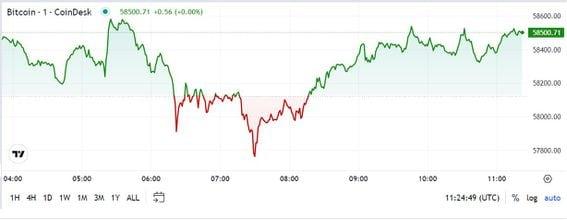
The latest price moves in crypto markets in context for Aug. 15, 2024. Latest Prices CoinDesk 20 Index: 1,888 −3.6% Bitcoin (BTC): $58,764 −3.8% Ether (ETC): $2,639 −3.7% S&P 500: 5,455.21 +0.4% Gold: $2,496 +2.3% Nikkei 225: 36,726.64 +0.78% Top Stories Bitcoin has fallen over 4.5% to under $58,500 in the last 24 hours, having dropped as low as $57,750. BTC losses led drops across major tokens, with ETH also down over 4.5% and SOL falling just under 4%. The broad-based CoinDesk 20, a liquid index tracking the largest tokens by capitalization, has lost 3.5%. Much of the drop came after U.S. July consumer price index (CPI) figures were released late Wednesday. The CPI increased by 2.9% year-on-year, as expected, the first time it has risen less than 3% since 2021. Some traders expect bitcoin to drop as low as $55,000 in the near term, which could spell further losses for other major tokens. Crypto prices have been "highly sensitive" to U.S. economic data in recent months as investors prefer stability over riskier assets, according to K33 Research. “A new sell-off momentum is still the prevailing scenario, with a potential pullback to $55K,” Alex Kuptsikevich, the FxPro senior market analyst, shared in a Thursday note. “Data supporting the Fed's imminent easing of monetary policy may encourage the bulls to overcome the short-term downtrend and give the green light to rise to $66K.” U.S.-listed spot bitcoin ETFs recorded $81 million in net outflows on Wednesday, ending a two-day positive streak. Grayscale’s GBTC registered $56 million in outflows, the most among counterparts, with Fidelity’s FBTC recording $18 million in outflows. Ark Invest’s ARKB and Bitwise’s BITB lost $6.7 million and $5.7 million respectively. Franklin Templeton’s EZBC and BlackRock’s IBIT were the only products with net inflows, adding a cumulative $6 million. Ether ETFs fared better, with $10 million in net inflows, extending a streak to three days. BlackRock’s ETHA recorded $16 million in inflows, while Grayscale’s ETHE lost $16 million. Grayscale’s mini Ether trust ETH, Fidelity’s FETH and Bitwise’s ETHW took on a cumulative $11 million inflows. Trending Posts BitGo Reiterates Autonomy From Justin Sun, Tron as MakerDAO Decides to Dump WBTC U.S. Crypto Bill Can Happen This Year, Senate's Schumer Tells Crypto Backers of Harris U.S. Moves $600M of Silk Road Bitcoin to Coinbase Prime, but Not Necessarily to Sell https://www.coindesk.com/markets/2024/08/15/first-mover-americas-bitcoin-drops-to-under-58k-after-us-cpi-data/
2024-08-15 10:40
It's a tin for Zyn. Comfy is a tin can for storing nicotine pouches, like Zyn. ZynCoin founder Colton Kirkpatrick said some of the profits will go to token buybacks ZynCoin, a memecoin that recently persuaded Philip Morris, the Fortune 500-owner of tobacco giant Swedish Match, to back off of legal threats for using the Zyn name, is launching a physical collectible for the $ZYN community called Comfy, which is now available for pre-sale. Physical collectibles are rare, though not entirely unheard of, in crypto. The most popular is Solana's Saga phone, which built a user base due to aggressive airdrop campaigns. Comfy is a made-in-the-U.S. aluminum can for storing Zyn nicotine pouches, ZynCoin founder Colton Kirkpatrick said in an interview with CoinDesk. It is designed to broaden $ZYN's appeal beyond crypto fans and token holders while providing rewards for the most loyal $Zynners. "We want the crypto aspect to be a subtle yet cool draw, so that people are first attracted to the sleek design and unique features of the can, like the bottle opener, and would want to buy it just for that," he said. He compared it to the silver cigarette cases popular with the upper classes in the roaring 20s. Kirkpatrick said some of the profits from the Comfy sales will go to token buybacks, which are intended to increase the value of the $ZYN token. When users buy a Comfy, they activate a unique code online connecting their account to a crypto wallet holding $ZYN, he said. The more $ZYN they hold, the higher their tier and the greater their weekly rewards. For its part, the $ZYN token has been one of the more poorly performing memecoins of the last month, losing 50%, and declining faster than the market, according to CoinGecko data. Other memecoin majors like DogWifHat and BONK are also down more than 10% on the month, but not as much. The Comfy is the first step in building out a larger $ZYN community, and Kirkpatrick said that there are meetups planned for later this year, likely in New York. After all, even critics say there's a large overlap in interests for those who like Zyn and crypto. https://www.coindesk.com/business/2024/08/15/zyncoin-launches-comfy-a-physical-collectible-that-earns-tokens-as-rewards/

2024-08-15 09:38
U.S.-listed mining companies produced a larger share of bitcoin in July than the previous month as they brought on new capacity faster than the network hashrate rose, the report said. Bitcoin mining was marginally less profitable last month, the bank said. Jefferies cut its Marathon Digital price target to $17 from $22. U.S-listed mining companies produced a larger share of bitcoin in July, the report said. Bitcoin (BTC) mining was slightly less profitable in July than the previous month as the price of the world's largest cryptocurrency fell over 6% while the network hashrate remained stable, investment bank Jefferies said in a research report on Thursday. Hashrate is a proxy for competition in the industry and mining difficulty. The bank cut its Marathon Digital (MARA) price target to $17 from $22 while maintaining a hold rating on the shares. The stock fell 0.7% to around $15 in pre-market trading. U.S.-listed mining companies produced a larger share of bitcoin in July than June, accounting for 21.1% of the total network versus 20.7% in May, the report said. August will be a more difficult month for the miners as the price of bitcoin has dropped about 5% while the network hashrate has started to grow again, the report added. Their market share rose as "public players brought on new capacity faster than the network hashrate increased," analysts Jonathan Petersen and Joe Dickstein wrote. Marathon Digital produced the most bitcoin in July, a total of 692 coins or 17% more than the month before, the report noted. The miner's installed hashrate also remains the largest in the sector. Wall Street giant JPMorgan (JPM) noted that U.S.-listed miners' share of the global hashrate reached a record in July, the bank said in a report last month. CORRECTION (Aug. 15, 10:52 UTC): Corrects month to July in first paragraph. https://www.coindesk.com/markets/2024/08/15/bitcoin-mining-was-less-profitable-in-july-than-june-jefferies-says/

2024-08-15 09:05
The registration was provisionally approved in May, subject to the crypto exchange paying a fine of about $2.2 million. The registration, Binance's 19th worldwide, means its website and app are fully available to users in India. Binance has been settling disputes with financial regulators in the world's largest economies. Binance, the world's largest cryptocurrency exchange, completed registration with India's Financial Intelligence Unit (FIU-IND) just months after it was fined $2.2 million for providing services in the country without authorization. The registration, Binance's 19th worldwide, means its website and app are fully available to users in India, according to an announcement on Thursday. The road to registration commenced in May, only a few months after Binance was banned under the country's Prevention of Money Laundering Act (PMLA) along with eight other exchanges. It was granted provision approval, subject to paying a fine for providing services to Indian clients without adhering to the country's anti-money laundering rules. The size of the fine was determined in June. "This registration underscores Binance’s commitment to adhering to anti-money laundering (AML) standards and fostering a secure, transparent, and efficient ecosystem," the company said in the statement. Among the other banned entities, KuCoin similarly paid a penalty to clear its slate with FIU-IND. KuCoin's fine amounted to $41,000. Binance has been settling disputes with financial regulators in the world's largest economies. It paid $4.3 billion in the U.S. last year to settle criminal charges of breaking sanctions and money-transmitting laws. As part of the settlement, founder Changpeng "CZ" Zhao stepped down as CEO and was sentenced to four months in prison in April. “Our commitment to stringent regulation forms a fundamental part of our business strategy. It's about fostering a secure, transparent, and efficient environment," CEO Richard Teng said in the statement. Read More: Binance Challenges $86M Indian Tax Showcause Notice: Source https://www.coindesk.com/policy/2024/08/15/binance-completes-registration-with-indias-financial-intelligence-unit-months-after-being-fined/
2024-08-15 08:01
Critics of Sun's involvement don't understand the operational mechanics, the crypto custodian's CEO, Mike Belshe, said during an X Space discussion. BitGo CEO Mike Belshe reiterated wBTC's autonomy from Justin Sun, despite BiT Global's involvement. MakerDAO passed a motion to reduce its exposure to wBTC, but it will not liquidate existing positions. BitGo CEO Mike Belshe took the opportunity of an online discussion to reiterate the safety of the bitcoin (BTC) that underpins its wBTC (WBTC), a token that allows the largest cryptocurrency by market cap to be utilized on blockchains other than the original Bitcoin system. In an X Spaces discussion, Belshe reiterated that Tron founder Justin Sun does not have access to the cryptocurrency custodian's asset keys. Belshe's assurance came as DAI stablecoin issuer MakerDAO passed a motion to eliminate its exposure to wBTC due to concerns that a proposal to shift custody to be held jointly with BiT Global – an entity partially controlled by Sun – would centralize too much control with BiT Global. During the online discussion, Belshe said the keys would be split between BitGo's U.S., and Singapore entities as well as BiT Global. "There is no single party that has the ability to mint or steal from the underlying treasury," Belshe said. Community concern mostly came from not understanding the operational mechanics of the keys, he said. Belshe also highlighted that Sun is not an employee of BiT Global. The company, he said, is structured as a public holding company in Hong Kong with a fiduciary duty to secure customer assets. Under local laws, no individual can own more than 20% of the company. MakerDAO's decision, which becomes available for execution after 13:24 UTC on Aug. 15, aims for the organization to stop tapping its wBTC vaults for liquidity. This would prevent further borrowing from these vaults, but existing positions would not be liquidated. Data from Dune shows that wBTC remains stable and there has been no discernable change in the volume of burns, or redemptions of wBTC for bitcoin as users look for alternatives. On Wednesday, crypto exchange Coinbase (COIN) indicated it might be preparing its own wrapped version of BTC, to be called cbBTC. https://www.coindesk.com/business/2024/08/15/bitgo-reiterates-autonomy-from-justin-sun-tron-as-makerdao-decides-to-dump-wbtc/




