2024-07-16 14:27
WLD is up by more than 26% over the past 24-hours. WLD is trading at $2.457, having risen by 15% after the announcement. It is up by 26% over the past 24 hours. The unlock schedule for early investors and team members has been increased from three years to five years, reducing the planned rise in circulating supply. Decentralized identity project Worldcoin has announced that it is extending lockups for early investors and team members, which has led to the project's native token (WLD) rising 15%. WLD is now trading at $2.457, up from $2.147 when the announcement was made, compounding a daily gain of 26%, CoinDesk data shows. "The unlock schedule for 80% of the WLD held by TFH’s (Tools for Humanity) team members and investors is being extended from 3 to 5 years," Worldcoin said in a blog post. This means that the vesting schedule will be more gradual until 2029 as opposed to the original plan. Token unlocks are typically seen as a bearish event, as it increases circulating supply and the potential for early investors to recoup their equity by selling in the open market. Worldcoin is the crypto project headed up by OpenAI CEO Sam Altman, the company raised $115 million in a Series C round last year to accelerate plans to onboard people around the world to have a Worldcoin decentralized ID. The circulating supply of WLD is currently at 275 million, with 77% of that originally being claimed by World ID holders. Under the original schedule, the circulating supply is expected to hit 400 million in September, as opposed to August. https://www.coindesk.com/business/2024/07/16/worldcoin-surges-15-as-investor-and-team-lock-up-extended/

2024-07-16 12:24
The aggregate market cap of 14 tracked bitcoin miners listed in the U.S. rose 29% since the end of June, the report noted. Bitcoin miners rallied strongly in the first two weeks of the month. JPMorgan notes that U.S.-listed bitcoin miners’ share of the global hashrate hit a record 26.6%. Every miner except Stronghold Digital outperformed bitcoin over this period, the bank said. Bitcoin (BTC) mining stocks hit record highs in the first two weeks of this month as both pure-play and high performance computing (HPC) miners gained, JPMorgan said in a research report on Tuesday. “U.S.-listed miners’ share of the global hashrate reached a record 26.6%,” analysts Reginald Smith and Charles Pearce wrote, adding that this represented an encouraging gain of 2.4% since the end of June and 5.6% since the bitcoin halving. Hashrate refers to the total combined computational power used to mine and process transactions on a proof-of-work blockchain and is a proxy for competition in the industry and mining difficulty. The total market cap of the 14 bitcoin miners listed in the U.S. that the bank tracks rose 29% since the end of June and now trade at “2.6 times their proportional share of the four-year block reward, the highest level on record," they wrote. This seems to suggest that the market thinks the artificial intelligence and HPC opportunity could offer alternative and more accretive use cases for bitcoin mining sites, the report said. The network hashrate increased 1% since June but is still about 60 exahashes per second (EH/s) below pre-halving levels, the bank noted. Miners listed in the U.S. added a total 17 EH/s of capacity in June, to the highest level on record, the bank said. Gains were led by Riot Platforms (RIOT), Bitfarms (BITF) and CleanSpark (CLSK). The bank notes that every miner except Stronghold Digital (SDIG), which dropped 8%, outperformed bitcoin in this period. Cipher Mining (CIFR) led advancers with a 44% gain. Broker Bernstein expressed similar positive sentiment about the AI/HPC opportunity in a report last week. It said recent AI deals including Core Scientific’s (CORZ) 12-year agreement with CoreWeave and Coatue Management’s $150 million investment in HUT 8 (HUT) have become key catalysts for the sector. https://www.coindesk.com/markets/2024/07/16/us-listed-bitcoin-miners-share-of-global-hashrate-reached-record-in-july-jpmorgan/

2024-07-16 10:13
In March, a U.K. judge ruled that Wright was not, as he had claimed, the creator of bitcoin. Craig Wright, who claimed to be Bitcoin inventor Satoshi Nakamoto, was referred to the Crown Prosecution Service (CPS) to be considered for perjury charges by Judge James Mellor, who is presiding over a case brought by the Crypto Open Patent Alliance case. COPA took Wright to court for a once-and-for-all ruling on whether he was the creator of Bitcoin. In March Mellor declared that Wright was not, and in a May judgment said Wright had lied extensively throughout the court case. "In these circumstances, as set out in the whole of my Main COPA Judgment, I have no doubt that I should refer the relevant papers in this case to the CPS for consideration of whether a prosecution should be commenced against Dr Wright for his wholescale perjury and forgery of documents and/or whether a warrant for his arrest should be issued and/or whether his extradition should be sought from wherever he now is," Mellor wrote in the court document on Tuesday. "All those matters are to be decided by the CPS." This is a breaking news story and will be updated. https://www.coindesk.com/policy/2024/07/16/craig-wright-referred-to-uk-prosecutors-for-consideration-of-perjury-charges/

2024-07-16 09:17
Spot ether exchange-traded funds are expected to see 30%-35% of bitcoin ETFs' net inflows, and may disappoint due to other factors such as the lack of staking, the report said. Ether spot ETFs net inflows are likely to be 30%-35% of bitcoin equivalents, the report said. Citi said this gives a range of $4.7 billion-$5.4 billion of potential net inflows into ether ETFs over six months. Flows could underwhelm due to a lack of staking and bitcoin’s first-mover advantage, the bank said. Spot ether (ETH) exchange-traded funds (ETFs) in the U.S. could see net inflows at just 30%-35% the levels of spot bitcoin (BTC) equivalents, with distribution skewed to the downside, Citi (C) said in a research report last week. That level gives a range of $4.7 billion to $5.4 billion of net inflows over six months, the report said. Morever, the inflows and the beta of ether returns relative to such flows could be lower than the analysis suggests, the bank said. “One reason is that while ETH may offer diversification benefits in the long-term, given its different and more extensive set of use-cases, this is currently not the case,” analysts led by Alex Saunders wrote. Spot ether ETFs are about to become available for trading in the U.S. after the Securities and Exchange Commission (SEC) greenlighted filings from issuers earlier in the year. They are expected to begin trading next week. Investors who would likely buy spot ETFs, as opposed to the respective tokens, may view bitcoin and ether as similar enough to split their allocations between the two cryptocurrencies, rather than viewing them as distinct assets, Citi said. That means ether may see flows that had been earmarked for bitcoin ETFs rather than additional allocations. The bank noted that another reason that flows could disappoint is due to the lack of staking in ether spot ETFs. Bitcoin also benefits from first-mover advantage, which saw billions of dollars of inflows and strong BTC outperformance prior to ether ETF listing approval in May, the bank said. Still, it's not all doom and gloom. The timing of spot ether ETF launches may align with an increasingly dovish Federal Reserve which could mean lower interest rates, a stronger equity market and a weaker U.S. dollar, and that is a macroeconomic environment that could be supportive for crypto, the report said. https://www.coindesk.com/markets/2024/07/16/ether-spot-etfs-could-see-up-to-54b-of-net-inflows-in-first-6-months-citi/

2024-07-16 07:24
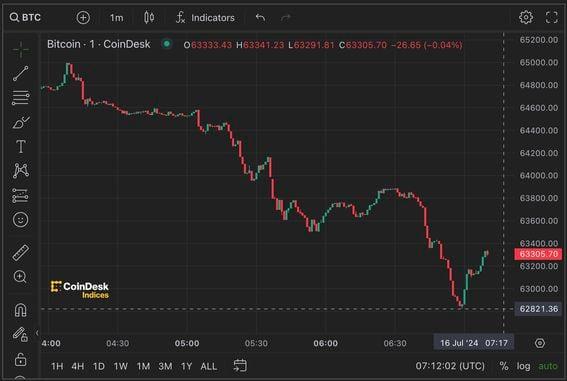
One observer said the movement of coins was likely a part of the exchange's creditor reimbursement plan. BTC dips 3% on renewed movement of coins by defunct crypto exchange Mt. Gox. One observer said the movement of coins was likely a part of the exchange's creditor reimbursement plan. Bitcoin (BTC) faced renewed selling pressure on Tuesday after blockchain data showed defunct exchange Mt. Gox started moving coins internally for potential repayments to creditors. The leading cryptocurrency by market value dipped 3% briefly falling below $63,000, after testing the $65,000 mark during the early Asian trading hours, according to CoinDesk. The decline happened as the wallet associated with Mt. Gox initially moved 0.021 BTC ($1,000) to the blockchain address: 1EoZd1QNCiN9JbnsqvLRDbHKLygAsXHg3V. The small movement, supposedly a transfer test, was followed by a significant movement of 44,527 BTC ($2.84 billion) to an internal wallet, according to data tracked by Arkham Intelligence. The movement was likely a part of the repayment plan, according to on-chain sleuth Lookonchain. Cryptocurrency exchange Kraken has reportedly confirmed creditor repayments, saying it has received funds and will distribute them over the next two weeks. Mt. Gox, once the largest bitcoin exchange in the world, went bust in 2014 after it lost hundreds of thousands of bitcoin in a hack. The exchange began repaying its debt on July 4, spurring fears of mass selling by creditors who have waited for reimbursements for a decade. Bitcoin's drop weighed over the broader market, with ether, the second-largest digital asset by market value, dipping over 2.5% to $3,400. The CoinDesk 20 Index (CD20), a broader market gauge, fell over 2% to 2,182. Update (11:21 UTC): Added detail about Kraken confirming Mt. Gox creditor repayments. https://www.coindesk.com/markets/2024/07/16/bitcoin-dips-below-63k-as-mt-gox-moves-28b-btc-to-internal-wallets/
2024-07-16 07:03
Investors' focus on ether is evident from ETH's sustained volatility premium over BTC. Relative richness of ether's short-term options-induced implied volatility suggests a pick up in hedging activity. The U.S.-listed ether ETFs are expected to begin trading next week. The impending debut of U.S.-based exchange-traded funds (ETF) tied to ether's (ETH) spot price has investors scrambling to the options market to hedge or protect existing market positions from price swings. Implied volatility (IV), or options-derived market expectations for price turbulence over a specific period, has ticked higher across timeframes, according to data sources Deribit and Kaiko. That's a sign of increased demand for options or derivatives offering protection against price swings. A call protects against price rallies, while a put offers insurance against price slides. The hedging activity has been more pronounced in short-term contracts, as evidenced by the recent relative richness of implied volatility determined by options contracts expiring on July 19 relative to those expiring on July 26. According to Kaiko, the July 19 expiry IV rose from 53% on Saturday to 62% on Monday, topping the July 26 expiry IV. "The increase in IV on the July 19 contract suggests traders are willing to pay more to hedge existing positions and protect against sharp price moves in the short run. This spike in near-term contracts IV indicates a level of uncertainty among traders," analysts at Kaiko said in Monday's edition of the newsletter. Traders also expect increased ether volatility relative to bitcoin. According to data source Amberdata, the spread between Deribit's 30-day ether and bitcoin implied volatility indices (BTC DVOL and ETH DVOL) has consistently averaged around 10% since late May, significantly higher than 5% in the first quarter. Crypto exchange Bybit and analytics firm BlockScholes made a similar observation in a report shared with CoinDesk on Monday. "Key findings indicate that investors are increasingly optimistic about ETH, particularly in anticipation of the imminent launch of the first Ether Spot ETFs in the United States. This optimism is reflected in ETH's sustained volatility premium over BTC, which has persisted amid heightened market activity," the report said. The pick-up in hedging activity in ether is consistent with the uber-bullish expectations from the spot ether ETFs, which are expected to begin trading next Tuesday. According to Gemini, spot ether ETFs will likely draw $5 billion in net inflows in the first six months, boosting ether's market value relative to bitcoin. Besides, traders, mindful of the "sell-the-fact" phenomenon that followed the debut of bitcoin ETFs on Jan. 11, might be preparing for similar price volatility in ether. Traders, however, should note that the present market mood and ether's bullish positioning are significantly more measured than bitcoin in early January, suggesting low odds of a post-debut sell-the-fact pullback. https://www.coindesk.com/markets/2024/07/16/ether-hedging-activity-picks-up-as-us-etf-debut-nears/