2024-10-22 15:41
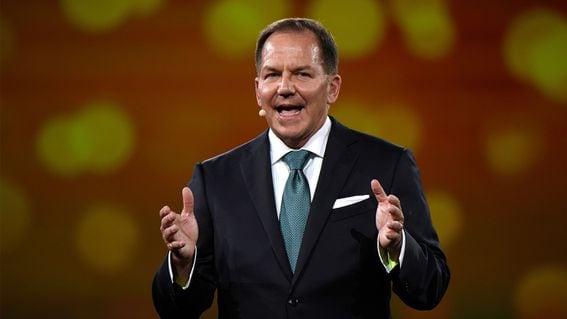
The U.S. government's debt and deficit issues aren't going anywhere no matter who wins the presidency next month, said Jones. The U.S. will need to inflate and outgrow its debt burden, Paul Tudor Jones said in a CNBC interview. He recommended owning a basket of gold, bitcoin, commodities and Nasdaq, and staying away from fixed income. Ballooning U.S. debt is at an unsustainable trajectory, billionaire hedge funder Paul Tudor Jones told CNBC on Tuesday and he's favoring bitcoin (BTC), gold and commodities instead of bonds. "I think all roads lead to inflation," he said. "I'm long gold, long bitcoin." Tudor added that he would short fixed income, particularly longer duration paper. His comments about the fiscal situation echoed similar warnings from other major public figures, with even Federal Reserve Chair Jerome Powell noting that U.S. debt levels are untenable. Tudor's fellow legendary investor Stanley Druckenmiller recently also disclosed betting against U.S. government bonds. The U.S. is at an "incredible moment in history," said Tudor, with the national debt ballooning to nearly 100% of GDP now from 40% only 25 years ago. Whoever will be elected next month will have to deal with the issue, he added, but campaign promises of additional spending and tax cuts made by Harris and Trump would only exacerbate the problem. "We are going to be broke really quick unless we get serious about dealing with our spending issues," he said. The only playbook to get out of the situation is to inflate and outgrow the debt burden, argued Jones. In this case, the Federal Reserve "should be easy" running nominal interest rates lower than inflation and supporting nominal economic growth above inflation. He suggested a "basket of gold, bitcoin, commodities and Nasdaq, and zero fixed income." https://www.coindesk.com/markets/2024/10/22/paul-tudor-jones-all-roads-lead-to-inflation-hes-long-bitcoin-and-gold/
2024-10-22 13:29
Scroll users vented their frustration at SCR token allocation last week. Scroll initially began trading at $1.40 but has since dropped to around $1.10. Scroll confirmed that all co-founders and team members would not be receiving an airdrop in response to criticism last week. SCR has a market cap of $212 million and a fully diluted value of $1.1 billion. Layer-2 network Scroll released its long-awaited native governance token on Tuesday, putting the project's initial valuation just over $200 million. Traders priced SCR at around $1.10, or a $212 million market cap, based on the circulating supply figure of 190 million. SCR will act as a native governance token with a roadmap to progress it towards being a protocol utility token as Scroll becomes more decentralized. The week prior to SCR's release was far from ideal for Scroll as users complained about disproportionate token allocation and the decision to give Binance 5.5% of the supply for its Launchpool users. Early users of the Scroll network also received SCR with 7% of the supply being set aside for an airdrop. But the token struggled to shrug off the negative sentiment it accrued in October as it dropped from $1.40 at 7:00am UTC to $1.12 at 12:45 UTC to mark an initial slump of 20%. Scroll was hit by further skepticism last week after it emerged that the team had been accruing "marks" which technically could have been converted into airdropped tokens. However, Scroll's core contributor Sandy dispelled the rumors on X by stating that "all Scroll co-founders and team members involved in developing scroll sessions or the airdrop will not be claiming the airdrop." On-chain data shows that the SCR token has accumulated more than 200,000 holders in its first day of release whilst racking up over 500,000 token transfers. Trading volume remains steady with $189 million changing hands across all SCR trading pairs, according to CoinMarketCap. Liquidity is also fairly deep as there is more than $400,000 within 2% of spot price on either side of the book on Binance. https://www.coindesk.com/tech/2024/10/22/scrolls-scr-token-debuts-at-212m-market-cap-in-volatile-trading-session/

2024-10-22 13:27
Institutions seem to be moving away from traditional cash and carry arbitrage to pure directional plays, according to observers. The mismatch between spot ETF inflows and the spike in CME futures open interest suggests bias for bullish directional bets, CF Benchmarks explained. Elevated futures premium suggests the same, according to Bitwise. If you are disappointed by bitcoin's (BTC) failure to get past $70,000, here is an insight that might brighten your day – The recent strong uptake for the U.S.-listed spot ETFs, often considered a proxy for institutional activity, mainly featured bullish directional bets than arbitrage plays. Since Oct. 14, the 11 spot BTC ETFs registered a cumulative net inflow of nearly $2.5 billion, the largest since March, according to data tracking website SoSoValue. Meanwhile, notional open interest or the dollar value of the active bitcoin futures on the Chicago Mercantile Exchange (CME) surged to new record highs above $12 billion, according to data source VeloData. Seasoned investors may see the concurrent rise in the two variables as a sign of continued institutional preference for cash and carry arbitrage, a non-directional strategy aimed at profiting from the price discrepancy between spot and futures prices. That was supposedly the case early this year, as institutions set up the so-called basis trade, involving a long ETF position and a short CME futures position, leaving bitcoin largely flat below $70,000. The latest ETF inflows, however, indicate a bias for bullish plays via spot ETFs, according to Sui Chung, CEO of crypto index provider CF Benchmarks. "An increase in basis trading is usually apparent when the inflow into spot ETFs and growth in CME OI correspond with one another. But in this case, there's a clear mismatch with the $2.5 billion ETF flows far exceeding the $1.6 billion increase in open interest for CME's bitcoin futures contracts," Chung told CoinDesk. "This tells us that only a proportion (we estimate around 40%) of the ETF inflow is down to basis trading; the other 60% or $1.4 billion is directional holding," Chung added. Most bitcoin spot ETFs refer to CF Benchmarks' Bitcoin Reference Rate - New York (BRRNY) variant. Futures premium spikes The elevated futures premium also undercuts any notion of ETF inflows being driven by cash and carry trades. A mass deployment of the strategy typically "arbs away" the premium, limiting the price differential. The annualized one-month BTC futures premium (basis) on the CME increased from roughly 6% to 13.9% last week, the highest since May, according to data tracked by K33 Research. The funding rates in perpetual markets also increased, suggesting a bias for bullish long trades. "The bitcoin basis rate [futures premium] has been moving up, implying a bias towards long positioning, which tends to steepen the futures curve and increase contango. The same is reflected in the perpetual funding rate, which has increased to the highest level since July 2024," André Dragosch, director, head of research - Europe at Bitwise, told CoinDesk. "Market makers like Jane Street tend to increase their BTC short positioning with increasing BTC ETF inventories; the latest evidence suggests that there has been a net increase in long positioning via futures and perpetuals more recently," Dragosch added. That said, some market participants seem to have bought ETFs while shorting CME futures. In the week ended Oct. 15, non-commercials or large speculators held a net short position of 1872 contracts, the highest since March, according to data tracked by Tradingster. "The latest data on CME Bitcoin Futures Non-Commercial net positioning imply that futures traders are net short on CME. However, on aggregate across all kinds of futures exchanges, the data imply the opposite," Dragosch noted. https://www.coindesk.com/markets/2024/10/22/more-than-arbitrage-25b-inflow-in-spot-btc-etfs-features-bullish-directional-bets/

2024-10-22 13:00
The project is spinning out of Solana Labs and its new leaders want to turn a profit. Realms has been in the business of crypto-governance for nearly as long the blockchain it's built on – Solana (SOL) – has been around. Its new leaders want to start turning a profit. The hub for crypto apps' voting, decision-making and treasury is under new management, an entity called "Realms Today Trust." It's a big change for the project built by all-important Solana Labs to give its blockchains' many startups a place to manage their politics. "We need to develop profit services, that way we can continue it," said Dean Pappas, a longtime Realms contributor and one of the four people leading the spinoff company. Realms' new "mandate" won't impact the "public goods" that dozens of Solana-based decentralized autonomous organizations (DAOs) have come to rely on, continued Pappas. The governance tools that give projects' communities of token-holders a say in their operations will remain free. Other new bells and whistles will not. Realms is launching a crypto-advisory service to help DAOs set up their governance structures. An incorporation-advisory line will help them create legal structures and bank accounts. And there will be a credit card through which they can spend down their crypto-treasuries. All that might help Realms capture some of the $1.5 billion in crypto that DAOs have parked on its infrastructure. Realms also plans to give away $200,000 in grants to Solana DAOs in support of upstart DAOs. Pappas declined to say where that money was coming from. New ownership Realms isn't the first piece of the Solana ecosystem to emerge from Solana Labs, the blockchain's main developer company. Metaplex, the entity underpinning Solana's non-fungible token (NFT) technology also did, said Matty Taylor, himself a Labs veteran who went on to independently run hackathons for the entire ecosystem. "The general ethos of Solana Labs is once things get to a certain point, it's time for it" to become its own standalone thing, Pappas said. Realms' new legal entity is owned outright by Solana Labs' DAO engineer Sebastain Bor, according to U.K. business records from late 2023. The company Realms Today LTD later added Pappas and Jose Neif Jury from BCB Group as directors. Asked if Bor had to purchase Realms from Labs, Pappas declined to comment. The Realms team currently has 12 full time employees and plans to grow further. They're slated to build more frontends for different tokenized governance use-cases, a change from what Pappas called the current website's "one size fits all" approach. Changes may also be coming to elements of Solana's governance standard for SPL tokens. That codebase is open-source and accessible to anyone. Realms plans to fork it – a step toward building something new. https://www.coindesk.com/business/2024/10/22/solanas-crypto-governance-hub-realms-is-under-new-management/
2024-10-22 12:35
Active addresses grew to 85,000, of which 37,000 were new wallets, indicative of strong demand. Meanwhile, Lookonchain data shows that Pump’s creators are raking in profits. Solana token issuer Pump.Fun is nearing 1 million SOL token in lifetime fees, with over 2.5 million tokens launched using the service since its early March release. Over 5,550 addresses issued 7,500 tokens in the past 24 hours alone, data shows. Monday saw a record 31,000 tokens launched as artificial intelligence-themed memecoins - a niche kickstarted by GOAT - renewed a speculative frenzy. Active addresses grew to 85,000, of which 37,000 were new wallets, indicative of strong demand. Meanwhile, Lookonchain data shows that Pump’s creators are raking in profits. A connected fee account sold over $6 million worth of SOL late Monday, taking its lifetime sales to over $78 million or 500,000 SOL. Pump lets anyone issue a token for less than $2 in capital, after which they choose the number of tokens, theme, and meme picture to accompany it. When the market capitalization of any token reaches $69,000, a portion of liquidity is deposited to the Solana-based exchange Raydium and burned. Pump is also available on Base and Blast networks but is most commonly used to issue memecoins on Solana. That has minted the project big money. Pump has earned $147 million since going live and is among the most profitable crypto upstarts. In an April report, CoinDesk estimated the service would earn at least $66 million in 2024. https://www.coindesk.com/markets/2024/10/22/solana-token-issuer-pumpfun-rakes-in-big-bucks-with-1m-sol-in-lifetime-fees/

2024-10-22 12:00
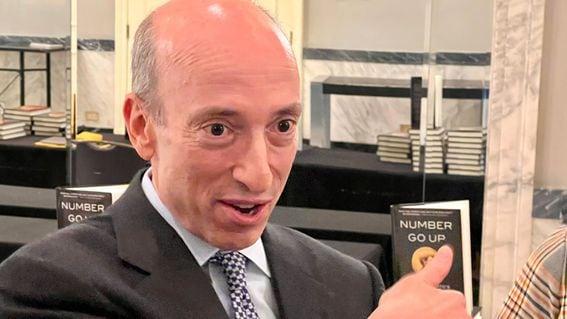
The U.S. SEC chair has arguably been the individual with the greatest influence over the direction of America's crypto policies, but his days atop the agency are numbered. Most Securities and Exchange Commission chiefs step down after a new president arrives, and for the crypto industry, Chair Gary Gensler's final moment is a point of high interest. Digital assets leaders have battled him in court, and their friends in Congress have attacked Gensler for standing in the way of innovation, but his time is running low. Gensler has options for how he wants to end things, and he still has some time left to engage in crypto policy and enforcement before he goes. Someday soon, somebody besides Gary Gensler will be calling the shots at the U.S. Securities and Exchange Commission, and most of the crypto industry will rejoice. More than any other figure in the U.S. government, this SEC chair played an unflinching antagonist to its aims. That no-holds-barred opposition to the way crypto companies want to do business is likely to cease, one way or another, in the coming year, when the securities agency gets a new boss. But the countdown for Gensler raises a number of questions, leaving one final chapter of drama in his reign over crypto (and the rest of securities regulation in the U.S.). And if there's a common feeling among those who watch the SEC closely, it's uncertainty. Gensler's five-year SEC term expires on Jan. 5, 2026, but tradition suggests a chair will step away if the opposing party takes the White House. Still, they don't have to. A second term for President Donald Trump doesn't mark an automatic end to Gensler's tenure. If he decided to make a stand, he could finish out his term as a commissioner and maintain a Democratic majority at the agency for as long as it takes for the new president to make appointments and the Senate to confirm them. When recently asked by a reporter whether he'd resign if Trump won, Gensler laughed quietly and said he wouldn't comment on the elections. But he added, "Elections have consequences." A former Goldman Sachs Group Inc. banker and Massachusetts Institute of Technology professor who lectured on crypto, Gensler has a deep well of financial and even digital-assets knowledge. And as the chair of the Commodity Futures Trading Commission after the global mortgage implosion in 2008, he cut his government teeth crafting novel, high-stakes regulation. But when he took the helm of the SEC in 2021 and found crypto on his plate, he made a consequential call: The SEC didn't need new rules. Existing securities law gave plenty of leeway to police this space. That's not the general sense of the SEC's overseers in Congress. A big majority of the House of Representatives passed a bill earlier this year that would create rules specifically tailored for digital assets – including how the SEC should approach what would be a more explicitly defined array of crypto securities. And while that bill has languished because it still needs approval in the Senate, crypto did see a win in that chamber, too. A strong majority of senators voted this year to overturn a key SEC crypto accounting policy, showing they believed the agency was overreaching and rebuffing Gensler's arguments that the industry-targeting standard was a natural response to the crypto sector's investor-harming bankruptcies. The lawmakers who make up next year's Congress, which will likely have at least two dozen members who can partly thank aggressive crypto campaign giving for their presence on Capitol Hill, is likely to be busy with digital assets. That's probably true no matter which party controls each chamber; Democrats look poised to have a majority in the House, according to electoral math and polling trends, while Republicans may win control of the Senate. But if the Democrats keep the Senate, crypto progress may remain challenged. "I think there is a real chance that the legislation gets passed next year," Michael Piwowar, a former acting chair of the SEC, said during an interview with CoinDesk. That would create a "nice, legal regulatory framework" for crypto that puts the securities agency in a defined lane that leaves less room for the legal interpretations the SEC and crypto businesses are still fighting over in federal courts, he added. "There's not clear authority on some of these things, which is why Congress needs to get involved." "Five years from now, we'll look back in the rearview mirror and say, 'Why couldn't we have done this sooner?'" Piwowar said. Part of that answer – critics and allies would agree – is Gensler. "Chair Gensler’s tenure at the SEC has been marked by missed opportunities," said Sheila Warren, who runs the Crypto Council for Innovation. She argued that Gensler has left U.S. businesses "operating in the dark" by leaning into enforcement rather than regulation. "A fresh start at the SEC is essential for the future of innovation in this country." Regulation-by-enforcement SEC Commissioner Hester Peirce, a Republican appointee who has been the most reliable crypto ally at the agency, has long been in open disagreement with the chairman's preference for whipping digital assets businesses into line by punishing them. "It's a very bad approach to trying to regulate an industry, if you're trying to protect investors, if you're trying to shepherd the commission's resources well," she told lawmakers at a hearing of the House Financial Services Committee last month. "It's very inefficient, and at the end of the day, it leaves everyone wondering where the lines of our authority are." But in the same hearing, Gensler again cited the so-called Howey test, the Supreme Court standard set in the 1940s (long before crypto and blockchains were even a dream) that decides whether an asset is a security. He's wielded it as his chief weapon in the SEC's epic enforcement battle with the industry. "The time-tested protections are really important," he told the lawmakers, citing some of the recent federal court successes for his agency, while leaving out the setbacks. "One court said Howey provides clearly expressed tests for determining what constitutes an investment contract. Another court said the SEC based its claim on straightforward application of a venerable Supreme Court precedent. I could go on and on and read quote after quote from cases in the crypto field." Most of the crypto space is breaking the law, according to the narrative he stands by, and its practitioners are threatening people's money with dicey business practices while they continue to evade compliance. Just last week, the SEC sued one of the biggest trading firms in financial markets (crypto and traditional assets alike), Chicago-based DRW, accusing the company of not getting proper permission to trade crypto assets. Gensler, who declined to be interviewed by CoinDesk for this story, has drawn that line in the sand and has spent years proving he won't budge from it. "The U.S. securities laws have worked to protect investors for 90 years, and there’s nothing incompatible about the crypto field with these time-tested laws," an SEC spokesperson told CoinDesk. So, what happens to Gensler and his crypto campaign after the presidential election next month? Former President Trump, the Republican candidate for next month's election, basked in a massive surge of applause in July when he told attendees at a Bitcoin conference that he'd fire Gensler, so a Trump win would promise storm clouds for the SEC chair. When the opposing party takes the White House, an SEC chair usually steps down right away or – at the latest – when the new president takes office two months after Election Day. "I don't think there's ever been a chairman who's ever stayed on when there's been a change of party," said Dennis Kelleher, CEO of Better Markets, a Washington-based advocacy group that's been critical of the hazards crypto poses to investors. (A Democrat, Joe Biden, currently resides in the White House.) Could linger But Jaret Seiberg, a financial-policy analyst with TD Cowen, suggests that Gensler – even if he vacates the top job – could stick around on the commission, where he'd sit alongside Democrats Caroline Crenshaw and Jaime Lizárraga. Crenshaw's term has expired, and President Biden sent her re-appointment to the Senate, but she hasn't yet been confirmed as the congressional session winds down. (In the absence of a replacement, an expired commissioner can stay on another 18 months.) "Nothing forces him to leave," Seiberg wrote in an analyst note to clients in September. "We expect progressives to pressure Gensler to preserve Democratic policy wins by depriving the GOP of an SEC majority." Kelleher, who said he'd be "more than pleased" if Gensler stayed on, sees strong odds against that scenario playing out. "There would be tremendous value in Gary Gensler staying until the end of his term," Kelleher said. "Based on precedent and practice, it's extremely unlikely." Without Gensler as chair, Trump could elevate either Republican commissioner – Peirce or Mark Uyeda – as acting chair while he seeks a permanent pick. That interim chair could start naming new department heads, including atop Gensler's cudgel – the enforcement division – and could change how the agency is pursuing pending legal cases. But until the commission has a third Republican confirmed, the Republicans wouldn't enjoy a majority that allows them to roll out new policies. The crypto masses have generally favored a Trump presidency, especially after his full-throated embrace of the technology this year, though the U.S. government's adversarial relationship with the sector arguably started on his watch. It was his own SEC chair, Jay Clayton, who first pursued Ripple. Still, his recent rhetoric paints the government as standing in the way of innovation. "If Trump wins, crypto wins," Daniel Gallagher, a former SEC commissioner, predicted when appearing at a recent event in Washington. Gallagher, whose name has appeared on lists of those who might be considered for replacing Gensler under Trump, has often spoken of his frustration as a senior lawyer at Robinhood Markets. He said the agency rebuffed the company as it tried to comply with SEC rules as a crypto platform. If Vice President Kamala Harris beats Trump, the replacement of Gensler potentially carries less urgency. But even her guarded sentiments that her presidency would foster digital assets growth and new regulations suggest a course that diverges from Gensler, who argues his agency doesn't need new regulations. Harris' campaign has held meetings with crypto insiders and privately convinced them that the vice president would reset industry relations that have ranged from stagnant to hostile under her current boss, Biden. Either way, the "age of Gary Gensler" will soon end, declared Anthony Scaramucci, Trump's short-lived communications director who has become a vigorous critic of the former president. "That era of crypto is ending," Scaramucci, the founder and managing partner at Skybridge Capital, said in a CoinDesk TV interview. "We're heading toward a much better regulatory framework no matter who wins the election." Time left Still, Gensler has some time left before the elections force his hand. Despite grumbling from the industry that his agency has refused to make rules tailored to crypto, he did set and defend crypto accounting policy in the form of what's known as Staff Accounting Bulletin No. 121, and the commission embarked on a few consequential rules. In February, the agency formally widened its definition for what makes a securities dealer, a new standard that is meant to include crypto operations among businesses the agency regulates as broker-dealers – potentially including decentralized finance (DeFi). And the commission has pursued a couple of ongoing efforts that could hit crypto hard: One proposed rule expands the definition of "exchange" to encompass digital assets platforms in a way that also explicitly included DeFi, and another proposal would demand investment advisers only keep clients' crypto assets with "qualified custodians," which the agency suggested leaves out the big crypto houses such as Coinbase. However, that custody rule is heading back to the drawing board, SEC officials have said. If Gensler and his colleagues pull the trigger on the exchange rule before he leaves, the nearness of the next congressional session in 2025 would give lawmakers an opportunity – as long as both chambers wanted to use it – to reverse anything the agency approves. That power is under the Congressional Review Act and is the same authority lawmakers in Congress tapped to try to erase the agency's crypto accounting rule, which drove President Biden to step in with a veto to stop them. Trump's first administration embraced the CRA power as it had never been used before, but it tends to require a Congress that's friendly to the president. Legal strategy Meanwhile, for whichever candidate shows up in the White House in January, there will almost certainly be a lengthy transition period. Rulemaking and enforcement cases are time-consuming endeavors, and an overhauled SEC inherits a great deal of work already mostly finished before new commissioners arrive. An incoming chair – and potentially new top legal officials, such as the general counsel and the enforcement director – would have a lot of triaging and decision-making to do on a herculean heap of court cases. Some of the foundational crypto cases, such as those targeting Ripple and Coinbase, could be elevated in the coming year through appeals as they potentially wind their way toward the Supreme Court, where Gensler's legacy may truly be decided. New management would have to work out how they want to proceed with those. Even if the agency is beat back by court losses or new laws from Congress that restrict its jurisdiction, the SEC will always have a major role in the U.S. crypto sector. Kelleher said that role will inevitably clash with the industry, because the regulator's first job is to protect investors, not businesses. And he cautioned the crypto world from seeing Gensler as a villainous Wizard of Oz behind everything it doesn't like, because Kelleher contended that the commission chair has actually done more for the industry than anybody in government. After losing his court battle to prevent the creation of spot bitcoin exchange-traded funds, Gensler acknowledged the loss and went against his two fellow Democrats to side with the Republican commissioners in approving the consequential ETFs. "I think Gensler's legacy on crypto is going to be the one guy in government who literally almost single-handedly did more to legitimize and mainstream crypto than anyone else," Kelleher said. https://www.coindesk.com/news-analysis/2024/10/22/gary-genslers-contentious-reign-over-crypto-approaches-its-twilight/