2024-10-22 11:28
The private transactions allow institutional users to define privacy conditions in a way that keeps onchain data private from all third parties and adversaries. Chainlink has introduced a new protocol aimed at ensuring privacy for financial institutions, enabling them to conduct secure, confidential transactions across different blockchain networks. Australia and New Zealand Banking Group (ANZ) will pilot this privacy feature for settling tokenized real-world assets, as part of Singapore's Project Guardian, highlighting a practical application of Chainlink's technology in the banking sector. Chainlink released its CCIP Private Transactions protocol, a privacy-preserving tool, on Tuesday. The tool will allow financial institutions to maintain confidentiality and regulatory compliance when transacting across blockchain networks. Australia and New Zealand Banking Group (ANZ) will be among the first financial institutions to pilot the capability for cross-chain settlement of tokenized real-world assets (RWAs) under the Monetary Authority of Singapore (MAS) Project Guardian initiative. Cross-chain protocols allow token holders to transfer and interact with applications among different blockchains, which is otherwise not possible. RWAs refer to a tokenized version of a physical asset, such as artwork or real estate, that is tradeable on the open market. Institutional requirements include the need for complete end-to-end privacy for private chain to private chain transactions and limiting data exposure for private chain to public chain transactions. The private transactions allow institutional users to define privacy conditions in a way that keeps onchain data private from all third parties and adversaries, while enabling authorized parties in the transaction or the compliance industry to view that same data. "Privacy is a critical requirement for most institutional transactions," said Sergey Nazarov, Chainlink co-founder, in a prepared statement. "So far the blockchain industry has not provided the level of privacy necessary for these institutional transactions to move forward successfully, limiting the entire industry's growth. “Now that private transactions across chains are possible, we expect an even greater influx of institutional adoption of blockchains, CCIP, and the Chainlink standard in general,” Nazarov added. https://www.coindesk.com/tech/2024/10/22/anz-to-kickstart-chainlink-private-transactions-protocol-in-rwa-boost/

2024-10-22 11:20
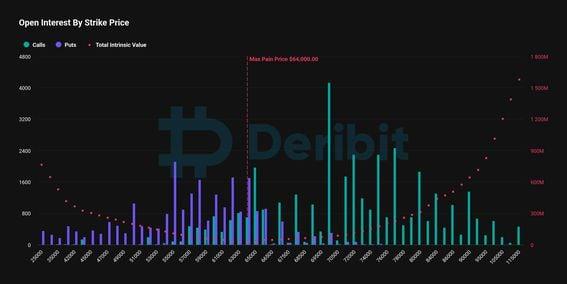
Approximately 16% ($682 million) of the notional value in bitcoin that is set to expire is currently “in the money.” October's expiry is due Friday at 08:00 UTC, with $4.2 billion in options expiry for bitcoin and over $1 billion for ether. Bitcoin has a higher put/call ratio than ether, which indicates a more bullish sentiment as we approach options expiry. The crypto market may be set up for some short-term volatility this week as monthly bitcoin (BTC) and ether (ETH) options contracts are set to expire on Friday. BTC and ETH options contracts worth $4.2 billion and $1 billion, respectively, will expire on Deribit at 08:00 UTC. An option allows the holder the right, but not the obligation, to buy or sell an underlying asset at a specified price within a certain time period. According to Deribit data, what’s worth noting is that BTC options worth over $682 million, equating to 16.3% of the tally of $4.2 billion are set to expire “in-the-money,” of which most are calls. A call with strike price below the going market rate is said to be ITM while ITM puts are those with strikes above the spot price. The dynamic could breed market volatility as holders of in-profit ITM options look to close their bets or move positions in the next expiry. The last quarterly expiry dated end of September had a similar distribution of open interest. Deribit data shows that the bitcoin put-to-call open interest ratio stands at 0.62 ahead of the expiry, indicating a relatively bullish sentiment. In other words, for every 100 call options active, 62 put options are open. The bias for calls is not surprising, considering BTC recently neared $70,000 for the first time since July. Max pain at $64K BTC’s max pain level is $64,000, where most options - would - expire worthless, causing the most loss to option buyers and maximizing profit for the options writers. At press time, BTC traded near $67,000, well above the max pain level while ether changed hands at around the max pain level of $2,600. So believers of the max pain theory might say bitcoin has room to fall ahead of the expiry while ether’s downside is capped. Max pain theory states that the pre-expiry activities of traders with short options exposure often drives the underlying asset closer to its max pain level. However, the crypto community is divided on the max pain effect, with some saying the options market is still quite small to impact the spot price. The options market will continue to grow Crypto options market has grown multi-fold in the past four years, with contracts worth billions of dollars expiring every month and quarter. That said, its still relatively small compared to the spot market. According to Glassnode, as of Friday's data, the spot volume was approximately $8.2 billion, while options volume was roughly $1.8 billion. In addition, BTC's open interest of $4.2 billion due to expire this Friday is less than 1% of BTC's market cap of $1.36 trillion. That said, it could get bigger and move beyond BTC and into crypto-linked products in future as more institutions participate in the market. On Friday, the U.S. Securities and Exchange Commission (SEC) approved options tied to spot bitcoin ETFs. This comes after the approval of trading options of BlackRock's iShares Bitcoin Trust (IBIT). Jeff Park, head of alpha strategies at Bitwise Invest, called the approval "game-changing" and believes exchanges with central guarantors, which LedgerX and Deribit don't provide, are necessary. Park goes on further to say that he believes the options will start available to start trading in Q1 2025. https://www.coindesk.com/markets/2024/10/22/bitcoins-42b-october-options-expiry-may-increase-short-term-volatility/
2024-10-22 10:32
Japan’s Democratic Party for the People is trying to attract crypto-conscious voters with tax system reforms. But it’s not alone. Political parties in Japan are pushing for further reforms to crypto tax regulation. The national elections will take place on Oct 27. Yuichiro Tamaki, leader of Japan’s Democratic Party for the People, is making an effort to woo voters by “proposing clear tax cuts and regulatory reforms regarding cryptocurrencies” ahead of national elections on Oct 27. “If you think crypto assets should be taxed separately at 20% instead of treated as miscellaneous income, vote for the Democratic Party for the People. There will be no tax when exchanging crypto assets with other crypto assets,” he posted on X on Oct 20. The DPFP - the sixth largest in the Diet’s House of Representatives, the lower house of Japan’s bicameral legislature, with seven seats - is also pushing for the launch of crypto exchange-traded funds and the conversion of the yen into an electronic currency, as well as the issuance of “digital regional currencies” by local governments to revitalize local economies. The crypto tax regime in the country has long faced criticism from investors. Under the current system, crypto profits are taxed as income, meaning high earners can be taxed as high as 45% if their income is over 40,000,000 yen ($265,000). Meanwhile, capital gains from sales of securities such as shares face a flat rate of 20%. But Tamaki isn’t the only politician advocating for changes in this policy. Crypto tax policies have been under review in Japan for the last two years. Last year, the country announced crypto holders would no longer face taxes on unrealized gains, while a policy document released by the Financial Services Agency in September recommended considering whether crypto assets should be treated as financial assets. The Sunday general election comes as Shigeru Ishiba, the Liberal Democratic Party leader who became prime minister in September, seeks to solidify his position following a party campaign funding scandal. His predecessor, Fumio Kishida, was a strong advocate for web3, referring to it as a “new form of capitalism”. In April, the Liberal Democratic Party released a white paper on its own approach to web3 and blockchain. Its then-web3 project team head, Masaaki Taira - who became Minister for Digital Transformation at the start of October - has also called for reforming the tax system for cryptocurrencies and the promotion of web3 and blockchain. He has also pointed out that Japan had an opportunity for growth through its gaming industry and the development of web3 games. The country’s second largest party, the Constitutional Democratic Party of Japan said it too would review the crypto tax system, which it sees as closely related to the development of web3 in the country. It wants to establish a legal framework for DAOs to clarify their status and the obligations of members and participants. The party would also consider the use of CBDCs, including ongoing pilot projects such as that of the Bank of Japan, as a means of diversifying payment methods and reducing costs. https://www.coindesk.com/policy/2024/10/22/as-japan-election-looms-political-parties-emphasize-need-to-reform-crypto-tax-regulations/

2024-10-22 10:22
Stablecoins have emerged as the main use case for blockchains, especially for cross-border payments, the report said. The Bridge deal validates the use of stablecoins on public blockchains, the report said. Bernstein said stablecoins are now the cheapest method of cross-border payments. The broker noted that this is the largest crypto acquisition by a major payments company. Stripe's acquisition of Bridge validates the usage of stablecoins for public blockchains, broker Bernstein said in a research report Tuesday. "With improvements in blockchain scalability, stablecoins have emerged as the leading use case for blockchains, particularly for cross-border payments," analysts led by Gautam Chhugani wrote. U.S. dollar denominated stablecoins on crypto rails are now the cheapest method of cross-border payments, at a cost of only 1-2 basis points, the report said. Payments processor Stripe finalized a deal to buy stablecoin platform Bridge for $1.1 billion, according to an X post from TechCrunch founder Michael Arrington on Sunday, later confirmed by both companies. Bernstein noted that the Bridge deal is the largest crypto acquisition by a major payments company to date. Companies such as Bridge "play an important role by building API software for businesses to integrate stablecoin payments within their regular payments experience," the authors wrote. This deal highlights the "growing recognition of stablecoin-based payments and their compelling benefits," investment bank Architect Partners said in a report Monday, noting that these coins are increasingly being used by non-crypto firms. It's hard to see a more disruptive challenge to the TradFi banking system, "payments at scale without the involvement of a bank," the report added. https://www.coindesk.com/markets/2024/10/22/stripes-acquisition-of-bridge-validates-the-usage-of-stablecoins-bernstein/

2024-10-22 05:54
The broad-based CoinDesk 20 (CD20), a liquid index tracking the largest tokens by market capitalization, lost 2.1%. Bitcoin briefly approached $70,000 over the weekend but failed to maintain the momentum, dropping by 2.2% to just above $67,000. This decline was mirrored by other major cryptocurrencies like ETH, TON, and ADA, with over $165 million in long positions liquidated, indicating significant leverage use in the market. Meanwhile, market analysts predict a rangebound week for cryptocurrencies like BTC and ETH, with key resistance levels not yet surpassed. Bitcoin’s (BTC) weekend push to nearly $70,000 failed to hold as the asset dipped 2.2% to just over $67,000 early Tuesday, with a drop across all major tokens. BTC fell 2%, with ether (ETH), Toncoin’s (TON) and Cardano’s (ADA) falling as much as 3%. XRP and BNB Chain’s (BNB) were slightly changed, while dogecoin (DOGE) dropped by nearly 1%. The broad-based CoinDesk 20 (CD20), a liquid index tracking the largest tokens by market capitalization, lost 2.1%. Over $165 million in longs -- or bets on higher prices -- were liquidated across crypto futures tracking major tokens in a sign of a leverage flush. As CoinDesk reported Monday, the use of leverage spiked over the weekend in a move that historically precedes market volatility. Elsewhere, Simon’s Cat (CAT) token jumped 63% to lead market gains after a futures listing on influential exchange Binance. Trading volumes surged from nearly $80 million on Sunday to over $422 million in the past 24 hours, showcasing trading demand for one of the largest tokens in the cat-themed token ecosystem. The Simon's Cat memecoin is officially linked to the mainstream Simon's Cat brand and backed by their IP. Banijay, the company holding the Simon's Cat IP, earned a revenue of $5.8 billion last year. CAT launched in August in partnership with Floki and trading firm DWF Labs. Meanwhile, traders warned of a rangebound week ahead amid a lack of fundamental catalysts. Both BTC and ETH have yet to clear July highs but are closing in on key 70k and 2800 resistance levels. A break above these levels is likely to attract massive retail attention,” Singapore-based QCP Capital said in a Telegram broadcast. “However with no major catalysts this week, we expect crypto to chop around these levels as it attempts to break higher. In terms of macro data, we only have PMI numbers on Thursday (24 Oct) where the market will look for some reassurance if the Fed will remain on their rate cut path,” QCP Capital wrote. https://www.coindesk.com/markets/2024/10/22/bitcoin-majors-dip-on-leverage-flush-cat-token-runs-up-60-on-futures-listing/

2024-10-22 05:42
Exchanges will now have until the last week of November to meet new requirements. Updates to current regulations were released on Oct 18. More than 30 crypto exchanges have applied for a full license. Indonesia’s Commodity Futures Trading Regulatory Agency (Bappebti) has extended the deadline for crypto exchanges to meet licensing requirements to become Physical Crypto Asset Traders until the last week of November. The extension follows updates released on Oct 18 to current regulations. Exchanges now need to form partnerships with local government bodies and introduce Know Your Transactions standards to remain compliant. The licensing of exchanges in Indonesia began with the introduction of regulations in 2019 requiring crypto exchanges in the country to seek authorization to continue operating. Indonesia also launched a national bourse for crypto assets -- which it considers commodities -- in 2023, requiring crypto exchanges to register with the platform to continue operating. It aims to both make investing crypto safer for investors and help track digital asset transactions for tax purposes. CoinDesk recently reported that 30 crypto exchanges have applied for licenses and several exchanges have already obtained full licenses, including Binance’s Indonesian subsidiary Tokocrypto. https://www.coindesk.com/policy/2024/10/22/indonesia-extends-deadline-for-crypto-exchange-license-requirements-following-regulatory-updates/