2024-10-17 06:30
Bitcoin, the cryptocurrency, is often referred to as "digital gold," but now it is possible to mint and trade physical gold on the Bitcoin blockchain via the Ordinals protocol – essentially encoding ownership of the yellow metal into an NFT. Swarm Markets is offering investment in gold bars on the Bitcoin network in partnership with OrdinalsBot. Swarm and OrdinalsBot's service involves inscribing satoshis with unique gold kilobar serial numbers, in effect allowing them to be traded on Bitcoin's Ordinals protocol. Bitcoin (BTC) is often referred to as "digital gold," but now it will be possible to mint and trade physical gold on the Bitcoin blockchain via the Ordinals protocol for the first time. Swarm Markets, a real-world assets (RWA) platform licensed by German regulator BaFin, is offering investment in gold bars on the Bitcoin network in partnership with OrdinalsBot. Gold will become the first RWA available on Trio, a marketplace developed by OrdinalsBot which is set to launch by the end of the year. Ordinals involves inscribing individual satoshis (the smallest unit of BTC at 1/100,000,000 of a full bitcoin) with data, such as images or text, making them unique and attaining individual value. They're often thought of Bitcoin's version of non-fungible tokens, or NFTs. Swarm and OrdinalsBot's service involves inscribing satoshis with unique gold kilobar serial numbers, in effect allowing them to be traded on Bitcoin's Ordinals protocol. Bitcoin is often compared to gold because of the properties they share as a store of value due to their finite supply. However, BTC does not always perform as well as gold during risk-off situations. This was highlighted in the third quarter of this year amid concerns of a U.S. recession when gold climbed 10% to record highs while BTC managed a negligible 0.8% gain. "Investors no longer need to debate whether they should hold real or digital gold, when Swarm’s Ordinals offer the ability to hold both simultaneously using one blockchain as a common infrastructure," Swarm co-founder Timo Lehes said in an announcement shared with CoinDesk on Thursday. Read More: Bitcoin, Gold May Be Sensing Monetary Debasement as Records Beckon https://www.coindesk.com/tech/2024/10/17/gold-arrives-on-digital-gold-as-bitcoin-gets-tokenized-version-of-the-metal/

2024-10-17 06:09
Technical indicators point to a price surge, and Polymarket bettors have their money on BTC passing $70K this month. Many signs are pointing to BTC hitting $70K in the near future, from technical market data to prediction market betting. Inflows into the U.S. BTC ETFs continue to be significant with $458.5 million inflow during the Wednesday trading day. Bitcoin's (BTC) demand is returning after being mostly muted since May, with apparent demand spiking to a monthly growth of 177,000 BTC last week in a move that preceded a 5% rally. Bitcoin is up 11% on-week, according to CoinDesk Indices data, beating the CoinDesk 20 (CD20), an index of the largest digital assets, which is up 9.6% during the same time period. That’s the largest reading since late April and has helped push BTC to a ten-week high price level of over $67,800, analysts at CryptoQuant led by Julio Moreno said in a weekly report. “An expansion of apparent demand is necessary for bitcoin prices to rally sustainably to a new all-time high. In these cases, apparent demand peaked at 490,000-550,000 BTC,” Moreno said, indicating more room for prices to grow. The chart below shows how positive and growing apparent demand preceded the BTC price rallies to new record highs in 2020-2021 and 2024. Spot exchange-traded funds (ETFs) in the USA have been net buyers, with positive inflows of an average of almost 9,000 BTC daily in Q1 2024, helping to drive the price of bitcoin to fresh highs. Data from SoSoValue shows that the U.S. BTC ETFs had another significant day of inflows Wednesday, with $458.5 million. Of all the listed products, Blackrock’s IBIT took in the most at $393.4 million. Other large investors also continue to accumulate bitcoin. The total balance of bitcoin whales - or influential large holders - excluding exchanges and mining pools, has continued to expand yearly, growing to 670,000 BTC. Moreover, the growth of holdings stands above its 365-day moving average, a positive sign for prices. The BTC open interest (OI) weighted perpetual futures funding rate spiked to a multi-month high of over 0.0136% earlier this week - signaling increased volatility ahead as new money entered the market. Polymarket bettors are giving a 64% that BTC will hit $70,000 in October, odds that are up 45 percentage points in the last week. They are also giving a 75% chance BTC will hit a new all-time high in 2024, up 23 percentage points during the same time period. Elsewhere in crypto, the Dog-themed majors stayed in the green after (DOGE) surged Wednesday as it was revealed Elon Musk donated $75 million to a Trump-aligned Political Action Committee and continues to promote the Department of Government Efficiency (DOGE) on X. DOGE, the crypto, is up 5.8% during the Wednesday Asia trading day, while its Solana-themed rival BONK is up almost 9%. https://www.coindesk.com/markets/2024/10/17/bitcoin-demand-surges-in-bullish-catalyst-that-may-drive-btc-price-to-70k/

2024-10-17 06:02
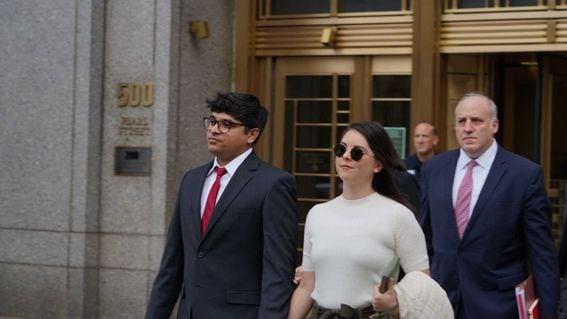
Singh will be sentenced for his role in the collapse of FTX on Oct. 30. Lawyers say that FTX engineering director Nishad Singh’s early cooperation was critical to bringing cases against the exchange's founder and former CEO Sam Bankman-Fried and former division exec Ryan Salame. Singh pled guilty to six criminal charges in February 2023. Lawyers representing former FTX Director of Engineering Nishad Singh have asked a federal judge to spare him prison in a sentencing submission document filed with the U.S. Southern District of New York on Oct. 16. The filing describes Singh as an “uncommonly selfless individual” and includes more than 100 letters from family, friends and former colleagues. “His role was far more limited than any other defendant. He does not minimize his conduct; he pled guilty to serious crimes at the outset of this case and will regret his actions for the rest of his life. But his sentence should recognize that Nishad did not join the conspiracy at the heart of this case – the theft of FTX customer funds – until September 2022, just two months before the collapse of FTX,” his lawyers wrote. The document also noted that following FTX’s announcement that it would declare bankruptcy, Singh flew to New York and cooperated with authorities. “The evidence Nishad provided in those early meetings was critical to helping the government bring both Sam Bankman-Fried and Ryan Salame to justice,” the document states. Singh pled guilty to six criminal charges, including fraud and conspiracy for his role in the collapse of FTX in February 2023. He testified against his former boss, Sam Bankman-Fried, during his trial in October 2023. Bankman-Fried was sentenced to 25 years in prison in March this year after being found guilty on seven different fraud and conspiracy charges. His former girlfriend and CEO of Alameda Research, Caroline Ellison, received two years last month after pleading guilty to the same charges as Bankman-Fried. The CEO of FTX Digital Markets, Ryan Salame, began a 7.5 year prison sentence earlier this month after pleading guilty to charges of operating an unlicensed money transmitter and conspiring to defraud the Federal Election Commission. Singh is due to be sentenced on Oct. 30. Former chief technology officer Gary Wang will be sentenced on Nov. 20. https://www.coindesk.com/policy/2024/10/17/nishad-singhs-lawyers-ask-judge-to-spare-him-prison-say-he-is-an-uncommonly-selfless-individual/
2024-10-16 20:34
Attackers appear to have obtained three out of 11 private keys needed to upgrade the protocol. Blockchain lending protocol Radiant Capital lost more than $50 million on Wednesday as the result of an apparent cyberattack, according to security experts and blockchain data. An attacker gained control of Radiant Capital's blockchain contracts by obtaining three of the "private keys" that control the protocol, security experts said. "Radiant Capital contracts were exploited on BSC & ARB chains with the 'transferFrom' function," Web3 security firm De.Fi explained on X. The exploit allowed attackers to "drain users' funds, namely $USDC $WBNB $ETH and others," the firm said. Radiant is controlled by a multi-signature, or "multisig" wallet with 11 signers, De.Fi said in a separate X post. The attacker was apparently able to obtain three of these signers' "private keys," which was enough to upgrade the platform's smart contracts. The Radiant platform encompasses a suite of tools allowing users to borrow, lend, and bridge cryptocurrencies across blockchains. It's the second time this year that the protocol has been targeted in an exploit: In January, Radiant lost $4.5 million in an unrelated hack stemming from a bug in its smart contracts. It was unclear at press time how the private keys were sabotaged in Wednesday's attack. Some members of an Ethereum security group on Telegram, the messaging app, speculated that the attack could've stemmed from a compromised front-end – meaning the legitimate Radiant key-holders may have accidentally interacted with a malware-laced protocol. Radiant acknowledged the exploit in a post to its official X account, but it did not provide specific details. "We are aware of an issue with the Radiant Lending markets on Binance Chain and Arbitrum," Radiant said. "We are working with SEAL911, Hypernative, ZeroShadow & Chainalysis and will provide an update as soon as possible. Markets on Base and Mainnet are paused until further notice." Radiant, which is controlled by a decentralized autonomous community, or DAO, states on its website that its mission is to "unify the billions in fragmented liquidity across Web3 money markets under one safe, user-friendly, capital-efficient omnichain." This is a developing story. Radiant Capital did not immediately respond to a request for comment. https://www.coindesk.com/tech/2024/10/16/radiant-capital-loses-50m-to-blockchain-exploit/

2024-10-16 18:18
Republican U.S. presidential candidate Donald Trump's pledge to support the crypto industry with favorable policies hasn't translated to a robust reception for his token sale this week, with just a tiny fraction placed out of the targeted $300 million. Crypto traders and industry executives have expressed favor toward Republican U.S. presidential candidate Donald Trump's policies on Bitcoin and digital assets. That predisposition has not translated to a fondness for the decentralized-finance project he is actively promoting, World Liberty Financial, or its WLFI tokens – as he found out this week. (Spoiler alert: The tokens are not exactly flying off the shelf.) ALSO: Kamala Harris's "opportunity agenda" falls short on crypto-policy details. Bitcoin's ecosystem is creeping not leaping, argues Coinbase's research chief. Answering questions you didn't know you needed to ask about decentralized exchange Uniswap's new layer-2 chain. A new way of ranking blockchain oracle projects – with a different result. Tesla's bitcoin transfers. $76 million of blockchain project fundraisings. Top picks from the past week's Protocol Village column: Karate Combat, Hedera, Nexus, RootstockLabs, BitVMX, The Depository Trust & Clearing Corporation (DTCC), Ben Rubin, Towns. Network News Screenshot from title page of World Liberty Financial's "Gold Paper," published this week (World Liberty Financial) SMALL HANDS? A crypto project endorsed by U.S. Republican presidential nominee Donald Trump pushed forward with a plan to raise hundreds of millions of dollars by selling tokens. But demand for World Liberty Financial's WLFI tokens proved underwhelming, with an Ethereum wallet connected to the effort holding crypto proceeds of just $11 million as of press time, or roughly 3.6% of the amount allocated to the public sale – not even enough to cover a reserve for basic expenses. Loyal readers of The Protocol will recall that CoinDesk was first to report, in early September, on the secret planning for World Liberty Financial – mostly confirmed a couple weeks later. We also chronicled the dismay over the project from hardcore Bitcoiners, who typically hate the idea of selling easily minted tokens, prompting some of them to reconsider their political support for Trump. Finally, last week, official details of what the project actually is, or aims to be, began to emerge: Still to be developed and launched, it's a "best-in-class consumer application," distinguished by "simple onboarding and familiar UI/UX via one-click social login and wallet creation," according to a blog post. (UI/UX is shorthand for user interface and user experience.) Under the hood, the project plans to operate an instance of the decentralized-finance (DeFi) project Aave atop the Ethereum blockchain, with plans to eventually deploy on the layer-2 network Scroll, according to the blog. World Liberty Financial even posted a "temperature check" proposal to the Aave governance discussion forum to gather community feedback. One commenter inquired aloud whether the deal made sense for Aave, given that the Trump-affiliated project would promise 20% of revenue to Aave, "compared to 100% from the main Aave instance," and added that "it’s worth evaluating whether this might lead to internal competition between Aave’s current market and WLF’s, or if the growth from new users and increased liquidity will far exceed any potential downside." One snarky poster wrote that "the irony of a man notorious for not paying back creditors launching a decentralized lending protocol is almost too good to be true." Several notable crypto figures joined a Spaces session on X on Monday to promote the token launch, including Stani Kulechov, founder of Aave; Sandy Peng, co-founder layer-2 network Scroll; and Luke Pearson, senior research cryptographer, Polychain Capital. "My DM's have been blowing up since this project happened," Scroll's Peng volunteered. Project officials said on the Spaces that some 100,000 users had already been whitelisted to claim the tokens. Additional details came on Tuesday when the project released a "Gold Paper" with lots of fine print, including the revelation that the initial $30 million of "net protocol revenues" – including token sale proceeds – would be set aside to cover "expenses, indemnities and obligations" – and that most of the rest of the money would go to a company called "DT Marks DEFI LLC," whose owners and principals include Donald Trump. (That company also was allocated 22.5 billion $WLFI tokens, worth about $337 million at the fixed price of $0.015 each.) The public token sale opened early in U.S. business hours on Tuesday, though the website for claiming the tokens quickly crashed and was down for most of the morning; there was virtually no communication from the team about what was happening. Commenters on the social-media site X widely noted that the token was "non-transferrable," seen as a serious drawback for fast-moving crypto trading types. At about 7 p.m. ET, Trump took to X to tout the token sale, writing "Today’s the day! @WorldLibteryFi token sale is live." After apparently discovering that World Liberty Financial's X handle had been misspelled, the post was deleted, and then reposted with the properly spelled handle, @WorldLibertyFi. The extra promotion didn't appear to have much of an impact, with sales continuing at a trickle. As of Wednesday, some 761.8 million tokens have been sold, out of 20 billion offered, according to a dashboard on the crypto-tracking website Dune Analytics. Dave Rodman, founder and managing partner of Rodman Law Group, who counts digital-assets and venture capital among his practice areas, told CoinDesk in an emailed comment that World Liberty Financial appears fraught with both securities-regulation and campaign-finance risks – "a joke project designed to extract value from purchasers in a very cynical manner whose principals will likely not face any real consequences and in the worst scenario, only serve to hurt this industry’s reputation in the long run." Here was the Bankless newsletter's take: "Whether the project can overcome skepticism and regain momentum remains to be seen, but the rocky start is a reminder that high-profile backers aren’t a guarantee for success in DeFi." It's important to note here that the team behind World Liberty Financial has not responded to CoinDesk's repeated requests for comment over the past two days. ELSEWHERE: Vice President Kamala Harris touted her "opportunity agenda" during a campaign speech on Monday without elaborating on what it would mean for digital assets. Earlier in the day, the campaign unveiled the broad agenda, which included the first thing resembling a substantive policy position from her on cryptocurrencies. But anyone hoping for more details from her speech in Erie, Pennsylvania, was left disappointed. Tigran Gambaryan, the crypto exchange Binance's head of financial crime compliance, who has been detained in Nigeria since February, was denied bail by a judge in the country, a family spokesperson said Friday. He has been in the notorious Kuje prison, facing charges including money laundering. A British man who says he accidentally threw out a hard drive in 2013 containing $527 million worth of bitcoin has filed a legal claim against a local council in Wales in an attempt to retrieve the device from a dump, according to news website WalesOnline. James Howells, 39, alleges he has made requests to Newport Council – proprietors of the landfill where the hard drive ended up – but has been "largely ignored." Coinbase Head of Research David Duong published a lengthy report on Bitcoin's blooming ecosystem of layer-2 networks, designed to accommodate faster and cheaper transactions, as well as greater programmability. But the report cautioned that "many of these protocols are in their early development stages, so we think it will likely take time for their utility in the Bitcoin ecosystem to be fully realized." He wrote that "many of the network’s L2s are mainly sourcing capital from among crypto natives within the Bitcoin ecosystem, while the lion's share of bitcoin unsurprisingly still remains on the L1. Moreover, bitcoin accumulation is happening more and more via spot bitcoin ETFs and other exogenous sources." Ethereum suffers from "middle-child syndrome," Zaheer Ebtikiar of Split Capital wrote on X. "The asset is not in vogue with institutional investors, the asset lost favor in crypto private capital circles, and retail is nowhere to be seen bidding anything at this size." JUST IN: Crypto Usage Setting Records Amid Regulatory Uncertainty, A16z Says in Report Uniswap's New Layer-2 'Unichain' on OP Stack: Industry Reactions Uniswap Labs CEO Hayden Adams (Uniswap Labs) The developer behind Uniswap, the biggest decentralized exchange, announced plans for Unichain, its own layer-2 network atop Ethereum, built with technology borrowed from the Optimism ecosystem. We rounded up some of the commentary. Per Messari's Kinji Steimetz: "Unichain can't incentivize liquidity through traditional means since the token has already been released, eliminating the possibility of airdrop farming for TVL…. The most plausible path for Unichain to gain traction could be something akin to the Base launch, where people bridged over to chase early memecoin opportunities. With Unichain, UNI now has a potential path to monetization as an L2 token." Per Coinbase Research: "The network is designed to facilitate 'seamless multi-chain swapping' among Superchain L2s while supporting ERC-7683 to enable broader interoperability for non-Superchain L2s. But the documentation provided by Uniswap doesn’t detail an explicit plan for how it will migrate existing liquidity from the Ethereum base layer to the new L2, nor does it confirm whether this is even necessary for Unichain’s immediate strategy." Eric Waisanen, cofounder of Astrovault, an automated market maker, wrote in an op-ed for CoinDesk that, "Despite the platform’s continued success and prominence within DeFi, serious questions remain about the sustainability of its business model and those of similar automated market makers (AMMs)." DeFi Report founder Michael Nadeau noted that "instead of paying $368 million in settlement fees to Ethereum validators, Uniswap Labs and potentially UNI holders would capture all that value when they launch on Unichain," according to a story by Unchained. Money Center Fundraisings Predicate, a project to build a "network for simplifying transaction prerequisites," has raised $7 million led by 1kx and Tribe Capital. According to a thread on X: "As was the case for apps like Venmo and Uber, pre-transaction rules become a critical building block as Web3 apps scale into the broader global economy. Predicate brings this concept on-chain, offering a library of prerequisites enforceable in a trust-minimized way. At the core of our system is the Predicate function, which evaluates conditions and returns true or false, deciding whether an onchain action can proceed. Predicates are the foundation for rules, which are stacked to form policies. Any entity – individuals, DAOs, organizations – can create and manage policies, which use both onchain and offchain data like flow-of-funds, allowlists, and verifiable credentials." Others (Details in Protocol Village column): Ithaca ($20M), Solv ($11M), PiP World ($10M) Mento ($10M), Yala ($8M), Apex Fusion ($6M), Blockcast ($2.85M), Moonveil ($2M) Deals and grants Kadena's Alana Ackerson (Kadena) Kadena, a proof-of-work blockchain that says it can scale to power global financial systems by braiding together multiple Bitcoin-like chains, has appointed Alana Ackerson, a executive of Thiel Foundation, SoFi and Digital Currency Group, as strategic advisor, "marking a strategic push into asset management and institutional tokenization." Ackerson previously served as CEO of HQ Digital, a wealth management subsidiary of DCG that catered to crypto millionaires, and she co-founded Figure, a crypto unicorn best known for its blockchain-powered home-equity lines of credit, according to the team. She also led the Thiel Foundation as CEO. SingularityDAO Plans to Merge With Cogito Finance, SelfKey to Form AI-Focused Layer-2 Ripple Names Exchange Partners for Stablecoin RLUSD, Awaits NYDFS Approval Bitcoin Developer Blockstream, led by Early Blockchain Contributor Adam Back (of Recent HBO Documentary Fame), Raises $210M in Convertible Note Financing Round Data and Tokens Crypto Degens Baited an Experimental AI Bot Into Promoting a Token. It’s Now Up 16,000% Is Elon Musk Selling Bitcoin? Tesla Transfers All $760M of Its BTC to Unknown Wallets. How a Crypto 'REIT' Misled Investors With Family Deals and 'Unjustified' Real-Estate Markups Crypto VC Market 'Tepid' as Q3 Investments Declined 20%, Says Galaxy Digital Ex-Valkyrie Founder’s Canary Capital Group Files for First Litecoin ETF Grayscale Looks to Turn Multi-Token Fund Into ETF (The fund tracks the CoinDesk Large Cap Select Index, which measures the market cap weighted performance of five of the largest cryptocurrencies, including bitcoin (BTC), ether (ETH), solana (SOL), XRP (XRP) and avalanche (AVAX).) Scroll Airdrop Allocation Met With Dismay From Points Farmers Arkham's Token Soars 16% on Report Sam Altman-Backed Crypto Firm Plans Derivatives Exchange Has Ethereum Lost Its Way? (Opinion) Regulatory and Policy Coinbase Escalates SEC Fight Over the Agency's Inside Chatter on ETH Bitnomial Exchange Sues U.S. SEC, Alleging Regulatory Overreach Heather 'Razzlekhan' Morgan Should Spend 18 Months in Prison, Prosecutors Tell Court Who's the Biggest Blockchain Oracle? It Depends Comparison of market-share rankings for oracle projects based on total value secured (left) and total transaction value (Blockworks Research) A recent Blockworks Research report on blockchain oracle projects was brought to our attention, showing different ways of ranking them – and how starkly different the results can be. Oracles are crucial for DeFi systems because they deliver off-chain information – such as cryptocurrency prices – onto blockchains, where it can be read and processed by decentralized applications and smart contracts. One thing to note here is the huge disclaimer that the Blockworks research was funded by Pyth Data Association, an organization supporting the blockchain oracle project Pyth, which clearly benefits from the report's conclusions. The report notes that "total value secured," or TVS, has historically been the most popular way of ranking these projects. The metric is described as "how much value is secured by each oracle, which is the equivalent to the total pool of value that would be lost if an oracle malfunctioned or reported incorrect prices in a worst case scenario." "TVS, at best, measures a pool of financial assets associated with an oracle’s services, but completely eschews the application’s activity associated with an oracle," according to the author, Ryan Connor. An alternative metric is total transaction value, or TTV, which is "more strongly correlated to frequency of oracle price updates and therefore oracle revenue," according to Connor. "We think the flaws in TVS, combined with the increasing demand for speed in DeFi ecosystems, and the necessity of DeFi to compete with centralized exchanges, makes TTV the most useful, publicly available key performance indicator for assessing oracle fundamentals today," the report concludes. Protocol Village Top picks of the past week from our Protocol Village column, highlighting key blockchain tech upgrades and news. Karate Combat's Tech Hustler and Tactical Investing fight at CoinDesk Consensus in May 2024 in Austin, Texas. (Shutterstock for Consensus) Calendar Oct. 15-17: Meridian, London. Oct. 16-18: Avalanche9000, Buenos Aires. Oct. 17: Worldcoin's A New World, San Francisco. Oct. 18-19: Pacific Bitcoin Festival, Los Angeles. Oct. 21-22: Cosmoverse, Dubai. Oct. 23-24: Cardano Summit, Dubai. Oct. 25-26: Plan B Forum, Lugano. Oct. 30-31: Chainlink SmartCon, Hong Kong. Nov. 9-11: NEAR Protocol's [REDACTED], Bangkok. Nov. 10: OP_NEXT Bitcoin scaling conference, Boston. Nov. 11-14: Websummit, Lisbon. Nov 12-14: Devcon 7, Bangkok. Nov. 15-16: Adopting Bitcoin, San Salvador, El Salvador. Nov. 20-21: North American Blockchain Summit, Dallas. Dec. 5-6: Emergence, Prague Jan. 21-25: WAGMI conference, Miami. Jan. 30-31: PLAN B Forum, San Salvador, El Salvador. Feb. 19-20, 2025: ConsensusHK, Hong Kong. May 14-16: Consensus, Toronto. May 27-29: Bitcoin 2025, Las Vegas. https://www.coindesk.com/tech/2024/10/16/the-protocol-crypto-turns-up-nose-at-trump-token-sale-gold-paper/

2024-10-16 16:49
Scared away by the various crypto collapses in 2022, institutional allocators have yet to make a comeback. Crypto VCs invested $2.4 billion in the third quarter of 2024, a 20% drop compared to the third quarter. The industry is on track to barely get more funding than in 2023. High interest rates, spot crypto ETFs, and the hangover from 2022 are keeping allocators away from the industry. Crypto venture capital activity has remained quiet in 2024, in particular during the third quarter. Venture capital firms invested $2.4 billion in cryptocurrency startups this quarter across 478 deals, according to a new report from crypto investment firm Galaxy Digital. That’s a 20% drop from the second quarter of the year in terms of funding, and a 17% decrease in the number of deals. With $8 billion invested over the course of the year's first three quarters, the industry is on course to barely get more funding in 2024 than it received in 2023. Those numbers are a far cry from the deals that crypto reaped in 2021 and 2022, when the industry saw more than $30 billion across 3,000 deals each year. “Allocator interest in crypto VC and venture capital more broadly is down from prior years,” Alex Thorn, head of firmwide research at Galaxy Digital, told CoinDesk, referring to the institutional allocators that venture investors themselves raise funds from. The reasons for that lack of interest? High interest rates have made venture funds less attractive, Thorn said, and spot bitcoin (BTC) and ether (ETH) exchange-traded funds (ETFs) offer new avenues to gain exposure to crypto. Not to mention that the industry’s various collapses in 2022 are still fresh in everyone’s minds. “This leaves venture investors struggling to find large sources of capital to launch new fund vehicles, leading to a tightening of the crypto venture investing market,” Thorn said. But the ETF-driven market surge is “leading to increased competition among surviving crypto VCs for deal flow and putting entrepreneurs in the driver's seat when it comes to valuation,” Thorn added. “It's a great time to be a founder if you can source investment capital,” he said. Allocating capital The majority of capital went to early stage firms – meaning to startups that are still developing their product and business model. They received 85% of capital investment, whereas later-stage companies, which generally already have a well-known product and brand, only received 15% of capital. Whereas crypto company valuations cratered in 2023, they bounced back in the second quarter of 2024, and have held firm in the third quarter, with a median pre-money valuation of $23 million and an average deal size of $3.5 million. Some sectors of the crypto ecosystem saw more interest than others. Crypto exchanges, lending, investing and trading platforms raised 18% of VC capital, over $460 million. Layer 1 projects came in next, at roughly $440 million, then Web3/Metaverse projects, at about $360 million, then infrastructure projects at $340 million. Meanwhile, projects combining crypto and artificial intelligence (AI) took in about $270 million – five times more than in the previous quarter, Galaxy said. Unsurprisingly, the U.S. led the way in terms of investment – providing 56% of all capital – and accounted for 44% of all crypto deals. The United Kingdom was a distant second in terms of capital, 11%, and placed third in terms of deals, accounting for 6.8% of them. Singapore-based VCs provided 7% of all capital, but struck 8.7% of all deals. Fundraising for crypto venture funds proved challenging, the report said, with only $140 million raised across eight new funds. “On an annualized basis, 2024 is shaping up to be the weakest year for crypto VC fundraising since 2020, with only 39 new funds raising $1.95 billion, well below the frenzy of 2021-2022,” the report said. https://www.coindesk.com/business/2024/10/16/crypto-vc-market-tepid-as-q3-investments-declined-20-says-galaxy-digital/