2024-10-16 10:00
The 2023 crash of Tangible's USDR stablecoin is infamous in crypto circles. But a CoinDesk investigation reveals there's another story to be told. Real estate-backed crypto project Tangible had an undisclosed business relationship with the CEO's brother, a CoinDesk investigation found. The brother's company would buy properties at a discount and then flip them to Tangible with markups as high as 21%. Such upselling has no justification, according to U.K. real estate professors who reviewed CoinDesk's findings. An investor known as ZilAYO started spotting "red flags" in crypto real estate project Tangible a week before calamity struck in October 2023. Before that, ZilAYO had no complaints. He had invested $50,000 in Tangible's flagship token, USDR, a stablecoin designed to trade one-to-one with U.S. dollars. In addition to stability, USDR promised yield, and up to then it had delivered both. By ZilAYO's estimate, "degenerate stablecoin farmers" like himself could milk returns of "20-80%" from USDR in part because of its backing: rent-generating real estate. Tangible had spent investors' money buying over 200 residential properties to backstop USDR. Tenants' rents produced some of the yield. The project was growing fast; in early October 2023 Tangible pitched itself to a venture capital firm at a valuation of nearly $100 million. Things were going so well that ZilAYO merely chuckled when he discovered something off-kilter: Tangible CEO Jagpal Singh's brother, Joshvun Singh, ran BMS Luna Stacks, a company dealing in fine wine, gold bars and real estate – assets Tangible turned into tokens. "I blindly trusted" Tangible would keep USDR stable, said ZilAYO. Nevertheless, he sold days later, having learned from the Terra-Luna disaster that good things in stablecoins often don't last long. He got out just in time. On Oct. 11, 2023, the equivalent of a bank run drained USDR's liquid reserves, leaving only the illiquid real estate. Investors panicked; they couldn't get their money out. USDR crashed from $1 to 50 cents. That plunge is well-known. But there's more to the story. A CoinDesk investigation uncovered the Singh brothers' lucrative, secret arrangement: Joshvun's company bought properties and quickly flipped them to Jagpal's companies – and thus to USDR investors – at markups sometimes greater than 20%. CoinDesk reviewed hundreds of pages of documents, U.K. lending records, and corporate and land registries to uncover the hidden business arrangement. U.K. land records suggest the upselling diverted at least £875,590 from USDR's treasury to the brothers' companies, but the true gap could be millions of pounds. Investors paid the price; any overpayment came out of money they had stashed in USDR's treasury. A Tangible representative said the markups were "previously disclosed" and covered "operational expenses." The representative declined to say where this information was released, when or by whom. In a statement, Tangible said it has been "working diligently" on making USDR investors whole. The company declined to answer a detailed list of questions, saying it's "focused on the redemption process." Joshvun Singh did not respond to a request for comment by press time. Get real Proponents of "real world asset" (RWA) projects – which represent conventional investments as tokens on a blockchain — think crypto can pump liquidity into finance's quieter corners. Tokens are easier to buy and sell than deeds to a house. Represent that deed with a token and – BADA BING – anyone in the world can trade it instantly. The same month USDR collapsed, one firm estimated RWAs could turn into a $10 trillion business by 2030. But Wall Street firms move slowly, following every applicable financial regulation. Crypto companies, by contrast, are freewheeling. Building on public blockchains, they set their own best practices. Tangible was largely a British operation. But it tokenized real estate offshore, sidestepping U.K. regulations for REITs, or real estate investment trusts. An employee once called USDR a "money REIT" on Discord. Investors told CoinDesk they liked USDR because they thought crypto was superior to stock market fare. Blockchains "can give you a better idea of what you are actually buying into," said a USDR investor who goes by 1ceo. However, REITs in the U.K. are also transparent. They provide detailed financial statements to investors. Meanwhile, Tangible withheld key legal details from investors who repeatedly asked for proof of ownership. Chief Marketing Officer Mike Slatkin once called the company's legal opinion a "competitive advantage" that had been expensive to obtain. Family affair On April 19, 2023, a Tangible special purpose vehicle (SPV) directed by Jagpal Singh bought a two-bedroom home in Halifax, England. Tangible redacted the seller's name in records it provided to USDR investors, which showed the SPV paid £167,782. To investors, the property looked like a good deal. Its purchase price was below a recent valuation commissioned by Tangible, which estimated the home could sell for £170,000 "in an arm's-length transaction." It was a short arm. The black boxes hid the full story: Joshvun Singh's company BMS Luna Stacks had bought the house for £138,500 on April 19. The company immediately flipped the property to Jagpal's SPV for £167,782, a 21% markup on the same day. "Such a price increase on the same day, or even in any short period of time, doesn't seem to be justified on any ground," said Tommaso Gabrieli, an associate professor of real estate at University College London. Real estate investment companies typically avoid buying marked-up houses from "related parties" like a company controlled by the CEO's brother, said Nick Mansley, executive director of the University of Cambridge's Real Estate Research Centre. After reviewing Tangible's undisclosed markups, Mansley concluded, "It would be hard to argue that investor interests have been put first – which they should be." 'Unjustified markup' Tangible obfuscated its markups behind redacted sales records, cherry-picked valuations and fees. To peel back this onion, consider Westcott House, a 24-flat building in Hull, England. In late June 2023, Tangible sold NFTs representing beneficial ownership of the 24 flats to USDR's treasury for $2.32 million in crypto, according to blockchain data. Partially redacted records explain the figure: On June 20, two dozen SPVs paid £1.56 million for the building's 24 flats. Tangible priced this in dollars at $2.06 million. It added $292,042 for various, clearly disclosed fees. It billed the final tab to USDR's treasury. A valuation report published by Tangible said the 24 flats were worth £1.53 million as of June 20. To investors, the SPVs only appeared to have paid a 2.45% premium – seemingly reasonable. But Tangible hid other things. First, the valuer's full report. Investors could only see his "special assumption valuation" on the freehold (the U.K. term for a building and its land) if Westcott House's 24 leaseholds (long-term leases) were sold piecemeal – a process that could take months. Second, the identity of the seller: BTS TNFT LTD, a company directed by Jagpal, is redacted from Tangible' records. BTS TNFT owned the Westcott House freehold even after flipping its 24 leaseholds to Tangible SPVs. (Jagpal essentially sold those leaseholds to himself; the U.K.'s business registry shows he's the sole shareholder of BTS TNFT, itself the sole shareholder of the Tangible SPVs.) Third, while it's not clear when BTS bought Westcott House's freehold, all indications are that it paid £1.425 million shortly before flipping the leaseholds to Tangible SPVs for £1.56 million. As of November, BTS valued the freehold at £1.425 million, according to the U.K. registry, which Gabrieli said reflected the price it had paid. The 10% premium "seems another unjustified markup over a short period of time," said Gabrieli. "Moreover a freehold should have a higher valuation than a leasehold." A building and its land should be worth more than the sum of its flats. Final tab CoinDesk's analysis of records from the U.K.'s land registry shows markups from Jagpal's and Joshvun's companies added at least £875,590 to the price of Tangible's properties. While the registry has incomplete information, granular data released by Tangible in 2024 – after it had stopped buying properties and long after USDR collapsed in October 2023 – indicates markups may have cost £2.5 million. That figure is the sum of the spreads between each property's "agreed price" (paid by BTS and BMS) and its "price" (paid by Tangible SPVs). CoinDesk gathered these data from 207 NFTs that represent U.K. properties owned by USDR's treasury. "Tangible employs a robust underwriting process to ensure that property valuations and final deals are conducted with the highest standards of accuracy and integrity," the company now says on a disclosure page that did not exist before mid-2024. Despite its redactions, Tangible has long stated elsewhere that it sourced properties from BTS TNFT. That disclosure makes no mention of a markup or of Joshvun's company. 'I just ape' One year after USDR's collapse, investors are still waiting for their money back. Tangible, now known as re.al, must first liquidate nearly 200 U.K. properties worth nearly £27 million. The 24 flats of Westcott House underscore how difficult recouping costs may be. Jagpal Singh's company sold the leaseholds for above-market prices the same day of the valuation – a feat, considering that report predicted sales could take up to two years. How fast, and for how much, can Tangible liquidate its properties when it's not selling, in essence, to itself? CoinDesk spoke to seven longtime investors in USDR. All but one said they would not have touched the token had they known Tangible was buying marked-up properties from related entities. After-the-fact disclosures don't cut it, said a DeFi builder who invested $8,000 into USDR in early 2023 and who asked to remain anonymous to maintain professional relationships. Before investing, he performed due diligence on USDR's real estate backing and even asked for proof Tangible owned what it claimed. "My assumption as a citizen of Web3" was that Tangible would act as transparently as the blockchain USDR is built on, said the investor. "If there are fees, you're gonna take your fees and be transparent about it." Others weren't as prudent. An investor who goes by Donk3ynuts said he didn't review any documents before tossing "thousands of dollars" into USDR. "I don't read that sh*t. I just ape," Donk3ynuts said. 'No clue' Pingu1 has been a paid moderator of Tangible's Discord since March and an investor in USDR even longer. In an interview, Pingu1 said he still keeps the faith. Tangible employees had "ample time to just disappear in the wild like many other teams did," he said. Still, Pingu1 said he has "no clue how the company operates." He wants clarity on these allegations just like any other investor with tens of thousands of dollars on the line. "I have no idea how [a] REIT operates, so all I can do is 'trust' the team, read the docs and white papers, verify the contracts and hope for the best," Pingu1 said. Donk3ynuts isn't ready to embrace financial regulations, even after getting burned by Tangible. "You will have good actors, but also bad actors," Donk3ynuts said, adding, "RWA tokenization is new, so this is part of the growing of the industry." https://www.coindesk.com/business/2024/10/16/how-a-crypto-reit-misled-investors-with-family-deals-and-unjustified-real-estate-markups/
2024-10-16 09:57
A total of 27 people between the ages of 21 and 34 were taken into custody suspected of conspiracy to defraud following a raid on a Hong Kong office. Among those arrested were local graduates and individuals with links to triad groups. Police said it was rare to find such operations in Hong Kong. Hong Kong police have shut down a group running a HK$360 million ($46.35 million) cryptocurrency investment scam out of an office in the Hung Hom area of the city. A total of 27 people between the ages of 21 and 34 were taken into custody suspected of conspiracy to defraud and possession of weapons last week, according to a police conference on October 14. Several were graduates in digital media from local universities, while others are believed to have links to local triad groups. In 2023, reported losses from crypto investment frauds hit $3.96 billion globally, up 53% from $2.57 billion in 2022, according to the Internet Crime Complaint Center. The actual figure is likely to be much higher. In Hong Kong alone, scam and fraud cases accounted for 43.9% of all crime reported in the city in the first half of this year. While such scam centers have been documented in other regions of Southeast Asia, India, Dubai and, more recently, Sri Lanka, the find was rare for Hong Kong. "It is rare to find a cross-border fraud center that is quite large, well-organized, has a careful division of labor, and operates physically in Hong Kong," said Yiu Wing-kin, superintendent of the New Territories South Crime Headquarters. But while not common, it’s not the only case of scam operations making inroads in the city. At the end of August, police arrested six Malaysians and five local residents involved in a HK$61 million ($7.8 million) phone scam racket. The group had four centers of operation in Hong Kong. Among the items seized in this latest operation were training manuals detailing how scams were conducted. Resembling a typical pig butchering scam, the group contacted victims on social media and tried to strike up a romantic relationship with them. They then persuaded the victims to invest in a fake cryptocurrency platform. Police said that the group collaborated with overseas scam operations and computer experts to design the fake cryptocurrency investment platforms. https://www.coindesk.com/policy/2024/10/16/hong-kong-police-bust-group-running-46m-crypto-investment-scam-using-deepfakes/

2024-10-16 06:34
Traders seek upside exposure in BTC even as FX option indicate a bias a bullish bias for the dollar index. Options show a bullish near-term bias for BTC and USD. Rising odds of a potential Trump victory have galvanized demand for BTC upside exposure. Historically, bitcoin (BTC) has largely maintained a negative correlation with the dollar index (DXY). However, this dynamic may break down around the U.S. election time if the prevailing options pricing is any guide. At press time, one-month 25-delta BTC risk reversals, the skew in the premium paid for calls relative to puts was 1.20, indicating a bullish bias for the next four weeks, according to options trading listed at the Chicago Mercantile Exchange, widely considered a proxy for institutional activity. The U.S. Presidential Election is due on Nov. 5 and results will be declared on Nov. 8. A call buyer is implicitly bullish on the market, while a put buyer is bearish and looking to hedge downside risks. Risk reversals for dominant crypto options exchange Deribit's election contracts expiring on Nov. 8 and options with subsequent expiries also showed positive values, indicating a bias for calls, per data tracked by Amberdata. Meanwhile, 30-day risk reversals for the euro-dollar (EUR/USD), the world's most liquid pair, was -0.39 on the CME, indicating concerns of continued dollar strength in the coming four weeks. The GBP/USD risk reversals suggested the same. In other words, options signal a continued rally in the dollar index, one of BTC's top nemesis. The euro is the largest component of the dollar index, making up 57.6% of the basket. It's worth noting that bitcoin has already begun ignoring the dollar index. The leading cryptocurrency by market value rose to nearly $68,000 Monday, reaching the highest since July 29 even as the dollar index held steady above 103.00, consolidating on its 3% rise since late September, data from TradingView show. Worth being long? Options traders' upbeat take on BTC comes as supposedly pro-crypto Republican candidate Donald Trump's victory odds grow in traditional markets. "The upside convexity on a Trump win is worth being long, and we are seeing market participants building positions in the lead-up. In the absence of an escalating crisis, we see BTCUSD at 70,000 in the coming weeks, continuing off current downside support, with equities breaking further highs," crypto liquidity provider Zerocap's Chief Investment Officer Jonathan de Wet said in an email. Lately, traders have been snapping up call options at a $80,000 strike price. The overall desire for upside exposure is also evident from the fact that the $100,000 call is the most popular option right now, boasting a notional open interest of over $1 billion. "The U.S. election has emerged as a relatively dominant narrative for crypto over the past six months. Donald Trump’s embrace of the space has been broad, including concrete policy proposals. On the other hand, the nature of crypto policy under a Kamala Harris administration has been unclear," FRNT Financial said in a newsletter on Tuesday. https://www.coindesk.com/markets/2024/10/16/bitcoins-inverse-ties-with-dollar-index-challenged-as-us-election-looms/

2024-10-16 05:51
Senior official Sean McHugh disputed any perception of VARA being a friendlier-than-usual crypto regulator. Dubai's crypto regulator has struck the "right balance, not too hot, not too cold," in terms of time taken to provide licenses, a senior VARA official told CoinDesk. In the past year, VARA has awarded full regulatory approvals to major global crypto exchanges such as OKX, Crypto.com and Binance. Dubai — Dubai’s Virtual Assets Regulatory Authority believes it has struck the correct balance in terms of time taken to award licenses to crypto-related applicants, its senior official Sean McHugh told CoinDesk in an interview on Tuesday, disputing any perception of being a friendlier-than-usual crypto regulator. Dubai, as the most populated of the seven emirates in the UAE, is among those smaller Asian jurisdictions fighting for the title of “the global crypto hub,” along with Singapore and Hong Kong. VARA’s role in that branding has been critical, along with other regulators in the country, including the Abu Dhabi Global Market (ADGM). “It’s like the story of Goldilocks and the Three Bears,” said McHugh, the Senior Director of Market Assurance at VARA. “Applicants to any process often think it’s moving slower than it should. Others on the outside might think we are moving too fast. They aren’t necessarily our target audience. We believe we have struck the right balance, not too hot, not too cold.” The fairy tale’s message is often termed the Goldilocks principle and represents the idea of “just the right amount.” In the past year, VARA has awarded full regulatory approvals to major global crypto exchanges such as OKX, Crypto.com and Binance. VARA does not state an average timeframe within which crypto-related entities may get the required license. However, representatives from at least two major exchanges told CoinDesk that these licenses involved months of back and forth for regulatory fine-tuning. Earlier this month, VARA updated the rules around marketing of virtual assets and then fined seven "entities" for operating without the required licenses. “Our focus is on responsible licensing, supervision, compliance around anti-money laundering and terrorism financing and customer protection,” McHugh said. McHugh, who was speaking to CoinDesk on the sidelines of the Future Blockchain Summit in Dubai, also said more major traditional financial institutions are going to show up soon at such events. “The interest in the ecosystem suggests that in two or three years time there will be more people in suits at such events, executives from the likes of BlackRock, Goldman Sachs and JP Morgan, resulting in the institutionalization of the space,” he said. McHugh has previously held roles at Goldman Sachs, Citibank, Fidelity Investments and Citadel. Read More: Dubai Regulator Wants to Lower the Cost of Compliance for Small Crypto Firms https://www.coindesk.com/policy/2024/10/16/dubais-vara-has-struck-correct-balance-in-licensing-time-frame-says-senior-official/
2024-10-15 23:29
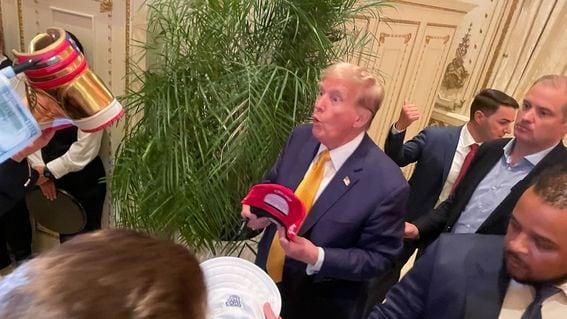
A token sale for World Liberty Financial was active earlier on Tuesday and raised about $9 million amid multiple website crashes, well below the $300 million fundraising target. U.S. Republican presidential candidate Donald Trump took to the social-media platform X to tout World Liberty Financial, a new crypto project promoted by his family, after initial sales of the platform's new WLFI tokens fell well short of the target. Trump's post came late in the U.S. day on Tuesday, several hours after the tokens were initially made available. Some $9 million of the tokens were sold as of press time, some 3% of the total tokens allocated to the public sale. "Today's the day!" Trump said in an X announcement. WLFI serves as a governance token for the platform, enabling users to participate in DeFi activities like borrowing, lending, and creating liquidity pools. The token sale website went live earlier Tuesday and suffered numerous outages. As such, trackers for the WLFI token on its website did not show an immediate spike in purchase volume after Trump's X post - with over 540 million tokens already purchased by users before his endorsement. https://www.coindesk.com/markets/2024/10/15/trump-touts-new-crypto-token-after-initial-sales-prove-dud/
2024-10-15 21:59
The fund tracks the CoinDesk Large Cap Select Index which measures the market cap-weighted performance of bitcoin, ether, solana, XRP, and avalanche. Grayscale has filed to convert the Grayscale Digital Large Cap Fund into an exchange-traded fund. The fund tracks the CoinDesk Large Cap Select Index which measures the market cap weighted performance of some of the largest cryptocurrencies. Grayscale Investments has filed to turn its multi-token fund, the Grayscale Digital Large Cap Fund (GDLC:OTCQX), into an exchange-traded fund (ETF), adding to its offerings of crypto ETFs after the conversion of its bitcoin (BTC) and ether (ETH) funds earlier this year. The fund tracks the CoinDesk Large Cap Select Index which measures the market cap weighted performance of five of the largest cryptocurrencies, including bitcoin (BTC), ether (ETH), solana (SOL), XRP (XRP), and avalanche (AVAX). Once approved and converted into an ETF, the fund which currently trades over the counter, will trade on the New York Stock Exchange, which submitted a 19b-4 filing with the Securities and Exchange Commission (SEC) on Tuesday. “Today, Grayscale filed to uplist Grayscale Digital Large Cap Fund as a diversified multi-crypto asset ETP on NYSE Arca. The fund is currently trading under ticker: GDLC, and continues to meet growing demand by providing diversified exposure to crypto through a portfolio of market-leading digital assets. This filing reflects Grayscale’s steadfast commitment to making the crypto asset class more accessible for all investors,” a spokesperson told CoinDesk. It would be Grayscale’s fifth ETF launch this year after the conversion of the Grayscale Bitcoin Trust (GBTC) and the Grayscale Ethereum Trust (ETHE) as well as two mini versions of the funds earlier this year. Both GBTC and ETHE have bled money since launching in January and April as investors have pulled over $23 billion out of the two funds, according to data from Farside Investors. The approval of the ETFs started a wave of fresh applications to launch funds tracking smaller tokens with issuers filing for funds holding Ripple's XRP, Solana's SOL and Litecoin's LTC. The Wall Street Journal reported this story first. https://www.coindesk.com/business/2024/10/15/grayscale-looks-to-turn-multi-token-fund-into-etf/