2024-10-10 09:24
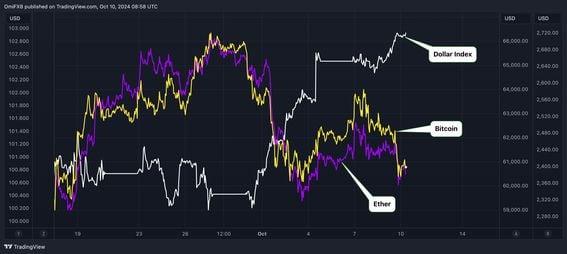
A hotter-than-expected inflation report would weaken the case for Fed interest-rate cuts. BTC, ETH recover from overnight lows, but remain in the red on a 24-hour basis. The rallying dollar might be weighing on the crypto market, according to one analyst. A hotter-than-expected U.S. inflation report would weaken the case for Fed rate cuts. The crypto market was listless during the European morning as a hawkish rethink of the odds of outsized Fed interest-rate cuts kept the U.S. dollar bid ahead of a pivotal inflation report. Bitcoin (BTC), the leading cryptocurrency by market value, traded near $61,000, slightly higher than the overnight low of $60,400 but still down more than 1.5% over 24 hours. Ether (ETH) saw similar price action, trading 1.9% lower at $2,395. Other major alternative cryptocurrencies, BNB and SOL, traded 1% lower, with XRP down 0.6%, according to CoinDesk data. The dollar index (DXY), which gauges the greenback's exchange rate against major fiat currencies, rose to 102.97, the highest since Aug. 16, taking the cumulative gain since the Sept. 30 low of 100.18 to 2.7%, according to data source TradingView. The CME's FedWatch tool showed traders assigning an 85% probability to the Fed cutting interest rates by 25 basis points at its Nov. 7 meeting instead of 65% a week ago. Back then, markets saw a 35% chance of the Fed delivering another 50 basis-point cut by year-end, having made the first in September. Friday's blowout nonfarm jobs report revived the "U.S. exceptionalism" story, forcing traders to reassess expectations for faster and bigger rate reductions. The minutes from the September Fed meeting, released Wednesday, showed policymakers were divided on how aggressive the central bank should be. "A substantial majority of participants" favored cutting by half a percentage point, though some expressed misgivings about going that large, the minutes said. "Crypto sentiment has moved back into the fear zone (39), reinforcing the contrast with 72 (greed) in equities," Alex Kuptsikevich, a senior market analyst at FxPro, said in an email. "This dynamic is easily explained by the appreciation of the dollar and the increased attractiveness of bonds, which reduces institutional traction in bitcoin." Kuptsikevich said Thursday's U.S. inflation report could breed market volatility if it deviates from expectations. The data due at 12:30 UTC is expected to show the consumer price index rose 0.1% month-on-month and 2.3% year-on-year in September, following August's 0.2% month-on-month and 2.5% year-on-year. The core CPI, which excludes food and energy prices, is forecast to print at 0.2% month-on-month and 3.2% year-on-year, according to FXStreet. Hotter-than-expected CPI prints could strengthen calls to stop rate cuts, potentially adding to DXY's upward momentum and leading to risk aversion. ING, however, said early this week that the CPI won't lead to material changes in the market positioning, given the Fed's focus has shifted to the labor market. https://www.coindesk.com/markets/2024/10/10/bitcoin-ether-nurse-losses-as-dollar-strengthens-ahead-of-us-inflation-report/
2024-10-10 06:59
Per SwissOne Capital, the BTC dominance rate and the U.S. interest are positively correlated. Per SwissOne Capital, the BTC dominance rate and the U.S. interest are positively correlated. The recent onset of the Fed rate-cutting cycle poses risk to the uptrend in the BTC dominance rate. The U.S. Federal Reserve's (Fed) rate-cutting cycle may stall the ongoing prolonged uptrend in bitcoin's (BTC) dominance rate, bringing wider gains in the crypto market, according to crypto asset manager SwissOne Capital. BTC's dominance rate, or the cryptocurrency's share in the total market capitalization, has increased from 38% to 58% in two years, according to data source TradingView. In other words, BTC has seen faster gains relative to the wider market, leading the doubling of the total digital asset market value to over $2 trillion. Per SwissOne Capital, there is now limited scope for further upside in BTC's dominance rate as the Fed has recently cut rates by 50 basis points, kicking off a so-called easing cycle. "Bitcoin Dominance is positively correlated to the Fed Funds rate," SwissOne Capital said in a market update, noting the decline in the dominance rate during the previous rate cutting cycles. The chart shows bitcoin's dominance peaked above 70% and turned lower with the start of the easing cycle in the second half of 2019. The metric fell to nearly 40% in late 2021 as central banks worldwide and governments injected trillions into the financial system to cushion against the impact of coronavirus, leading to unprecedented risk-taking in all corners of the financial market, including alternative cryptocurrencies (altcoins), or tokens other than BTC. The positive correlation between the two was also evident through the 2022-23 and 2018 rate hike cycles. "The recent start of the U.S. rate cutting cycle certainly points to little further upside if history is to repeat itself," SwissOne Capital noted. Per CME's FedWatch tool, traders expect the Fed to reduce rates by another 25 basis points by the end of the year. Lower highs The BTC dominance rate has produced lower peaks since 2015 in a sign of broader market growth. The latest two-year surge, though impressive, still leaves the metric well short of the previous peak of 73%. That's probably due to the explosive growth of stablecoin, reflected by a record market capitalization of $172 billion. "With stablecoin market caps close to 10% of total market cap we believe it explains why Bitcoin dominance could be topping between current levels and 60% (maximum) before a major reversal ensues," SwissOne Capital said. https://www.coindesk.com/markets/2024/10/10/uptrend-in-bitcoins-dominance-rate-threatened-by-fed-rate-cut-cycle-crypto-asset-manager-says/
2024-10-09 21:46
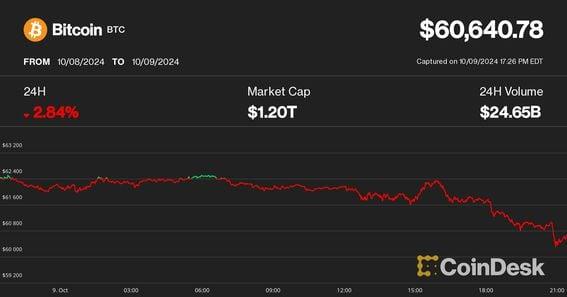
One observer noted 7,000 PlusToken-related ETH transferred to crypto exchanges on Wednesday, raising concerns about potential selling pressure. Cryptocurrencies continued to show weakness on Wednesday with bitcoin (BTC) dipping below $61,000, in stark contrast with U.S. stocks, which climbed to new records. BTC started the day around $62,000, then slipped ever lower during the later hours of the U.S. trading session to $60,400, down 2.4% over the past 24 hours. Ether (ETH) held up slightly better for most part of the day, then dived 3.2%. What likely weighed on prices was reports circulating about seized cryptos linked to the PlusToken ponzi scheme being moved to exchanges during the day, raising concerns of potential selling pressure coming to the market. Chinese authorities seized nearly $4 billion worth of crypto, including ETH, BTC dogecoin (DOGE), xrp (XRP) from the PlusToken operators in November 2020. One observer noted that some 7,000 ETH, worth $16 million, of the remaining $1.3 billion ETH was moved to exchanges in the past 24 hours, which may indicate an intention to sell the assets. Microcaps pump on market manipulation charges Strange action happened at some unexpected corners of the crypto market. Earlier today, U.S. federal prosecutors charged crypto trading firms Gotbit, ZM Quant, CLS Global and MyTrade and their employees with market manipulation and fraud. Notably, a CoinDesk report in 2019 detailed how Alexey Andryunin, the co-founder of Gotbit and one of the individuals charged by prosecutors, built a business out of faking exchange volumes for tiny crypto tokens using trading bots to get listed on price aggregators like CoinMarketCap. Robo inu (RBIF), one of the tokens mentioned in the documents, more than doubled in price for a brief minute on the news, and was still up 20% during the day, per CoinGecko data. Prosecutors created a cryptocurrency called NexFundAI Token at the direction of law enforcement for the investigation, a court document showed. A token with the ticker NEX with insignificant market value surged as much as 3,500% as speculators rushed to chase the potential token to profit off the attention. Then, its price quickly tumbled as the document also said that prosecutors had already disabled trading with the token before unsealing the charges. Less dovish Fed A check on traditional markets showed the S&P 500 closing the day at a new all-time high, with the tech-focused Nasdaq climbing 0.6%. The 10-year U.S. Treasury rates advanced to a two-month high of 4.08% during the day, as investors digested the minutes of the September meeting of the Federal Market Open Committee. The document showed that a "substantial majority" of Federal Reserve officials supported the larger cut, but some favored a 25 bps. Policymakers agreed that more cuts are likely coming but appeared split about the pace and size of future cuts. Traders now see a 21% probability that the Fed will keep rates steady at the next meeting in November, up from zero only a week ago, while expectations of another 50 bps cut vanished, down from 35% last week. https://www.coindesk.com/markets/2024/10/09/bitcoin-dips-below-61k-ether-slips-3-as-some-plustoken-china-ponzi-related-coins-moved-to-exchanges/
2024-10-09 20:58
Gensler also called out fraud in crypto: “With all respect, the leading lights of this field in 202[4] are either in jail or awaiting extradition right now.” NEW YORK — U.S. Securities and Exchange Commission (SEC) Chairman Gary Gensler said he thinks it's unlikely that bitcoin (BTC) or other cryptocurrencies will ever be widely used as a form of payment and, instead, will continue to be seen as more of a store of value. Speaking at an event at NYU School of Law in Manhattan on Wednesday, Gensler responded to a question from an attendee about what the value of cryptocurrency – which was created to be separate from any government – would be to its users if totally brought into the regulatory fold. Gensler said that the agency is "merit neutral" and the investing public will get to decide – "through disclosures" if there's a utility for any given cryptocurrency. "But I did teach this stuff up at MIT and so forth, so I'm just going say this – these debates literally go back to Plato and Aristotle," he said. "This is 3,000 years of history. Hundreds of great nations, thousands of nation-states – we tend to have one currency per geographic economic state. We tend even not to have bimetallism." Gensler cited Gresham's law – a monetary principle dating back to the 19th century that asserts that "bad money drives out the good" – and added that nations typically want just a single currency. "You want one currency unit because it's a store of value, a medium of exchange, a unit of account. It all has tremendous economics of networks," Gensler said. "So it's unlikely this stuff is going to be a currency. It's going to have to show its value through disclosure, through use. ... The same way you pick amongst the thousands of securities that are listed on the stock exchange." Fraudsters, grifters and scams During the wide-ranging conversation with NYU Law Professor Robert Jackson, Gensler defended his agency's track record of aggressive enforcement actions against crypto companies. "Without a cop on the beat, will all our laws be enforced?" Gensler asked. "It's something about human nature. In finance … we play near to the line. … We sometimes need to bring the enforcement actions to bring people back to the right side of the line." He said that the crypto industry was rife with "a lot of fraudsters, a lot of grifters, a lot of scams," adding: "With all respect, the leading lights of this field in [2024] are either in jail or awaiting extradition right now." Gensler added that he sees no need for additional regulatory framework beyond the one granted by the Supreme Court in 1940: the Howey Test. "If anybody is wondering whether [they] might meet this time-tested test of what is an investment contract … think about it this way, who is signing the engagement letter with your law firm? There's a central enterprise, somebody is signing that engagement letter. Who is tapping on the door of the broker-dealer saying, 'Can you make a market in my particular asset?' It belies logic that there's no common enterprise at most," Gensler said. Gensler declined to comment on how the upcoming presidential election could impact the SEC, or whether he would step down if former President Trump were to win re-election. https://www.coindesk.com/policy/2024/10/09/sec-chair-gary-gensler-on-crypto-its-unlikely-this-stuff-is-gonna-be-a-currency/
2024-10-09 19:39
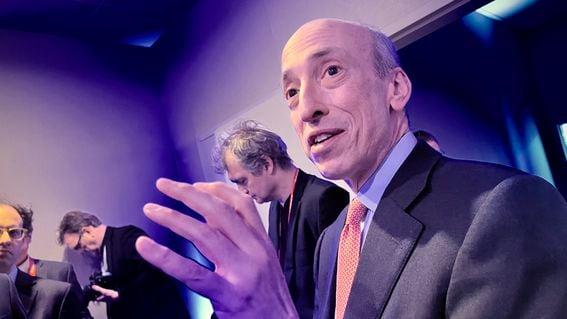
Gotbit, CLS Global, MyTrade, and ZM Quant were secretly offering market manipulation services to projects that wanted to artificially inflate their trading volume, prosecutors allege. Federal prosecutors charged four purported market makers, a handful of crypto projects, and over a dozen individuals with manipulating various crypto markets Wednesday, saying they profited from fees and selling manipulated coins at elevated values. According to charging documents unsealed Wednesday, Gotbit, CLS Global, MyTrade and ZM Quant wash traded various tokens to make it appear they had more legitimate activity than they actually did, selling some of these tokens at "artificially inflated prices" to others, marketing these coins on various platforms and convincing exchanges to let them buy tokens with reduced fees. The U.S. Securities and Exchange Commission also brought charges against ZM Quant and employees Baijun Ou and Ruiqi Lau; Gotbit and employee Feder Kedrov; and CLS Global with employee Andrey Zhorzhes, alongside a number of individuals described as "crypto asset promoters": Russell Armand, Maxwell Hernandez, Manpreet Singh Kohli, Nam Tran and Vy Pham. A representative for the Department of Justice (DOJ) said that the cases were referred to prosecution by the SEC over two years ago. Prosecutors say that the market maker defendants publicly claimed to be legitimate market makers offering legal services, but privately offered clients illegal services including wash trading. At least in Gotbit’s case, the illegal offerings weren’t really all that private: in 2019, Gotbit co-founder Alexey Andryunin, then a 20-year-old college sophomore, explained to CoinDesk exactly how the wash trading services he offered his clients worked. He was blunt about the questionable nature of his business, admitting that Gotbit was not registered in any jurisdiction because it was “not entirely ethical.” Separate criminal charges have been filed against Andryunin. ZMQuant was registered in the British Virgin Islands, but the employees named in its indictment were based in Hong Kong. Though Gotbit was not registered anywhere, it's employees are believed to be Russian. The list of manipulated tokens included Robo Inu, which pumped after the indictment was unsealed. Other named defendants include VZZN and Saitama. According to the indictments, each token – including Robo Inu – is classified as a security. Several of the people behind the projects, including Robo Inu founder Vy Pham, have also been named as defendants. During the course of their investigation, Federal Bureau of Investigation (FBI) agents created an Ethereum-based cryptocurrency, called NextFundAI, with the help of "cooperating witnesses" and used it to "identify, disrupt, and bring these alleged fraudsters to justice," according to a Wednesday press release. The token, according to court documents, is also a security. A representative for the FBI added that there was limited trading "activity" on the coin but declined to share any additional information beyond what is currently available in public documents, including whether the FBI worked with any crypto companies on the project. Joshua Levy, the Acting U.S. Attorney for the District of Massachusetts, said trading on the token was disabled during a press call Wednesday afternoon. Levy said during the call that the DOJ already has about $25 million it's secured from "fraudulent proceeds" that will go back to investors, though he did not share a full total of how much the defendants generated. https://www.coindesk.com/policy/2024/10/09/prosecutors-charge-two-crypto-market-makers-employees-with-market-manipulation-fraud/

2024-10-09 18:14
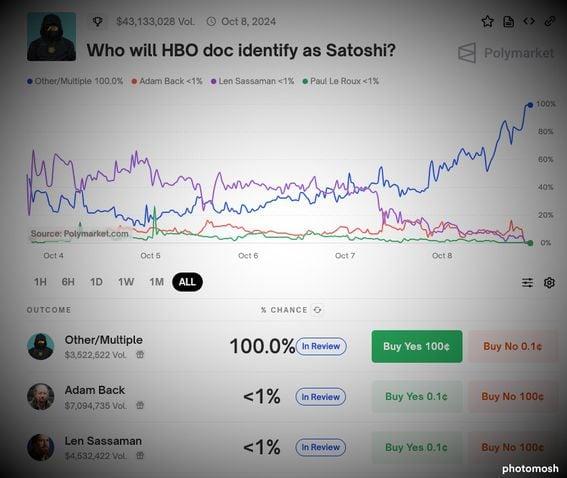
The HBO documentary turned the spotlight on an early Bitcoin contributor who recently has proposed an upgrade to fix all the bugs left in Bitcoin's original code. PLUS: Criticisms mount after EigenLayer unlocks EIGEN token, as Babylon vaults to top of Bitcoin DeFi leaderboard. We watched the HBO documentary on Satoshi Nakamoto's possible identity just like everyone else. It was one of those where-were-you-when moments. The film was entertaining enough. We've got the rundown here – and also: a fresh angle! Some might call it a plot twist! Or a cliffhanger. Possibly a sequel. Read on. ALSO: Babylon's $1.5B deposit haul in under 1.5 hours vaults project to top of Bitcoin DeFi leaderboard. Ethereum layer-2 network Scroll unseals token plans. Commentary on EigenLayer's EIGEN token unlock turns to whether the circulating supply is low relative to its fully diluted value. Data corner: Ethereum's 'ultrasound money' status in question, Binance Research says. Top picks from the past week's Protocol Village column: Axelar, Marathon, Anduro, Vertalo, Polyhedra, Hex Trust, Clearpool, Ozean, Cosmos. >$30 million of blockchain project fundraisings. Network news Screengrab from Polymarket prediction market on HBO documentary. (Polymarket) SATOSHI BLOOPERS: Bettors on Polymarket, the Polygon-based prediction market, got whipsawed amid speculation over whom a much-promoted HBO documentary would identify as Bitcoin inventor Satoshi Nakamoto. Initially the focus was on Len Sassaman, who was once conjectured to be Satoshi because of his long history of published academic works regarding cryptography, which often showed his strong ideological commitment to privacy and decentralization. (He took his own life in 2011 after a battle with depression, and the theory that he was Satoshi has since been mostly discredited.) Eventually, as purported clips from the documentary started to leak out, the Polymarket odds shifted toward Peter Todd, an early contributor to Bitcoin. Indeed, in a tense scene toward the end of the film, with scary music playing in the background, the documentarian Cullen Hoback confronts Todd with the theory that he is Satoshi. It's "ludicrous," Todd says in the undeniably awkward scene. Later, Todd told CoinDesk's Marc Hochstein in an interview with CoinDesk, "Of course I'm not Satoshi." Also, Todd posted on X that he agreed with the infamous Satoshi claimant Craig Wright's not-exactly-PG-rated assessment that the HBO documentary was not to be believed. Ironically, or perhaps fittingly, Todd now might be trying to undo some of Satoshi's wrongs. Last month, in a long blog post analyzing Bitcoin layer-2 technologies, he acknowledged the reality that Satoshi was far from perfect when writing the blockchain's original code: "There’s a number of things that Satoshi got wrong in the initial Bitcoin protocol, in particular, scripting DoS attacks, the timewarp attack, and issues with the merkle tree." Todd suggested the possibility of a "consensus cleanup soft-fork" – an elaborate way of describing what would essentially be an upgrade to patch the bugs. HOW SUSPICIOUS IS THAT??? We're kidding of course. But maybe this will provide the gist for a gripping sequel. ELSEWHERE: Babylon, a Bitcoin staking platform billed as a new way of providing the original blockchain's security to new protocols and decentralized applications, pulled in about $1.5 billion worth of bitcoin on Tuesday after briefly opening to additional deposits. The uptake could show robust demand for a growing decentralized finance (DeFi) ecosystem atop the 15-year-old Bitcoin blockchain, previously confined to alternative networks like Ethereum and Solana. Scroll, the team behind the layer-2 network, shared Tuesday that it plans to launch a SCR token to support the blockchain. In a blog post, the team said that the SCR token would be the first step in its roadmap to decentralization. “SCR will be used as a primary governance mechanism of the protocol and progress to being a protocol utility token as Scroll becomes more decentralized,” the team wrote. The International Monetary Fund (IMF) recommended that El Salvador narrow the scope of the bitcoin law and strengthen the regulatory framework and oversight of the bitcoin ecosystem. During a press conference, IMF spokesperson Julie Kozack also said that the IMF recommended El Salvador limiting public sector exposure to bitcoin, Reuters reported. This isn't the first time IMF has warned El Salvador. Most recently, in August, the IMF said something similar when it declared in a statement that “while many of the risks have not yet materialized, there is joint recognition that further efforts are needed to enhance transparency and mitigate potential fiscal and financial stability risks from the Bitcoin project.” EigenLayer's EIGEN Token Floating Low as Criticisms Mount I will reluctantly admit to watching many loops of this marketing video produced by Eigen Foundation in connection with the EIGEN token unlock. In this screenshot, what looks like a rogue sperm appears to leap out of a blueish ball that in turn appears to be falling down an infinity tunnel of concentric squares. (Eigen Foundation) The headlines on EigenLayer's unlocking last week of its previously non-transferrable EIGEN tokens managed to sneak into The Protocol just as we went to press. But the drama and controversy unfolded for several days afterward, with fresh revelations, indignant recriminations and cynical reflections that highlighted a couple of the crypto industry's less savory funding practices. First on the list is the widespread custom of allowing early investors whose token allocations are still locked up for another year to stake their tokens now – and in doing so to receive additional tokens that are not locked, i.e. they can be dumped immediately. One exasperated poster on X noted that there are "MANY token vesting protocols" out there, and projects could opt to build their own vesting contract, but instead the modus operandi is to "ask them to 'pretty please don't sell for a while ok?'" Viktor Bunin, protocol specialist for the U.S. crypto exchange Coinbase, spoke up to clarify that "Eigen Labs worked with companies like Toku, Coinbase, and BitGo to distribute tokens. These companies enforce vesting agreements offchain (rather than using onchain vesting contracts)." He added that, "This is standard practice - most protocols do this," to which one snarky X user responded, "absolutely cracked that this is considered standard practice in our industry." For what it's worth, EigenLayer updated its project documentation to disclose that investors are "not restricted from staking EIGEN," and that the "EIGEN investors receive from staking will not be subject to the lockup schedule." So at least there's that. Another knotty topic was the practice of citing project's "fully diluted value" as evidence of its worth, when often the "float" – consisting of unlocked tokens that are ostensibly free to trade – represents a very small percentage of the total potential supply; in many cases these would not actually be available for trading until some very distant point in the future. As analysts at crypto exchange Binance noted in a report in May, when the float is low, "tokens can experience rapid price appreciation due to limited liquidity available for trading at launch." Former CoinDesk reporter Tracy Wang (now at Framework Ventures) wrote in her February 2022 opus on the well-followed crypto trader GCR that his successful "Big Short" trade included the very specific strategy of betting against tokens with high fully diluted valuations relative to their float. In the case of the EigenLayer, a breathless Bankless headline noted that EIGEN had launched at a "$7B Fully Diluted Value," and we did something similar here at CoinDesk, although our Oliver Knight followed quickly afterward with a story highlighting the "supply concerns," noting that the circulating supply had a value of just $650 million. A common complaint, according to the social-media commentator @DefiIgnas, is that EIGEN is a "VC-funded, low-float, high-FDV token," though he quickly added that several other "similarly branded" tokens trade at even more ludicrous ratios. Money Center Fundraisings Layer co-founders Sam Cassatt, Jake Hartnell and Ethan Frey (Layer) Layer, a startup that aims to extend the functionality of Ethereum by making the first developer tools that support full-stack decentralized applications with Web Assembly, disclosed that it has raised a $6 million seed round led by 1kx, with participation from Fabric Ventures, Arrington Capital, Stake Capital Group, and IOBC. Notable angels include Sreeram Kannan of EigenLayer, Rok Kopp and Mike Silagadze of Ether.fi, and Paul Taylor, formerly of BlackRock. Others (details in Protocol Village): Bitlayer ($9M), Dragonz Lab ($9M), Semantic ($3M), Botanika ($1.5M), Locked.Money ($1.1M) Deals and grants Screen grab from a demo video for the Archiv3 project (Archiv3) PROTOCOL VILLAGE EXCLUSIVE: Bluwhale, an AI Web3 startup that uses smartphones as nodes, aims to raise as much as $10 million through a node sale, running now through the end of November. According to a press release shared with CoinDesk: "By participating in the node sale, Bluwhale users can generate passive income on their smartphones by keeping the app running behind the scenes as well as contribute data, and potentially storage and compute, in the near future. Anyone with more than 500 BLUAI points can stake them to operate the Master Nodes on mobile while there are three seasons of airdrops allocated for all node owners. Bluwhale will be selling a total of 100,000 network nodes. Aptos Labs, a blockchain developer, has agreed to acquire HashPalette Inc., a subsidiary of HashPort Inc. and developer of the Palette blockchain. According to the team: "As part of the agreement, HashPort will migrate the Palette Chain and HashPalette’s applications into the Aptos Network, including EXPO2025 DIGITAL WALLET for Expo 2025, Osaka, Kansai, Japan." Infinex, a next-generation platform that provides access to onchain protocols, services and apps founded by Kain Warwick, creator of Synthetix, announced the selection of Wormhole as its primary interoperability provider. Poland's second-largest bank, Bank Pekao S.A., has partnered with Aleph Zero to launch Archiv3, "a project to tokenize and preserve renowned Polish artworks," according to the team: "Using Aleph Zero's eco-friendly blockchain, digital reproductions of masterpieces by artists like Jan Matejko and Stanisław Wyspiański have been minted as NFTs and stored in the Arctic World Archive for long-term preservation." Data and Tokens Memecoin Moodeng on Ethereum Jumps 480% After Vitalik Buterin's Mention and Donation Sales Crypto Exchange Bitget Pledges to Compensate Losses After Native BGB Token Flash-Crashes 52% Binance, FalconX and the Curious Case of 1.35M Missing Solana Tokens Regulatory and Policy Crypto.com Sues SEC, Chair Gary Gensler After Receiving Wells Notice Coinbase to Delist Unauthorized Stablecoins in EU by December Hong Kong Gearing up to Approve More Cryptocurrency Exchange Licenses by Year End: SFC Ether's 'Ultrasound Money' Status in Question: Binance Research There's been a lot of discussion among blockchain developers, crypto traders and digital-asset analysts lately about the "parasitic" aspect of Ethereum's scaling roadmap – the idea that, in pushing most transactional activity off onto layer-2 networks, there's a lot less to be done on the main blockchain. That, in turn, may have reduced the case of Ethereum's ETH token as a compelling investment. (See last week's The Protocol for a glimpse of just what a laggard ETH was during September among members of the CoinDesk 20 index.) Binance Research has just published its monthly "Market Insights" report for October, with the chart above showing the bottom-line impact. Under Ethereum's monetary rules, higher transactional fees result in more ETH getting burned, but "as L2s cannibalized network activity throughout the year – further impacted by broader market conditions – transaction fees and, consequently, burned fees on Ethereum declined," according to Binance Research. As a result, ETH is no longer seeing the deflation witnessed on the blockchain earlier this year, and now it appears to be consistently inflationary, with the token's supply steadily increasing. "This increase has raised doubts about the 'Ultrasound Money' narrative," the analysts wrote. "For ETH to regain its deflationary status, increased activity on the Ethereum mainnet may be crucial. However, with the growth of L2s, users are increasingly drawn to these scaling solutions due to their improved usability and lower costs." Protocol Village Top picks of the past week from our Protocol Village column, highlighting key blockchain tech upgrades and news. Diagram of Mobius Development Stack, from the project's litepaper (Axelar) Axelar, a blockchain interoperability project, has launched Mobius Development Stack, described as "a reimagined Web3 design space," according to the team: "Axelar Mobius Development Stack (MDS), an open interoperability platform for decentralized applications, is live on mainnet. Upcoming L1 launches include Flow, Hedera, Solana, Sui, XRP Ledger. MDS is a new interoperability standard: Advanced token utility, infinite security and scalability." Sergey Gorbunov, CEO, Interop Labs, said in a statement that "MDS is the first architecture that scales to support thousands of heterogeneous blockchains." Multichain layer-2 network Anduro, incubated by mining firm Marathon Digital Holdings (MARA), has developed a platform for issuing and investing in real-world assets (RWAs) on Bitcoin. The platform Avant, developed alongside tokenization specialist Vertalo, is planning a pilot project to tokenize whiskey barrels, according to an announcement shared exclusively with CoinDesk. Polyhedra Network, a blockchain project specializing in zero-knowledge (ZK) proofs, released the first set of data from its new Proof Arena, a benchmarking platform designed to evaluate and compare different ZK provers. According to the team, "The data includes comparisons of provers from Polyhedra, Polygon, Linea and StarkWare – Expander, Plonky3, GNARK, Halo2 respectively. Results: the Expander prover is significantly faster in terms of proof generation time and peak memory; Plonky3 achieves stellar performance in terms of setup and verification time, and GNARK has the smallest proof size." Hex Trust, a fully-licensed digital asset custodian with more than $5 billion in assets under custody attained, said it has joined forces with Clearpool, a DeFi credit protocol, to launch Ozean, described as "the blockchain for RWA yield," supported by Optimism. According to the team: "The partnership combines Hex Trust’s industry-leading services, 270-plus institutional clients and regulated infrastructure with Clearpool’s RWA lending expertise to position Ozean as the blockchain to unlock the power of DeFi for RWAs, powered by the CPOOL token." Calendar Oct. 9-11: Permissionless, Salt Lake City. Oct. 9-10: Bitcoin Amsterdam. Oct. 10-12: Bitcoin++ mints ecash: Berlin. Oct. 13-16: Future Blockchain Summit, Dubai Harbour. Oct. 15-17: Meridian, London. Oct. 17: Worldcoin's A New World, San Francisco. Oct. 18-19: Pacific Bitcoin Festival, Los Angeles. Oct. 21-22: Cosmoverse, Dubai. Oct. 23-24: Cardano Summit, Dubai. Oct. 25-26: Plan B Forum, Lugano. Oct. 30-31: Chainlink SmartCon, Hong Kong. Nov. 9-11: NEAR Protocol's [REDACTED], Bangkok. Nov. 10: OP_NEXT Bitcoin scaling conference, Boston. Nov. 11-14: Websummit, Lisbon. Nov 12-14: Devcon 7, Bangkok. Nov. 15-16: Adopting Bitcoin, San Salvador, El Salvador. Nov. 20-21: North American Blockchain Summit, Dallas. Dec. 5-6: Emergence, Prague Jan. 21-25: WAGMI conference, Miami. Jan. 30-31: PLAN B Forum, San Salvador, El Salvador. Feb. 19-20, 2025: ConsensusHK, Hong Kong. May 14-16: Consensus, Toronto. May 27-29: Bitcoin 2025, Las Vegas. https://www.coindesk.com/tech/2024/10/09/the-protocol-peter-todd-wants-to-fix-satoshis-bitcoin-bugs/