2024-10-04 06:00
The U.K. financial services regulator issued the payments provider a s166 notice late last year. The inquiry is now closed. BCB Group was the subject of a now-closed investigation by the FCA, according to sources. The company's chief compliance officer recently resigned from the business and will join crypto exchange Kraken in November. BCB Group, a payments processor that links cryptocurrency firms to the banking system, was the subject of a now-closed investigation by the U.K. financial services regulator, according to two people with knowledge of the matter. The Financial Conduct Authority, or FCA, gave BCB a so-called s166 notice late last year, the people said, who spoke on condition of anonymity as the matter is private. The investigation has since been concluded in a way a source close to BCB deemed positive for the company. BCB is in constructive talks with the regulator about expanding its licence, a third person added. "BCB Group has at all times operated a compliance first approach in its business activities and continues to do so," said Oliver Tonkin, CEO of BCB, in emailed comments. "We have regular open and transparent dialogue with all our regulators across our licenced businesses and from our perspective we are in good standing with them all. Our engagement with the FCA continues to be positive and we have recently been given the green light to expand our regulatory footprint in the UK should we wish to do so," he added. The FCA declined to comment. Payments companies like BCB are important intermediaries in the digital assets ecosystem, moreso following the collapse of a number of crypto-friendly banks in the U.S. last year. They provide banking rails to some of the biggest institutions in the digital-asset sector, including exchanges such as Bitstamp, Crypto.com, Gemini and Kraken. It's not clear what sort of inquiry BCB faced. A s166 review can be triggered by the FCA for a number of reasons. There may be concerns about a company's regulatory requirements, and whether it is complying with specific rules. The regulator could be worried about potential misconduct issues. The supervisory body may also have concerns about a firm's risk management processes and its financial stability. If the FCA suspects market abuse or misconduct, it can also launch an investigation. BCB is not a unique case, as the FCA issues about 50 of these notices to companies in the U.K. every year. Natasha Powell, the former chief compliance officer at BCB, recently resigned from the business, as reported by CoinDesk. She will be joining crypto exchange Kraken as head of U.K. compliance in November. Powell will still retain links with BCB, and will continue to support the group as a non-executive director of BCB Payments Ltd., its U.K.-regulated payments business. The payments processor recently received a takeover approach from an unidentified investor, CoinDesk revealed last month. The buyout interest was initiated by the potential acquirer while BCB was exploring a Series B funding round, according to people familiar with the matter. https://www.coindesk.com/business/2024/10/04/crypto-payments-firm-bcb-group-was-the-subject-of-an-fca-investigation-sources/
2024-10-03 21:52
The IMF has been asking El Salvador for changes regarding its bitcoin law since its adoption in 2021. The IMF has been asking El Salvador for changes regarding bitcoin since 2021, when the Central American country established it as a legal tender. In its latest presentation on El Salvador, the IMF called for the country to also limit public sector exposure to bitcoin. The International Monetary Fund (IMF) recommended on Thursday that El Salvador narrow the scope of the bitcoin law and strengthen the regulatory framework and oversight of the bitcoin ecosystem. During a press conference, IMF spokesperson Julie Kozack also said that the IMF recommended El Salvador limiting public sector exposure to bitcoin, Reuters reported. This isn't the first time IMF has warned El Salvador. Most recently, in August, the IMF said something similar when it declared in a statement that “while many of the risks have not yet materialized, there is joint recognition that further efforts are needed to enhance transparency and mitigate potential fiscal and financial stability risks from the Bitcoin project.” At that time, the IMF also said that “additional discussions in this and other key areas remain necessary.” In fact, the back-and-forth history between El Salvador and the IMF over bitcoin goes back years. In November 2021, the IMF said that bitcoin should not be used as legal tender in El Salvador and urged the Central American country to strengthen the regulation and supervision of that ecosystem, something it called for again in January 2022. El Salvador established bitcoin as legal tender in September 2021, being the first country to do so globally. Currently, it holds 5892 BTC, equivalent to about $345 million at today's price. Nayib Bukele, El Salvador's president, recently said his plan to make the country a hotbed for the largest and oldest cryptocurrency has been “net positive” but adoption has fallen short of his expectations. In Thursday's presentation, the IMF positively highlighted Bukele's budget for 2025, which expects the country to be debt-free. CORRECTION (Oct. 3, 2024, 23:50 UTC): Fixes day of week in first paragraph. https://www.coindesk.com/policy/2024/10/03/imf-urges-el-salvador-again-to-strengthen-regulatory-framework-and-oversight-of-bitcoin/

2024-10-03 20:41
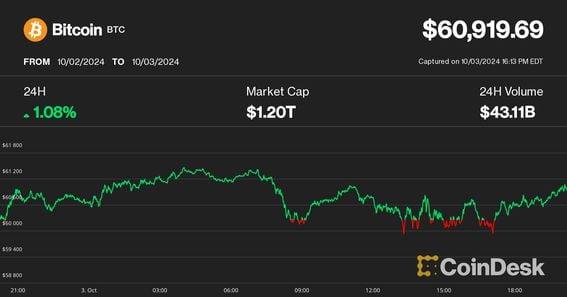
Bitcoin held above the $60,000 key support level, while Ethereum's ETH fell to near its weakest level against BTC since mid-September. Bitcoin held above $60,000 support level, while many altcoins tumbled. The U.S. dollar surged to its strongest level since mid-August amid strong economic data, geopolitical turmoil, weighing on risk assets. Spike in a key interbank borrowing rate may signal U.S. dollar liquidity stress, a Steno Research analyst noted. Bitcoin (BTC) once again was teetering above the $60,000 level on Thursday, while smaller cryptocurrencies tumbled amid geopolitical turmoil and the surging U.S. dollar. BTC rebounded to $61,500 during the Asian trading hours from Wednesday's very brief dip below $60,000, but turned lower during the European and U.S. sessions. The largest cryptocurrency changed hands around $60,700 recently, up 1% over the past 24 hours. Meanwhile, the broad-market benchmark CoinDesk 20 Index fell 1.5% during the same period, indicating the weakness in the rest of the digital asset market relative to BTC. Ethereum’s ether (ETH) was down 1%, while Ripple's XRP (XRP), Solana (SOL), Avalanche (AVAX) and Render (RNDR) led losses among altcoin majors. One notable outperformer was layer-1 blockchain Aptos' (APT) native token gaining 7% for the day. Wednesday news of Franklin Templeton expanding its tokenized money market fund to that blockchain may explain that outperformance, while some observers speculated that traders rotated some profits from close competitor network Sui's (SUI) 110% rally in a month. Bitcoin's outperformance over the broader market meant that BTC's market share of the total crypto market capitalization – also known as Bitcoin Dominance – climbed above 58%, while the ETH-to-BTC ratio dropped near its mid-September trough of 0.038. "Bitcoin dominance continues to trend higher, and it is now just 0.2% away from a new three-year high,” said James Van Straten, a senior analyst at CoinDesk. U.S. dollar surging The overall dismal week for crypto happened with increasing concerns about military escalation in the Middle East, which sent crude oil prices near $74 a barrel, the highest in more than a month, while the U.S. dollar hit its strongest level against key currencies since mid-August. Thursday's stronger-than-expected ISM non-manufacturing data also supported dollar strength, which usually weighs on prices for risk assets like cryptocurrencies. "We saw more solid services data from the U.S., which pushed the U.S. dollar index (DXY) closer to 102, giving a 70% likelihood of a 25-basis-point rate cut at the November meeting," Van Straten said. What may have exacerbated dollar strength and the general risk-off move on asset markets in early October is a spike in Secured Overnight Financing Rate (SOFR), a key borrowing interest rate between banks that could be a signal of liquidity stress, Steno Research's Samuel Shiffman noted in a report. The report added that the situation is reminiscent – albeit on a smaller scale – of the repo crisis in September 2019, when the Federal Reserve was forced to intervene to end dysfunction in key lending markets. "We are nearing levels where liquidity pain becomes acute," Shiffman said, adding that the Fed "could feel tempted to address it" by adding liquidity to the financial system. Another important catalyst for markets will be Friday's U.S. jobs report. "A combination of expected rate cuts and labor strength could boost risk assets," crypto hedge fund QCP Capital said. https://www.coindesk.com/markets/2024/10/03/bitcoin-dominance-nears-3-year-high-amid-altcoin-weakness-aptos-outperforms-as-sui-drops/
2024-10-03 20:19
Punk 1563 changed hands for 24,000 ETH, a huge markup versus recent pricing. A hallmark of the last cryptocurrency bull market was the remarkably high sale prices for various non-fungible tokens (NFTs). The world has largely moved on from NFTs, with enthusiasm for crypto products embellished with quirky images now directed toward memecoins – so, so many memecoins. Yet, on Thursday, a sign of bull markets past returned: A CryptoPunk NFT just sold for a record price of $56.3 million. The prior all-time high of $23.7 million was set in February 2022, months before the crypto winter got truly dark. Punk 1563, depicting a pixelated woman with dark hair and blue eyes, fetched 24,000 ether (ETH) in the transaction. As recently as September, it was offered for sale for less than 30 ETH – meaning the latest deal represented a huge markup versus recent pricing. NFTs have historically seen all manner of weirdness around sales. There was the time in 2021 when another CryptoPunk technically sold for $532 million, though blockchain data clearly show the same person was on both sides of the trade. And there have been allegations that NFTs were used for money laundering. It's not clear what the motivations were for Punk 1563, though. https://www.coindesk.com/markets/2024/10/03/nft-mania-is-back-maybe-not-but-a-cryptopunk-just-sold-for-a-record-563m/

2024-10-03 17:09
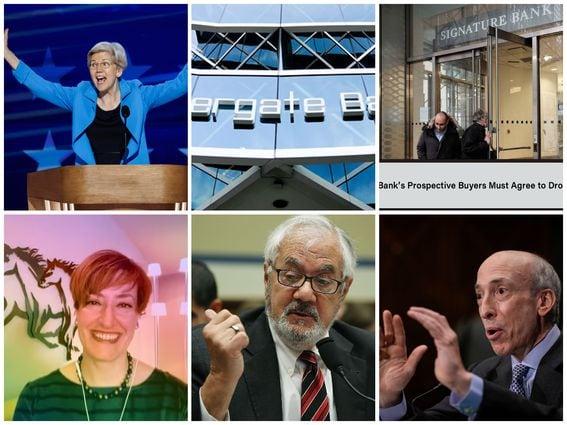
It’s become increasingly clear that crypto-focused banks such as Signature and Silvergate were closed by political mandate during the 2023 banking crisis, says Nic Carter. And the way it was done should bother anyone who cares about open access to financial services. Last week, I published a new article revisiting the last days of the doomed pro-crypto bank Silvergate, alleging that it had been effectively killed off by federal regulators within the Biden administration. You may be wondering why I am relitigating events that took place in the spring of 2023. The truth is, I believe that those fateful events are widely misunderstood, and that hindsight has brought us more information to better understand what really took place. The conventional narrative is that Silvergate, Signature, and others were the architects of their own demise. They accepted crypto firms as clients and paid the price when the crypto space experienced tremors in 2022 and 2023; and mismanaged the maturity of their asset portfolio throughout a period of rising rates. But I hold a different view. In my opinion, we have evidence enough to suggest that the two most important pro-crypto banks, Silvergate and Signature, were opportunistically executed amid the fog of war during the 2023 banking crisis, as part of a broader coordinated attempt to de-bank the crypto industry. The Biden administration went far further than simply discouraging banks from serving crypto; they actually shuttered the two most critical banks that were serving the sector. This brazen scheme has never been talked about in DC. Establishment post mortems of the banking crisis focus on interest rates, maturity mismatches in asset portfolios and depository flight. We have enough evidence now to make sense of what really happened. One sign that something was amiss was Signature board member Barney Frank alleging that the bank was shut down “because of our prominent identification with crypto.” A banker familiar with the process told me: “Signature wasn’t even given a chance to raise capital and save themselves. It was definitely an execution.” For their part, the New York Department of Financial Services, the state’s main regulator, denies this. There were also significant irregularities in the process of selling Signature. FDIC refused to allow Flagstar, Signature’s acquirer, to take ownership of $4 billion of deposits from crypto firms. The funds were forcibly sent back to depositors. The sale of Signature’s SigNet network, which allowed bank crypto clients to transact between each other 24/7, was also stymied. One banker involved in the process told me that Tassat (the developer of SigNet tech) was interested in buying back the asset. Apollo Global Management had also lined up a consortium to place a bid. The person familiar with the situation told me: “The FDIC didn’t put it in writing, but they called during the bidding process and told us verbally ‘Don’t bid on the crypto products.’” The auction for SigNet finally went live on Friday, June 9 2023 – the week that the SEC sued Binance and Coinbase. There were no bids and the SigNet asset was furloughed completely. As a reminder, the FDIC’s stated mandate is to maximize taxpayer value by arranging the sale of all bank assets, not just the ones that are politically benign. A subsequent memo from the Congressional Research Service noted that “This reluctance [of banks to serve crypto] was evinced by the FDIC’s announcement that it will return Signature’s deposits to crypto firms…,” acknowledging that the FDIC’s excising of Signature’s crypto business was a telling. The WSJ Editorial Board, for its part, felt that this was a smoking gun, writing “This [refusal by the FDIC to sell the crypto business] confirms Mr. Frank’s suspicions — and ours — that Signature’s seizure was motivated by regulators’ hostility toward crypto.” And then there’s Silvergate. Silvergate was never sold, but rather voluntarily liquidated by management. None of its executives have since dared speak up. In early 2023, the SF Fed communicated to them, with the seeming tacit approval of other regulators, that they would have to reduce their crypto deposits to a de minimis share of their overall business. This was fatal to its practice – as over 90% of their deposits related to the crypto space as of Q2 2022. Following the bank run in Dec. 2022-Jan. 2023, Silvergate was still solvent. After all was said and done, they were able to make all depositors whole, even though they were cut off from last-resort liquidity at the FHLB thanks to a pressure campaign from Sen. Elizabeth Warren (D-MA). Perversely, Silvergate leadership have not been able to speak up regarding the sudden change in regulatory policy, as they have been busy settling cases with their regulatory overseers, alongside class actions. Revelations regarding the informal cap on deposits that made their business impossible are considered “confidential supervisory information” and hence ineligible to be publicly shared. However, in recent bankruptcy filings, Silvergate Chief Accounting Officer Elaine Hetrick for the first time laid out Silvergate’s version of the story. She directly accuses regulators of forcing a shutdown of the bank, writing: “This public signaling and sudden regulatory shift made clear that, at least as of the first quarter of 2023, the Federal Bank Regulatory Agencies would not tolerate banks with significant concentrations of digital asset customers, ultimately preventing Silvergate Bank from continuing its digital asset focused business model.” Both Silvergate and Signature faced rumors during the panic of 2023 that they were under criminal investigation relating to their dealings with the crypto space. Silvergate was infamously a service provider to FTX. These allegations formed a large part of the case against the banks made by high profile short sellers – as well as Warren. No criminal allegations ever materialized. Silvergate settled with regulators for surveillance outages on SEN, the bank’s exchange network. It settled with the SEC with respect to perceived inaccuracies in statements made by management regarding their compliance program. Thus, the passage of time has brought things into focus. The allegations of criminality swirling around the banks ended up being vacuous. New filings from Silvergate lend credence to the idea that they were liquidated by political mandate. And, since the crisis, bank regulators have continued to harass banks known to serve crypto, like Customers and Cross River, who have both been hit with enforcement actions or consent orders. Newer banks are being prohibited from filling the gap, too. Custodia continues to wage a protracted legal campaign to obtain a master account at the Fed, a necessary precondition to becoming a full-fledged bank. Meanwhile, Protego Trust Company, which had received a preliminary federal charter from the OCC, saw its charter revoked. Not only were existing pro-crypto banks killed off, and new aspirants discouraged from doing business with the sector, but newer entrants were simply prohibited from opening their doors. Within the conventional banking sector, bad rules like the SEC’s SAB121 (whose congressional overturn was vetoed by Biden) effectively prohibit banks from touching crypto. The Fed has also issued dire warnings about banks wanting to do business with stablecoins. The crackdown on crypto via financial regulation has been incredibly comprehensive and involved every important U.S. financial regulator. U.S.-based crypto entrepreneurs and operators know first-hand that obtaining banking is uniquely challenging – harder than it should be. Even though we in the crypto space are the primary victims of this round of financial repression, this issue goes far beyond crypto. Ultimately, it’s about the government unconstitutionally choosing to marginalize a specific (legal) industry, not by passing a law or with notice-and-comment rulemaking, but via covert, informal threats made to bankers. As the law firm Cooper & Kirk has argued, this kind of financial redlining is a violation of the due process clause in the Fifth Amendment, because affected firms are not given the opportunity to challenge these rules. Secret, informal rulemaking also may violate the administrative procedures act. Ultimately, this issue comes down to the fundamental question: should banking infrastructure – effectively an arm of the state – be weaponized for political ends, or should it remain neutral, free for any legal business to rely on? Sadly, the contemporary left appears comfortable using bank regulation against political disfavored industries, both under Obama and again under Biden. While Trump was more reticent to employ the same tactics, it's not inconceivable that the shoe could be on the other foot soon. There is a partisan tinge to the fact-pattern but there doesn’t have to be one. As a highly regulated industry with barriers to entry, banking should not be deputized for arbitrary political ends. Crypto is the latest victim of this misbehavior, but this issue should deeply concern anyone. Note: The views expressed in this column are those of the author and do not necessarily reflect those of CoinDesk, Inc. or its owners and affiliates. https://www.coindesk.com/opinion/2024/10/03/why-you-should-still-care-about-silvergate/
2024-10-03 16:21
Risks stemming from the Middle East conflict are likely to push bitcoin below $60K before the weekend, the report said. Bitcoin is likely to weaken below $60K, but investors should buy the dip, the report said. Standard Chartered said that the digital asset is not a safe haven against geopolitical risk. The bank wrote that bitcoin is a hedge against traditional financial issues. Geopolitical risk related to the ongoing conflict in the Middle East will likely weigh on the bitcoin (BTC) price and push it below the $60,000 level before the weekend, still, the dip should be bought, investment bank Standard Chartered (STAN) said in emailed comments Thursday. The world's largest cryptocurrency is not a safe haven against geopolitical risks, the report said. "Gold is a geopolitical hedge," wrote Geoff Kendrick, global head of digital assets research at Standard Chartered, adding that "BTC is a hedge against TradFi issues such as bank collapses or de-dollarisation/U.S. Treasury issues." The bank noted that geopolitical concerns depressed the bitcoin price while at the same time increasing Donald Trump's odds of winning the U.S. election in November, "which improves BTC's post-election probabilities." Options market activity also supports this view, with open interest for the bitcoin December expiry at 80,000 jumping in recent days, the report noted. Bitget Research echoed this positive sentiment. "Despite the general downturn, institutional investors continue to buy digital currency at a rate at par or higher than the quantity mined daily," said Ryan Lee, chief analyst of Bitget Research, in emailed comments. Bitcoin was trading around $60,500 at publication time, falling about 0.4% on the day, while broader crypto market index CoinDesk 20 (CD20) fell 5.5%. https://www.coindesk.com/business/2024/10/03/bitcoin-not-a-safe-haven-from-geopolitical-risks-but-still-buy-the-dip-standard-chartered/