2025-09-15 12:45
MILAN, Sept 15 (Reuters) - Italiana Petroli's founding family is nearing the sale of the oil refiner to State Oil Company of Azerbaijan (SOCAR) in a deal that would hand the group control of one of Italy's largest petrol station networks, three sources said. A deal with SOCAR is expected to be signed as early as Monday, two of the people said, barring any last-minute postponement. Sign up here. The sources did not disclose the financial terms of the agreement. People close to the matter had previously told Reuters Italy's Brachetti-Peretti family was seeking an enterprise value of around 2.5 billion euros ($2.9 billion) for their company, which holds some 500 million euros in cash. SOCAR and Italiana Petroli did not respond to requests for comment. SOCAR is being advised by Italy's Intesa Sanpaolo IMI CIB with UniCredit advising the owner of IP. IP has a total refining capacity of around 200,000 barrels per day and operates a network of more than 4,500 fuel stations. It also owns important storage and transport assets in Italy, including for jet fuel. Last year it posted an adjusted core profit of nearly 500 million euros. The expected deal would follow the sale by Italy's Moratti family of its controlling stake in oil refiner Saras to global commodity trading house Vitol last year. These transactions underscore a broader trend of private investors retreating from Europe's refining sector, which has become increasingly volatile. The acquisition would boost SOCAR's presence in the Mediterranean fuel market. The company already owns the 200,000 bpd STAR refinery in Turkey. IP currently owns a refinery in Ancona in eastern Italy, as well as the SARPOM refinery in Trecate in the north. It also has a tolling contract for the Alma refinery in Ravenna. IP increased its refining and fuel storage capacity in 2023 when it finalised the acquisition of Exxon Mobil's (XOM.N) , opens new tab Italian assets. ($1 = 0.8524 euros) https://www.reuters.com/business/energy/socar-close-buying-oil-refiner-italiana-petroli-sources-say-2025-09-15/
2025-09-15 12:32
Sept 12 (Reuters) - Transit technology maker Via Transportation (VIA.N) , opens new tab was valued at $3.5 billion on Friday after its shares fell 4.4% at open in their New York Stock Exchange debut. The stock opened below its $46 offer price before rebounding to close up 7.6% at $49.51. Sign up here. Via and selling shareholders raised $493 million by selling 10.7 million shares, priced above the marketed range of $40 to $44. The U.S. IPO market has revived as easing trade tensions and rising expectations of interest-rate cuts lift investor appetite for new issues, creating the busiest week for U.S. IPOs since 2021. Unlike traditional ride-hailing platforms, Via works with existing public transit networks rather than operating independently. The company provides software and operational services to cities, transit agencies, schools, and other institutions, combining on-demand ride sharing with intelligent routing to optimize public transit. The business is expanding, but it remains unprofitable. For the three months ended June 30, Via reported revenue of $107.1 million and a net loss of $21.2 million. "The model that Via offers brings its own challenges: lower margins, slower scaling across jurisdictions, and dependence on local relationships and regulatory compliance," said Kat Liu, vice president at IPO research firm IPOX, noting that exposure to public-sector budgets and regulatory complexity continues to pose risks. Changing climatic conditions, growing congestion and rapid urbanization have made it increasingly important to enhance public transit systems across the globe. Even so, performance among "tech" IPOs has varied. "While tech IPOs have been the most prominent this year, the standout performers have largely been in or related to AI and FinTech. Other tech segments have seen mixed, though generally positive, results," said Edward Best, partner at Willkie Farr & Gallagher. Via is one of the biggest transportation-related tech IPOs in the U.S., according to data from Dealogic. https://www.reuters.com/business/finance/transit-tech-firm-via-valued-35-billion-nyse-debut-2025-09-12/

2025-09-15 12:13
NEW DELHI, Sept 15 (Reuters) - Sanctioned vessel Noble Walker carrying Russian oil has changed course to India's Vadinar port after the country's Adani Group banned entry of blacklisted ships at its Mundra port, ship tracking data showed on Monday. The Noble Walker, carrying about a million barrels of Russian crude for Indian refiner HPCL Mittal Energy Ltd, was until Friday headed to Mundra, according to shipping reports and data from LSEG and Kpler. Sign up here. The vessel has been blacklisted by the European Union and Britain for breaching sanctions in transporting Russian oil. HMEL did not respond to a Reuters email seeking comment. Reuters has not been able to find any contact information for Mancera Shipping which owns Noble Walker, according to LSEG data. Last week, Adani issued orders barring entry of vessels that are sanctioned by the EU, Britain and the United States at its 14 ports including Mundra in western India. Indian refiners HMEL and Indian Oil Corp (IOC.NS) , opens new tab use the port for oil imports, including from Russia. India has become the biggest buyer of seaborne Russian oil after Western sanctions imposed on Moscow for its 2022 invasion of Ukraine. However, India has been tightening surveillance of vessels and transactions involving Russian supplies. Russian oil is mostly shipped by a so-called shadow fleet after the United States, EU and Britain imposed a raft of sanctions targeting vessels, traders and companies among others to curb Moscow's oil revenue, its economic lifeline. Another sanctioned tanker, Spartan, a suezmax carrying 1 million barrels of Russian crude, was anchored near Mundra port on Monday. The vessel was supposed to discharge its crude at the port on Monday, Kpler data showed. https://www.reuters.com/business/energy/sanctioned-ship-with-russian-oil-switches-indian-port-after-adani-ban-data-shows-2025-09-15/

2025-09-15 12:08
Orsted faces financial challenges amid Trump's anti-wind policies Orsted plans to issue 901 million new shares Issue price of DKK 66.6 vs Friday's close of DKK 200.3 Right to sell subscription rights limits share price fall COPENHAGEN, Sept 15 (Reuters) - Danish offshore wind developer Orsted (ORSTED.CO) , opens new tab will offer heavily discounted shares in its $9.42 billion rights issue to raise funds as U.S. President Donald Trump's resistance to renewable energy projects curtails its activities in the United States. Orsted has expanded rapidly over the past decade through an aggressive financing model, where it has sold stakes in projects under development to help to fund construction and free up capital for new projects. But it has recently faced supply chain disruption, surging interest rates and project delays. Sign up here. Two thirds of the new capital is earmarked for Sunrise Wind. Potential co-investors had fled the U.S. project after the White House ordered Norway's Equinor to halt a neighbouring wind farm in April. OVERALL AMBITION IS FOR A SUCCESSFUL RIGHTS ISSUE The world's biggest offshore wind developer set the price of its rights issue at 66.6 Danish crowns ($10.46) per share, a 67% discount to Friday's close of 200.3 crowns, or a 39% discount to a weighted price of 109 crowns derived when trading rights are subtracted, according to a prospectus. "The overall ambition is, of course, to make sure that the rights issue is a success," Orsted finance chief Trond Westlie told Reuters when asked about the subscription price. "It's consistent with ... transactions done in similar contexts and circumstances, and therefore we believe it's in line with market standards." Existing shareholders will have the right to buy 2.14 new shares for each share they currently own, with the option to sell their rights if they don't wish to participate. The company will now review its strategy of selling stakes in projects under development to help to fund construction, Westlie said. "Farm-downs have been a very profitable way when returns have been good and interest rates low. That has changed," he added. Orsted's shares lost 1.8% in Copenhagen by 1130 GMT and are down 85% from their January 2021 peak. Trading on Monday and Tuesday includes subscription rights, limiting the share price fall, Sydbank analyst Jacob Pedersen said, adding that when these begin to trade separately on Wednesday, the share price will drop sharply. LAWSUIT OVER STOP-WORK ORDER ON REVOLUTION PROJECT U.S. officials also issued a stop-work order last month against Orsted's nearly complete Revolution Wind project. The joint venture overseeing it subsequently filed a lawsuit against the administration. After the rights issue is completed, Orsted will have a liquidity reserve of 145 billion Danish crowns, which the CFO said would be sufficient to complete its current projects. Orsted has 420 million shares outstanding and plans to add 901 million new shares in the rights issue. The company's biggest shareholders, the Danish government with 50.1%, Equinor (EQNR.OL) , opens new tab with 10% and Andel A.M.B.A with 5%, have said they will participate in the share issue, which closes on October 2, with trading in the new shares expected to start on October 10. The sale of the remaining shares is fully underwritten by a group of banks. ($1 = 6.3661 Danish crowns) https://www.reuters.com/sustainability/climate-energy/offshore-wind-group-orsted-sets-deep-discount-share-issue-trump-policies-hit-us-2025-09-15/
2025-09-15 12:00
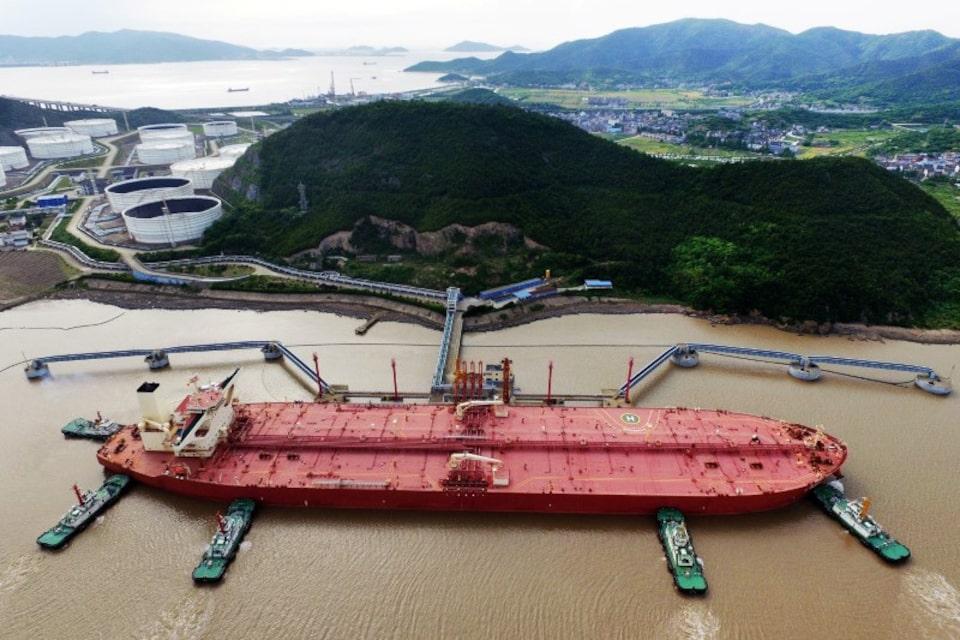
LAUNCESTON, Australia, Sept 15 (Reuters) - China's surplus crude surged to just over 1 million barrels per day (bpd) in August as robust imports and domestic production trumped an increase in refinery processing. China's refiners processed 14.94 million bpd in August, up 7.6% from the same month last year to be the second-strongest month in the past 17, according to data published on Monday by the National Bureau of Statistics. Sign up here. However, crude oil imports were 11.65 million bpd in August and domestic output rose 2.4% from the same month in 2024 to 4.3 million bpd. This gave a combined total of 15.95 million bpd available to refiners, leaving a surplus of 1.01 million bpd once the actual processing rate is subtracted, or almost double the 530,000 bpd surplus in July. China does not disclose the volumes of crude flowing into or out of strategic and commercial stockpiles, but an estimate can be made by deducting the amount of oil processed from the total of crude available from imports and domestic output. For the first eight months of the year, the average volume of surplus crude in China was 990,000 bpd, the bulk of this being built up from March onwards as crude imports and domestic output rose at a faster rate than refinery processing. It is worth noting that not all of this surplus crude is likely to have been added to storage, with some being processed in plants not captured by the official data. But even allowing for gaps in the official data, it is clear that from March onwards China has been importing crude at a far higher rate than it needs to meet its domestic fuel requirements. Why have Chinese refiners been building up inventories, especially when the widespread market expectation is that prices are likely to trend lower as the OPEC+ group of eight exporters continue to wind back their voluntary output cuts? Part of the answer is that the expected move to oversupply is relatively recent and China's refiners are more likely to have been buying more crude than they need because there already was a moderating price trend. Global benchmark Brent futures trended lower from the peak so far this year of $82.63 a barrel on January 15 to a low of $58.50 on May 5. However, since then, prices had a brief spike back above $80 a barrel during the conflict between Israel and Iran in June, before settling into a range anchored around $65. MORE TO BE STORED? The question for the market is whether prices at this level will be enough to continue to encourage China's refiners to keep adding to inventories. During last week's APPEC oil and gas events in Singapore, the likely path for China's stockpiles was a keenly debated topic. The consensus view was Chinese refiners had the ability to add more crude to storage, but there was disagreement over whether this was likely. The key for China's refiners is usually price, and the signs are that they are shifting their view to believe that prices should be more around $50 to $60 a barrel than the current $60 to $70 range. But it's also worth noting that China is still buying significant volumes from the three exporters currently under some form of Western sanctions, namely Russia, Iran and Venezuela. Imports from Venezuela were 561,000 bpd in August, according to data compiled by commodity analysts Kpler, which was the strongest month in records going back to 2013. Arrivals from Venezuela are also poised to increase further in September, with Kpler tracking imports of 755,000 bpd so far. Imports from Iran were 1.02 million bpd in August, up from 737,000 bpd in July, according to Kpler. However, seaborne arrivals from Russia were down to 1.03 million bpd in August from 1.25 million in July, although Kpler is expecting a rebound to 1.13 million bpd in September. China's crude stockpiling has been something of an X-factor in oil markets so far this year, and it is likely to remain so given the opaque nature of how it is conducted. If prices do trend lower amid increasing supply, the reasonable expectation is that China will keep buying more oil than it needs. Enjoying this column? Check out Reuters Open Interest (ROI), your essential new source for global financial commentary. ROI delivers thought-provoking, data-driven analysis of everything from swap rates to soybeans. Markets are moving faster than ever. ROI can help you keep up. Follow ROI on LinkedIn , opens new tab and X , opens new tab. The views expressed here are those of the author, a columnist for Reuters. https://www.reuters.com/markets/commodities/china-keeps-building-crude-oil-stockpiles-even-processing-gains-2025-09-15/
2025-09-15 11:51
Ukraine attacks more Russian energy facilities over the weekend Trump presses NATO nations to halt Russian oil purchases US Federal Reserve interest rate decision in focus LONDON, Sept 15 (Reuters) - Oil prices were little changed on Monday as investors assessed the impact of Ukrainian drone attacks on Russian refineries, while U.S. President Donald Trump said he was prepared to impose sanctions on Russia if NATO nations stop buying Russian oil. Brent crude futures rose 7 cents, or 0.1%, to $67.06 a barrel by 1121 GMT while U.S. West Texas Intermediate crude was at $62.80 a barrel, up 11 cents, or 0.18%. Sign up here. Oil remains range-bound between $65-70, underpinned by disruption risks from Ukrainian attacks on Russian energy facilities and renewed calls from Trump for tougher secondary sanctions on Russian crude buyers, said Saxo Bank analyst Ole Hansen. Ukraine launched a large attack with at least 361 drones targeting Russia overnight, sparking a brief fire at the vast Kirishi oil refinery in Russia's northwest, Russian officials said on Sunday. Both crude contracts gained more than 1% last week as Ukraine stepped up attacks on Russian oil infrastructure, including the largest oil exporting terminal, Primorsk. Primorsk has a capacity to load about 1 million barrels per day of crude, while the Kirishi refinery processes about 355,000 barrels per day of Russian crude, equal to 6.4% of the country's total. Pressure is mounting on Russia as U.S. President Trump said on Saturday that the U.S. was prepared to impose fresh energy sanctions on Russia, but only if all NATO nations ceased purchasing Russian oil and implemented similar measures. Oil also received some support from solid refinery demand in China last month and a decline in US crude inventories, while weaker economic data from China weighed on prices, said UBS analyst Giovanni Staunovo. Investors are also awaiting the interest rate decision by the U.S. Federal Reserve at its September 16-17 meeting, at which the bank is expected to reduce interest rates. Lower borrowing costs could boost fuel demand. Last week, softer job-creation data and rising inflation in the U.S. raised concerns about economic growth in the world's largest economy and oil consumer. https://www.reuters.com/business/energy/oil-holds-steady-investors-assess-attacks-russian-energy-facilities-2025-09-15/