2025-09-05 06:09
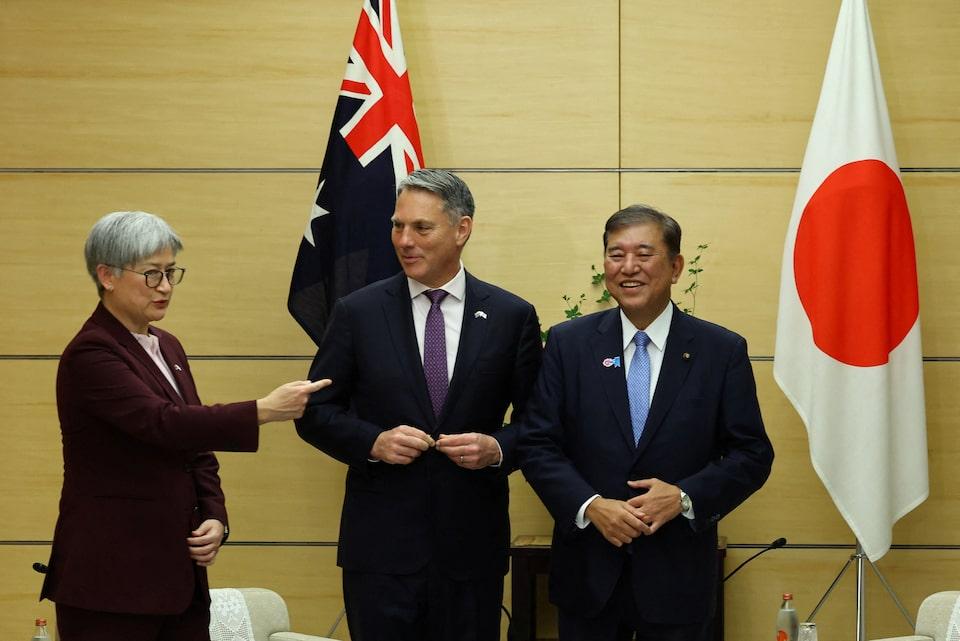
TOKYO, Sept 5 (Reuters) - Australia and Japan on Friday said they would deepen cooperation to address increasing security challenges in the Indo-Pacific region, including assisting each other in evacuating citizens at risk overseas. "We agreed to further strengthen our collective deterrence capabilities and to activate discussions on potential contingencies that could affect the security of both countries and the region," Japan's Foreign Minister Takeshi Iwaya said. Sign up here. His comments came after a meeting in Tokyo that also included Japanese Defence Minister Gen Nakatani and their Australian counterparts, Penny Wong and Richard Marles. Japan and Australia, both close allies of the United States, are forging closer ties as China's regional influence expands. Their cooperation includes joint military training and a reciprocal access agreement signed in 2023 that allows their forces to operate on each other’s territory. Japan and Australia are also members of the Quad grouping alongside the United States and India. Last month, Japan clinched a landmark A$10 billion ($6.5 billion) deal to build warships for Australia, marking Tokyo's most consequential defence sale since it ended a ban on military exports in 2014. Japan is seeking more defence industry collaboration in areas such as advanced unmanned systems, Nakatani said. Australia's Wong said Canberra aimed to expand economic cooperation with Tokyo beyond its role as a major supplier of energy, including liquefied natural gas. "We want the next stage of this to be economic security in the area of critical minerals. And we see that as of great importance," she said. (This story has been refiled to fix the day of the week to Friday in paragraph 1) https://www.reuters.com/world/china/japan-australia-pledge-closer-security-ties-counter-indo-pacific-risks-2025-09-05/
2025-09-05 06:08
KYIV, Sept 5 (Reuters) - Ukraine attacked Russia's Ryazan oil refinery, the commander of its drone forces, Robert Brovdi, said on messaging app Telegram on Friday, as well as an oil depot in the occupied Luhansk region. Debris fell on the grounds of an industrial enterprise after a drone attack, said Pavel Malkov, Ryazan's regional governor, with air defense and electronic warfare systems shooting down eight drones in the region, but causing no casualties. Sign up here. A previous Ukrainian drone attack forced the Ryazan refinery to halt half its capacity in early August, industry sources said at the time. Recent Ukrainian drone attacks have shut down facilities accounting for at least 17% of Russia's oil processing capacity, or 1.1 million barrels per day, Reuters calculations show. https://www.reuters.com/markets/commodities/ukraine-says-it-attacks-russian-refinery-ryazan-oil-depot-luhansk-2025-09-05/

2025-09-05 05:57
U.S. stock futures point higher after S&P 500 notches record close Treasury yields edge to four-month lows in Tokyo as traders lock in September Fed cut bets Crude oil slips for a third day as investors looks to weekend's OPEC+ meeting TOKYO, Sept 5 (Reuters) - Asian stocks tracked Wall Street's rise to a record high and Treasury yields eased to four-month lows on Friday as traders cemented bets for the Federal Reserve to cut rates this month, even with crucial U.S. jobs data looming later in the day. The U.S. dollar eased, giving up small gains from Thursday, as traders adjusted positions ahead of the labor report, while gold held steady after Thursday's retreat from an all-time high. Sign up here. Crude oil drifted lower for a third straight day as investors awaited an OPEC+ meeting this weekend that will consider further output hikes. Markets are all but certain of a quarter-point cut at the conclusion of the Fed's two-day rate-setting meeting on September 17, and price a cumulative 60 basis points of reductions this year, according to LSEG data. On Thursday, data showed that the number of Americans filing new applications for unemployment benefits increased more than expected last week, while hiring by private employers slowed in August, further evidence that labor market conditions were softening. Economists expect Friday's non-farm payrolls report to show the economy added 75,000 jobs in August, not much above the 73,000 figure for July, that first set a fire under expectations for a near-term Fed rate reduction. Fed Chair Jerome Powell later reinforced that speculation with an unexpectedly dovish speech at last month's closely watched Fed symposium in Jackson Hole, Wyoming. "Unless it's an absolutely stellar payrolls print, it's hard to see too much that's going to change the market away from locking in a September cut," said Ken Crompton, head of rates strategy at National Australia Bank. "Beyond that, the terminal rate and how you get there, that's arguably still up for grabs." Expectations of an easier monetary environment have supported global equities, and the S&P 500 (.SPX) , opens new tab rose 0.8% on Thursday to finish at a record high. The Nasdaq (.IXIC) , opens new tab climbed 1% to just shy of its own all-time closing high from August 13. S&P 500 futures pointed 0.2% higher on Friday, and Nasdaq futures advanced 0.4%. Japan's Nikkei (.N225) , opens new tab rose 0.9% and Taiwan's stock benchmark (.TWII) , opens new tab climbed 1.1%. Both those markets are close to recent record highs. Hong Kong's Hang Seng (.HSI) , opens new tab added 0.8%, while mainland Chinese blue chips (.CSI300) , opens new tab advanced 1%. Australian stocks (.AXJO) , opens new tab gained 0.5%. "The non-farm payrolls data tonight is something of a sink or swim moment for the markets," said Kyle Rodda, senior financial market analyst at Capital.com. "The critical question is ... whether the Fed is in the right position to lower rates and buffer the economy, or if it's behind the curve," he said. "Should the data point (to) an economy accelerating off a cliff, that could spark risk aversion and volatility." Long-end sovereign bonds globally have been the locus for volatility this week, amid worsening fiscal deficits from Washington to Brussels and London to Tokyo, often exacerbated by political instability. However, a strengthening belief that the Fed will soon be cutting rates reined in sharp rises in bond yields mid-week. Yields on 30-year Treasuries slipped to a three-week low of 4.839% on Friday in Tokyo, while the 10-year and two-year yields eased to four-month lows of 4.153% and 3.582%, respectively. Japanese 30-year government bond yields sank to 3.230%, retreating for a second day from Wednesday's all-time peak of 3.255%. The U.S. dollar index , which measures the currency against six major peers, declined 0.1% to 98.128, giving back the ground it took on Thursday. For the week though, it is up around 0.3%, on the back of big gains from Tuesday, when the yen and sterling slumped amid a flare-up in fiscal worries. Gold added 0.4% to around $3,558 per ounce, retracing Thursday's 0.4% decline as the market steadied following a breathless, seven-day 6.3% rally to a record peak of $3,578.50 on Wednesday. Brent crude futures fell 0.2% to $66.88 a barrel, while U.S. West Texas Intermediate crude eased 0.3% to $63.32. Eight members of the Organization of the Petroleum Exporting Countries and allies like Russia in OPEC+ will consider further raising production in October at a meeting on Sunday, two sources familiar with the discussions told Reuters. https://www.reuters.com/world/china/global-markets-wrapup-2-2025-09-05/
2025-09-05 05:15
Yen gains after Japan-US trade deal lowers auto tariffs Traders expect near-100% chance of Fed rate cut this month Trump's Fed nominee vows independence from political pressure TOKYO, Sept 5 (Reuters) - The dollar trimmed its weekly gain on Friday as bond markets stabilised and traders awaited key U.S. jobs data expected to firm up the case for an interest rate cut by the Federal Reserve. The yen gained after Japan solidified a trade deal with the United States that lowers tariffs on U.S. imports of autos. New Zealand's kiwi dollar climbed along with Asian shares. Sign up here. Data on Thursday showing higher-than-expected applications for jobless benefits in the U.S. served as a prelude to the more critical nonfarm payrolls report. Bonds rallied in the U.S., Europe and Japan after fiscal concerns spurred a run-up in long-term yields. Anxiety over U.S. President Donald Trump's meddling with Fed policy and his unpredictable tariff regime has made investors shy about holding dollar assets of late, said Bart Wakabayashi, the Tokyo Branch Manager of State Street. "The dollar remains very, very underweight," Wakabayashi said. "I do think there is room for the dollar buying to come back at some point. Maybe investors are just waiting for the rate cut to happen and then pile back in." The dollar index , which tracks the greenback against a basket of currencies of other major trading partners, dipped 0.1% to 98.14, trimming its gain for the week to 0.4%. The greenback dropped 0.2% to 148.21 yen. The euro was up 0.1% on the day at $1.1666. Several Fed officials said labour market worries continue to support their calls for rate cuts, boosting expectations of an imminent easing. The Fed is due to meet on September 16 and 17. The Labor Department's Bureau of Labor Statistics (BLS) will report U.S. nonfarm payrolls for August, with economists surveyed by Reuters expecting an increase of 75,000 jobs after a gain of 73,000 in July. That follows figures on Thursday showing that U.S. private payrolls increased by less than expected in August and jobless claims in the final week of the month were higher than predicted. "The risk is still tilted to payrolls underperforming U.S. economists' expectations that will weigh on the USD tonight," Joseph Capurso, head of international economics at the Commonwealth Bank of Australia, wrote in a note. Traders are pricing in a near-100% chance of the Fed cutting interest rates later this month, up from 87% a week ago, CME FedWatch showed. The two-year U.S. Treasury yield, which typically moves in step with interest rate expectations for the Fed, fell 0.7 basis points to 3.585% in Tokyo trading. Stephen Miran, Trump's pick to fill an open seat at the Fed, said he would "not at all" be the president's puppet when questioned by lawmakers on Thursday about whether he would make interest-rate decisions independently of political pressure. Trump signed an order on Thursday to implement lower tariffs on Japanese automobile imports and other products that were announced in July. Japan also confirmed its commitment to an annual $7 billion worth of energy purchases from the U.S., a joint statement from the countries showed. A surge in long-term bond yields of late has signalled increasing concerns about the fiscal health of major economies from Japan to Britain and the U.S. Those fears abated on Thursday and Friday, with yields falling back to earth. Yields on 2-year and 10-year Treasuries slid to the lowest since May 1. Yields on Japanese government bonds fell for a second day after a closely watched auction of 30-year debt passed smoothly on Thursday. Sterling traded at $1.3449 , up 0.1%. The Australian dollar rose 0.2% to $0.6526 . The New Zealand dollar rose 0.3% to $0.5859 . In cryptocurrencies, bitcoin climbed 1% to $111,472.54, while ether added 0.6% to $4,334.27. https://www.reuters.com/world/africa/dollar-trims-weekly-gain-bonds-find-footing-jobs-data-looms-2025-09-05/
2025-09-05 04:42
MUMBAI, Sept 5 (Reuters) - The Indian rupee gave up modest early gains to trade little changed on Friday ahead of crucial key U.S. labour market report due later in the day. The U.S. dollar slipped against most Asian currencies while Treasury yields dipped to their lowest in four months on strong wagers on a rate cut by the Federal Reserve later this month. Sign up here. The rupee was at 88.1650 against the dollar, against its close at 88.1450 in the previous session. The interest-rate expectation sensitive 2-year U.S. Treasury yield fell to a four-month low in Asia trading, extending its decline to 3.59%. Money markets are currently pricing in near certainty of a 25-basis-point rate cut by the Fed in September. The wagers were cemented by indications of weakness in U.S. labour data released on Thursday. "A negative surprise or sharp downward revision to July’s figure could put downward pressure on the USD," MUFG said in a note, referring to the jobs report. While a soft print may offer modest relief to the rupee, a rally is unlikely unless equity flows pick up meaningfully or there are positive developments related to U.S. tariffs, a trader at a state-run bank said. Indian exports to the U.S. face a tariff of as much as 50%. MUFG reckons the rupee could weaken to 89 by the first quarter of calendar year 2026 under the assumption that the steep tariffs remain for now but are eventually lowered to 25% sometime next year. https://www.reuters.com/world/india/indian-rupee-little-changed-before-us-data-fed-rate-cut-bets-support-2025-09-05/
2025-09-05 04:33
A look at the day ahead in European and global markets from Kevin Buckland Markets are in buoyant mood, clearly anticipating Friday's hotly awaited U.S. payrolls report will keep the Fed on course to cut rates this month and once more by year-end. Sign up here. It was the previous month's payrolls shocker that got speculation really going that U.S. monetary policy would need to come down fast, and economists predict an only slightly higher reading this time around. Fed Chair Jay Powell surprised many at last month's closely watched Jackson Hole symposium with a keynote that suggested a cut on September 17 is coming unless the data gets in the way. Fedspeak from other officials has been leaning dovish on the whole, and the window for additional comments closes later today as the central bank enters a blackout period in the run-up to its policy gathering. U.S. stock futures are pointing higher after the S&P 500 notched a record-high close overnight, and the Nasdaq Composite came within 6 points of doing the same. European futures are doing the same, and Asian markets from Japan to Taiwan to mainland China are rising about 1%. Bond markets too, which had turned so volatile at the start of the week, have been calmed by a run of soft U.S. jobs data that has bolstered confidence for a non-farm payrolls report that will further the narrative for easier Fed policy. After surging to record highs on Wednesday, Japanese 30-year government bond yields have retraced about half of that day's rise. Similarly dated U.S. Treasury yields have slipped to three-week lows, while two- and 10-year yields have eased to four-month troughs. British 30-year gilt yields are back at the levels from a week ago, before the four-day spike to the highest since 1998. German and French yields are down from multi-year peaks. Gold is also biding its time, hovering below Wednesday's all-time high following a breathless seven-day rally. That means there's a lot riding on a benign U.S. payrolls reading. And there's not a lot to distract from it in the lead-up, with German factory data, British retail sales and revised euro-area GDP the most noteworthy. Key developments that could influence markets on Friday: -U.S. payrolls -Canada payrolls -Euro zone revised GDP -Germany industrial orders, manufacturing output -UK retail sales, Halifax house prices https://www.reuters.com/world/china/global-markets-view-europe-2025-09-05/