2025-08-29 23:32
SAN SALVADOR, Aug 29 (Reuters) - El Salvador, the first country to make Bitcoin legal tender, will move its reserves of the popular cryptocurrency to multiple new addresses from the single address it previously used in order to improve security, it said on Friday. The country's National Bitcoin Office said on X each address would hold up to 500 Bitcoin (around $54 million as of recent prices), and that a public dashboard would make the full balance across these addresses transparent to the public. Sign up here. The Central American nation has for years been consolidating its Bitcoin position. As of Friday, it held around $682 million worth in the volatile cryptocurrency. https://www.reuters.com/world/americas/el-salvador-transfer-bitcoin-reserves-multiple-addresses-2025-08-29/

2025-08-29 22:36
WASHINGTON, Aug 29 (Reuters) - U.S. Department of Homeland Security Secretary Kristi Noem said on Friday that there had been an IT breach at the Federal Emergency Management Agency, the American disaster response agency that has been buffeted by deep cuts and is slated for elimination. Noem's statement gave few specifics about the nature of the breach except to blame FEMA's staff, two dozen of whom she said she had fired. Sign up here. Noem said the hack threatened "the entire Department and the nation as a whole" but at the same time said that "no American citizens were directly impacted." She added: "No sensitive data was extracted from any DHS networks." DHS did not immediately respond to a message seeking further clarity on what happened. Noem devoted nine paragraphs of her statement about the breach to attacks on FEMA's IT staff, accusing them of "failure," "neglect," "incompetence" and dishonesty. She said 23 of them had been fired. Reuters could not immediately verify her claims. News of the FEMA breach - and the mass firing purportedly connected to it - follows an open letter , opens new tab of dissent against the agency's leadership signed by scores of current and former FEMA employees. The letter warned Congress that the inexperience of top appointees of President Donald Trump's administration could lead to a catastrophe on the level of Hurricane Katrina, which ravaged the Gulf Coast of the United States 20 years ago. Trump has said he wants to eliminate FEMA, a linchpin of the United States' disaster response, and instead distribute federal money through his own office. FEMA has extended a hiring freeze through at least the end of this year, according to three sources familiar with the matter, as the peak of hurricane season approaches. The Department of Homeland Security "is committed to ensuring FEMA delivers for the American people," a FEMA spokesperson said in a statement on Friday. The spokesperson did not respond to a question about the hiring freeze. https://www.reuters.com/world/us/us-homeland-security-chief-reports-breach-fema-fires-23-employees-2025-08-29/

2025-08-29 22:18
BRASILIA, Aug 29 (Reuters) - Brazil's 2026 annual budget bill, submitted to Congress on Friday, projects a primary surplus of 34.5 billion reais ($6.36 billion) for the central government, equivalent to 0.25% of the country's gross domestic product. The forecast meets the 0.25% of GDP primary surplus target for next year proposed by President Luiz Inacio Lula da Silva's government in April, still pending congressional approval. Sign up here. The calculation, however, excludes 57.8 billion reais in expenses not counted toward the fiscal target, notably linked to court-ordered payments. Without this adjustment, the projection would show a primary deficit of 23.3 billion reais, equivalent to a 0.17% of GDP shortfall. Many economists have criticized the exclusion of large expenditures from Brazil's calculation of its primary balance, saying it masks the true fiscal picture even though the practice is legal. While the government may hit its targets on paper, the exemptions still drive spending and add to the hefty debt of Latin America's largest economy. The Treasury estimated in July that gross debt as a share of GDP - a key fiscal indicator - will have risen more than 10 percentage points under Lula, who took office in 2023. The leftist leader introduced a new fiscal framework with a more flexible spending-growth rule alongside primary budget targets. Initially, his economic team projected a primary surplus equivalent to 0.5% of GDP for this year, followed by 1% of GDP surplus by the end of his mandate in 2026. However, the fast-growing cost of pensions and social benefits, reluctance to pursue deeper spending cuts and challenges in raising new revenue led the government to abandon its original plan last year in favor of a more gradual fiscal adjustment. ($1 = 5.42 reais) https://www.reuters.com/world/americas/brazils-2026-budget-bill-projects-primary-surplus-025-gdp-2025-08-29/

2025-08-29 22:10
Banxico raises 2023 growth forecast to 0.6% from 0.1% Core inflation forecast increased to 3.7% for Q4 2025 Economic weakness was a factor behind this month's rate cut MEXICO CITY, Aug 29 (Reuters) - Mexico's economy is performing better than expected, the Bank of Mexico said on Friday in its quarterly report, while increasing its growth forecast for the rest of the year for Latin America's second largest economy. The report offered a positive, if mixed, assessment: Mexico's economy is showing resilience in the face of an uncertain business environment and on-again, off-again tariffs from the U.S., Mexico's largest trade partner. Sign up here. But Banxico, as Mexico's central bank is known, said economic growth remains sluggish and it projected higher rates of inflation for the rest of the year compared with its previous estimate. It said the economic effects of U.S. tariffs may take more time to become clear. "The Mexican economy has performed better than the external environment would suggest and could continue performing better than anticipated as long as the adverse effects of change in U.S. economy policy take time to materialize," the bank's quarterly report said. Banxico raised its forecast for economic growth this year to 0.6% from its previous estimate of 0.1%. The central bank also increased its outlook for economic growth in 2026 to 1.1% from a prior estimate of 0.9%. "The Mexican economy grew more than expected," Central Bank Governor Victoria Rodriguez said during a presentation of the report. But the bank also highlighted an increase in the price of goods. It now expects annual headline inflation in the fourth quarter to reach 3.7%, versus a prior forecast of 3.3%. Even so, the bank maintained its estimate that headline inflation will converge to its 3% target in the third quarter of 2026. The forecast for annual core inflation, which excludes some volatile goods and is considered a more reliable indicator, was revised upwards to 3.7% for the fourth quarter of 2025, compared with the bank's earlier forecast of 3.4%. Banxico cited the economy's weakness as a factor when it cut its benchmark interest rate earlier this month to 7.75%, bringing the rate to its lowest level in three years. Central banks often cut interest rates to stimulate the economy, although that can also fuel inflation. Deputy Governor Jonathan Heath, who was the only member of the five-member board to vote against lowering the interest rate and cited persistent inflation, again raised concerns during Friday's presentation, singling out higher food prices at taco stands and restaurants. But he said Mexico's economy clearly needs to grow more, saying it's between "lethargy and stagnation." https://www.reuters.com/world/americas/mexicos-central-bank-hikes-economic-forecast-growth-remains-sluggish-2025-08-29/
2025-08-29 21:56
Removal of tariff exemption to disrupt e-commerce, raise costs, analysts say Customs agency collecting duties on all global parcel imports Many postal services suspended shipments of parcels to US Disruptions similar to February's not yet seen, logistics expert says WASHINGTON, Aug 29 (Reuters) - The U.S. ended tariff exemptions for parcel imports on Friday without the logistical hiccups that dogged prior attempts, while consumers, e-commerce companies and small businesses using online marketplaces braced for cost increases and supply chain disruptions. The U.S. Customs and Border Protection agency began collecting normal duty rates on all package shipments valued under $800, regardless of value, country of origin, or mode of transportation. Sign up here. For the first six months, importers can opt to pay a flat-rate duty of $80 to $200 per package shipped from foreign postal agencies. The change broadens the Trump administration's cancellation of the de minimis exemption, already in place for packages from China and Hong Kong since May as part of an effort to halt shipments of fentanyl and its precursor chemicals into the U.S. The customs agency's commissioner, Rodney Scott, said it was ready to enforce the new duty requirements. "For too long, this loophole handed criminal networks a free pass to flood America with fentanyl, fake goods, and illegal shipments. Those days are over." Trump administration officials said the change could boost U.S. customs revenues by $10 billion annually. The de minimis exemption has been in place since 1938, starting at $5 for gift imports, and was raised from $200 to $800 in 2015 to foster small business growth on e-commerce marketplaces. Direct shipments from China surged after President Donald Trump raised tariffs on Chinese goods during his first term, creating a new direct-to-consumer business model for e-commerce firms such as Shein and Temu (PDD.O) , opens new tab. The National Coalition of Textile Organizations hailed a "historic win" for U.S. manufacturing following the closing of a loophole that allowed foreign fast-fashion firms to avoid tariffs and import apparel sometimes made with forced labor, undercutting American jobs. "The administration's executive action closes this channel and delivers long overdue relief to the U.S. textile industry and its workers," the group said. The customs agency has estimated that the number of packages claiming the de minimis exemption jumped nearly 10-fold , opens new tab from 139 million in fiscal 2015 to 1.36 billion in fiscal 2024 - a rate of 4 million per day. More than 25 foreign postal services suspended mail to the U.S. in the run-up to the de minimis deadline, helping the U.S. to avoid a repeat of the chaotic package pile-up that forced the Trump administration to pull back on its first attempt at ending the de minimis exemption for China in February. "I'm not hearing of any huge slowdowns at any of the ports right now, but it's still early," said Bernard Hart, vice president of customs and trade at logistics provider Flexport. "We do believe that industry had enough time to react to this and to move inventory around." The customs agency said 95% of all de minimis shipments are handled by general cargo carriers or express shippers such as FedEx (FDX.N) , opens new tab, UPS (UPS.N) , opens new tab and DHL (DHLn.DE) , opens new tab, which had already adapted to the China changes. Britain's Royal Mail resumed shipments on Thursday. European postal groups including Germany's DHL and Norway's Posten Bring on Friday were seeking ways to handle the new fees and extra paperwork after suspending certain shipments. HIGHER COSTS, MORE PAPERWORK Retail and trade analysts say the end of de minimis is likely to raise prices for many goods sold through e-commerce companies, as those that previously avoided tariffs because of the exemption become subject to duties. This may put such firms on a par with costs for more established retailers like Walmart (WMT.N) , opens new tab that tend to import merchandise in bulk containers that are subject to tariffs. It is also likely to curb trade on peer-to-peer platforms such as eBay (EBAY.O) , opens new tab and Etsy (ETSY.O) , opens new tab, which are used by small businesses to sell secondhand, vintage or handmade items. The customs agency has collected more than $492 million in additional duties on packages shipped from China and Hong Kong since their exemptions were eliminated on May 2, another Trump administration official said. Foreign postal agencies can opt to collect and process the duties based on the value of the package contents, or they can collect a flat tax calculated from the tariff rate in effect for the country of origin. Based on the agency's guidance , opens new tab issued on Thursday, parcels would be charged $80 from countries with Trump-imposed duty rates below 16%, such as Britain and the European Union; $160 from countries between 16% and 25%, such as Indonesia and Vietnam; and, $200 from countries above 25%, including Brazil, Canada, China and India. https://www.reuters.com/world/china/us-tariff-exemption-low-value-packages-ends-with-few-hiccups-higher-costs-loom-2025-08-29/

2025-08-29 21:55
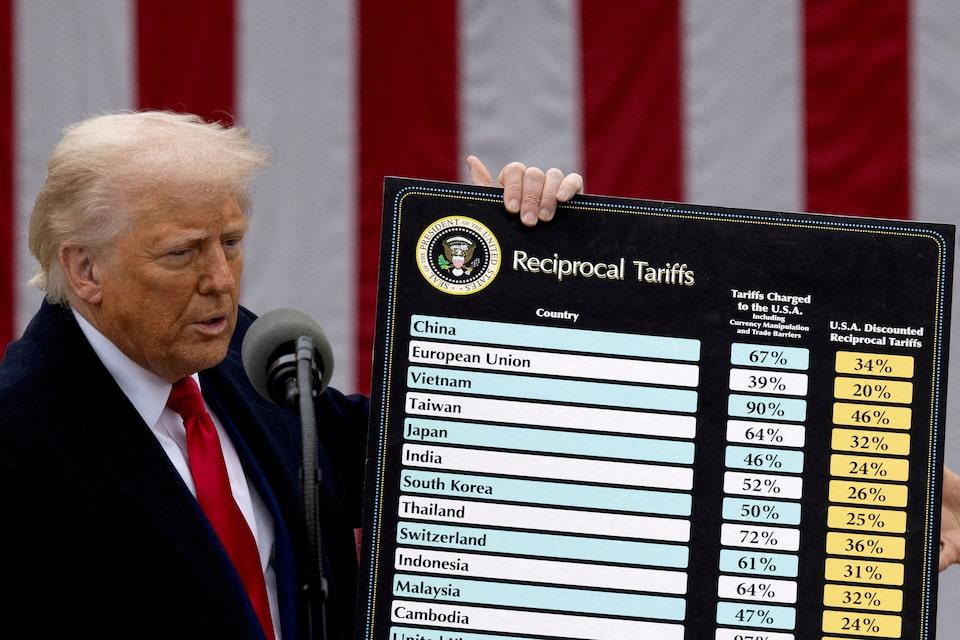
Appeals court on 7-4 vote rules against Trump's tariffs Court delays ruling taking effect to allow for Supreme Court appeal Trump administration may have Plan B NEW YORK, Aug 29 (Reuters) - A divided U.S. appeals court ruled on Friday that most of Donald Trump's tariffs are illegal, undercutting the Republican president's use of the levies as a key international economic policy tool. The court allowed the tariffs to remain in place through October 14 to give the Trump administration a chance to file an appeal with the U.S. Supreme Court. Sign up here. The decision comes as a legal fight over the independence of the Federal Reserve also seems bound for the Supreme Court, setting up an unprecedented legal showdown this year over Trump's entire economic policy. Trump has made tariffs a pillar of U.S. foreign policy in his second term, using them to exert political pressure and renegotiate trade deals with countries that export goods to the United States. The tariffs have given the Trump administration leverage to extract economic concessions from trading partners but have also increased volatility in financial markets. Trump lamented the decision by what he called a "highly partisan" court, posting on Truth Social: "If these Tariffs ever went away, it would be a total disaster for the Country." He nonetheless predicted a reversal, saying he expected tariffs to benefit the country "with the help of the Supreme Court." The 7-4 decision from the U.S. Court of Appeals for the Federal Circuit in Washington, D.C., addressed the legality of what Trump calls "reciprocal" tariffs imposed as part of his trade war in April, as well as a separate set of tariffs imposed in February against China, Canada and Mexico. Democratic presidents appointed six judges in the majority and two judges who dissented, while Republican presidents appointed one judge in the majority and two dissenters. The court's decision does not impact tariffs issued under other legal authority, such as Trump's tariffs on steel and aluminum imports. 'UNUSUAL AND EXTRAORDINARY' Trump justified both sets of tariffs - as well as more recent levies - under the International Emergency Economic Powers Act. IEEPA gives the president the power to address "unusual and extraordinary" threats during national emergencies. "The statute bestows significant authority on the President to undertake a number of actions in response to a declared national emergency, but none of these actions explicitly include the power to impose tariffs, duties, or the like, or the power to tax," the court said. "It seems unlikely that Congress intended, in enacting IEEPA, to depart from its past practice and grant the President unlimited authority to impose tariffs." The 1977 law had historically been used for imposing sanctions on enemies or freezing their assets. Trump, the first president to use IEEPA to impose tariffs, says the measures were justified given trade imbalances, declining U.S. manufacturing power and the cross-border flow of drugs. Trump's Department of Justice has argued that the law allows tariffs under emergency provisions that authorize a president to "regulate" imports or block them completely. Trump declared a national emergency in April over the fact that the U.S. imports more than it exports, as the nation has done for decades. Trump said the persistent trade deficit was undermining U.S. manufacturing capability and military readiness. Trump said the February tariffs against China, Canada and Mexico were appropriate because those countries were not doing enough to stop illegal fentanyl from crossing U.S. borders, an assertion the countries have denied. MORE UNCERTAINTY William Reinsch, a former senior Commerce Department official now with the Center on Strategic and International Studies, said the Trump administration had been bracing for this ruling. "It's common knowledge the administration has been anticipating this outcome and is preparing a Plan B, presumably to keep the tariffs in place via other statutes." There was little reaction to the ruling in after-hours stock trading. "The last thing the market or corporate America needs is more uncertainty on trade," said Art Hogan, chief market strategist at B. Riley Wealth. Trump is also locked in a legal battle to remove Federal Reserve Governor Lisa Cook, potentially ending the central bank's independence. "I think it puts Trump's entire economic agenda on a potential collision course with the Supreme Court. It's unlike anything we've seen ever," said Josh Lipsky, chair of international economics at the Atlantic Council. The 6-3 conservative majority Supreme Court has issued a series of rulings favoring Trump's second term agenda but has also in recent years been hostile to expansive interpretations of old statutes to provide presidents newly-found powers. The appeals court ruling stems from two cases, one brought by five small U.S. businesses and the other by 12 Democratic-led U.S. states, which argued that IEEPA does not authorize tariffs. The Constitution grants Congress, not the president, the authority to issue taxes and tariffs, and any delegation of that authority must be both explicit and limited, according to the lawsuits. The New York-based U.S. Court of International Trade ruled against Trump's tariff policies on May 28, saying the president had exceeded his authority when he imposed both sets of challenged tariffs. The three-judge panel included a judge who was appointed by Trump in his first term. Another court in Washington ruled that IEEPA does not authorize Trump's tariffs, and the government has appealed that decision as well. At least eight lawsuits have challenged Trump's tariff policies, including one filed by the state of California. https://www.reuters.com/legal/government/most-trump-tariffs-are-not-legal-us-appeals-court-rules-2025-08-30/