2025-08-27 11:20
BRUSSELS, Aug 27 (Reuters) - European Union targets to cut CO2 emissions from vehicles, including a 100% reduction for cars by 2035, are no longer feasible, the heads of the European automobile manufacturers' and automotive suppliers' associations said on Wednesday. European Commission President Ursula von der Leyen is set to host automotive sector executives on September 12 to discuss the future of the sector, which is facing twin threats of Chinese competition in electric vehicles and U.S. tariffs. Sign up here. In a letter to von der Leyen, Mercedes-Benz (MBGn.DE) , opens new tab CEO Ola Kaellenius and Matthias Zink, CEO of powertrain and chassis at Schaeffler AG (SHA0n.DE) , opens new tab, said they were committed to achieving the EU's net zero goal in 2050. However, they said EU manufacturers now faced near-total dependency on Asia for batteries, as well as uneven charging infrastructure, higher manufacturing costs and U.S. tariffs. The bloc needed to go beyond new-vehicle targets, they argued, such as 55% CO2 emissions reductions from 2021 levels for cars and 50% for vans by 2030 and of 100% for both by 2035. Electric cars have a market share of around 15% of new EU cars, with vans at 9%. "Meeting the rigid car and van CO2 targets for 2030 and 2035 is, in today’s world, simply no longer feasible," they wrote. Legal mandates and penalties would not drive the transition, they wrote. "EVs will lead the charge, but there must also be space for (plug-in) hybrids, range extenders, highly efficient internal-combustion engine vehicles, hydrogen and decarbonised fuels," the letter said. CO2 regulation for heavy-duty trucks and buses must also be reviewed, the two association chiefs said. In March, the Commission agreed to give automakers extra time to meet CO2 emission reduction targets initially set for 2025. Members of von der Leyen's centre-right grouping have also called for the EU to withdraw its 2035 ban on combustion engines. https://www.reuters.com/sustainability/boards-policy-regulation/eu-auto-groups-press-change-no-longer-feasible-car-co2-emission-targets-2025-08-27/

2025-08-27 11:13
Election takes places September 7-8 Tight contest between centre-left and centre-right blocs Cost of living and inequality central to campaign OSLO, Aug 27 (Reuters) - Norway's general election on September 7-8 is expected to be a close race between a centre-left bloc led by the incumbent Labour Party, and a centre-right bloc dominated by the populist Progress Party and centre-right Conservatives. Among the issues that could decide the vote are inequality and taxation, while the outcome could have an impact on energy and power supplies to Europe and the management of Norway's huge sovereign fund. Sign up here. WHAT'S AT STAKE? Prime Minister Jonas Gahr Stoere's Labour is looking to extend its rule after returning to power in 2021, following eight years of Conservative-led governments. Labour has led a minority government, supported by the Socialist Left and the rural-based Centre Party. Inequality tops voters' list of concerns, according to an August 7-13 survey by Respons Analyse for daily Aftenposten, replacing defence and national security, which slipped to sixth place since a similar poll in April. Cost of living and pocketbook issues have been central to the campaign, with food price inflation at 5.9% in the last 12 months. The economy, jobs and taxes are also high priorities for voters, the survey showed. While Labour favours broadly stable taxes, some of its allies seek stiffer rates for the wealthy to finance tax cuts for low-income families and expanded public services. Progress and the Conservatives both advocate large tax cuts. SOVEREIGN WEALTH FUND Norway's $2 trillion wealth fund, built on vast oil and gas income, allows governments to spend much more freely than fellow European countries, though the need to control inflation and interest rates are constraining factors. A debate over investments in Israel took centre stage at the beginning of the campaign, sparking an unusually public debate over how the world's largest sovereign fund operates. The Socialist Left last week said it would only support a future Labour government if it divested from all companies involved in what it called "Israel's illegal warfare in Gaza". Labour rejected the demand, but it may be difficult to rebuff such calls after the election. OIL AND GAS Norway is Europe's top gas supplier, replacing Gazprom after Russia's 2022 invasion of Ukraine. Its role is set to grow as the European Union plans to phase out use of Russian gas by 2027, but exploiting new oil and gas reserves is critical to slowing down an expected production decline. The election could decide whether Norway opens new areas for exploration, or if oil companies will remain restricted to existing ones, depending on the influence wielded by the Greens, Liberals and other small parties. More radical proposals to stop exploration completely are unlikely to gather sufficient support. POWER Norway produces more power than it consumes and exports the surplus to Europe. Still, some left-wing and right-wing parties are campaigning on limiting exports to the continent. If that happened, it would be a problem for Norway's neighbours and Brussels. Norway is not in the EU but is part of the single European market and must respect its rules. Restricting power exports would breach them. Parties are also divided over how to meet growing domestic demand that is eroding Norway's surplus, with little generation capacity added in recent years. Wind on land, solar and new hydropower are relatively cheap and quick to build, but face local protests over their ecological impact. Offshore wind is controversial due to its high costs. HOW DOES IT WORK? Norway has a system of proportional representation whereby 169 lawmakers are elected from 19 geographical districts for a fixed, four-year term. Any party scoring above 4% support nationwide is guaranteed representation, although a strong showing in individual districts can also yield one or more seats. No party is expected to win the 85 seats required for an outright majority, so continued minority rule under Labour or the formation of a coalition are the likeliest outcomes. Polls show nine parties are expected to win seats. On the left, Labour, the Socialists, the Greens, Centre and the Reds; and on the right, the Conservatives, Progress, the Christian Democrats and the Liberals. If the centre-left wins, Labour's Stoere is expected to remain in office, while a centre-right win could see either Progress Party leader Sylvi Listhaug or Conservative Party head Erna Solberg become prime minister. RESULTS The ballot ends on September 8 at 1900 GMT, when the first exit polls are expected. Results could become clear late that evening, though the final outcome may not be known until the following day. The exact combination of parties in the cabinet will depend on post-election negotiations. https://www.reuters.com/business/finance/what-you-need-know-about-norways-upcoming-election-2025-08-27/

2025-08-27 10:51
LONDON, Aug 27 (Reuters) - What matters in U.S. and global markets today By Mike Dolan , opens new tab, Editor-At-Large, Finance and Markets Sign up here. It's hard for markets to see much beyond tonight's earnings from AI-lodestar Nvidia, but political tensions surrounding the Federal Reserve have seen two-year Treasury yields plunge to near four month lows and the 2-30 year yield curve steepen more. Emboldened by brisk demand at Tuesday's auction, the intensifying political pressure on the Fed to slash interest rates and now the possibility of another Trump appointee replacing Lisa Cook on the board have sent two-year Treasury yields sliding to their lowest since May 1 at 3.65% - even as 30-year yields remain above 4.90%. Futures still only see an 80% chance of a cut in the 4.25%-4.50% policy rate in September, but the betting on where rates will be in a year's time has dropped 25 basis points over the past month to as low as 2.92%. * The standoff between the Fed and the White House over Cook's position remains uncertain as she seems set to seek a legal injunction to stay in position, presumably for the September policy meeting, while courts rule on President Donald Trump's ability to remove her. Most investors see Fed independence at the heart of the row and, as it stands, the market's main move is to steepen the yield curve to its widest in more than three years to account for early easing, but also rising inflation expectations on a view those cuts may not be appropriate. * Aside from the Nvidia vigil, which options markets suggest could see a 6% swing either way in its share price and up to 1% swing in the S&P500, Wall Street stocks riffed off the mounting rate cut speculation and ended higher on Tuesday. Futures were flatter ahead of today's bell. The dollar was firmer despite the drop in 2-year yields, but its moves have been hampered by the euro's reaction to a flare-up in French political tensions this week - with the government there possibly collapsing again in a budget confidence vote set for September 8. A heavy sell-off in French stocks and bonds on Tuesday calmed somewhat today, with France's 30-year bond yield pausing close to new 14 year highs. * India's rupee fell close to the year's lows as Trump's doubling of tariffs on imports from India to as much as 50% took effect as scheduled on Wednesday, delivering a serious blow to ties between the two countries. China's stocks underperformed generally positive world stock markets after news China's industrial profits fell for a third consecutive month in July, with businesses struggling in the face of subdued demand and persistent factory-gate deflation despite policy measures to help shore up the economic recovery. Today's column looks at the AA+ U.S. sovereign credit rating, both how tariff revenues are supporting the stable outlook and also what's behind the market's more skeptical view of U.S. creditworthiness. Today's Market Minute * U.S. President Donald Trump's doubling of tariffs on goods from India to as much as 50% took effect as scheduled on Wednesday, escalating tensions between the world's two largest democracies and strategic partners. * Nvidia's (NVDA.O) business in China will be the focus of investors when the AI chipmaker reports earnings on Wednesday, following an unusual deal with the Trump administration and Beijing's subsequent efforts to stall imports. * Federal Reserve Governor Lisa Cook will file a lawsuit to prevent President Donald Trump from firing her, a lawyer for the embattled central bank official said on Tuesday, kicking off what could be a protracted legal fight over the White House's effort to shape U.S. monetary policy. * The increased U.S. tariffs on Indian goods are a textbook example of a lose-lose situation for both countries, but, writes ROI columnist Clyde Russell, they are perversely a win for the intended target, Russia. * Questions are arising about the hype surrounding artificial intelligence. Nvidia's quarterly results this week could therefore potentially be explosive – not just for the company's shares or the tech sector, but for all of Wall Street, argues ROI markets columnist Jamie McGeever. Chart of the day The Conference Board's monthly surveyofU.S.consumersshowedperceptionsoftheabilitytofindajobwereattheirweakestinmorethanfouryearsinAugust,reinforcingtherecentFeddovishnessabouttheunfoldingstateofthelabormarket.Thesurveyshowedtheshareofconsumerswhoviewedjobsas"hardtoget"jumpedto20.0%inAugust,thehighestsinceFebruary2021,from18.9%inJuly. The proportion saying jobs were "plentiful" eased slightly. That pushed the survey's so-called labor market differential down to 9.7 from 11.0 in July. And that measure tends to correlate to the unemployment rate in the Labor Department's monthly employment report. The headache for the Fed of course is that inflation expectations are rising in tandem - consumers' average 12-month inflation view rose to 6.2% after easing for three straight months. Today's events to watch * Richmond Federal Reserve President Thomas Barkin speaks * U.S. corporate earnings: Nvidia, HP, Agilent, CrowdStrike, NetApp, Williams-Sonoma, JM Smucker * U.S. Treasury sells $70 billion of 5-year notes, $28 billion of 2-year floating rate notes * French President Emmanuel Macron, German Chancellor Friedrich Merz and Polish Prime Minister Donald Tusk visit Moldova Want to receive the Morning Bid in your inbox every weekday morning? Sign up for the newsletter here. You can find ROI on the Reuters website , opens new tab, and you can follow us on LinkedIn , opens new tab and X. , opens new tab Opinions expressed are those of the author. They do not reflect the views of Reuters News, which, under the Trust Principles , opens new tab, is committed to integrity, independence, and freedom from bias. https://www.reuters.com/world/europe/global-markets-view-usa-2025-08-27/

2025-08-27 10:34
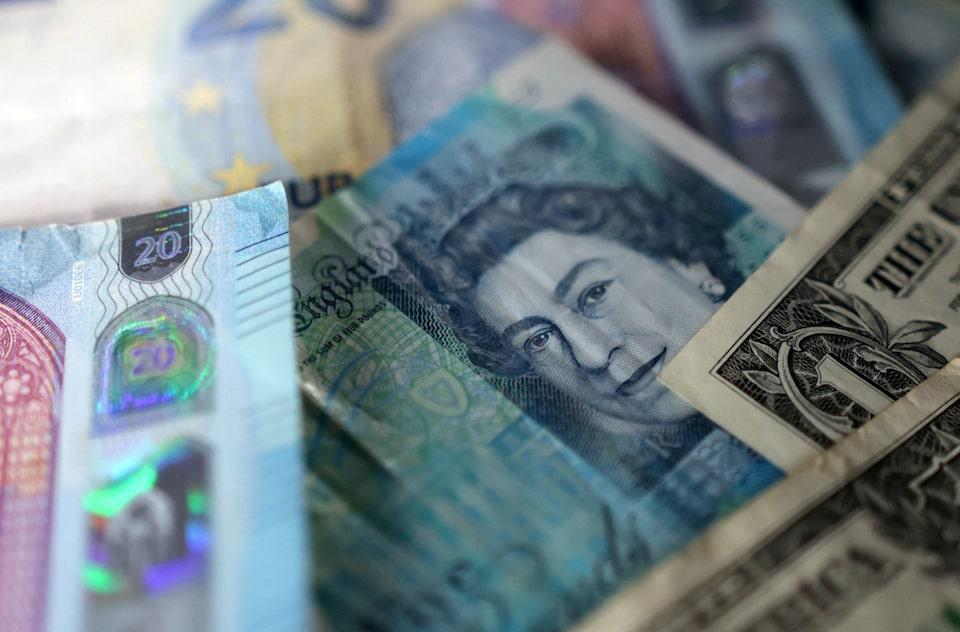
August 27 (Reuters) - Sterling slipped on Wednesday as the U.S. dollar firmed against major currencies, recouping losses spurred by investor worries over independence of the U.S. Federal Reserve while traders also digested UK's producer price inflation data. The UK unit was down 0.33% at $1.3434, trailing a fall in the euro which declined 0.5% to $1.1584. Sign up here. While the dollar had initially weakened on Tuesday following U.S. President Donald Trump's move to oust Fed Governor Lisa Cook over alleged improprieties in obtaining mortgage loans, that reaction was shortlived, and the greenback was last up 0.3% at 98.6 against a basket of peers . On the month, sterling remains on course to end higher by about 1.5% against the U.S. dollar, comforted by a pullback in expectations of rate cuts by the Bank of England and buoyant economic data. "A more persistent hold on Bank Rate is appropriate right now, to maintain the tight - but not tighter - monetary policy stance needed to lean against inflation persistence persisting," Bank of England Monetary Policy Committee member Catherine Mann said in remarks released by the BoE on Tuesday. British producer output price inflation rose to a two-year peak of 1.9% year-on-year in June, according to preliminary official data released on Wednesday. The producer price data trails a consumer inflation report which showed that British CPI rose to an 18-month high of 3.8% in July. Money markets are pricing in around a 40% chance of a BoE rate cut before the end of the year. Against the euro, the balance of risks for sterling is tilted to the upside with "the hawkish repricing in Bank of England rate expectations still underpinning decent GBP short-term momentum," Francesco Pesole, an FX strategist at ING said in a note. "In GBP/USD, we still think a structural break above 1.35 is a matter of when rather than if," the note said. On Tuesday, sterling was a tad higher against the euro at 86.22 pence to the common currency . https://www.reuters.com/markets/europe/sterling-retreats-dollar-rebounds-traders-digest-british-ppi-2025-08-27/
2025-08-27 10:19
LONDON, Aug 27 (Reuters) - A downturn in British retail sales entered its 11th consecutive month in August and shops raised their prices by the most since late 2023, a Confederation of British Industry survey showed on Wednesday. The CBI's monthly gauge of how retail sales compared with a year earlier was little changed at -32 from July's -34 but better than a dip to -46 in June. The outlook for September improved to -16. Sign up here. "Weak demand and higher labour costs continue to put pressure on margins, dampening sentiment across the retail and wider distribution sector," Martin Sartorius, principal economist at the CBI said. "This downbeat outlook is reflected in firms' plans to scale back investment and hiring," he said. Many employers have said they are feeling the strain from a decision by finance minister Rachel Reeves to make them pay more higher employment taxes from April at the same time as a sharp increase in Britain's minimum wage. The CBI's measure of average selling prices in the 12 months to August rose to +65, the fastest rate since November 2023, from -35 in May but the expected increase for September was a slower +43. The data was collected between July 28 and August 14 and was based on responses from 56 retailers and 98 wholesalers. https://www.reuters.com/business/retail-consumer/uk-retailers-suffer-11th-month-downturn-prices-rise-sharply-cbi-says-2025-08-27/

2025-08-27 09:46
European stocks calm after French selloff Investors await pivotal Nvidia earnings after Fed drama Dollar recovers even as Fed independence worries linger European markets calm after French selloff LONDON/SINGAPORE, Aug 27 (Reuters) - The U.S. dollar recovered on Wednesday even as investors remained nervous about attacks on Federal Reserve independence, while European shares steadied after a sharp drop a day earlier with all focus on earnings from AI leader Nvidia (NVDA.O) , opens new tab. Concerns for U.S. Federal Reserve independence swirled as a lawyer for Fed Governor Lisa Cook, whose firing President Donald Trump ordered on Monday, said she would file a lawsuit against his move. Sign up here. Even so, the dollar rebounded on Wednesday from its drop in the previous session and was up 0.4% against a basket of currencies by 0858 GMT. "If you think about near-term policy and the impact, despite thinking that inflation can become unanchored when you have a less independent central bank, Cook has been dovish overall," said Justin Onuekwusi, chief investment officer at St. James's Place. "I think what concerns markets overall is the persistent rhetoric on the Fed that can put the future independence of the central bank into question," said Onuekwusi, adding that markets appeared complacent about the attendant risks to policymaking. The two-year U.S. Treasury yield , which typically moves in step with interest rate expectations, hit its lowest since May at 3.651% in Asian trade earlier. The yield on the 30-year bond , which bore the brunt of Tuesday's selloff, was last unchanged at 4.91%. Trump has repeatedly criticised Fed Chair Jerome Powell and policymakers for not cutting interest rates. Market watchers interpreted Powell's comments at the Fed's annual Jackson Hole symposium last week as indicating cuts could be on the way. That has led to investors raising their bets on a rate cut next month, with traders pricing in an 84% chance of the Fed moving in September and expecting more than 100 bps of easing by June 2026. "I think investors are focused more on the upcoming payroll print and what that means for a September rate move," said Ben Bennett, APAC investment strategist at Legal and General Investment Management. The pan-European STOXX 600 index was trading flat on the day after a nearly 1% drop on Tuesday, when French Prime Minister Francois Bayrou's gamble to win backing for his deeply unpopular debt-reduction plan backfired. Bayrou's move to call a confidence vote on September 8 has raised the risk that the euro zone's second largest economy could soon face another collapse of the government. However, French bonds calmed and stocks rose (.FCHI) , opens new tab on Wednesday following a sharp selloff a day earlier. "What is key is whether or not we will be able to have a budget by the end of the year," said AXA chief economist Gilles Moec. For the time being, markets were pricing in a repeat of last year, when the French government ultimately pushed through a budget, but market reaction could change if a new snap election were called, he added. NVIDIA U.S. stock futures were trading flat. , All focus turned to earnings from Nvidia later on Wednesday, which will set the tone for how tech-concentrated U.S. equity indexes, which have reached near record highs, will trade. Data showed options traders are pricing in about a $260 billion swing in Nvidia's market value after the firm reports earnings, where its business in China will be watched after an unusual profit-sharing deal with the Trump administration. Caught in the crossfire of a Sino-U.S. trade war, the fate of Nvidia's China business hangs on where the world's two largest economies land on tariff talks and chip trade curbs. In Asia, Japan's long-dated government bond yields, which have been under sustained pressure in recent months, rose to fresh all-time highs on Wednesday following a weak result in the Bank of Japan's regular debt purchase operations. Chinese stocks, however, remain on the charge with the blue-chip stock index <.CSI300> hitting a three-year high earlier in the day, buoyed by the tech sector. In commodities, spot gold was 0.2% lower after touching a two-week high in the previous session. Oil prices were down 0.4% with the market on alert for fresh developments in the war in Ukraine and investors weighing hefty new U.S. tariffs on India, the world’s third-biggest crude consumer. Both Brent crude and West Texas Intermediate crude futures (CLc1> were down nearly 30 cents at $66.94 and $62.99 respectively. https://www.reuters.com/world/china/global-markets-wrapup-3-2025-08-27/