2025-08-13 04:22
SINGAPORE, Aug 13 (Reuters) - Oil prices were steady on Wednesday as investors awaited clearer indications of U.S. inventory data, while eyeing an upcoming meeting between U.S. President Donald Trump and Russian President Vladimir Putin. Brent crude futures were flat at $66.12 a barrel at 0330 GMT, while U.S. West Texas Intermediate crude futures dipped 6 cents to $63.11. Both contracts settled lower on Tuesday. Sign up here. Trump and Putin are due to meet in Alaska on Friday to discuss ending Russia's war in Ukraine that has shaken oil markets since February 2022. Oil investors are in a "wait-and-see mode" ahead of the meeting, said ING commodity strategists. "The outcome could remove some of the sanction risk hanging over the market," the ING strategists added. Investors also awaited further cues after an industry report showed U.S. crude stockpiles climbed last week. Crude inventories in the U.S., the world's biggest oil consumer, rose by 1.52 million barrels last week, market sources said, citing American Petroleum Institute figures on Tuesday. Gasoline inventories dropped while distillate inventories gained slightly. Should the U.S. Energy Information Administration data set for release later on Wednesday also show a decline, it could indicate that consumption during the summer driving season has peaked and refiners are easing back their runs. The demand season typically runs from the Memorial Day holiday at the end of May to the Labor Day holiday in early September. Analysts polled by Reuters expect the EIA report to show crude inventories fell by about 300,000 barrels last week. Outlooks issued by OPEC and the EIA on Tuesday pointed to increased production this year which also weighed on prices. But both expect output in the U.S., the world's largest producer, to decline in 2026 while other regions will increase oil and natural gas production. U.S. crude production will hit a record 13.41 million barrels per day in 2025 due to increases in well productivity, though lower oil prices will prompt output to fall in 2026, the EIA forecast in a monthly report. The Organization of the Petroleum Exporting Countries' monthly report said global oil demand will rise by 1.38 million bpd in 2026, up 100,000 bpd from the previous forecast. Its 2025 projection was left unchanged. The White House on Tuesday tempered the expectations for a quick Russia-Ukraine ceasefire deal, which may lead investors to reconsider an end to the war soon and any easing of sanctions on Russian supply, which had been supporting prices. "Trump downplayed expectations of his meeting with President Putin ... However, expectations of additional sanctions on Russian crude continue to fall," ANZ senior commodity strategist Daniel Hynes wrote in a note. https://www.reuters.com/business/energy/oil-stable-market-waits-inventory-data-us-russia-meeting-2025-08-13/

2025-08-13 03:13
MUMBAI, Aug 13 (Reuters) - The Indian rupee is poised to open higher on Wednesday after the July U.S. inflation data indicated limited impact of tariffs, providing room for the Federal Reserve to cut rates next month. The 1-month non-deliverable forward indicated the rupee will open in the 87.58-87.62 range versus the U.S. dollar, compared with Tuesday's close of 87.7125. Sign up here. The rupee may get "only modest relief" from the boost in Fed rate cut expectations, a currency trader at a Mumbai-based bank said. Uncertainty over U.S. tariffs remains the dominant drag on sentiment, he noted, adding that the upcoming Trump-Putin summit is a key risk event that could sway the currency’s direction. U.S. President Donald Trump and his Russian counterpart Vladimir Putin will meet this Friday in Alaska to hold discussions on halting the war in Ukraine. The upcoming Putin-Trump meeting takes on added significance for the rupee amid the recent escalation in U.S. tariffs on India over its purchase of Russian oil. The outcome could shape expectations on whether trade tensions will ease or deepen. Any sign of a thaw between Washington and Moscow could open the door for tariff relief, offering the rupee breathing space, traders said. DOLLAR, U.S. YIELDS DROP The dollar index dropped on Tuesday and near maturity U.S. yields declined after the highly-anticipated U.S. July inflation reading indicated Trump's tariff regime had yet to filter down to consumer prices. "Inflation was broadly in line with expectations," ING Bank said in a note. "Tariffs continue to be largely absorbed within U.S. corporate profit margins. This gives the Fed the room to respond to the weaker jobs backdrop and cut interest rates from September." The already-high odds of a September rate cut have climbed to 94%, with investors now pricing in about 60 basis points of total cuts for the year. KEY INDICATORS: ** One-month non-deliverable rupee forward at 87.71; onshore one-month forward premium at 11.25 paise ** Dollar index down at 98.02 ** Brent crude futures down 0.1% at $66 per barrel ** Ten-year U.S. note yield at 4.29% ** As per NSDL data, foreign investors sold a net $110.1mln worth of Indian shares on Aug. 11 ** NSDL data shows foreign investors sold a net $15.1mln worth of Indian bonds on Aug. 11 https://www.reuters.com/world/india/tariff-bite-missing-us-inflation-rupee-rise-fed-cut-hopes-2025-08-13/

2025-08-13 01:57
SINGAPORE, Aug 13 (Reuters) - Singapore-based fintech firm OpenEden said on Wednesday it has appointed U.S. financial firm BNY (BK.N) , opens new tab as the investment manager and primary custodian for assets backing its tokenised U.S. Treasury fund. The fund, launched in 2023, provides investors with direct exposure to a pool of short-dated U.S. Treasury bills and overnight reverse repurchase agreements through the minting of Treasury bill tokens. It has nearly $300 million of assets under management. Sign up here. Doni Shamsuddin, head of Asia Pacific at BNY Investments, said this arrangement is the first time BNY is offering both investments and custody services to tokenised funds. BNY, or the Bank of New York Mellon Corporation, will manage the fund and invest in Treasury bills, money market funds and similar assets that will back the tokens issued by OpenEden. The move comes at a time of rising demand for tokenised money market funds and as big U.S. banks debate expanding into cryptocurrencies following strong endorsements from regulators. Tokenisation generally refers to the process of turning financial assets such as bank deposits, stocks, bonds, funds and even real estate into cryptocurrency assets listed on the blockchain. https://www.reuters.com/sustainability/boards-policy-regulation/bny-appointed-investment-manager-openedens-tokenised-us-treasury-fund-2025-08-13/
2025-08-13 00:46
TAIPEI, Aug 13 (Reuters) - A large swathe of southern and eastern Taiwan shut down on Wednesday and hundreds of flights were cancelled ahead of the arrival later in the day of Typhoon Podul, with thousands of people evacuated. Taiwan is regularly hit by typhoons, generally along its mountainous, sparsely populated east coast facing the Pacific. Sign up here. The mid-strength Typhoon Podul, packing wind gusts as strong as 191 kph (118 mph), was heading for the southeastern city of Taitung as it intensifies and was expected to make landfall nearby on Wednesday afternoon, weather officials said. "Destructive winds from typhoon expected. Take shelter as soon as possible," read a text message alert issued to cellphone users in parts of Taitung early on Wednesday. The alert warned people of gusts above 150 kph (93 mph) in the coming hours. Nine cities and counties announced the suspension of work and school for Wednesday, including the southern metropolises of Kaohsiung and Tainan. In the capital Taipei, home to Taiwan's financial markets, there was no impact. Authorities are also working to evacuate those whose homes were damaged by a July typhoon that brought record winds and damaged the electricity grid in a rare direct hit to Taiwan's west coast. The government said almost 5,000 people had been evacuated ahead of the typhoon's arrival. All domestic flights were cancelled on Wednesday, while Taiwan's two main international carriers China Airlines (2610.TW) , opens new tab and EVA Air (2618.TW) , opens new tab cancelled a handful of international flights as well. After making landfall, the storm is expected to hit Taiwan's much more densely populated western coast before heading for China's southern province of Fujian later this week. As much as 600 mm (24 inches) of rain was forecast in southern mountainous areas over the next few days, the Central Weather Administration said. More than a year's rainfall fell in a single week this month in some southern areas, unleashing widespread landslides and flooding, with four deaths. https://www.reuters.com/business/environment/southern-taiwan-shuts-down-ahead-arrival-typhoon-podul-2025-08-13/

2025-08-13 00:17
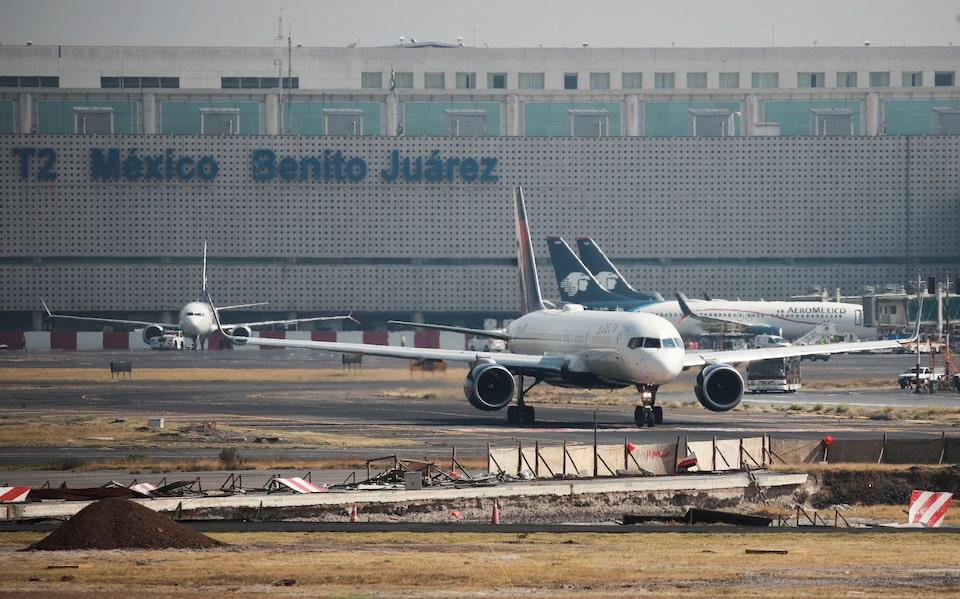
MEXICO CITY, Aug 12 (Reuters) - Carriers Delta (DAL.N) , opens new tab and Aeromexico on Tuesday argued against winding down their antitrust agreement, as proposed by the U.S. Department of Transportation, while asking for an extension to do so if needed. The two, in a filing to authorities, requested the deadline be extended to March 28 of next year, the end of the sector's "winter season," from the current October 25. Sign up here. https://www.reuters.com/sustainability/boards-policy-regulation/delta-aeromexico-request-extension-wrap-up-antitrust-agreement-2025-08-13/
2025-08-12 23:47
CoreWeave reports quarterly revenue of $1.21 billion Net loss of $290.5 million, compared with estimates of $190.6 million CEO says significant challenge right now is accessing power shells CoreWeave is seeing rising demand for AI inference Aug 12 (Reuters) - CoreWeave (CRWV.O) , opens new tab easily topped quarterly revenue estimates on Tuesday as the rapid adoption of artificial intelligence tools boosted demand for its cloud services, but a bigger-than-expected net loss sent its shares slumping 10% after the bell. The company currently operates 33 AI data centers across the U.S. and Europe and offers access to backer Nvidia's (NVDA.O) , opens new tab chips, which are highly coveted by enterprises to train and run large AI models amid intense competition. Sign up here. CoreWeave posted second-quarter revenue of $1.21 billion, beating estimates of $1.08 billion. It also reported a revenue backlog of $30.1 billion as of the end of June, compared with $25.9 billion on March 31. "Demand is humming, but it is the cost of growth that tempered the stock down in aftermarket trading," said Michael Ashley Schulman of Running Point Capital Advisors. Operating expenses jumped to $1.19 billion in the second quarter, from $317.7 million a year earlier. The company posted a net loss of $290.5 million, compared with analysts' average estimate of $190.6 million, according to data compiled by LSEG. "We are scaling rapidly as we look to meet the unprecedented demand for AI," CEO Michael Intrator said. "There's a lot of different pieces that are constrained, but ultimately the piece that is the most significant challenge right now is accessing power shells that are capable of delivering the scale of infrastructure that our clients are requiring." The company reiterated the benefits of its $9 billion all-stock deal for crypto miner Core Scientific (CORZ.O) , opens new tab, which will help it secure the firm's entire 1.3 GW power under contract and future pipeline. The comment comes as Two Seas Capital, the largest shareholder of Core Scientific, said last week it would vote against the sale. Investors have also focused on the company's reliance on a few big customers. CoreWeave said it has also expanded contracts with hyperscalers in the past few weeks to meet their growing internal and external demand. "The backlog surge to $30B+ suggests demand visibility well beyond 2025, but the concentration in mega-customers like OpenAI means those relationships remain both the crown jewel and the single point of failure," said eMarketer analyst Jeremy Goldman. CoreWeave has seen rising demand for AI inference, especially when models use chain-of-thought reasoning to go through a problem in a logical sequence — a technique doubled down on by frontier labs such as OpenAI. "The actual quality of the intelligence was improved so much by the chain-of-reasoning models, but it also requires an incredible increase in the amount of computing to be able to drive that level of accuracy," Intrator said in an interview. The Livingston, New Jersey-based company raised its annual revenue forecast to be between $5.15 billion and $5.35 billion. It had previously projected $4.9 billion to $5.1 billion. Shares of the company, which reaffirmed its annual capital expenditure projection, were trading at $133.71 after hours. The stock has gained nearly three-fold since the IPO in March. https://www.reuters.com/business/coreweave-revenue-beats-estimates-ai-boom-shares-fall-bigger-loss-2025-08-12/