2025-08-11 21:06
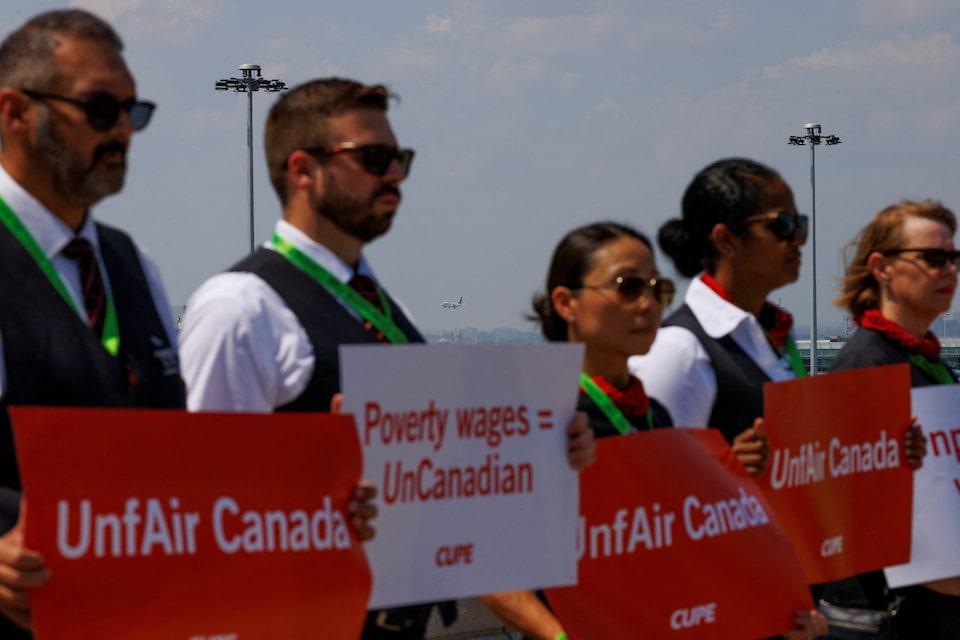
Cabin crew protest unpaid work at Canadian airports Union seeks pay for non-flight tasks, higher wages for new recruits Air Canada said it would make attendants best paid in Canada MONTREAL/TORONTO Aug 11 (Rtrs) - Hundreds of cabin crew members took their fight to major Canadian airports on Monday, picketing against unpaid labor, as talks on wages intensify between Air Canada AC.TO and its flight attendants this week ahead of a possible strike. A group of 700 mostly female flight attendants in crisp dark grey uniforms demonstrated at Toronto Pearson International Airport, donning signs with messages like "unpaid work won't fly," according to The Canadian Union of Public Employees, which said the contention is a key issue in contract talks with the carrier as a possible strike may come as early as August 16. Sign up here. A walkout during the busy summer travel season would be a blow for Canada's largest carrier, which recently reported a drop in second-quarter profit, weighed by weak passenger traffic to its key U.S. market. The negotiations between Air Canada and the union representing more than 10,000 flight attendants are further testing the way airlines compensate cabin crews, following earlier gains by cabin crew at some U.S. carriers. Most airlines have paid cabin crew members only when planes are in motion. But in their latest contract negotiations, flight attendants in North America have sought compensation for hours worked, including for tasks like boarding passengers and waiting around the airport before and between flights. The Canadian Union of Public Employees, which represents Air Canada flight attendants, has said it is also asking for higher pay for members, especially for recent recruits. Air Canada said in a statement it remains at the bargaining table and is focused on achieving a negotiated settlement that would make its flight attendants the best paid in the country, while supporting the long-term growth of the company. CUPE Strike Committee Chair Shanyn Elliott told reporters in Toronto that attendants perform an average of 35 unpaid work hours monthly for safety checks, boarding, deplaning, and passenger emergencies. She said their last contract was signed 10 years ago, so wages lag inflation, and some attendants rely on food banks or shared bunk rooms. The demonstrations did not impact Air Canada's operations. Both sides have said they want to get a negotiated agreement. Jim Ken, 73, an Air Canada passenger who is flying to Malta for vacation, told Reuters that he has sympathy for the workers, but is concerned about delays when he returns home in 11 days. “I hope flight attendants get a fair contract and they deserve it," he said. "I just hope everything goes smooth ... for both sides." Jennifer Kozelj, press secretary to Canada's Minister of Jobs and Families, said both sides are working with federal mediators. "We have faith in their ability to reach an agreement. Canadians expect them to work this out at the bargaining table." https://www.reuters.com/business/world-at-work/air-canada-pay-talks-intensify-cabin-crew-protest-threaten-strike-2025-08-11/
2025-08-11 21:05
ORLANDO, Florida, Aug 11 (Reuters) - TRADING DAY Making sense of the forces driving global markets Sign up here. By Jamie McGeever, Markets Columnist World markets got the week off to a subdued start on Monday, although the Nasdaq nudged a new high, as a light earnings and data calendar allowed investors to digest the latest tariff-related news and look ahead to Tuesday's U.S. inflation figures. More on that below. In my column today I look at the blizzard of U.S. labor market data - often conflicting, sometimes distorted - and ask which number best shines a light through the fog. Could it now be continuing jobless claims? If you have more time to read, here are a few articles I recommend to help you make sense of what happened in markets today. Today's Key Market Moves Tariffs, CPI nerves soften sentiment Wall Street closed lower on Monday, even as the Nasdaq touched fresh highs, with the latest news related to U.S. President Donald Trump's tariff war generally sapping risk appetite rather than strengthening it. Trump signed an executive order on Monday extending the China tariff deadline for another 90 days, with only hours to go before U.S. tariffs on Chinese goods were due to snap back to triple-digit rates. This came after a U.S. official told Reuters over the weekend that chip companies Nvidia and Advanced Micro Devices have agreed to give the U.S. government 15% of revenue from sales of advanced chips to China. The news was surprising and confusing. "It's wild," said Geoff Gertz, a senior fellow at Center for New American Security, an independent think tank in Washington, D.C. "Either selling H20 chips to China is a national security risk, in which case we shouldn't be doing it to begin with, or it's not a national security risk, in which case, why are we putting this extra penalty on the sale?" A rise for Nvidia shares this week would mark a record-breaking 12 consecutive weekly gains. The stock now accounts for 8% of the entire S&P 500 market cap, the biggest weight of any individual stock in the wider index since the data began in 1981, according to Apollo's Torsten Slok. The so-called "Magnificent Seven" megacap stocks, of which Nvidia is one, now account for a record 35.3% of the S&P 500's total market cap. The top 10 stocks make up a record 40% of the index's market cap. This concentration risk is nothing new, of course, but the steady advance deeper into uncharted territory is bound to unnerve some investors. Meanwhile, U.S.-Brazil relations show no sign of improving. Brazil's Finance Minister Fernando Haddad said on Monday that his virtual meeting with U.S. Treasury Secretary Scott Bessent scheduled for later this week has been canceled, a blow to Brasilia as it attempts to get the 50% tariff on many Brazilian exports to the U.S. reduced. Speculation continues to swirl around who Trump will nominate to replace Fed chair Jerome Powell, whose term officially ends next May. As of Monday, no fewer than eight names appear to be under consideration, according to media reports. The main economic indicators on Monday were from China, which showed producer prices fell more than expected in July and no change in consumer prices. Deflation still stalks China, in contrast to the U.S. where tariffs are putting upward pressure on prices. Attention on Tuesday turns to Australia, where the central bank is expected to reduce its cash rate by a quarter point to 3.60%, and then to CPI inflation figures for July from the U.S. Which data point may shine light through U.S. jobs fog? Amid a blizzard of contradictory signals, it's becoming increasingly difficult to get any visibility on the U.S. labor market. But of all the numbers that feed into the all-important unemployment rate, the one worth paying most attention to may be continuing weekly jobless claims. Federal Reserve Chair Jerome Powell has said that while he and his colleagues look at the "totality" of the data, the best gauge of the health of the labor market is the unemployment rate. That's currently 4.2%, low by historical standards, and consistent with an economy operating at full employment. But it is a lagging indicator, meaning that once it starts to rise sharply, the economy will probably already be in a very precarious position. And it is also being depressed by labor demand and supply factors unique to the U.S.'s current high tariff, low immigration era. LOW FIRE, LOW HIRE Economic growth is slowing. Broadly speaking, it is running at an annual rate of just over 1%, half the pace seen in the last few years. Unsurprisingly, firms' hiring is slowing too. The latest Job Openings and Labor Turnover Survey, or JOLTS, showed hiring in June was the weakest in a year, while July's nonfarm payrolls report and previous months' revisions were so disappointing that President Donald Trump fired the head of the agency responsible for collecting the data. But the unemployment rate isn't rising, largely because firms aren't firing workers. Why? Perhaps because they are banking on tariff and inflation uncertainty lifting in the second half of the year. It's also possible that firms are still scared from the post-pandemic labor shortages. Whatever the reason, the pace of layoffs simply has not picked up, the monthly JOLTS surveys show. Layoffs in June totaled 1.6 million, below the averages of the last one, two and three years. Meanwhile, lower immigration, increased deportations, and fewer people re-entering the labor force are offsetting weak hiring, thus keeping a lid on the unemployment rate. The labor force participation rate in July was 62.2%, the lowest since November 2022. And what about weekly jobless claims, another key variable in the labor market picture? In previous slowdowns, rising layoffs would be reflected in a spike in the number of people claiming unemployment benefits for the first time. That's not happening either. Last week's 226,000 initial claims were right at the average for the past year, and only a few thousand higher than the averages over the past two and three years. "It's a low fire, low hire economy," notes Oscar Munoz, U.S. rates strategist at TD Securities. REGULAR CHECK-UP One high-frequency number that has gone under the radar, but which merits more attention is continuing jobless claims, which measures the number of workers continuing to file for unemployment benefits after losing their jobs. Rising continued claims suggest people actively looking for a job are struggling to get one, a sign that the labor market could be softening. That figure spiked last week to 1.97 million, the highest since November 2021, which in theory should put upward pressure on the unemployment rate. Using the 'stock' versus 'flow' analogy, continuing claims are the 'stock,' and weekly claims are the 'flow'. Everyone will have their own view on what's more important, but right now initial claims are offering no guidance while continuing claims are pointing to softening in the job market. Fed officials are on alert, but what would move them to cut rates? Munoz and his colleagues at TD Securities estimate that continuing claims of around 2.2 million would be consistent with an unemployment rate of 4.5%, a level of joblessness most economists agree would prompt the Fed to trim rates. That's also the year-end unemployment rate in the Fed's last economic projections from June, a set of forecasts which also penciled in 50 bps of easing by December. An unemployment rate of 4.4% would probably tip the balance on the Federal Open Market Committee, while 4.3% would make it a much closer call, perhaps a coin toss. Further muddying the picture, other indicators suggest the labor market is ticking along nicely. July's payrolls report showed that average hourly earnings last month rose at a 3.9% annual rate, consistent with the level seen in the past year. And the average number of hours worked was 34.3 hours, right at the mean for the past two years. These numbers and the JOLTS data are released monthly, and there will be one more of each before the Fed's September 16-17 policy meeting. But if the increased focus on the unemployment rate means investors want a more regular labor market temperature check, they should keep a close eye on weekly continuing claims. What could move markets tomorrow? Want to receive Trading Day in your inbox every weekday morning? Sign up for my newsletter here. Opinions expressed are those of the author. They do not reflect the views of Reuters News, which, under the Trust Principles , opens new tab, is committed to integrity, independence, and freedom from bias. https://www.reuters.com/business/global-markets-trading-day-graphic-2025-08-11/
2025-08-11 21:01
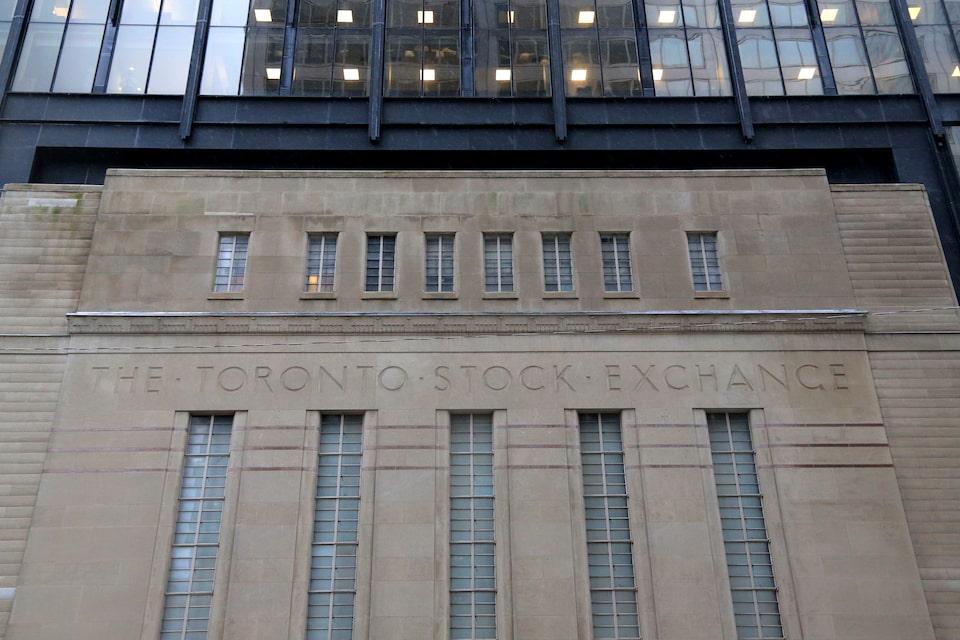
TSX ends up 0.1% at 27,775.23 Constellation Software adds 4.4% on earnings beat Materials group loses 0.5% as gold prices fall Energy ends down 0.9% Aug 11 (Reuters) - Canada's main stock index edged higher on Monday as industrial and technology shares notched gains, but the move was limited ahead of a key U.S. inflation report and as investors fretted about a seasonally weak period for the market. The S&P/TSX composite index (.GSPTSE) , opens new tab ended up 16.55 points, or 0.1%, at 27,775.23, after last week posting its biggest weekly gain since September. Sign up here. "We got a big inflation report, CPI, tomorrow, which will be a big number," said Allan Small, senior investment advisor of the Allan Small Financial Group with iA Private Wealth. "That will move markets on both sides of the border." Wall Street's main indexes ended lower as investors anxiously awaited U.S. consumer price index data on Tuesday to assess the outlook for interest rates and eyed U.S.-China trade developments. U.S. President Donald Trump has signed an executive order extending a pause in sharply higher U.S. tariffs on Chinese imports for another 90 days, a White House official said. "I would not be surprised to see volatility in the last two weeks of August and of course into September," Small said. Over the past 35 years, August and September have ranked as the worst-performing months for the S&P 500, the U.S. benchmark, according to the Stock Trader's Almanac. The technology sector (.SPTTTK) , opens new tab added 0.2%, helped by a gain of 4.4% for the shares of Constellation Software (CSU.TO) , opens new tab after the company's quarterly earnings beat estimates. Industrials (.GSPTTIN) , opens new tab were up 0.3% and health care (.GSPTTHC) , opens new tab ended 4.9% higher, with shares of Bausch Health Companies Inc jumping 16.1%. The materials sector (.GSPTTMT) , opens new tab, which contains metal mining shares, was a drag. It fell 0.5%, weighed by a drop in gold prices as Trump said tariffs will not be placed on imported gold bars. Shares of Barrick Mining Corp (ABX.TO) , opens new tab were down 2.4% after the company reported second-quarter results. Energy (.SPTTEN) , opens new tab was down 0.9% as the price of oil settled 0.1% higher at $63.96 a barrel. https://www.reuters.com/world/americas/tsx-ends-higher-move-limited-ahead-us-inflation-report-2025-08-11/
2025-08-11 20:57
NEW YORK, Aug 11 (Reuters) - Do Kwon, the South Korean cryptocurrency entrepreneur facing U.S. fraud charges over two digital currencies that lost an estimated $40 billion in 2022, is expected to enter a guilty plea, court records showed on Monday. In a brief scheduling order, U.S. District Judge Paul Engelmayer said he had been advised that Kwon may change his plea and set a hearing for Tuesday at 10:30 a.m. EDT (1430 GMT) in Manhattan federal court. Sign up here. Kwon, who co-founded Singapore-based Terraform Labs and developed the TerraUSD and Luna currencies, had previously pleaded not guilty to a nine-count indictment charging him with securities fraud, wire fraud, commodities fraud and money laundering conspiracy. Neither lawyers for Kwon nor the Manhattan U.S. Attorney's office, which brought the charges, immediately responded to requests for comment. https://www.reuters.com/legal/government/crypto-exec-do-kwon-charged-with-fraud-expected-plead-guilty-2025-08-11/

2025-08-11 20:32
Vitol's subsidiary rushing to secure deal with bondholders Some creditors unwilling to accept non-cash offers Final hearing in Delaware set for August 18 HOUSTON, Aug 11 (Reuters) - Subsidiaries of miner Gold Reserve (GRZ.V) , opens new tab and commodities trader Vitol are nearing the finish line in a fiercely contested U.S. court-organized auction that will determine control of Venezuela-owned U.S. refiner Citgo Petroleum, according to two sources with knowledge of the process and court filings. A court officer overseeing the bidding round last month recommended a $7.4-billion offer by a group led by a unit of Bermuda-based Gold Reserve (GRZ.V) , opens new tab as the auction's winner, out of a total of five bids submitted, including one by a Vitol subsidiary. Delaware Judge Leonard Stark is expected to choose the winner after a final sale hearing on August 18. Sign up here. The decision will determine control of the crown jewel of Venezuela's overseas assets, the seventh-largest U.S. refiner. Despite Gold Reserve's leadership status, its bid faces objections from parties in the case and holders of a Venezuelan bond, some of whom the Vitol unit is seeking to strike a deal with, in a move that could shake up the auction again. Following his recommendation, court officer Robert Pincus last week told the court that a competing bid by a company he did not identify was on the table, but it had not so far met the criteria to be considered superior to the Gold Reserve group's offer. The bid he was referring to was made by the Vitol subsidiary, according to the sources, who spoke on the condition of anonymity because they were not authorized to speak publicly. Pincus' disclosure was the latest twist in a complex court process initiated by miner Crystallex against Venezuela in 2017. Over a dozen additional companies hit by defaults in Venezuela or whose assets were expropriated by the state are pursuing proceeds from the auction. Gold Reserve on Monday asked the court to proceed to the final sale hearing as scheduled and warned that any competing offer, including a non-cash consideration, would be rejected by the company, which is also a creditor in the case trying to recover $1.18 billion from the expropriation of its assets. "This rival bid appears to be an attempt to derail a well-documented and progressed auction," Paul Rivett, Gold Reserve's vice chairman of the board, told Reuters. Vitol declined to comment. HOT COMPETITION Gold Reserve's frontrunner status in the auction of Citgo's parent PDV Holding could be threatened if the Vitol unit succeeds in securing a payment agreement with holders of the PDVSA 2020 bond, collateralized with Citgo equity, sources close to the talks said. Vitol's push follows objections by bidders and creditors, ranging from mining and oil firms whose Venezuelan assets were expropriated to holders of defaulted notes, which have flooded the court in recent weeks opposing some terms of the bid by Gold Reserve's subsidiary Dalinar Energy, especially its lack of an agreement to pay the bondholders. The Vitol subsidiary's improved offer, submitted in late June after rival consortia had sent and negotiated theirs, includes a purchase price of $8.45 billion for the PDV Holding shares and intends to make a separate payment to the bondholders, according to the bid, filed with the bidder's name redacted. The $8.45 billion would cover the claims of 13 of a total of 15 creditors registered to claim proceeds, versus the 11 creditors expected to be covered by the Gold Reserve group's bid. But because the Vitol subsidiary's offer was not entirely disclosed, it remains unclear if it includes non-cash considerations. "We intend to finance the transaction entirely with cash on hand and existing or new intracompany credit facilities," the company told the court. The Vitol subsidiary also told the court that it was in discussions with the 2020 bondholders. Pincus last week confirmed the talks, but at the time of his submission on Thursday, no documentation of any such agreements had been received. "As much as they've got the top-line number looking good, the reality is, unless it's all cash, that it doesn't conform as required," Gold Reserve's Rivett said, referring to the competing offer. Pincus did not say if a deadline had been set for the Vitol unit to provide the required agreements, but the clock is ticking for the judge to stick to his proposed calendar without additional delays. A procedural conference is scheduled for August 13, and a final hearing marked as the last step before a decision by Judge Stark on the winner remains set for August 18. "It's disconcerting because this company (the rival bidder) has been in this process. They've done the diligence. They understand how the process works. They could have put a bid in and become the stalking horse. They didn't. They could have put a bid in to become the recommended bidder. And they didn't," Rivett added. The PDVSA 2020 bond rose 1.375 cents on Monday to trade at 91 cents on the dollar, the highest level in nearly a month. https://www.reuters.com/business/energy/gold-reserve-vitol-battle-citgos-parent-before-sale-hearing-2025-08-11/
2025-08-11 20:30
China-US tariff truce extended, White House says Analysts say quadrupling soybean orders is 'highly unlikely' Aug 11 (Reuters) - U.S. soybean prices soared to a two-week high on Monday after President Donald Trump urged China to quadruple its purchases ahead of a tariff truce deadline, though analysts questioned the feasibility of any such deal. China, the world's biggest soybean importer, has not yet pre-purchased soybeans from the upcoming U.S. harvest amid trade tensions with Washington, an unusual delay that has fuelled concerns among U.S. farmers and traders as the harvest export season approaches. Sign up here. "Rapid service will be provided. Thank you President XI," Trump said in a late-night Sunday social media post. A tariff truce between Beijing and Washington was set to expire on Tuesday, but Trump signed an executive order extending the tariff deadline by 90 days, a White House official said on Monday. The most active soybean contract on the Chicago Board of Trade jumped 2.4% to $10.11-1/4 a bushel. China imported roughly 105 million metric tons of soybeans last year, with just under a quarter coming from the U.S. and most of the remainder from Brazil. Quadrupling shipments would require China to import the bulk of its soybeans from the U.S. China imports the oilseed to crush it into soymeal for livestock feed. After record imports earlier this year, traders said a glut of soymeal in China would likely reduce Chinese demand for soybeans. "It's highly unlikely that China would ever buy four times its usual volume of soybeans from the U.S.," said Johnny Xiang, founder of Beijing-based AgRadar Consulting. It was unclear whether the U.S. secured any commitment by China to buy more U.S. soybeans as a condition for the truce extension, as Trump looks to reduce China's trade surplus with the U.S. China's soymeal futures fell 0.65% to 3,068 yuan per metric ton on expectations that U.S. imports could increase supply. The United States faces fierce competition for soybean sales to China from Brazil, the world's biggest exporter. U.S. sales would suffer if China keeps a tariff on American soy, said Gary Vetter, who raises crops and cattle in Westside, Iowa. "They're going to go to their cheapest producer," he said, referring to China. U.S. farmers largely backed Trump in his campaigns to become president and said they appreciated his social media post, even if it does not immediately increase export sales. "He is trying to support the United States," Vetter said. China's Ministry of Commerce did not immediately respond to a Reuters request for comment. SOYBEAN SHIFT During the first Trump administration, a trade war with China hurt U.S. soybean growers as China shifted purchases toward Brazil. In the years since, China has looked to ramp up crop imports from South America and is developing a port in Chancay, Peru. Under the Phase One trade deal that China signed to end the trade war, Beijing agreed to boost purchases of U.S. agricultural products, including soybeans. However, Beijing fell far short of meeting those targets. "They certainly don’t have the room to buy multiples of U.S. bean imports," financial firm Marex said. China started importing U.S. soybeans in 1995, and the country typically begins booking post-harvest purchases much earlier in the year. This year is the longest that China has avoided booking soybeans from the autumn harvest since at least 2005, according to U.S. Department of Agriculture data and interviews with exporters. "On Beijing's side, there have been quite a few signals that China is prepared to forego U.S. soybeans altogether this year," said Even Rogers Pay, an agricultural analyst at Trivium China. Reuters previously reported that Chinese feedmakers have purchased three Argentine soymeal cargoes as they aim to secure cheaper South American supplies. The U.S. soybean industry has been seeking alternative buyers, but no country matches China's scale. Last year, China imported 22.13 million tons of soybeans from the U.S., and 74.65 million tons from Brazil, according to Chinese data. "We're all working to diversify away from China, but China is critically important for us," said Jim Sutter, CEO of the U.S. Soybean Export Council. "So we've been encouraging the U.S. government to work with China to try and get another agreement in place." https://www.reuters.com/world/us/us-soybean-prices-jump-after-trump-urges-china-quadruple-orders-2025-08-11/