2025-08-04 19:49
OPEC+ to raise output by 547,000 barrels per day in September Group to discuss further hikes at next meeting Trump to raise tariffs on India over Russian oil purchases NEW YORK, Aug 4 (Reuters) - Oil prices fell to their lowest levels in a week on Monday after OPEC+ agreed to another large output increase in September, adding to oversupply concerns after U.S. data showed lacklustre fuel demand in the top consuming nation. Brent crude futures fell 91 cents, or 1.3%, to settle at $68.76 a barrel, while U.S. West Texas Intermediate crude declined by $1.04, or 1.5%, to close at $66.29 a barrel. Sign up here. Both contracts settled at their lowest in a week, after declining close to 3% on Friday. The Organization of the Petroleum Exporting Countries and its allies, together known as OPEC+, agreed on Sunday to raise oil production by 547,000 barrels per day (bpd) for September. The latest in a series of accelerated output increases aimed at capturing market share was in line with market expectations and marks a full and early reversal of the group's largest tranche of output cuts, amounting to about 2.5 million bpd, or about 2.4% of global demand. While the group cited healthy market fundamentals to back its decision, data released by the U.S. government last week showed the weakest gasoline demand in May, the start of the country's summer driving season, since the COVID-19 pandemic of 2020. The data also showed U.S. oil production at a monthly record high in May, adding to global oversupply concerns. Oil traders are now hedging for the possibility of further supply increases from OPEC+, with potential discussions to unwind a further 1.65 million bpd of cuts at the group's next meeting on September 7 adding pressure to oil prices. "OPEC+ retains a substantial amount of spare production capacity, and markets are now watching closely to see whether the group will tap into it," StoneX analyst Alex Hodes said. "So far, there are no clear signals that OPEC+ intends to deploy this additional capacity, but the possibility remains on the table," he added. Analysts at Goldman Sachs expect the actual increase in supply from the eight OPEC+ countries that have raised output since March will be 1.7 million bpd because other members have cut output after overproducing. Investors also continued to digest the impact of the latest U.S. tariffs on exports from dozens of trading partners, and remain wary of further U.S. sanctions on Russia. U.S. President Donald Trump has threatened to impose 100% secondary tariffs on Russian crude buyers as he seeks to pressure Moscow into halting its war in Ukraine. Trump on Monday said he will substantially raise tariffs on India over its purchases of Russian oil, after two Indian government sources told Reuters over the weekend that the country will keep buying oil from Moscow despite Trump's threats. That development helped limit oil's losses. About 1.7 million bpd of crude supply will be at risk if Indian refiners stop buying Russian oil, ING analysts said in a note. "All eyes in the market will now shift to U.S. President Trump's decision on Russia this Friday and whether he targets buyers of Russian oil with secondary sanctions/tariffs or not," UBS analyst Giovanni Staunovo said. https://www.reuters.com/business/energy/oil-falls-opec-output-hike-adds-oversupply-concerns-2025-08-03/
2025-08-04 19:25
Dollar rebounds slightly after Friday's slide Weak jobs, uncertainty over Fed independence weigh on dollar Investors pricing in more than 80% chance of September Fed cut NEW YORK, Aug 4 (Reuters) - The U.S. dollar slightly recovered on Monday, consolidating recent moves, after Friday's trio of market-moving events that showcased the fragility of the greenback: a dismal U.S. jobs report, the resignation of a Federal Reserve Governor, and President Donald Trump's firing of a top statistics official. Those developments battered the currency and prompted investors to ramp up bets of imminent Fed rate cuts. Sign up here. But the dollar's bounce on Monday could be short-lived, analysts said, and the broader downtrend could re-emerge given U.S. policymaking uncertainty and a U.S. economy that is finally showing cracks. Data on Friday showed U.S. employment growth undershot expectations in July while the nonfarm payrolls count for the prior two months was revised down by a massive 258,000 jobs, suggesting a sharp deterioration in labour market conditions. "The U.S. seems to be ... experiencing a slowdown across industries that are doubting the benefits to arrive from deterring overseas production and purchasing," said Juan Perez, director of trading at Monex USA in Washington. "The world is not necessarily experiencing much optimism even as economic indicators here help in suggesting that aid will come from the Fed via rate cuts," he added. In afternoon trading, the dollar rose against the euro, Swiss franc, and the commodity-linked currencies such as the Australian and New Zealand dollars. The euro dipped 0.1% against the U.S. unit to $1.1576 , while the dollar rose 0.5% against the Swiss franc to $0.8078 . The drop in the Swiss currency was not a surprise after Trump hit Switzerland with some of the highest tariffs as part of the White House's global trade reset. The Aussie and New Zealand dollars also declined on Monday versus the greenback, falling 0.2% to US$0.6463 and down 0.3% at US$0.5904 . Against the Swiss franc, the dollar rose 0.5% at 0.8081 . Versus the yen, the U.S. currency gained 0.3% to 146.945 . "July's rebound in the dollar ran into a wall last week, but so far there's no sign of a big jump in any risk premium for holding U.S. assets," said Karl Schamotta, chief market strategist, at Corpay in Toronto. "Strong corporate earnings are - so far - managing to overshadow fears of an incipient slowdown in labor markets, the impact of higher tariffs, the threat to the independence of U.S. statistical agencies, and the growing likelihood that the next Fed chair tries to lead monetary policy in an inflation-boosting dovish direction," he said. BLS FIRING; KUGLER RESIGNATION In other developments, Trump fired BLS Commissioner Erika McEntarfer on Friday, accusing her of faking the jobs numbers. An unexpected resignation by Fed Governor Adriana Kugler also opened the door for Trump to make an imprint on the central bank much earlier than anticipated. Trump has been at loggerheads with the Fed for not lowering interest rates sooner. The developments sent the dollar down more than 2% against the yen and roughly 1.5% against the euro on Friday. The euro slipped 0.2% on Monday to $1.1568 , while sterling was little changed at $1.3275. Trump said on Sunday he will announce a candidate to fill the open position at the Fed and a new BLS head in the next few days. Against a basket of currencies, the dollar edged up 0.1% to 98.77, after sliding more than 1.3% on Friday. The dollar rose 3.4% in July, its biggest monthly gain since a 5% jump in April 2022 and first monthly rise of the year, as markets became more at ease with Trump's trade policy and economic data had remained resilient in the face of tariffs. In other markets, the policy-sensitive two-year Treasury yield fell to a three-month low of 3.659% on Monday as traders heavily raided bets of a Fed cut in September, while the benchmark 10-year yield strayed not too far from a one-month low at 4.2257%. Markets are now pricing an 84% chance the Fed will ease rates by a quarter-point next month owing to the weaker than expected jobs data, according to CME's FedWatch, with just under 60 basis points worth of cuts expected by December, implying two 25 basis point cuts and a 40% chance of a third. https://www.reuters.com/world/india/us-dollar-gains-consolidation-move-after-fed-turmoil-trumps-shake-up-2025-08-04/
2025-08-04 18:18
Stock pickers up 7.8% in 2025 Quants recover from record monthly loss Crowded trades drain gains LONDON/NEW YORK, Aug 5 (Reuters) - Hedge fund returns climbed in July as many were lifted by rising stock markets that hit record highs, though others were caught in turbulence sparked by U.S. trade uncertainty, according to a Goldman Sachs report and sources familiar with the funds. Hedge fund stockpickers returned almost 1.5% in July and are up roughly 7.8% for the year so far, said Goldman Sachs in a note to clients on Monday seen by Reuters. Sign up here. Systematic hedge funds trading stocks were on track to deliver their worst monthly performance on record before rebounding after July 25 to claw back half of their losses, finishing with a negative 2% return, said Goldman. These funds were up 10% for the year so far, however, added the bank. While stockpickers benefited by piling into already crowded trades, hedge funds using algorithms to create systematic trading strategies were hurt by busy trades, said Goldman. The S&P 500 (.SPX) , opens new tab hit record highs during July, but only returned 1.38%. The biggest multi-strategy funds posted muted returns, including Schonfeld Strategic Advisors' flagship fund Strategic Partners, which was down 0.3% in July and is now up 5.8% for 2025, according to a source familiar with the matter. Schonfeld's Fundamental Equity fund gained 1.4% last month and was up 7.1% in the year, the source added. The $76.9 billion British hedge fund Marshall Wace returned a negative 0.2% in its Market Neutral TOPS fund, bringing its half-year performance to roughly 11%. Its Eureka fund returned 1.6% in July and is up 6.1% for 2025 so far, said another source familiar with the fund's results. *result as of Aug 4 https://www.reuters.com/markets/wealth/stockpickers-rise-quants-suffer-multistrategy-funds-steady-july-2025-06-03/
2025-08-04 18:02
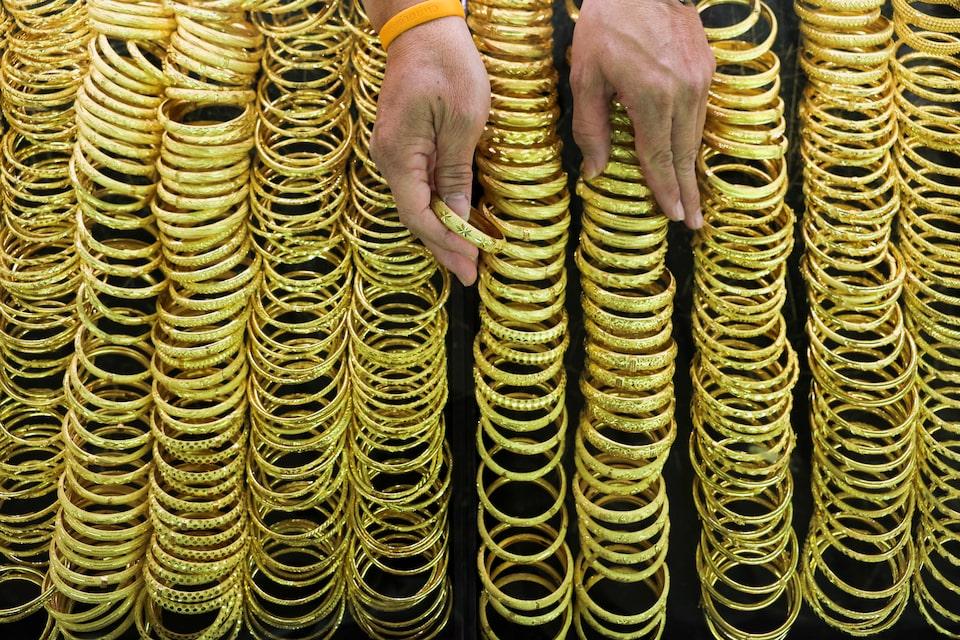
Traders expect US rate cut in September Fresh tariffs imposed by Trump to stay, says Trade Rep Palladium at a 3-week low Aug 4 (Reuters) - Gold prices rose for a third straight session on Monday after last week's economic data fueled expectations of interest rate cuts by the U.S. Federal Reserve. Spot gold rose 0.3% to $3,372.15 per ounce as of 0146 p.m. ET (17:46 GMT), its highest level since July 24. U.S. gold futures settled 0.8% higher at $3,426.4. Sign up here. "The odds are stronger now for a rate cut in September and even stronger for another rate cut in December. That coupled with the headwinds of inflation, I think is pretty bullish for gold," said Daniel Pavilonis, senior market strategist at RJO Futures. Last week, data showed that U.S. employment growth was weaker than expected in July while the nonfarm payrolls count for the prior two months was revised down by a massive 258,000 jobs, suggesting a sharp deterioration in labor market conditions. Additionally, the Fed's preferred gauge, U.S. PCE inflation data, increased 0.3% in June after an upwardly revised 0.2% gain in May as tariffs started raising the cost of some goods. According to the CME FedWatch tool, traders now see an 87.8% chance of a September rate cut, up from just over 63% a week ago. Bullion typically performs well in a low-interest-rate environment and is regarded as a hedge against inflation. The tariffs U.S. President Donald Trump imposed last week on scores of countries are likely to stay in place rather than be cut as part of continuing negotiations, Trade Representative Jamieson Greer said in comments aired on Sunday. Trump set rates including a 35% duty on many goods from Canada, 50% for Brazil, 25% for India, 20% for Taiwan and 39% for Switzerland, according to a presidential executive order. Elsewhere, spot silver was up 0.9% at $37.35 per ounce. Platinum rose 1.3% to $1,332.20, while palladium slipped 1.6% to $1,188.90 after reaching a three-week low earlier in the session. Palladium prices still has some upside and are likely to see a rebound with downside support at $1,180/oz and upside breakout at $1,230, Pavilonis said. https://www.reuters.com/world/china/gold-extends-gains-us-rate-cut-expectations-2025-08-04/
2025-08-04 17:53
Aug 4 (Reuters) - Energy solutions company Lummus Technology said on Monday it has confidentially filed for an initial public offering in the United States amid President Donald Trump's broader strategy to enhance domestic energy production. U.S. IPO market activity, which began the year sluggishly, is showing signs of a steady rebound after recent new listings attracted strong investor demand. Sign up here. During his presidential campaign, Trump promised to increase U.S. energy production, and his recent signing of the "Big Beautiful Bill" further reinforced the ongoing dominance of oil and gas in the country's energy mix. "Given the outsized gains posted by recent energy listings amid surging AI-driven power demand and tailwinds from Trump’s 'Unleash American Energy' agenda, the timing to go public seems right for Lummus," said Lukas Muehlbauer, IPOX research associate. Oilfield services provider Flowco (FLOC.N) , opens new tab and Infinity Natural Resources (INR.N) , opens new tab, which went public in January, drew a warm reception from investors on debut. Muehlbauer said American energy firms are increasingly "shielded from Middle East-focused geopolitical risks" as the current administration moves to ramp up domestic production. In 2020, The Chatterjee Group's unit and Rhone Capital acquired , opens new tab Lummus Technology from McDermott International at a $2.73 billion valuation. Black Rock Coffee Bar and crypto custody startup BitGo, among others, confidentially filed for a U.S. IPO in July, joining a growing number of companies aiming to tap into strong market momentum. Confidential filings let companies share private info with regulators and test investor interest before formal launch. Founded in Houston, Texas, in 1907, Lummus Technology offers process technologies, lifecycle services and digitalization tools to petrochemicals, refining, gas processing and sustainable energy industries. "Lummus offers investors an alternative to capital-intensive energy operators by positioning itself as a technology licensor and services provider with high-margin revenue through recurring royalties and lifecycle support rather than owning heavy assets," said Muehlbauer. The terms of the offering were not disclosed. https://www.reuters.com/business/energy/energy-tech-firm-lummus-confidentially-files-us-ipo-amid-trumps-domestic-push-2025-08-04/

2025-08-04 17:37
Aug 4 (Reuters) - U.S.-based Commonwealth LNG on Monday said it has chosen France-based Technip Energies (TE.PA) , opens new tab to provide engineering, procurement, and construction (EPC) services for its 9.5 million tonnes per annum (mtpa) LNG facility in Cameron Parish, Louisiana. The United States is the world's largest exporter of LNG. Based on projects under construction and those expected to receive financial approval this year, the country could triple its export capacity by 2030. Sign up here. The Cameron Parish project is expected to reach a final investment decision in the second half of 2025, with LNG production slated to begin in 2029. Commonwealth LNG is working to build what it says will be the United States' first integrated LNG export facility, enabling its majority shareholder, Kimmeridge, to sell gas from its Eagle Ford shale operations directly to the plant. Last month, Reuters had reported that oil giant Saudi Aramco (2222.SE) , opens new tab is in talks , opens new tab with Commonwealth LNG to buy liquefied natural gas from the the proposed facility, as the energy giant seeks to strengthen its position in the global market for the supercooled fuel. https://www.reuters.com/business/energy/commonwealth-lng-selects-technip-energies-us-lng-project-2025-08-04/