2025-07-11 06:58
Gas business down $0.1 bln-$0.3 bln Q2 vs Q1 Oil business down $0.6 bln-$0.8 bln Q2 vs Q1 Downstream divsision to benefit from higher margins LONDON, July 11 (Reuters) - BP's (BP.L) , opens new tab second-quarter results are expected to be impacted by lower prices received for gas and oil, while its upstream output is set to be higher than previously forecast, the company said in a trading update on Friday ahead of results due on August 5. Crude oil prices fell in the quarter as OPEC+, made up of the Organization of the Petroleum Exporting Countries and allies such as Russia, started to unwind self-imposed production cuts of 2.17 million barrels per day in April. Sign up here. BP said crude oil prices averaged $67.88 a barrel in the second quarter, compared with $75.73 a barrel in the previous quarter. "In the gas & low carbon energy segment, realisations (prices received), compared to the prior quarter, are expected to have an impact in the range of $(0.1) to (0.3) billion," BP said. "In the oil production & operations segment, realisations, compared to the prior quarter, are expected to have an impact in the range of $(0.6) to (0.8) billion." BP said its gas trading result is expected to be average, without giving further details. BP guided for a rise in average refining margins in the quarter to $21.1 a barrel from $15.2 a barrel in the previous three months. Its customers and products business is set to benefit from the higher refining margins to the tune of $300 million to $500 million compared to the previous quarter, despite higher maintenance activity at its plants. It said oil trading was strong in the division. BP expects its oil and gas output in the second quarter to be above the first quarter, when it produced around 2.24 million barrels of oil equivalent per day, citing its U.S. onshore business as a driver. It had previously guided for a flat trend. Its net debt is expected to be slightly lower than the previous quarter's $27 billion. Rival Shell (SHEL.L) , opens new tab said earlier this week that it expects quarterly earnings to be hit by weaker trading in its integrated gas division and losses at chemicals and products operations. https://www.reuters.com/business/energy/bp-flags-lower-gas-oil-price-hit-second-quarter-2025-07-11/
2025-07-11 06:54
UK GDP falls 0.1% in May, after 0.3% decline in April Drops in industry and construction cancel out services growth Data adds to difficulties for UK growth-seeking government Finance minister Reeves says data "disappointing" July 11 (Reuters) - Britain's economy contracted unexpectedly for a second month running in May, official data showed on Friday, compounding worries at home for finance minister Rachel Reeves as the nation navigates growing global turbulence. Gross domestic product shrank by 0.1% after a 0.3% drop in April, the Office for National Statistics said. Sign up here. Economists polled by Reuters had mostly forecast that gross domestic product would rise by 0.1% from April's level. And while the services sector eked out a sliver of growth, declines in industrial output and construction dragged down overall output. Following a growth surge early in the year, Britain's economy could now be facing flat or weaker growth than previously expected for the April-to-June period, economists said. Friday's data now adds to expectations the Bank of England will cut interest rates next month. "The lack of momentum in the UK economy indicated by these sluggish figures means that an August interest rate cut currently looks inevitable, despite the recent spike in inflation," said Suren Thiru, economics director at accountancy body ICAEW. Prime Minister Keir Starmer's Labour government has struggled to improve growth meaningfully in its first year, with a tax hike on employers and U.S. President Donald Trump's trade wars weighing on the economy. Britain's goods exports to the United States - its single-largest export destination - surged earlier this year as U.S. importers rushed to beat the imposition of Trump's tariffs. But they fell sharply in April. And trade data published on Friday showed only a slight recovery to around 4.4 billion pounds ($6.0 billion) in May, bringing export levels back down to where they were roughly three years ago. Economists say it looks increasingly likely Reeves will need to raise taxes again in her next budget - something she had hoped to avoid. "While today's figures are disappointing, I am determined to kickstart economic growth," Reeves said of Friday's data. Britain's economy expanded rapidly in the first quarter of 2025, outstripping growth in other countries in the Group of Seven advanced economies. In May the Bank of England revised up its full-year growth forecast to 1%. However, much of the growth in early 2025 was likely linked to the expiry of a tax break for some home purchases in April, which boosted the sector before the deadline, as well as a rush by manufacturers to beat higher U.S. import tariffs. The BoE has said it thinks the economy grew by about 0.25% in the second quarter of 2025. After Friday's May figures, June's monthly data will need to show at least a flat reading, assuming no revisions to earlier months, in order to achieve any growth for the quarter, the ONS said. A month-on-month contraction of 0.4% or worse for June would herald a quarterly contraction. "The second straight decline in monthly real GDP in May will increase concerns that the government's growth plan has been derailed by external and domestic shocks," said Raj Badiani, economics director, Europe, at S&P Global Market Intelligence. Yael Selfin, chief economist at KPMG UK, said she expected the economy to have remained flat in the second quarter, but spending by households might now be picking up now. "With wage growth remaining ahead of inflation and borrowing costs set to ease further, a modest pick-up in consumer spending could be on the cards in the second half of the year," she said. ($1 = 0.7386 pounds) https://www.reuters.com/sustainability/sustainable-finance-reporting/uk-economy-shrinks-01-may-ons-says-2025-07-11/

2025-07-11 06:54
Trump announces 35% tariff on Canada Fed's Daly says two rate cuts remain on table for this year Palladium up more than 2% July 11 (Reuters) - Gold prices rose for a third straight session on Friday, as U.S. President Donald Trump's announcement of new tariffs on Canada and broader tariff threats against other trading partners lifted demand for the safe-haven asset. Spot gold was up 0.6% at $3,344.02 per ounce as of 1108 GMT. U.S. gold futures gained 0.9% to $3,355. Sign up here. "We're seeing some growing demand for gold as a haven. There are investors looking for some safety assets despite stock markets hitting highs. And any dip in gold is seen as a buying opportunity now," said Carlo Alberto De Casa, an external analyst at Swissquote. On Thursday, Trump said the United States would impose a 35% tariff on imports from Canada and planned to impose blanket duties of 15% or 20% on most other trade partners. This followed Wednesday's announcement of a 50% tariff on U.S. copper imports and a similar levy on goods from Brazil. "Rising trade tensions have reinvigorated demand for haven assets such as gold amid the prospect of an economic slowdown. The more dovish Fed is also boosting investor appetite," analysts at ANZ wrote in a note. Federal Reserve Governor Christopher Waller reiterated his belief the central bank could cut rates at its policy meeting later this month. Meanwhile, Fed Bank of San Francisco President Mary Daly said two rate cuts remain on the table for this year. Lower rates boost non-yielding gold's appeal. Elsewhere, spot silver rose 1.1% to $37.43, platinum rose 0.2% to $1,363.31 and palladium climbed 2.5% to $1,170.24. The premium of the U.S. futures for silver, platinum and palladium against the London benchmarks rose after Trump's copper tariff announcement this week, leading to a spike in lease rates. "Traders unwound open positions on NYMEX/COMEX and had to borrow the other side," said a precious metals trader, adding that this activity in the so-called white metals left gold unaffected. https://www.reuters.com/world/china/gold-rises-trumps-latest-tariffs-firmer-dollar-caps-gains-2025-07-11/
2025-07-11 06:53
Brent, WTI rise 1% after loss in previous session IEA describes tight market despite flagging surplus for 2025 Summer travel demand propping up prompt market Trump says he will make a major statement on Russia on Monday LONDON, July 11 (Reuters) - Oil prices rose by around 1% on Friday as investors weighed a tight prompt market against a potential large surplus this year forecast by the IEA, while U.S. tariffs and possible further sanctions on Russia were also in focus. Brent crude futures were up 76 cents, or 1.11%, at $69.40 a barrel as of 1153 GMT. U.S. West Texas Intermediate crude ticked up 82 cents, or 1.23%, to $67.39 a barrel. Sign up here. At those levels, Brent was headed for a 1.6% gain on the week, while WTI was up around 0.6% from last week's close. The IEA said on Friday the global oil market may be tighter than it appears, with demand supported by peak summer refinery runs to meet travel and power-generation. Front-month September Brent contracts were trading at a $1.11 premium to October futures at 1153 GMT. "Civilians, be they in the air or on the road, are showing a healthy willingness to travel," PVM analyst John Evans said in a note on Friday. Prompt tightness notwithstanding, the IEA boosted its forecast for supply growth this year, while trimming its outlook for growth in demand, implying a market in surplus. "OPEC+ will quickly and significantly turn up the oil tap. There is a threat of significant oversupply. In the short term, however, oil prices remain supported," Commerzbank analysts said in a note. Further adding support to the short-term outlook, Russian deputy prime minister Alexander Novak said on Friday that Russia will compensate for overproduction against its OPEC+ quota this year in August-September. One other sign of robust prompt oil demand was the prospect of Saudi Arabia shipping about 51 million barrels of crude oil in August to China, the biggest such shipment in over two years. Longer term, however, rival forecasting agency OPEC cut its forecasts for global oil demand in 2026 to 2029 because of slowing Chinese demand, the group said in its 2025 World Oil Outlook published on Thursday. Both benchmark futures contracts lost more than 2% on Thursday as investors worried about the impact of Trump's evolving tariff policy on global economic growth and oil demand. "Prices have recouped some of this decline after President Trump said he plans to make a 'major' statement on Russia on Monday. This could leave the market nervous over the potential for further sanctions on Russia," ING analysts wrote in a client note. Trump has expressed frustration with Russian President Vladimir Putin due to the lack of progress on peace with Ukraine and Russia's intensifying bombardment of Ukrainian cities. The European Commission is set to propose a floating Russian oil price cap this week as part of a new draft sanctions package, but Russia said it has "good experience" of tackling and minimising such challenges. https://www.reuters.com/business/energy/oil-prices-recover-slightly-us-tariffs-opec-downgrade-weigh-2025-07-11/
2025-07-11 06:52
July 11 (Reuters) - Asian stocks drew foreign inflows for a second straight month in June, buoyed by investors wagering on U.S. Federal Reserve interest rate cuts and a softer U.S. dollar, though gains were capped by jitters over looming U.S. tariffs. Foreign investors bought a net $6.02 billion worth of equities across Taiwan, South Korea, India, Thailand, Indonesia, Vietnam, and the Philippines in June, down from $10.65 billion in the previous month, according to LSEG data. Sign up here. The MSCI Asia ex-Japan Index (.MIAPJ0000PUS) , opens new tab rose 5.33% last month, its strongest monthly gain since September 2024, outperforming the MSCI World Index (.MIWD00000PUS) , opens new tab, which advanced 4.36%. Upbeat demand for artificial intelligence-linked products, underscored by record highs in chip-maker Nvidia (NVDA.O) , opens new tab and Broadcom (AVGO.O) , opens new tab last month, spurred strong foreign inflows into Asia's technology sector, with Taiwan and South Korea - the region’s dominant tech exporters - attracting net purchases of $3.22 billion and $2.01 billion, respectively. Foreign investors also added a net $1.69 billion worth of Indian stocks in a third straight month of net purchases. Indonesian, Thai, Vietnamese and Philippines stocks, meanwhile, saw net outflows of $515 million, $243 million, $73 million and $72 million, respectively in the last month. However, analysts remained cautious about the regional outlook, which hinges largely on tariff policy decisions by U.S. President Donald Trump. Earlier this week, Trump postponed his tariff deadline to August 1 from the previous July 9 to allow time for negotiations, but simultaneously escalated trade tensions by announcing new duty rates for several countries, including major trading partners Japan and South Korea, and imposing a 50% tariff on copper. While tariff uncertainty now extends to August, the growth impact may be less severe than feared, Goldman Sachs said on Friday, and that final announcements could act as a risk-positive "clearing event" despite higher-than-expected rates. https://www.reuters.com/business/asian-stocks-attract-foreign-inflows-second-month-tariff-outlook-clouds-2025-07-11/
2025-07-11 06:49
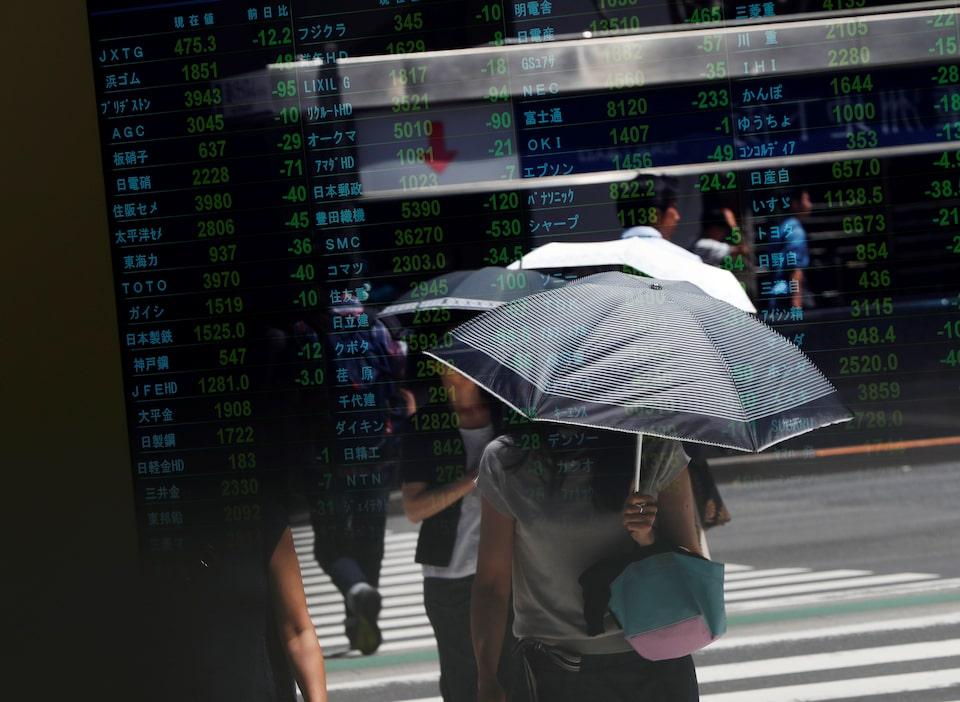
July 11 (Reuters) - Citigroup on Friday introduced its mid-2026 target for the MSCI All Country World Index (ACWI) Local as they expect global equity markets to be rangebound until year-end, with "meaningful" gains coming in the first half of next year. The Wall Street brokerage set a target of 1,150 for the benchmark global equity index (.dMIWD00000P) , opens new tab, implying an upside of about 5% to its last close of 1,100.213. Sign up here. "Our targets imply the most upside in Japan and Europe over the medium term," Citi added. The brokerage maintained its preference for European stocks among global equities, but downgraded Japan to "neutral" on concerns over near-term tariff risks and the strength of the Japanese yen . Global equities have climbed back to all-time highs after a volatile first half of 2025, even as the economic outlook looks uncertain broadly due to Trump's tariffs and geopolitical tensions. Citi set its 2026 year-end earnings-per-share (EPS) growth for the index at above 11%, which remains below consensus estimates of more than 13%. "Though still positive on average, bottom-up EPS forecasts around the world have been under pressure, as markets grapple with trade tensions and geopolitical uncertainty," the brokerage said, as it estimated an EPS growth of just above 5% for this year. Citi maintained its "neutral" stance on U.S. equities and "underweight" on emerging markets and Australia. On the global sector front, it reiterated its "overweight" view on technology and "underweight" rating on consumer stocks. https://www.reuters.com/business/citigroup-sets-mid-2026-target-1150-mscis-global-equity-index-2025-07-11/