2025-06-06 12:34
EU ends wartime quota exemption for Ukraine agri products Pre-war tariffs apply from Friday as temporary fix New deal could be reached by summer, EU agri chief says BRUSSELS, June 6 (Reuters) - The European Union reimposed duties and quotas on Ukrainian agricultural products from Friday, and hopes to clinch a deal on new quotas that will be smaller than imports during the last three years after Russia's invasion, the EU's agriculture commissioner told Reuters. The EU temporarily waived duties and quotas on agricultural products in June 2022 after Russia's full-scale invasion to help Ukraine compensate for the higher costs of its exports, after Russia threatened its traditional Black Sea shipping lanes. Sign up here. Those tariff suspensions expired on Thursday. The EU and Ukraine reverted to the pre-war regime of trade quotas on Friday, while the two sides negotiate a new longer-term deal. Brussels is seeking to strike a balance between supporting Ukraine in its war with Russia, and heeding European farmers' concerns about cheaper Ukrainian imports. "What will be negotiated will be something in between the quotas under the existing DCFTA and the autonomous trade measures, the volumes that have been exported there," EU agriculture commissioner Christophe Hansen said in an interview with Reuters on Thursday. The DCFTA refers to Ukraine and the EU's pre-war trade deal. The EU's "autonomous trade measures" temporarily suspended quotas on Ukrainian imports from 2022. Ukraine's farm minister Vitaliy Koval told Reuters this week that Kyiv was pushing for an agreement on higher quotas than it had before the war. EU farmers have complained that large shipments of cheaper Ukrainian sugar imports under the wartime tariff exemptions have undercut local supplies. The EU triggered "emergency brakes" to re-impose quotas on products including sugar and eggs in the past year, in response to surging imports. The EU's Ukrainian sugar imports soared to 400,000 tons in the 2022/23 season and over 500,000 tons in 2023/24, far exceeding the pre-war quota of 20,000 tons. Hansen said the new quotas on sugar would be "significantly higher" than those under the pre-war arrangements. "I think we can absorb a certain amount of those products," he said, while noting sensitivities among European farmers concerned about higher imports of sugar, poultry and eggs. Negotiations on the new EU-Ukraine deal started on June 2. Hansen said it was feasible a deal could be reached by summer. "It depends now on both sides, I think technically that could be feasible," he said. Agricultural goods accounted for about 60% of Ukraine's total exports last year, with the EU buying around 60% of those goods, worth about $15 billion. A senior Ukrainian lawmaker said last month the loss of tariff-free access to the EU market could cost the country 3.5 billion euros ($3.99 billion) in annual revenue. "Our solidarity with Ukraine is as firm as ever, and therefore we are very committed to deliver this agreement as quickly as possible," Hansen said. The pre-war quota regime, which applies as of Friday, also includes lighter rules on import licenses for some goods like poultry and eggs, where instead of requiring licenses, quotas will be allocated on a first-come, first-served basis. ($1 = 0.8763 euros) https://www.reuters.com/world/europe/new-eu-ukraine-agri-trade-quotas-be-in-between-current-deal-wartime-exemptions-2025-06-06/

2025-06-06 12:34
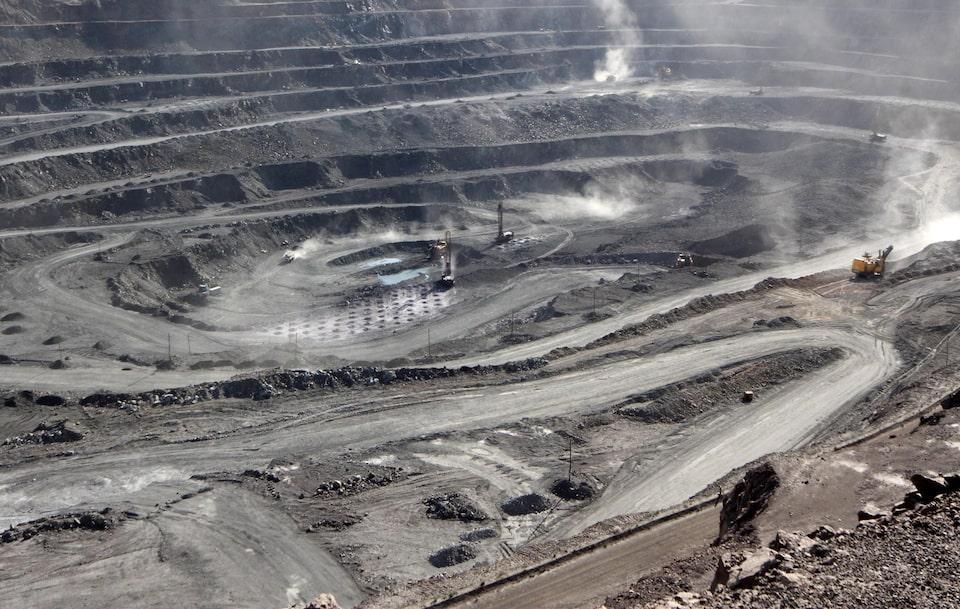
China's expanding sanctions regime modelled on the U.S. Export licence system key for global supply chain surveillance Impossible to know what share of requests get approved BEIJING, June 6 (Reuters) - China has signalled for more than 15 years that it was looking to weaponise areas of the global supply chain, a strategy modelled on longstanding American export controls Beijing views as aimed at stalling its rise. The scramble in recent weeks to secure export licences for rare earths, capped by Thursday's telephone call between U.S. and Chinese leaders Donald Trump and Xi Jinping, shows China has devised a better, more precisely targeted weapon for trade war. Sign up here. Industry executives and analysts say while China is showing signs of approving more exports of the key elements, it will not dismantle its new system. Modelled on the United States' own, Beijing's export licence system gives it unprecedented insight into supplier chokepoints in areas ranging from motors for electric vehicles to flight-control systems for guided missiles. "China originally took inspiration for these export control methods from the comprehensive U.S. sanctions regime," said Zhu Junwei, a scholar at the Grandview Institution, a Beijing-based think tank focused on international relations. "China has been trying to build its own export control systems since then, to be used as a last resort." After Thursday's call, Trump said both leaders had been "straightening out some of the points, having to do mostly with rare earth magnets and some other things". He did not say whether China committed to speeding up licences for exports of rare earth magnets, after Washington curbed exports of chip design software and jet engines to Beijing in response to its perceived slow-rolling on licences. China holds a near-monopoly on rare earth magnets, a crucial component in EV motors. In April it added some of the most sophisticated types to an export control list in its trade war with the United States, forcing all exporters to apply to Beijing for licences. That put a once-obscure department of China's commerce ministry, with a staff of about 60, in charge of a chokepoint for global manufacturing. The ministry did not immediately respond to Reuters' questions sent by fax. Several European auto suppliers shut down production lines this week after running out of supplies. While China's April curbs coincided with a broader package of retaliation against Washington's tariffs, the measures apply globally. "Beijing has a degree of plausible deniability – no one can prove China is doing this on purpose," said Noah Barkin, senior adviser at Rhodium Group, a China-focused U.S. thinktank. "But the rate of approvals is a pretty clear signal that China is sending a message, exerting pressure to prevent trade negotiations with the U.S. leading to additional technology control." China mines about 70% of the world's rare earths but has a virtual monopoly on refining and processing. Even if the pace of export approvals quickens as Trump suggested, the new system gives Beijing unprecedented glimpses of how companies in a supply chain deploy the rare earths it processes, European and U.S. executives have warned. Other governments are denied that insight because of the complexity of supply chain operations. For example, hundreds of Japanese suppliers are believed to need China to approve export licences for rare earth magnets in coming weeks to avert production disruptions, said a person who has lobbied on their behalf with Beijing. "It's sharpening China's scalpel," said a U.S.-based executive at a company seeking to piece together an alternative supply chain who sought anonymity. "It's not a way to oversee the export of magnets, but a way to gain influence and advantage over America." DECADES IN THE MAKING Fears that China could weaponise its global supply chain strength first emerged after its temporary ban of rare earth exports to Japan in 2010, following a territorial dispute. As early as 1992, former Chinese leader Deng Xiaoping was quoted as saying, "The Middle East has oil, China has rare earths." Beijing's landmark 2020 Export Control Law broadened curbs to cover any items affecting national security, from critical goods and materials to technology and data. China has since built its own sanctions power while pouring the equivalent of billions of dollars into developing workarounds in response to U.S. policies. In 2022, the United States put sweeping curbs on sales of advanced semiconductor chips and tools to China over concerns the technology could advance Beijing's military power. But the move failed to halt China's development of advanced chips and artificial intelligence, analysts have said. Beijing punched back a year later by introducing export licenses for gallium and germanium, and some graphite products. Exports to the United States of the two critical minerals, along with germanium, were banned last December. In February China restricted exports of five more metals key to the defence and clean energy industries. Analysts face a hard task in tracking the pace of China's approvals following the Trump-Xi call. "It's virtually impossible to know what percentage of requests for non-military end users get approved because the data is not public and companies don't want to publicly confirm either way," said Cory Combs, a critical minerals analyst with Trivium, a policy consultancy focused on China. https://www.reuters.com/world/china/chinas-rare-earth-weapon-changes-contours-trade-war-battlefield-2025-06-06/
2025-06-06 12:22
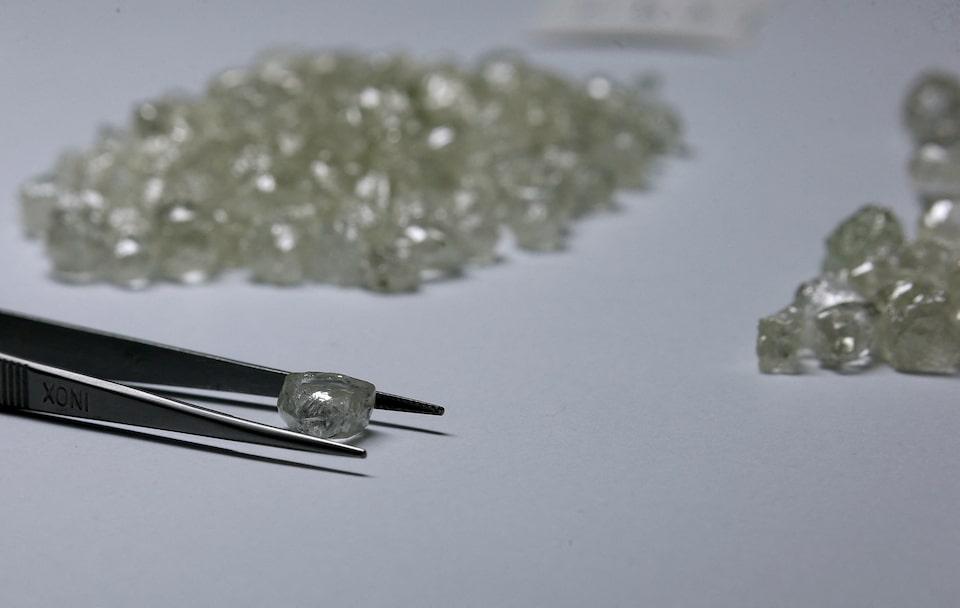
Debswana cuts output by 16% to 15 million carats in 2025 Three-month production pauses at Jwaneng Cut 9 and Orapa mines Debswana says Jwaneng underground project continues GABORONE, June 6 (Reuters) - Botswana's Debswana Diamond Company is temporarily pausing production at some of its mines, cutting output in response to prolonged weakness in the global diamond market, it said on Friday. The global diamond market has experienced a downturn since the second half of 2023, which caused Debswana to cut production by 27% to 17.93 million carats in 2024. Debswana, which accounts for about 90% of Botswana's diamond sales, reported a 46% drop in sales revenues last year. Sign up here. The company, a 50-50 joint venture between Botswana's government and global giant De Beers, now plans to reduce output to 15 million carats in 2025, it said in a statement. "Debswana Diamond Company continues to prudently navigate the challenging market conditions, including sustained low demand across the diamond pipeline and emerging pressures such as U.S.-imposed tariffs," it said. Debswana is temporarily pausing production at Jwaneng Cut 9 and Orapa mines, after suspending operations at its Letlhakane tailing plant and Jwaneng Modular plant in April. The temporary stoppages are expected to deliver significant cost savings across fuel, electricity, and other production consumables, Debswana added. Long-term initiatives such as the Jwaneng underground project, to convert Debswana's flagship open pit mine to an underground operation, will continue, but selected capital projects will be slowed down to save costs. No job involuntary cuts are planned, although the company continues to offer voluntary separation, it added. Botswana gets 30% of its revenue and 75% of its foreign currency earnings from diamonds and the current market downturn resulted in the economy contracting by 3% in 2024. The International Monetary Fund has forecast a further 0.4% contraction this year. https://www.reuters.com/world/africa/botswanas-debswana-curbs-diamond-production-weak-demand-persists-2025-06-06/
2025-06-06 12:18
GM, Stellantis have paid significant fuel economy penalties in recent years Senators say proposal would save automakers $200 million Proposal is latest move in Washington to make it easier to sell gas-guzzlers WASHINGTON, June 6 (Reuters) - The Transportation Department paved the way for looser U.S fuel economy standards on Friday by declaring that former President Joe Biden's administration exceeded its authority by assuming high uptake of electric vehicles in calculating rules. The department made the declaration as it published a final "Resetting the Corporate Average Fuel Economy Program" (CAFE) rule. A future separate rule from the administration of President Donald Trump will revise the fuel economy requirements. Sign up here. "We are making vehicles more affordable and easier to manufacture in the United States. The previous administration illegally used CAFE standards as an electric vehicle mandate," said Transportation Secretary Sean Duffy in a statement. The department's National Highway Traffic Safety Administration (NHTSA), in writing its rule last year under Biden, had "assumed significant numbers of EVs would continue to be produced regardless of the standards set by the agency, in turn increasing the level of standards that could be considered maximum feasible," it said Friday. Duffy in January signed an order directing NHTSA to rescind fuel economy standards issued under Biden for the 2022-2031 model years that had aimed to drastically reduce fuel use for cars and trucks. Late Thursday, Senate Republicans led by Commerce Committee chair Ted Cruz proposed eliminating fines for failures to meet CAFE rules as part of a wide-ranging tax bill - the latest move aimed at making it easier for automakers to build gas-powered vehicles. Last year, Chrysler-parent Stellantis (STLAM.MI) , opens new tab paid $190.7 million in civil penalties for failing to meet U.S. fuel economy requirements for 2019 and 2020 after paying nearly $400 million for penalties from 2016 through 2019. GM (GM.N) , opens new tab previously paid $128.2 million in penalties for 2016 and 2017. Stellantis said it supported the Senate Republican proposal "to provide relief while DOT develops its proposal to reset the CAFE standards... The standards are out of sync with the current market reality and immediate relief is necessary to preserve affordability and freedom of choice." GM referred questions to a trade group representing the Detroit Three automakers, which said "the current CAFE rules are challenging to achieve for automakers and real regulatory relief is needed," and praised the Senate Republican proposal. NHTSA in June 2024 under Biden said it would hike CAFE requirements to about 50.4 miles per gallon (4.67 liters per 100 km) by 2031, from 39.1 mpg currently, for light-duty vehicles. The agency last year said the rule for passenger cars and trucks would reduce gasoline consumption by 64 billion gallons and cut emissions by 659 million metric tons, cutting fuel costs with net benefits it estimated at $35.2 billion. https://www.reuters.com/business/energy/us-declares-biden-fuel-economy-rules-exceeded-legal-authority-2025-06-06/

2025-06-06 12:10
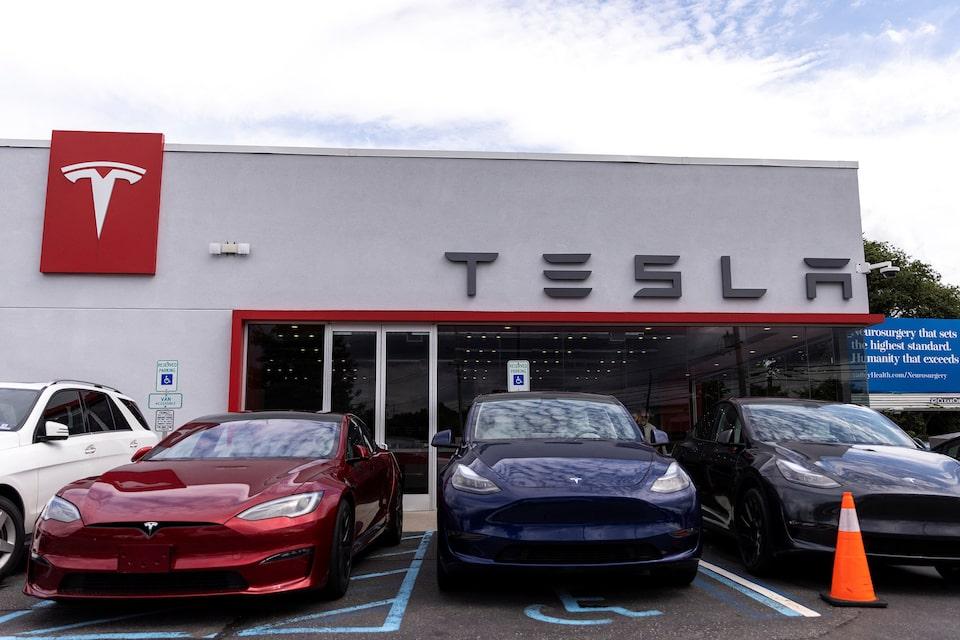
June 6 (Reuters) - Tesla is the worst-performing large-cap stock this year, thanks to declining electric vehicle demand, Chief Executive Elon Musk's political controversies over his ties to far-right groups, and now, his public feud with President Donald Trump. Tesla shares slumped on Thursday, after Trump on social media threatened to cut off government contracts with Elon Musk's companies, following Musk's sharp criticism of the president's signature tax and spending bill on his X social media platform. Sign up here. The market capitalization of Tesla Inc (TSLA.O) , opens new tab has fallen 29.3% to $917 billion so far this year, the biggest drop among big companies in the world. Tesla, which ranked eighth globally in market capitalization at the beginning of the year, slipped to tenth as of June 5. The company's shares rose in early trading on Friday, as investors took some comfort from White House aides scheduling a call with Musk to broker peace after a public feud with Trump. Apple, which began the year as the world's most valuable company, has slipped to No. 3 this year, dragged down by weak demand in China, Trump's tariff threats, and slower progress in AI. Its market capitalization has declined over 20% this year, falling to $2.99 trillion as of Thursday. Meanwhile, Microsoft has claimed the No. 1 spot in market capitalization, driven by surging demand for AI services, including its partnership with OpenAI and the integration of tools like Microsoft 365 Copilot. https://www.reuters.com/business/retail-consumer/global-markets-marketcap-pix-2025-06-06/
2025-06-06 12:03
LONDON, June 6 (Reuters) - Britain's financial regulator is to remove a ban on consumers buying crypto exchange-traded notes (ETNs), ditching its previous position of wanting to keep them out of the hands of retail investors. The Financial Conduct Authority said on Friday that allowing retail investors to buy ETNs would support growth and competitiveness, in the latest sign that the UK is shifting its approach to crypto as the government seeks to grow the economy and support a digital assets industry. Sign up here. Last year the FCA had approved the launch of crypto ETNs for professional traders but banned retail investors from access, calling the products "ill-suited" because of "the harm they pose". "We want to rebalance our approach to risk and lifting the ban would allow people to make the choice on whether such a high-risk investment is right for them given they could lose all their money," David Geale, executive director of payments and digital assets at the FCA, said in a statement on Friday. The proposal will now go out for consultation. Britain in April published draft laws for bringing cryptocurrencies under compulsory regulation for the first time, aligning it with the United States' approach, rather than the European Union, which has built rules tailored to the industry. To be sold to individual consumers, the ETNs will need to be traded on an FCA-approved investment exchange, the regulator said. A ban on retail investors trading cryptoasset derivatives would remain, the watchdog added. (This story has been refiled to remove an extraneous word in the headline) https://www.reuters.com/sustainability/boards-policy-regulation/embargoed-uk-end-ban-retail-investors-buying-crypto-exchange-traded-notes-2025-06-06/