2025-05-27 11:26
EGA unit's stockpiles approximately 2m metric tons of bauxite Exports and operations suspended since last year EGA hopes to resume amicable talks with Guinea government DAKAR, May 27 (Reuters) - Emirates Global Aluminium's (EGA) subsidiary in Guinea has accumulated a stockpile of nearly two million metric tonnes of bauxite since the suspension of its operations last year, three sources familiar with the matter told Reuters on Tuesday. EGA, equally owned by Abu Dhabi sovereign wealth fund Mubadala, and Dubai sovereign wealth fund the Investment Corporation of Dubai, operates one of the largest bauxite mines in Guinea through its Guinea Alumina Corporation (GAC) subsidiary. Sign up here. The standoff with Guinea's government highlights the aggressive push by the military authorities to increase benefits from the country's vast natural resources as the world's largest bauxite producer leverages its position in aluminium supply chains to force downstream processing commitments. The company has been in a dispute with the government since October last year when its GAC bauxite exports, and mining operations were later suspended by the authorities. Reuters reported earlier this month that the government has launched a process to withdraw EGA's mining licence over its failure to build an alumina refinery. Since the suspension of exports and mining operations, its stockpile of bauxite at the port and train loading facility at the mining site, have reached nearly two million metric tonnes, the three sources familiar with the situation, told Reuters. The sources requested anonymity because there were not authorized to speak for the company. EGA and GAC did not respond to Reuters' requests for comments on the stockpiles. The company said in a separate statement on Tuesday it hoped to resume talks with the Guinean government that could lead to a lifting of measures blocking its bauxite mining operations. In its statement, GAC said the measures imposed by the authorities had hampered its operations, leading to their complete stoppage in December 2024 and significant financial losses for the company and its shareholders. Responding to a Reuters request for comment, Guinea's mines minister Bouna Sylla said the country was committed to working with all investors who fully comply with their contractual commitments, adding they intend to clean up the mining sector. "This process will continue rigorously, respecting the current legal framework while ensuring the legitimate interests of all stakeholders, including Guinean investors," Sylla said. Responding to reports that the dispute was due to its failure to fulfil commitments, including building a refinery, GAC said in the statement that it had always fulfilled all of its obligations under agreements Guinea, and contests that it has acted differently. "As regards an alumina refinery project in Guinea, GAC has repeatedly indicated to the Guinean authorities that the realisation of such a project is contingent upon overcoming numerous and significant economic, technical and environmental challenges," it said. Mali, Burkina Faso and Niger, also military-led West African states have taken similar routes to assert more control over their mineral-rich mining sectors in a bid to generate higher revenue. https://www.reuters.com/world/africa/egas-guinea-bauxite-unit-hopes-resume-talks-with-government-2025-05-27/

2025-05-27 11:23
LONDON, May 27 (Reuters) - What matters in U.S. and global markets today By Mike Dolan , opens new tab, Editor-At-Large, Financial Industry and Financial Markets Sign up here. Markets were left nonplussed by increasingly erratic U.S. tariff announcements over the weekend, although nerves have been soothed slightly by the reduction of tensions at the long-end of several major government bond markets. I'll get into all of this below and then explore why the U.S. government, issuing ever more debt, should be wary about becoming overly reliant on the kindness of private investors. Today's Market Minute * U.S. President Donald Trump said Vladimir Putin had "gone absolutely CRAZY" by unleashing a massive aerial attack on Ukraine and said he was weighing new sanctions on Moscow. * The euro could become a viable alternative to the dollar, earning the 20-nation bloc immense benefits, if governments could only strengthen the bloc's financial and security architecture, ECB President Christine Lagarde said on Monday. * Japan will consider trimming issuance of super-long bonds in the wake of recent sharp rises in yields for the notes, as policymakers seek to soothe market concerns about worsening government finances. * Ukraine’s security is critical to Europe, but the continent can no longer rely on the United States to support the country’s war with Russia. The EU, the UK and other willing countries therefore need a way to support Ukraine that does not require Trump’s permission. The best option is to unlock Russia’s $300 billion of frozen central bank assets. Read the latest essay from Breakingviews columnist Hugo Dixon. * U.S. President Donald Trump’s budget bill is likely to bake in outsized deficits for years to come. Listen to the latest episode of Reuters Econ World podcast, where I speak with host Carmel Crimmins about what that means for U.S. debt levels and the wider economy. Trade confusion and long yield relief After a torrid week for long-dated sovereign debt, some calm was restored on Tuesday by indications Japan would consider trimming sales of super-long bonds. Policymakers in Tokyo are seeking to reduce market concerns about the country's worsening government finances. Yields on 30-year Japanese government bonds fell by up to 20 basis points to 2.83% after the report, the lowest since May 8. The benchmark 10-year yield dropped 5 points to 1.455%. The dollar rose 0.5% against the yen to 143.9. Also helping ease pressure on the long end of bond markets was a Financial Times interview with Britain's debt management chief Jessica Pulay, who emphasized that the UK had shifted to shorter-term borrowing this year. Pulay noted that demand for long bonds from pension funds has waned due to demographics and pension scheme changes. UK 30-year gilt yields fell back almost 20 bps from last week's peaks. U.S. 30-year yields declined in sympathy, retreating below 5% for the first time since last Tuesday. As traders returned following the long Memorial Day weekend, U.S. stock futures were up smartly, largely because Trump has backed off from Friday's threat to impose 50% tariffs on EU imports next month. He instead restored a July 9 deadline to allow for talks between Washington and the 27-nation bloc to produce a deal. European stocks (.STOXXE) , opens new tab were higher too on Tuesday, with the euro slipping back after two days of gains on the confusing policy twists. The back and forth on tariffs will likely keep trading on edge, but markets will likely have to get used to this policy volatility in the weeks and months ahead. Federal Reserve Bank of Minneapolis President Neel Kashkari on Tuesday called for keeping U.S. interest rates steady until there is more clarity on how higher tariffs are affecting inflation. He warned against simply looking through the impact of a potential supply side shock. "It may take months or years for negotiations to fully conclude, and there could be tit-for-tat tariff increases as trading partners respond to one other," he said. This week's release of the April personal consumption expenditures update - the Fed's favored inflation gauge - will be monitored closely. U.S. markets return amid a sweep of economic updates, including durable goods orders for April and consumer confidence readings for May. Meanwhile, tech investors are turning to the big earnings event of the week. Shares of semiconductor industry bellwether Nvidia (NVDA.O) , opens new tab gained 2.8% as the company is slated to report quarterly earnings after markets close on Wednesday. Elsewhere, Trump Media & Technology Group (DJT.O) , opens new tab advanced 10% after a media report said Trump's social media firm planned to raise about $3 billion to spend on cryptocurrencies such as bitcoin. Now to today's deep dive, where I explore how declining investor appetite for long-duration debt could stress government funding markets. Long bond blues stress the 'bedrock' Bonds had a bruising week recently and investor aversion to long-dated government debt appears to be rising. Anxiety over U.S. debts and deficits took center stage as Trump's fiscal bill passed the House of Representatives - potentially adding another $3.8 trillion to the $36 trillion debt pile over the coming decade. But mountainous government debts across major economies and unpredictable inflation, amplified by unfolding trade wars, fuel uncertainty over the central bank interest rate horizon. At the same time, central banks continue to reduce the huge holdings of government debt accumulated over the past 15 years, particularly during the pandemic. These developments require private investors to take up the growing slack at a nervy time, even as many of these investors are increasingly price-sensitive and wary of long-duration bonds. Many non-bank private investors embrace long-duration debt. This includes pension and insurance funds that crave steady long-term income streams from relatively safe government credits in order to match their long-term liabilities. Others, such as mutual funds or hedge funds, may be less willing to absorb outsized price risks. And as exchange-traded funds that track long-term Treasuries show, it's been a dire few years. The iShares ETF of U.S. Treasuries with remaining maturities of 20 years or more is down 3.5% for the year so far, almost as much as the loss in Wall Street's tech-heavy Nasdaq equity index (.IXIC) , opens new tab. It has now halved in price since it peaked during the pandemic and is down 30% from the eve of the COVID outbreak. While "terming out" government debt to longer maturities has long been seen as a prudent practice to reduce roll-over risks with too much short-dated borrowing, this strategy may now contain frailties of its own due to shifts in the investor base. With economic and policy uncertainties rife, attention is shifting toward private investor commitment and market stability. MARKET BEDROCK The International Monetary Fund , opens new tab last week highlighted potential risks to the functioning of government bond markets that policymakers need to address to protect what is called "the bedrock of capital markets". In a piece that focused on liquidity risks and the smooth pricing of a market covering some $80 trillion of core government debt, it pointed out how bank dealers continue to play a critical role and have expanded sovereign bond holdings. But it said that the rise in bank dealers' core sovereign debt had not kept pace with the growth of outstanding bonds. The stock of U.S. Treasury securities grew nearly fourfold in the 15 years through 2023, for example, but U.S. bank-dealer balance sheets expanded by just 1.5 times. Now, U.S. Treasury securities account for almost 70% of primary dealers' securities inventories - the highest share in over a decade - and about three-quarters of their securities financing is also collateralized by Treasuries. "The challenge is that dealers' internal limits on concentrated holdings could curtail intermediation activities, especially in times of stress," the IMF blog noted. That leaves the other non-bank financial institutions (NBFIs) to supplement the role of market makers. "However, because they (NBFIs) have a generally weaker mandate to support government bond markets compared to bank-dealers, they may also quickly curb activities during times of market stress," the IMF piece said. "The increasing presence of NBFIs makes market resilience more uncertain and opaque because they tend to be less regulated and subject to fewer data reporting requirements." The IMF then goes on to urge governments to ensure more "structural resilience" via more central clearing, more timely, consistent and comprehensive data on market pricing and transactions and better information on NBFIs' soundness and reliability in times of stress. To be sure, bond markets appear to be clearing well despite the outsize policy upheavals under way. But few doubt that there are difficult moments ahead and stress at the "bedrock" could be seismic. Chart of the day Europe's STOXX 600 index stock index lost 1% on Friday after Trump threatened to impose 50% import duties on Europe from June 1, but has since recouped all of that after he said he was postponing them and continuing negotiations. The euro gained regardless and hit its highest in three weeks on Monday before falling somewhat today. The United States was the European Union's biggest export partner in 2024, making up 20.6% of exports, according to Eurostat. Medicinal and pharmaceutical products were the EU's most exported sector to the U.S. in 2024, followed by motor vehicles and aircraft and associated equipment, the data showed. The three largest exporters to the United States in the EU were Germany, which exported 161 billion euros ($182.62 billion) worth of goods, Ireland, at 72 billion euros, and Italy, at 65 billion euros. Today's events to watch * U.S. April durable goods orders (8:30 a.m EDT), March home prices (9:00 a.m. EDT), May consumer confidence (10:00 a.m. EDT), Dallas Federal Reserve May manufacturing survey (10:30 a.m. EDT) * Richmond Federal Reserve President Thomas Barkin, New York Fed President John Williams and Minneapolis Fed chief Neel Kashkari all speak * U.S. Treasury sells $69 billion of 2-year notes * U.S. corporate earnings: Autozone Opinions expressed are those of the author. They do not reflect the views of Reuters News, which, under the Trust Principles , opens new tab, is committed to integrity, independence, and freedom from bias. https://www.reuters.com/business/finance/global-markets-view-usa-2025-05-27/

2025-05-27 10:57
May 27 (Reuters) - Tyremaker Goodyear India (GDYR.BO) , opens new tab reported a profit in the fourth quarter on Tuesday, as higher replacement demand for tyres offset the impact of higher rubber prices. U.S.-based Goodyear Tire's (GT.O) , opens new tab Indian unit posted a profit of 48.7 million rupees ($570,578) for the three months ended March 31 against a loss of 42.1 million rupees a year ago. Sign up here. Goodyear India supplies tyres to BMW (BMWG.DE) , opens new tab and Toyota (7203.T) , opens new tab among others and depends on automakers' sales for a major chunk of its revenue. Total vehicle sales in India rose 1.8% year-over-year in the reported quarter but analysts said that demand for replacing old or worn out tyres sustained. Rival CEAT (CEAT.NS) , opens new tab missed its quarterly profit estimates last month, while MRF (MRF.NS) , opens new tab beat estimates. Goodyear India's revenue from operations rose 9.5% to 6.03 billion rupees, compared to a 15.6% fall last year. Its total expenses grew 7.2%, led by a 28.7% rise in cost of materials consumed. The company had expected a pick up in replacement demand, which is cyclical in nature, in the fiscal year ending March. Its shares closed 1.6% higher before the results. ($1 = 85.3520 Indian rupees) https://www.reuters.com/world/india/tyremaker-goodyear-india-posts-quarterly-profit-higher-replacement-demand-2025-05-27/

2025-05-27 10:48
KYIV, May 27 (Reuters) - Ukraine's energy regulator has approved a gas import mechanism that will avoid high transit fees when supplying gas through the Transbalkan pipeline from Greece to Ukraine, the Ukrainian energy ministry said on Tuesday. Ukraine has faced a serious gas shortage since a series of devastating Russian missile strikes this year, which significantly reduced domestic gas production. Sign up here. Ukraine now imports gas via Slovakia and Hungary, but does not use the southern route because of its higher transit tariffs, as gas from LNG terminals in Greece also passes through Bulgaria, Romania and Moldova. "The Transbalkan route has significant potential to meet Ukraine's immediate needs ... however, this route passes through five countries, and the direct application of regulated tariffs makes it commercially unattractive compared to alternative options," the ministry said in a statement. The ministry noted gas transit operators of five countries had "developed an optimised solution that will, in particular, allow the use of the currently unused capacity of the Transbalkan pipeline to import gas to Ukraine at a competitive tariff." The ministry gave no more details, but added that it hopes for positive decisions from all participating countries on the use of the route. The Kyiv government has said Ukraine needs to import at least 4 billion cubic metres (bcm) of gas for the new 2025/26 heating season while analysts and former officials estimated the imports at about 6.3 bcm. Ukraine's state firm Naftogaz has already started buying, having contracted 300 million cubic metres (mcm) of U.S. LNG from Poland's Orlen, whose supplies go through Poland. The Polish and Lithuanian routes were the cheapest, but Ukraine would also have to use other pipelines as the Polish interconnector allows the import of only up to 7 mcm per day, compared with demand of at least 25 mcm. Ukraine plans to import about 20 mcm of gas from Slovakia, Poland and Hungary on Tuesday. "Having abandoned Russian energy supplies, Ukraine, like our partners in the EU, is actively working to find alternative gas supply routes. The use of the Transbalkan route is important in this context," Ukraine's energy minister German Galushchenko said in a statement. https://www.reuters.com/sustainability/boards-policy-regulation/ukraine-hopes-import-gas-via-transbalkan-pipeline-lower-transit-fee-2025-05-27/

2025-05-27 10:06
MUMBAI, May 27 (Reuters) - The Indian rupee and its regional peers weakened on Tuesday as the greenback rose against major peers and Asian equities declined, with rupee traders also pointing to month-end dollar payments from importers that weighed on the local unit. The rupee closed at 85.33 against the U.S. dollar, down 0.3% on the day. Sign up here. The South Asian currency has experienced choppy moves over recent trading sessions, quickly reversing course from a fall past 86 last week to touch a two-week high of 84.78 on Monday and then shedding those gains in the face of a firmer dollar. The rupee's very-near-tenor implied volatility - a gauge of future expectations - has also ticked up, with the spot-week gauge rising above 6%. The year-to-date average is around 4.5%. The rupee seems to be "settling into an 84.80-85.80 range and unless it breaks out on either side, the choppy moves may persist," an FX trader at a foreign bank said. The dollar index was up 0.4% at 99.3 while the 10-year U.S. Treasuries rose, mimicking a steep price rally in longer-term Japanese debt that came after Reuters reported Tokyo will consider trimming issuance of the super-long bonds. Despite the uptick on Tuesday, the dollar is on course to notch its fifth consecutive monthly decline against major peers as worries over uncertain trade policies and worries over fiscal health hurt appetite for U.S. assets. In many ways, the dollar is "behaving more like an emerging market currency, where investors are fixated on public finance sustainability, watching capital flows closely, and forced to factor in unpredictable policy moves," ING bank said in a note. Asian currencies declined on Tuesday, with the offshore Chinese yuan down 0.2%. The Malaysian ringgit led losses with a nearly 0.5% fall. India's benchmark equity indexes, the BSE Sensex and Nifty 50 (.NSEI) , opens new tab ended lower by around 0.7% each, tracking a fall in most regional stocks. https://www.reuters.com/world/india/rupee-weakens-alongside-asian-peers-dollar-finds-footing-2025-05-27/
2025-05-27 09:31
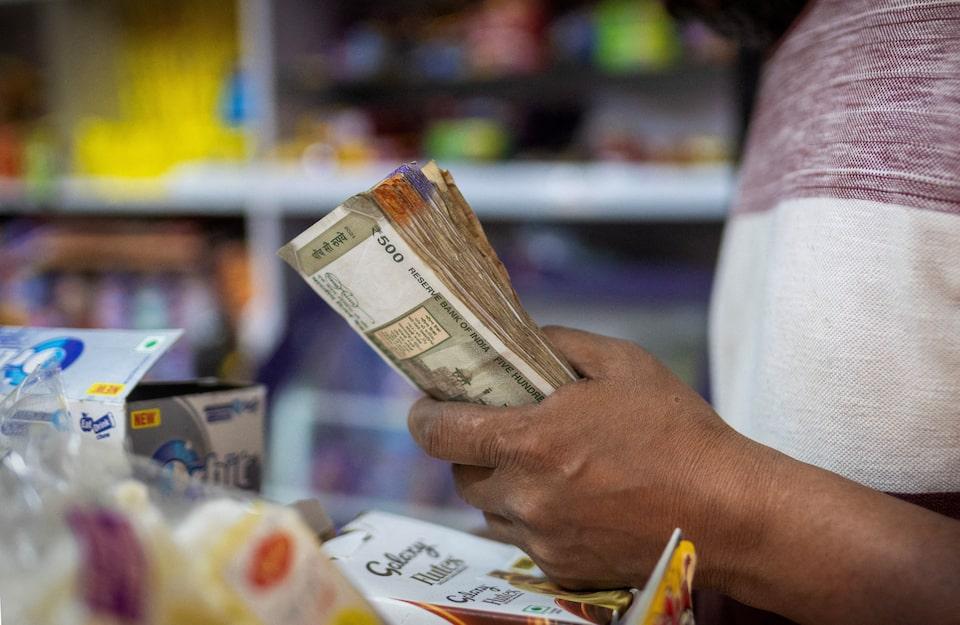
BENGALURU, May 28 (Reuters) - India's stock market is forecast to hit a new high by the end of 2025 and rise further next year, according to a Reuters poll of equity analysts, although there were some concerns about lofty valuations and a possible correction over the next three months. Foreign investors turned net buyers in April for the first time in four months and the blue-chip Nifty 50 index (.NSEI) , opens new tab has climbed nearly 15% from a 10-month low in early April, though it is below an all-time high of 26,277.35 hit in late September. Sign up here. That momentum came despite a sharp slowdown in economic growth, which likely cooled to 6.3% last fiscal year from over 9% the year before. U.S. President Donald Trump's renewed tariff threats have also stirred concerns for India's export-heavy sectors such as pharmaceuticals and chemicals. The Nifty 50 was forecast to rise 6% to 26,500 by end-2025 from Monday's close of 25,001.15, and then reach 27,300 and 28,450 by mid-2026 and end-2026 respectively, according to a May 15–27 poll of 31 analysts. That would mark the longest time the index has taken to recover from a correction in nearly a decade. The BSE Sensex is expected to climb to 86,100 by end-2025, 89,000 by mid-2026 and 95,000 by end-2026, the poll showed. "India is starting to look like a safer bet since there aren't many growth alternatives," said Yogesh Kalinge, associate director of research at A.K. Capital Services. "Trump's policy is not leading to the usual outflows toward the U.S. safe haven and is in fact making emerging markets look better...(But) if you look at valuations, they do look stretched." With an average price-to-earnings ratio of 23.52, the Indian stock market ranks among the world's most expensive, below the U.S. at 25.41 but far exceeding China's 12.00. Just over half of analysts who answered an additional question, 15 of 28, said a correction - usually defined as a decline of 10% or more - was very likely or likely. The other 13 said it was unlikely or very unlikely. "I expect a correction in the short term ... because of the inability of large caps to grow as expected. Large-cap index revenue growth is below India's nominal economic growth, which is worrisome," said Sreeram Ramdas, vice president at Green Portfolio PMS. A near 80% majority, 23 of 29, said corporate earnings growth in 2025 would be marginally higher, which included four who said significantly higher. Six said marginally lower or significantly lower. Profit growth for Nifty 50 companies also remained muted in the December quarter, with most missing estimates. Still, that was an improvement after three notably weaker quarters. "Earnings growth moderated due to a slower recovery in private sector investment. While some of these pressures have started to ease, the recovery has been insufficient to offset the overall slowdown in corporate performance," said Ajit Mishra, senior vice president of research at Religare Broking. "The earnings commentary is not very encouraging so far, so it's too early to say whether the worst is behind us." (Other stories from the Reuters Q2 global stock markets poll package) https://www.reuters.com/world/india/indian-stocks-hit-new-highs-despite-concerns-market-is-expensive-2025-05-27/