2025-05-23 21:02
EU, US trade chiefs talk on Friday after Trump tariff threat Exchange of wish-lists in past week, with clear gaps EU already facing tariffs, has prepared countermeasures BRUSSELS, May 23 (Reuters) - The European Commission urged the U.S. on Friday to bring respect, not threats, to trade talks after President Donald Trump pushed for a 50% tariff on EU goods. Insisting the European Union was committed to securing a deal that worked for both sides, EU trade chief Maros Sefcovic spoke with U.S. Trade Representative Jamieson Greer and U.S. Commerce Secretary Howard Lutnick. Trump had recommended higher tariffs on the EU from June 1. Sign up here. The European Commission, which oversees trade policy for the 27-nation bloc, remained ready to work in good faith, Sefcovic said. "EU-U.S. trade is unmatched & must be guided by mutual respect, not threats. We stand ready to defend our interests," he wrote in a post on X. Major stock indices tumbled, the dollar fell against major currencies and the euro pared gains after Trump's announcement on EU tariffs and a potential 25% duty on Apple iPhones manufactured outside the U.S. "With Trump, you never know, but this would be a major escalation," said Holger Schmieding, chief economist at Berenberg. "The EU would have to react and it is something that would really hurt the U.S. and European economy." The tariff threat comes as talks are stuck, with Washington demanding unilateral concessions from Brussels to open up to U.S. business while the EU seeks an agreement in which both sides could gain, according to people familiar with the talks. EU leaders and ministers that spoke after Trump's announcement broadly backed the European Commission's approach. Polish deputy economy minister Michal Baranowski, whose country holds the rotating EU presidency, said the tariff threat appeared to be a negotiating ploy. "The European Union and the United States are negotiating," he told reporters on the sidelines of a meeting in Brussels, adding negotiations could last until early July. "The fact that we see some important statements in the public domain does not mean that they will translate into actions of the U.S. administration," he said. Dutch Prime Minister Dick Schoof said the EU would stick to the path it had chosen. "We have seen that tariffs can go up and down in talks with the U.S," he told reporters in The Hague. The EU already faces 25% U.S. import tariffs on its steel, aluminium and cars and so-called "reciprocal" tariffs of 10% for almost all other goods, a levy that was due to rise to 20% after Trump's 90-day pause expires on July 8. French Trade Minister Laurent Saint-Martin said Trump's new threats did nothing to help negotiations. "We are maintaining the same line: de-escalation, but we are ready to respond," he wrote on X. Italian Foreign Minister Antonio Tajani told Italian news agency ANSA that the aim remained "zero-for-zero tariffs". DIFFERING WISH-LISTS In the past week, Washington has sent Brussels a list of demands to reduce the U.S. goods trade deficit, including so-called non-tariff barriers, such as by adopting U.S. food safety standards and removing national digital services taxes, according to people familiar with the paper. The EU response has been to offer a mutually beneficial deal that could include both sides moving to zero tariffs on industrial goods, the EU potentially buying more liquefied natural gas and soybeans and cooperation on issues such as steel overcapacity, which both sides blame on China. The Sefcovic-U.S. call was planned as a follow-up to these exchanges and ahead of a possible early June meeting in Paris. Robert Sockin, senior global economist at Citigroup, said he believed Trump was seeking to bring the EU to the table. "With a 50% tariff, there would be a recessionary forecast for Europe, but I am doubtful it would be enacted," he said. Washington says the tariffs are designed to redress the U.S. deficit in goods trade with the European Union, which was almost 200 billion euros ($226.48 billion) last year, according to EU statistics agency Eurostat. But the United States does have a large trade surplus with the EU in services. The European Commission has repeatedly said it preferred a negotiated solution, but is ready to wield countermeasures if negotiations fail. The bloc put in place, but then suspended, duties on 21 billion euros of annual U.S. imports in response to the U.S. metals tariffs and has compiled a list of 95 billion euros of U.S. goods as countermeasures to the U.S. 'reciprocal' and car tariffs. ($1 = 0.8831 euros) https://www.reuters.com/world/china/eu-awaits-clarity-trumps-50-tariff-threat-2025-05-23/
2025-05-23 20:54
Trump's approval clears last big hurdle for the deal US Steel shares surge 21% on Trump comments Trump to hold a rally at US Steel in Pittsburgh next Friday WASHINGTON, May 23 (Reuters) - U.S. President Donald Trump on Friday expressed support for Nippon Steel's (5401.T) , opens new tab $14.9 billion bid for U.S. Steel (X.N) , opens new tab, saying their "planned partnership" would create jobs and help the American economy. Shares of U.S. Steel soared 21% as investors interpreted Trump's post on Truth Social to mean Nippon Steel had received his approval for its long-planned takeover, the last major hurdle for the deal. Sign up here. "This will be a planned partnership between United States Steel and Nippon Steel, which will create at least 70,000 jobs, and add $14 Billion Dollars to the U.S. Economy," Trump said in a post on Truth Social. This week, Reuters reported that Nippon Steel has said if the merger is approved, it would invest $14 billion into U.S. Steel's operations, including up to $4 billion in a new steel mill. Trump added that the bulk of that investment would occur in the next 14 months and said he would hold a rally at U.S. Steel in Pittsburgh next Friday. U.S. Steel praised Trump's leadership. "U.S. Steel will remain American, and we will grow bigger and stronger through a partnership with Nippon Steel that brings massive investment, new technologies, and thousands of jobs," the company said in a statement. Nippon Steel also applauded Trump's decision. "The partnership is a game changer - for U.S. Steel and all of its stakeholders, including the American steel industry, and the broader American manufacturing base," the Japanese company said in a statement on Saturday. A Nippon Steel spokesperson in Tokyo declined to comment on the $14 billion investment and the 14-month timeline that Trump cited. The White House did not immediately respond to questions about the announcement. It is unclear whether Trump's term "partnership" refers to the full acquisition Nippon Steel has been pursuing. For Japan's top steelmaker, the deal is core to its global expansion strategy, lifting production to 86 million metric tons from 63 million tons now - especially at a time when domestic demand is declining. The merger would create the world's third-largest steel producer by volume, following China's Baowu Steel Group and Luxembourg-based ArcelorMittal (MT.LU) , opens new tab, according to World Steel Association data. U.S. Steel kept rising after hours, hitting $54, just shy of the $55 per share that Nippon Steel offered in late 2023. While no details were released, investors expressed confidence that terms will be similar to those agreed in 2023. Investors said that eventually U.S. Steel will no longer be publicly traded and they will receive a cash payout for their shares. The deal has been one of the most highly anticipated on Wall Street after it morphed into the political arena with fears that foreign ownership would mean job losses in Pennsylvania, where U.S. Steel is headquartered. It factored into last year's election, in which Trump regained the White House. Pennsylvania Senator Dave McCormick, who also called the deal a "partnership," said on Friday it was a "huge victory for America and the U.S. Steel Corporation," which will protect more than 11,000 Pennsylvania jobs and support the creation of at least 14,000 more. The last pieces of the deal came together surprisingly fast. The Committee on Foreign Investment in the U.S., which reviews deals for national security risks, told the White House this week that the security risks can be addressed, Reuters reported, moving the final decision to Trump's desk. Following an earlier CFIUS-led review, then-President Joe Biden blocked the deal in January on national security grounds. The companies sued, arguing they did not receive a fair review process. The Biden White House rejected that view. The companies argued Biden opposed the deal when he was running for reelection to win support from the United Steelworkers union in the battleground state of Pennsylvania. The Biden administration had defended the review as essential to protecting security, infrastructure and supply chains. Trump also initially opposed the deal, arguing the company must be owned and operated in the U.S. The United Steelworkers were against the deal as recently as Thursday when they urged Trump to block the deal despite the $14 billion investment pledge from Trump. For investors, including prominent hedge funds, the news spells relief after more than a year of waiting for a resolution. "There were huge high-fives all around today," one recent investor said, adding, "We understood Donald Trump's psyche and we played it to our advantage here." Investors said Trump appears to have won ground after the pledge for new investments was increased. "This deal ensures that steelmaking will live on in Pittsburgh for generations," another investor said. https://www.reuters.com/markets/deals/us-steel-remain-america-form-partnership-with-nippon-trump-says-2025-05-23/
2025-05-23 20:51
SANTIAGO, May 23 (Reuters) - Chile's state-run mining firm ENAMI aims for its new Rio Tinto lithium partnership at Altoandinos to begin production in 2032 with 35,000 metric tons of the battery metal per year, and ramp up over three years to 75,000 tons, ENAMI company chief Ivan Mlynarz said on Friday. The Altoandinos project, as well as the Maricunga project that Rio Tinto (RIO.L) , opens new tab, (RIO.AX) , opens new tab was tapped this week to spearhead alongside state-run copper producer Codelco, will give the global miner a critical role in Chile's lithium industry alongside long-established players SQM (SQMA.SN) , opens new tab and Albemarle (ALB.N) , opens new tab. Sign up here. Rio Tinto will initially put forward $425 million to the project, which ENAMI said will require a total investment of $3 billion. ENAMI previously estimated the Altoandinos project capacity to be 60,000 tons a year, before new studies showed more resources than expected, particularly at the La Isla salt flat. Mlynarz said ENAMI plans for the project to start with direct lithium extraction (DLE), an innovative method that has yet to be used in Chile, and that Rio Tinto is testing at its Rincon project in Argentina. ENAMI has begun testing DLE options from various companies, and Mlynarz said early results from Rio Tinto's technology look promising, paving the way for its potential use on the project. "The results have been encouraging with Rio Tinto, and it has the advantage of having the operator use their own technology," Mlynarz said. He added that the partnership needed approval from international regulatory agencies, but that ENAMI in the meantime would continue exploration studies, with the hope that Rio Tinto will take the lead in 2026. "We need to keep working in the salt flat because both ENAMI and Rio Tinto know that timing is key," Mlynarz said. https://www.reuters.com/business/energy/chiles-enami-says-lithium-venture-with-rio-tinto-start-production-2032-2025-05-23/
2025-05-23 20:50
May 23 (Reuters) - The Trump administration approved Anfield Energy's (AEC.V) , opens new tab proposed Velvet-Wood uranium mine project in Utah on Friday after a rapid 14-day environmental review as part of a new process to fast-track permitting of energy and mining projects. Such studies typically take years because of the large potential environmental consequences of uranium mining. Sign up here. The Canadian company's project is the first approved under an emergency process for the Interior Department to permit energy facilities on federal lands. The new procedures are in response to President Donald Trump's national energy emergency declaration, made on his first day in office in January in an effort to boost domestic energy supplies, bring down fuel prices and bolster national security. Anfield filed its plan of operations for the mine on April 1, according to documents on an Interior Department web site. "This approval marks a turning point in how we secure America's mineral future," Interior Secretary Doug Burgum said in a statement. "By streamlining the review process for critical mineral projects like Velvet-Wood, we're reducing dependence on foreign adversaries and ensuring our military, medical and energy sectors have the resources they need to thrive. This is mineral security in action." Anfield was not immediately available for comment. The Velvet-Wood mine project in San Juan County will produce uranium, used in both nuclear energy and nuclear weapons production, as well as vanadium, a metal than can be used in batteries or to strengthen steel and other alloys. It is located at the site of a previous mining operation. https://www.reuters.com/business/energy/us-approves-utah-uranium-mine-after-two-week-environmental-review-2025-05-23/

2025-05-23 20:35
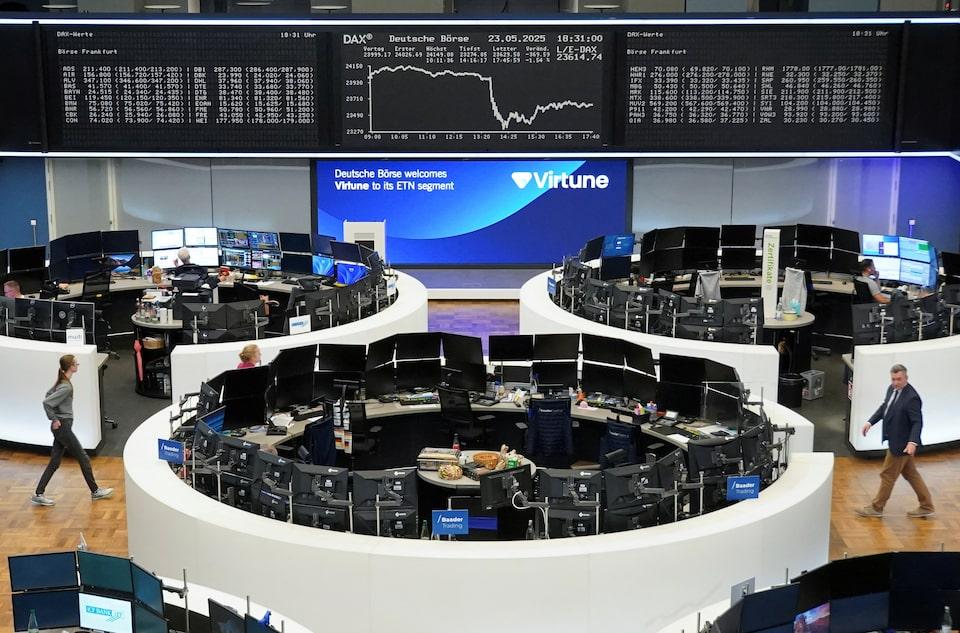
ORLANDO, Florida, May 23 (Reuters) - By Jamie McGeever, Markets Columnist Just when a degree of calm appeared to have settled over world markets, despite a worrying spike in many countries' long-term bond yields, U.S. President Donald Trump gave the world a stark reminder on Friday that his trade war is far from over. Sign up here. In threatening 50% tariffs on European goods effective June 1 and floating a 25% charge on Apple iPhones sold in the U.S., Trump shook investors from any complacency the recent de-escalation may have cultivated. European and U.S. stocks slumped - the S&P 500 sealed its steepest weekly fall since March - ensuring it will be a nervy and anxious long weekend for investors. U.S. and UK markets are closed on Monday for holidays. The optimistic view is this is a familiar negotiation tactic - come out all guns blazing, create chaos, secure concessions, retreat, then claim victory since whatever deal is struck is nowhere near as bad as the original worst-case scenario. Analysts at Citi are confident tariff fears are contained, and that a 50% levy on Europe won't last long even if it is implemented. The downside for risky assets is "manageable". This may be the path U.S.-Europe talks follow, as appears to be the case with the U.S.-China negotiations. But large doses of uncertainty and risk have been injected back into markets, and investors must price assets accordingly. Barclays economists estimate that if 50% tariffs on EU goods are realized, the overall trade-weighted tariff rate on all U.S. imports would rise to 21% from 14%, and an extra 0.5 percentage point hit to GDP growth would put the U.S. economy on the brink of recession. The other main focus for investors this week was sovereign bonds, specifically longer maturities, in many G7 countries including the U.S., Japan and Britain. Weak auctions, debt and deficit worries, and policy paralysis fears pushed long-dated yields to multi-year or record highs. Moody's stripping the U.S. of its triple-A credit rating a week ago also weighed on the price of Treasuries. Worryingly, rising U.S. Treasury yields offered no support to the dollar and finally started to weigh on Wall Street. Indeed, the slump in U.S. stocks immediately after Wednesday's 20-year note auction was the third-worst market reaction to a bond auction ever, according to Kevin Gordon at Charles Schwab. The U.S. and UK holiday on Monday and month-end flows were always likely to distort markets next week. A re-escalation of global trade tensions and historically high bond yields are now in the mix too. I'd love to hear from you, so please reach out to me with comments at [email protected] , opens new tab. You can also follow me at @ReutersJamie and @reutersjamie.bsky.social. This Week's Key Market Moves Chart of the Week The dollar's slide is remarkable. I wrote this week that while there are many valid long-term reasons to be bearish on the dollar - fiscal woes, policy credibility, end of 'U.S. exceptionalism', de-dollarization, to name a few - the pace of selling was unsustainable and a short-term reversal appeared likely. The dollar's lurch lower on Friday following Trump's latest tariff salvos puts any correction on ice. But it's still on the cards, if the breakdown in the dollar's correlation with yield spreads is any guide. The dollar's link to U.S.-euro zone yield spreads is usually very tight - when the dollar's yield advantage widens, the currency rises; when it shrinks, the dollar weakens. But that correlation collapsed completely round about ... Liberation Day. The link is broken, but history suggests it won't be for long. Here are some of the best things I read this week: What could move markets on Tuesday? (U.S. and UK markets are closed on Monday) Opinions expressed are those of the author. They do not reflect the views of Reuters News, which, under the Trust Principles , opens new tab, is committed to integrity, independence, and freedom from bias. Trading Day is also sent by email every weekday morning. Think your friend or colleague should know about us? Forward this newsletter to them. They can also sign up here. https://www.reuters.com/business/global-markets-trading-day-2025-05-23/
2025-05-23 20:10
Trump administration offers encouragement for pipeline builds Some large energy projects commissioned since November Pressure remains on greenfield growth from low oil prices, tariffs Many firms find buying pipeline assets a more economical way to grow NEW YORK, May 23 (Reuters) - President Donald Trump's pro-energy policies were meant to speed the construction of the United States' next generation of energy infrastructure, but many oil and gas pipeline operators would still rather buy than build their way to expansion due to a host of factors impeding large projects. Trump declared an energy emergency on his first day in office and has issued directives to support exports, reform permitting and roll back environmental standards. Since his November election, a number of large-scale projects have been greenlit, including a liquefied natural gas terminal and a handful of pipelines. Sign up here. But higher costs from a global trade war sparked by U.S. tariffs, labor shortages, low oil prices, and the risk of legal snags mean many companies are generally reluctant to commit to bold new construction. Instead, operators see mergers and acquisitions as a more efficient way to grow. In the first quarter of this year, 15 U.S. midstream deals were struck, the highest quarterly number since the final three months of 2021, according to energy tech company Enverus. "We have spent a lot of time thinking about the buy versus build question and, at this time, we're seeing more opportunities to buy assets," said Angelo Acconcia, a partner at ArcLight Capital Partners, which invests in energy infrastructure. Acconcia said factors including tariffs and high demand for supplies and labor made it challenging to calculate the economics of building a project. One of the most prevalent trends in dealmaking so far in 2025 has been pipeline companies buying back stakes in joint ventures, previously sold to help fund the initial development costs of prior-year builds. Targa Resources (TRGP.N) , opens new tab said in February it would acquire preferred equity in its Targa Badlands pipeline system from Blackstone (BX.N) , opens new tab for $1.8 billion, while MPLX (MPLX.N) , opens new tab said in the same month it would buy the 55% interest in the BANGL natural gas pipeline previously owned by WhiteWater Midstream and Diamondback Energy (FANG.O) , opens new tab for $715 million. Private equity owners of energy infrastructure are keen sellers, having spent recent years developing systems that are now online. Northwind Midstream, a New Mexico-focused pipeline operator, is currently being marketed for sale by Five Point Infrastructure, for example. TARIFFS WEIGH In recent years, U.S. oil and gas pipeline projects have faced regulatory hurdles and robust environmental opposition, resulting in years of delay and substantial cost overruns. The Mountain Valley Pipeline, a natural gas conduit owned by an EQT Corp-led group (EQT.N) , opens new tab, started operating last June but took six years to build and cost more than double its initial $3.5 billion budget. While the industry has welcomed Trump's pro-fossil fuel sentiment, some of his other policies - including tariffs on products like steel - are pushing up the cost of new energy projects. Weak global crude prices have also prompted warnings from U.S. oil and gas producers that they could curtail output growth, making pipeline firms cautious about new spending. Some companies, including Kinder Morgan (KMI.N) , opens new tab, said they believe there are better economics in smaller-scale projects that expand existing infrastructure than in big new ones. Others are wary of even those types of projects. DT Midstream (DTM.N) , opens new tab CEO David Slater said last month that while some bite-size expansion may continue on the company's LEAP system in the Haynesville basin, he wanted to see how local producers react to commodity price movements before considering new plans. "I think we just need to let the clock run here a little bit, see how the basin responds," he told analysts on a call. OPTING TO BUILD Despite the hurdles, the math still favors new construction for some companies. Energy Transfer (ET.N) , opens new tab said it will build the $2.7 billion Hugh Brinson natural gas pipeline in Texas, and Tallgrass Energy plans to construct a pipeline to move natural gas from the Permian to its Rockies Express Pipeline running through Colorado and Wyoming. "Generally, on buy versus build, if you have the opportunity to build, you build because the returns are largely better," said Ali Akbar, managing director of energy investment banking at Greenhill, a Mizuho affiliate. He said buying an asset like a pipeline can sometimes cost two times more than building something similar. Williams Companies (WMB.N) , opens new tab unveiled in March its $1.6 billion Socrates project to build natural gas infrastructure to support data center development in Ohio and has said Washington's newfound support for projects is a welcome change. "It's nice to see some people that actually think their job is to help get infrastructure built as opposed to being obstructive," outgoing CEO Alan Armstrong said on an earnings call this month. https://www.reuters.com/sustainability/us-pipeline-firms-wrestle-buybuild-conundrum-trump-pushes-energy-expansion-2025-05-23/