2025-05-12 11:06
BERLIN, May 12 (Reuters) - Germany's network regulator on Monday started a formal process to rethink the electricity grid fee structure, aiming for a system better suited to renewable energy. Fees for using the power network already make up around 20% of consumer bills in Germany, contributing to energy prices that are among the highest in Europe, hurting the country's industry and overall economic output. Sign up here. The current system needs reform to boost revenue and involve more stakeholders in network expansion costs. It lacks incentives for flexible users to reduce peak demand and fails to guide energy infrastructure planning with clear price signals, industry experts say. In a discussion paper published by the regulator on Monday, the agency outlined several proposals, including making renewable energy producers contribute to the cost of the grid, so far borne by consumers alone through their energy bills. The new system might charge a flat fee or a surcharge based on the size of a user's connection instead of how much electricity is used. It introduces so-called dynamic pricing, determining grid fees by how busy the network is, hoping to push consumers to use energy in a smarter way. The network agency, which gave a June 30 deadline for the public and stakeholders to comment on the paper, may set up special rules to better integrate batteries and storage facilities into the system. In addition to the proposals, Germany's new government plans to reduce power tax to the European minimum and halve transmission network fees, with the aim of permanently capping them, in a bid to lower prices. https://www.reuters.com/sustainability/boards-policy-regulation/germany-proposes-grid-fee-overhaul-better-suit-renewables-2025-05-12/
2025-05-12 11:01
LONDON, May 12 (Reuters) - What matters in U.S. and global markets today By Mike Dolan , opens new tab, Editor-At-Large, Financial Industry and Financial Markets Sign up here. A confusing mix of trade policy shifts and opaque economic data has left financial markets and the Federal Reserve searching for solid ground. In today's column, I take a close look at this pervasive lack of clarity, examining whether the recent market rally signals a genuine easing of pressures or merely a temporary lull before further economic storms. Now on to more market analysis. Today's Market Minute * The United States and China said on Monday they have agreed a deal to slash reciprocal tariffs for now as the world's two biggest economies seek to end a trade war that has disrupted the global outlook and set financial markets on edge. * U.S. President Donald Trump said on Sunday he would sign an executive order to cut prescription prices to the level paid by other high-income countries, an amount he put at 30% to 80% less. * The military operations chiefs of India and Pakistan are set to discuss on Monday the next steps for the nuclear-armed neighbours, India said, as a ceasefire returned calm to the border, and their equity markets edged higher. * China's imports of crude oil edged into positive territory for the first months of the year, but this is not necessarily a sign of improving fuel demand. Find out why in Clyde Russell’s latest column. * Holding high levels of cash is usually frowned upon by asset managers because of the "drag" on portfolio returns, but in this uncertain environment, fixed income investors may be wise to consider doing just that. Read Marty Fridson’s latest piece. Trade peace in our time? Wall Street stock futures and the dollar soared on Monday after U.S. and Chinese trade negotiators meeting in Geneva agreed to slash sky-high reciprocal tariffs for 90 days, as several hot wars are cooling to boot. The breakthrough in weekend talks far exceeded most investors' expectations, even though the pause now ushers in a period of intense talks on details that mean tensions won't disappear. But the Geneva climbdown from both sides marks a broader de-escalation of April's U.S. tariff shock and comes on the heels of last week's U.S.-Britain agreement to roll back many of April 2's planned U.S. levies on British imports. The extent of the market reaction on Monday shows just how much the Sino-U.S. news was a genuine surprise. S&P 500 futures soared almost 3% before Monday's bell, with Nasdaq and Russell 2000 futures climbing almost 4%. Hong Kong stocks (.HSI) , opens new tab also surged 3%, with European stocks (.STOXXE) , opens new tab following with slightly more modest gains of more than 1%. The dollar index (.DXY) , opens new tab burst higher to its best levels in more than a month, with the euro and yen weakening. U.S. Treasury yields also climbed to their highest in a month. Crude oil prices jumped to two-week highs and Bitcoin hit its best level since January. Perhaps most significant, given other geopolitical developments in the background, gold tumbled 3%. Frenetic politicking over the weekend around the Ukraine conflict led Ukrainian President Volodymyr Zelenskiy to say he was ready to meet Russia's Vladimir Putin in Turkey on Thursday, after U.S. President Donald Trump told him publicly to accept the Kremlin leader's proposal of direct talks. Zelenskiy's suggestion of a meeting with Putin capped a dramatic 48 hours in which European leaders joined Zelenskiy in demanding a 30-day ceasefire from Monday, only for Putin to make a counterproposal to instead hold the first direct Ukraine-Russia talks since the early months of the 2022 invasion. Elsewhere, a ceasefire between India and Pakistan appears to have held over the weekend. And in Turkey, the Kurdistan Workers Party (PKK) militant group, which has been locked in bloody conflict with the Turkish state for more than four decades, decided to disband and end its armed struggle. Back to more prosaic economic matters, the trade optimism will dominate later on Monday, but April retail and inflation numbers later in the week should now start to tot up some of the damage caused by the jarring uncertainties of last month. And shares of U.S. drugmakers fell between 2% and 3% pre-market after Trump pledged to slash prescription prices by about 30%–80%, which aligns with price levels paid by other wealthy nations. In a post on Truth Social, Trump said he would sign the executive order on Monday morning to pursue what is known as "most favored nation" pricing or international reference pricing. Make sure to check out my column today, where I look at whether markets are justified in thinking we're through the worst of the trade fog. Chart of the day As the United States and China on Monday agreed a deal to slash sky-high reciprocal tariffs for 90 days, world stock markets and the U.S. dollar rallied sharply. But even before today's news, measures of trade policy uncertainty were already ebbing from April's extreme historic highs, helped by last week's U.S.-Britain agreement to roll back many of April 2's planned U.S. levies on British imports and Washington's promise of more bilateral deals to come this week. The trade component of the Baker, Bloom & Davis , opens new tab model of U.S. Economic Policy Uncertainty rocketed in March and April to record highs - four times the previous peaks of the past 40 years. But weekly moving averages of the index show it has almost halved from those peaks in May, even if it remains well above prior highs from 2019. Today's events to watch * U.S. April Federal budget * Federal Reserve Board Governor Adriana Kugler speaks. Bank of England policymakers Catherine Mann and Alan Taylor speak * Eurogroup finance ministers meet in Brussels * U.S. corporate earnings: Fox, NRG, DaVita, Hertz, Simon Property Opinions expressed are those of the author. They do not reflect the views of Reuters News, which, under the Trust Principles , opens new tab, is committed to integrity, independence, and freedom from bias. https://www.reuters.com/markets/us/global-markets-view-usa-2025-05-12/
2025-05-12 10:53
LONDON, May 12 (Reuters) - The U.S. Virgin Islands (USVI) is involved in a proposal that aims to create a US international ship registry domiciled in the U.S. territory, the island's governor said. President Donald Trump's administration is considering the proposal as part of efforts to enlarge the tiny commercial shipping fleet flying the American flag, sources familiar with the matter told Reuters last week. Sign up here. Using the USVI could be the most efficient way to "strengthen American maritime posture" because the island territory could provide a U.S.-controlled flag without the costly restrictions associated with a straight U.S. flag registration, according to Eric Dawicki, president of the Center for Ocean Policy and Economics research body, which submitted the proposal to U.S. officials. "We have been working with Eric R. Dawicki on this project for a while now. This is an innovative solution to strengthen American shipping," USVI Governor Albert Bryan Jr. said in a LinkedIn post on Saturday. Bryan's office did not immediately respond to a request for comment on Monday. Increasing the number of U.S.-flagged vessels is important for Trump's administration because it would enhance the ability of the U.S. commercial shipping fleet to provide logistical support for the military in time of war, and ease Washington's dependence on foreign ships to transport supplies and equipment across sea lanes. https://www.reuters.com/world/us/us-virgin-islands-involved-us-international-ship-registry-proposal-governor-says-2025-05-12/

2025-05-12 08:35
LONDON, May 12 (Reuters) - Bank of England Deputy Governor Clare Lombardelli said on Monday that there were signs that inflation pressures in Britain would continue to weaken but she was still cautious and would wait for evidence of the slowdown. "Caution remains appropriate. I’ll be more comfortable when I see material deceleration in the data over a longer period," Lombardelli said in a speech at King’s Business School. Sign up here. She said she had initially been undecided about the need to cut interest rates last week before being persuaded by signs of progress on disinflation and the intensification of global trade tensions. The BoE cut interest rates on May 8 for the fourth time since last August as U.S. President Donald Trump's trade war loomed over the global economy. Lombardelli said progress on cooling domestic inflation pressures had been a more important factor than the U.S. trade tariffs for her decision to back the rate cut last week. However, wage growth was still too high to bring inflation down to the BoE's 2% target and it was sensible to continue with a gradual pace of cutting rates. Lombardelli said she welcomed reports of a trade deal struck by the United States and China. https://www.reuters.com/world/uk/bank-englands-lombardelli-says-caution-still-needed-over-inflation-risks-2025-05-12/
2025-05-12 08:03
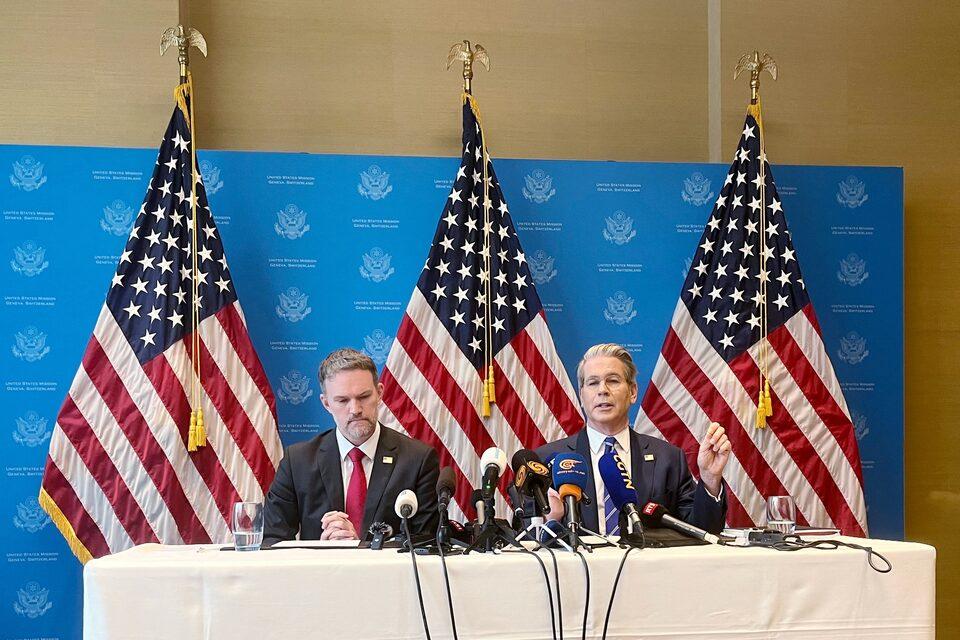
LONDON/SHANGHAI, May 12 (Reuters) - Stocks and the dollar surged on Monday after the United States and China said they had agreed on a 90-day pause on tariffs and reciprocal duties would drop sharply, giving investors some confidence that a full-scale trade war may have been averted. U.S. Treasury Secretary Scott Bessent, speaking after talks with Chinese officials in Geneva, told reporters the two sides had reached the deal that was outlined in a joint statement and that reciprocal rates would drop by 115 percentage points. Sign up here. This weekend's meetings were the first face-to-face interactions between U.S. and Chinese officials since U.S. President Donald Trump returned to power and launched a global tariff blitz, imposing particularly hefty duties on China. MARKET REACTION: STOCKS: Futures on the S&P 500 and Nasdaq jumped, while in Europe, the STOXX 600 (.STOXX) , opens new tab rose 0.8%. FOREX: The dollar extended gains, with the euro down 1.5% at $1.1078, while the yen weakened, leaving the U.S. currency up 2.1% at 148.49. BONDS: Benchmark 10-year U.S. Treasury yields rose 8 basis points on the day to 4.457%, having traded up 5 bps before the joint statement. COMMENTS: CHARLES WANG, CHAIRMAN, SHENZHEN DRAGON PACIFIC CAPITAL MANAGEMENT CO, SHENZHEN "The result of the China-U.S. talks is certainly good news. Both sides have returned to reason and common sense. However, neither has changed the tough stance based on deliberation of national interest. "The U.S. side has kept the 20% tariffs based on its hegemony and excuse over Fentanyl. In addition, if no deal is reached after 90 days, long-term tariffs will be 54% on Chinese exports and 34% on U.S. exports. That would be semi-decoupling. "So today's news cannot be counted as being long-term positive. It's long-term positive plus 90 days of uncertainty." SHELDON MACDONALD, CIO, MARLBOROUGH, LONDON “Our snap reaction is that this reduction is much bigger than expected. Yes, it’s only temporary, but the market is going to see this as confirmation that Trump doesn’t really want to cause the sort of disruption he has previously seemed to embrace. “That said, if we assume the ‘steady state’ is 10% blanket tariffs and 30% on China, it’s still negative relative to the situation when Trump took over. It’s also still a negative for growth – just smaller than had been expected more recently – so there’s no ‘all clear’ on recession fears just yet. “With positioning pretty ‘wrong way’ in a lot of assets, there’s potential for a bigger unwind. This could see risk assets up, the dollar up and a flatter yield curve. Conversely, safe-haven trades might soften. So once again we have sentiment, psychology and positioning in the driving seat rather than fundamentals.” SIMON EDELSTEN, FUND MANAGER, GOSHAWK ASSET MANAGEMENT, LONDON “It's no surprise that the world’s two largest economies are trying to address their long-standing issues, but don’t expect an easy resolution. Even if quite modest tariffs remain, that could make a large difference to trade flows as many Chinese exports to the US are low-margin and price sensitive. China may devalue the renminbi to make up for the change of terms of trade, which will reignite another old argument. This is like a mix of Chinese opera and soap opera – colourful characters and a plot that takes years to unfold.” JAN VON GERICH, CHIEF MARKET ANALYST, NORDEA, HELSINKI "Markets have taken it at face value, I personally am a bit sceptical, if you want to end up with low tariffs then why do it like this? It’s still bouncy, and uncertainty is elevated. "I’m still worried that there will be a last word, that now they’ve come to an initial conclusion the details won’t satisfy both sides, and there will be something else but, of course, time will tell. I would not take everything we hear at the moment at face value, that’s what we saw on ‘Liberation Day’ (April 2 tariff announcement), and now, and it still bounces both ways." JANE FOLEY, HEAD OF FX STRATEGY, RABOBANK, LONDON "We’ve had reassurance from the U.S. that negotiations will continue and that the tone of the negotiations have been positive and US and China don’t want to decouple, so there is a lot more optimism that the tariffs won’t have the devastating impact that perhaps they could have done, and there is a collective sigh of relief in markets. "That doesn’t mean that we’re back to where we were before the Trump inauguration, the 10% baseline tariff still exists everywhere, the 90-day pause is there and the clock is starting to tick. The overall scenario is not as bad as it could have been, but we still have a fair amount of uncertainty about where these tariffs will settle, their impact on world growth and central bank policy." KENNETH BROUX, SENIOR STRATEGIST FX AND RATES, SOCIETE GENERALE, LONDON "It's a clear vote by the market in favour of riskier assets. It's a step in the right direction and a positive of U.S. assets and U.S. economy." "The dollar was lagging other markets in the recovery from the April lows. We had equities up back to April 2nd levels, we had bond yields up to those levels and the dollar was actually lagging that move. Now the conditions are falling into place for a deeper adjustment and a bigger recovery of the dollar to catch up with equities and bond yields." ZHIWEI ZHANG, CHIEF ECONOMIST, PINPOINT ASSET MANAGEMENT, HONG KONG "This is better than I expected. Obviously, this is very positive news for economies in both countries and for the global economy, and makes investors much less concerned about the damage to global supply chains in the short term. "But we also need to keep in mind this is only a three-month temporary reduction of tariffs. So this is the beginning of a long process. The two sides will spend months probably, to come up with a resolution, or reach a final trade deal, but this is a very good starting point." ARNE PETIMEZAS, DIRECTOR RESEARCH, AFS GROUP, AMSTERDAM "Such a sharp U-turn by the US on tariffs on a Monday morning is quite the surprise. It seems that tariffs on China will fall to manageable levels, albeit temporary. Markets should rally on this. How can Trump credibly raise tariffs when the 90-day pause ends? He has toned down his tariffs faster than anyone thought he could, and April 2 will soon be forgotten. Granted, he told you to buy the dip." WILLIAM XIN,CHAIRMAN OF HEDGE FUND SPRING MOUNTAIN PU JIANG INVESTMENT MANAGEMENT, SHANGHAI "The result far exceeds market expectations. Previously, the hope was just that the two sides can sit down to talk, and the market had been very fragile. Now, there's more certainty. Both China stocks and the yuan will be in an upswing for a while." https://www.reuters.com/world/china/view-us-china-agree-cut-tariffs-90-day-pause-2025-05-12/
2025-05-12 07:23
May 12 (Reuters) - Japanese investors sharply ramped up their overseas equity purchases in April, shifting away from bonds as they rebalanced portfolios amid global market volatility triggered by U.S. tariffs, and capitalizing on discounted international shares. Japanese investors bought a net 3.27 trillion yen ($22.37 billion) in overseas stocks — the highest monthly total since at least 2005 — while pulling 1.08 trillion yen from foreign bonds, according to Ministry of Finance data released on Monday. Sign up here. Institutional investors pulled 1.99 trillion yen from long-term debt securities but allocated a net 906.3 billion yen into short-term instruments. Trust accounts led equity purchases with a record 2.76 trillion yen, followed by investment trust firms, which added 801.4 billion yen in foreign stocks. Life insurers, however, offloaded 462 billion yen in foreign shares, marking a fourth consecutive month of net selling. U.S. Treasury yields rose in early April as bonds sold off, with hedge funds unwinding leveraged basis trades and overseas investors selling U.S. debt in apparent retaliation for tariffs, amid growing doubts about the safe-haven status of U.S. assets. Separately, data released by the Bank of Japan on Monday showed Japanese investors pumped 2.12 trillion yen into U.S. equities in March — the most since at least 2014 — while trimming holdings of European stocks by a modest 21.82 billion yen. Meanwhile, overseas investors snapped up 3.68 trillion yen in Japanese markets in April, the largest monthly inflow in two years. Analysts suggested that early April buying was likely fuelled by optimism over Japanese companies, driven by corporate reforms, increased confidence in yen stability, and relatively attractive valuations compared with Western markets. ($1 = 146.1500 yen) https://www.reuters.com/business/finance/japanese-foreign-equity-purchases-april-hit-20-year-high-global-market-2025-05-12/