2025-05-05 11:55
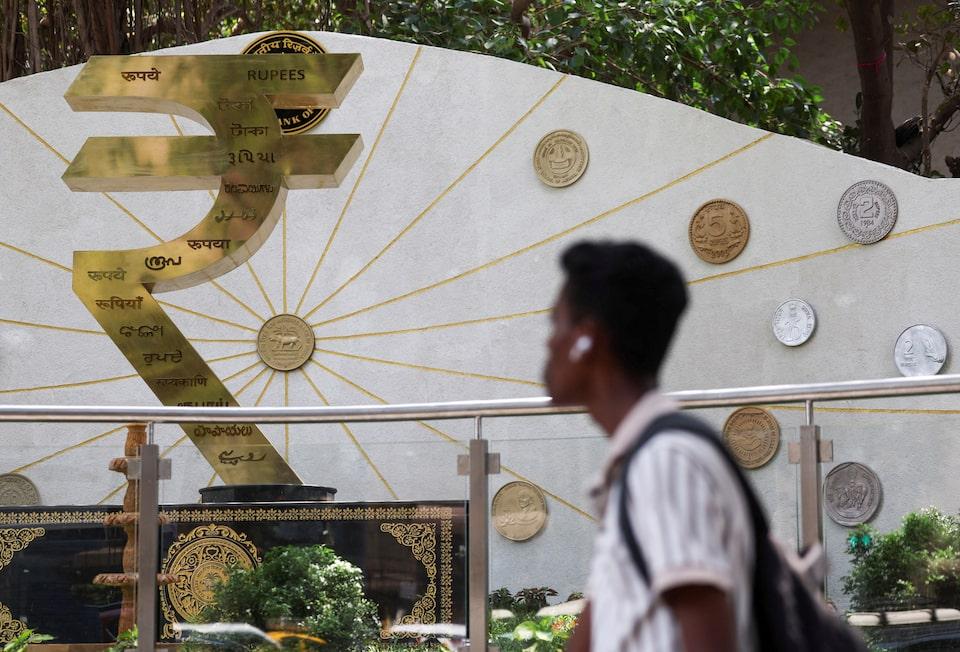
MUMBAI, May 5 (Reuters) - The Indian rupee strengthened on Monday, tracking a rise in the offshore Chinese yuan and comforted by falling crude oil prices, even as dollar demand from importers and a large foreign bank ate into some of the currency's intraday gains. The rupee closed at 84.25 against the U.S. dollar, up 0.4% on the day. The currency had touched a peak of 84.1275 in early trading but trimmed gains in the latter half of the session. Sign up here. The dollar index was down 0.2% at 99.6 while the offshore Chinese yuan touched a near six-month high of 7.1876, buoyed by optimism about trade talks between China and the United States. Oil prices, meanwhile, fell more than 2% on Monday after OPEC+ decided over the weekend to further speed up oil output hikes, spurring concerns about a glut of supply into an uncertain demand environment. "We expect the USD/INR pair to stabilise in the range (of) 85-87 for 2025. The domestic impact of tariffs on the dollar will be visible in 2025, which will support rupee," State Bank of India said in a note on Monday. The bank expects the dollar to weaken further as the U.S. economy adjusts to the impact of tariff policies. Meanwhile, dollar-rupee forward premiums fell, with the 1-year implied yield down 9 basis points at 2.18%. Slimmer chances of a rate cut by the Federal Reserve in June and the rupee's recent string of gains have both weighed on far-forward premiums, traders said. A pick-up in portfolio inflows and cutting of bearish bets boosted the rupee by about 2% over the last four weeks. Meanwhile, the odds of a June rate cut by the Fed have declined to about 33% from nearly 64% a week earlier. https://www.reuters.com/world/india/rupee-ends-higher-aided-by-stronger-yuan-slumping-oil-prices-2025-05-05/
2025-05-05 11:38
Canadian mining firm looking for gold opportunities in Guinea Fortuna faced security, regulatory challenges in Burkina Faso Exploration budget raised, with a portion allocated to Guinea DAKAR, May 5 (Reuters) - Canada's Fortuna Mining (FVI.TO) , opens new tab is eyeing expansion into Guinea after exiting Burkina Faso, where it faced regulatory instability and high security costs because of jihadist threats, its CEO told Reuters. Fortuna, which is not currently established in Guinea, is looking for gold mining opportunities there, conducting site visits and meeting with authorities, Ganoza said. Sign up here. "We find Guinea to be a place we would invest today," Jorge Ganoza said by video call. A portion of the mining company's growing exploration budget will go to Guinea where "there is a lot of room for discovery", he said. The comments highlight how mining companies are responding to the changing landscape in West Africa, where military-run governments are revising mining codes while struggling to mitigate the threat posed by jihadists. Burkina Faso and its neighbours Mali and Niger have all seen military officers seize power in coups since 2020. The new leaders have introduced new mining codes to increase local control over the sector while sometimes deploying hardball tactics. Malian authorities have arrested foreign executives and seized gold stocks amid negotiations with mining companies in recent months. Niger in December seized a French-run uranium site, while Burkina Faso's junta last month vowed to take control of more foreign-owned industrial mines. Guinea, which borders Mali to the southwest, is also led by a military government - coup leader Mamady Doumbouya seized power in 2021 - but does not face the same jihadist threats. Its government has not revised its mining code, but has put pressure on foreign firms including by threatening their licences if they fail to meet a tight construction deadline for the giant Simandou iron ore deposit. "We don't see the same situations as we see today in Mali or Burkina Faso or Niger," Ganoza said. BURKINA EXIT Fortuna announced last month it was exiting Burkina Faso with the sale of the Yaramoko gold mine to a private local company for $130 million. Though Fortuna expects to lose approximately 70,000 ounces of gold from the sale, according to Ganoza, he said the deal was "a very compelling offer" given the mine's low reserves. Insecurity from jihadist attacks had driven the company's annual security costs to as much as $7 million, Ganoza said. In other jurisdictions he said such costs are between $200,000 and $300,000. Fortuna had been forced to operate on "a complete fly-in, fly-out basis for all personnel", with ground transportation too dangerous, Ganoza said. He added that Burkina Faso's government was "pricing themselves out of the market" by demanding state participation in mining firms as high as 30% in the revised mining code adopted in July 2024. Fortuna's retreat from Burkina Faso follows competitor Endeavour's (EDV.L) , opens new tab exit last year. Globally, Fortuna is investing $51 million in exploration and project development this year, up from $41 million in 2024, Ganoza said. In addition to Guinea, he said there will be a heavy focus on Senegal's Diamba Sud gold project and expanding operations in Ivory Coast, where Fortuna's flagship Seguela gold mine is located. https://www.reuters.com/world/africa/fortuna-eyes-guinea-investments-after-burkina-faso-exit-ceo-says-2025-05-05/

2025-05-05 11:36
May 5 (Reuters) - Tyson Foods (TSN.N) , opens new tab beat Wall Street expectations for second-quarter profit, driven by increased demand for its chicken products as well as lower costs, and reaffirmed its annual revenue forecast on Monday. Shares of the company fell 1.5% in premarket trading after it narrowly missed quarterly revenue estimates. Sign up here. It witnessed sustained demand for its frozen meat and ready-to-eat food as consumers increasingly preferred eating at home. Robust growth in Tyson's chicken segment at its restaurant and food service channels helped the company offset stubbornly high beef prices due to low U.S. cattle supplies. However, it faces challenges as consumer sentiment in the United States ebbed for a fourth consecutive month in April, in anticipation of a surge in product prices due to President Donald Trump's tariff policies. Tyson said recent changes in trade policies and tariffs may lead to some sales disruptions as its exports account for less than 10% of its business, the company disclosed in a filing on Monday. It also warned that tariffs and trade disputes affect the pricing of commodities and raw materials, and in turn lead to additional costs for the company and its suppliers. Smithfield Foods (SFD.O) , opens new tab, the biggest U.S. pork processor and a Tyson rival, said on Tuesday that China was no longer a viable market owing to retaliatory tariffs. Beijing's additional tariffs push China's effective duty rate on U.S. pork to 172%, according to industry data. On an adjusted basis, Tyson earned 92 cents per share for the quarter ended March 29, compared with analysts' estimate of 82 cents, according to data compiled by LSEG. Quarterly net sales of $13.07 billion missed analysts' estimate of $13.14 billion. Tyson increased its contingency accrual by $250 million for claims that its pork business was involved in price fixing, according to the regulatory filing. Sales in its beef segment, the company's largest, were up 4.9% in the quarter. Prices were up 8.2%, while volumes declined 1.4%. Adjusted operating margin at its chicken segment rose to 7.5% from 3.9% in the year-ago quarter, while its pork business rose to 3.7% from 2.2% a year ago. https://www.reuters.com/business/retail-consumer/tyson-foods-beats-quarterly-profit-estimates-strong-chicken-demand-2025-05-05/
2025-05-05 11:34
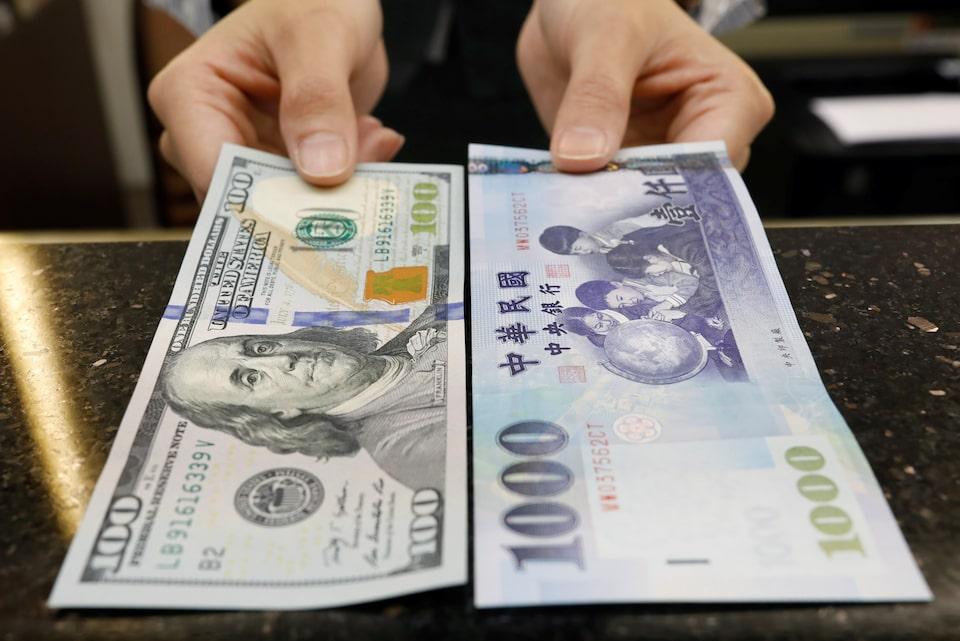
Taiwan dollar gains 8% vs USD in two days Central bank says US did not ask for stronger TWD Move suggests unwinding of financial imbalances - strategist SINGAPORE/TAIPEI, May 5 (Reuters) - An unprecedented two-day surge in Taiwan's currency is the latest leg of a scramble out of the U.S. dollar and signal of disquiet in markets as U.S. President Donald Trump's trade war rattles confidence and disrupts trade relationships. Taiwan occupies one of the most valuable and vulnerable points in the global economy, as the dominant manufacturer of high-end computer chips and supplier to both the U.S. and China. Sign up here. Its currency, usually contained by a central bank with a mandate for stability, has leapt 8% in two days, with traders complaining of no buyers for U.S. dollars that insurers, exporters and investors suddenly wanted to sell. The precise trigger for the sudden rise was not clear. Yet the move coincided with the end of U.S.-Taiwan trade talks in Washington, which fuelled speculation of an agreement to weaken the greenback in return for trade concessions. Such a deal has been repeatedly denied by the central bank, but not entirely believed by a market which sees the Taiwan dollar's jump having its tacit approval, as well as likely to be welcomed by the United States. The scale of the rally suggests a big unwinding is under way and shines a light on one economy among many where years of big trade surpluses have built up large long dollar positions at exporters and insurers that are now under question and on edge. "The Taiwan dollar is appreciating at a faster pace than I've ever seen," said one senior Taiwanese financial industry executive, on condition of anonymity as they were not authorised to speak to the media. "Hot money is coming into Taiwan, and the central bank is allowing it. Many are saying that's due to pressure from the U.S. I would say that must be the case." Taiwan's central bank said on Monday the U.S. did not ask for a stronger Taiwan dollar and said the currency had been volatile lately because of foreign fund inflows and companies' expectations of a stronger Taiwan dollar. Taiwan President Lai Ching-te on Monday also weighed in calling on people not to spread fake stories about foreign exchange rate talks with the United States. Taiwan's office of trade negotiations said on Monday that the talks last week did not include the central bank or touch on the exchange rate. The currency notched its strongest close in more than two years on Monday, closing at 30.145 to the dollar . HOW IT HAPPENED The Taiwan dollar has been moving higher since early April, when Trump announced the heaviest of his tariffs and put a - since suspended - 32% import tax on Taiwan. The trend seemed to start with a bump from the easing of U.S.-China tensions, but started to feed on itself as unique features of Taiwan's capital markets drove desperate buying. As exporters saw the value of their U.S. dollar receipts dropping and insurers the value of their vast offshore holdings fall in Taiwan dollar terms, exporters rushed to convert and insurers scrambled simultaneously to hedge their currency exposure. "The (U.S. dollar) selling interest originates onshore," said Tareck Horchani, head of prime brokerage dealing at Maybank Securities in Singapore. That, in turn, he said, pushed foreigners with leveraged positions in the cheap-to-borrow Taiwan dollar to quit and the forced buying of Taiwan dollars turbocharged the moves. To be sure, on both Friday and Monday the currency stabilised after morning surges and the central bank reiterated on Monday that it would do its best to maintain stability. Still, the speed and size of the jump - in statistical parlance a 19-standard-deviation event - point to longer-term forces afoot. "It ... underscores how a pileup of less-noticed financial imbalances can elicit sharp corrections when the underlying political canvas undergoes a seismic change," said Aninda Mitra, head of Asia macro strategy at BNY Investment Institute. And those speculating on a broader shakeout as the Trump administration seeks to re-shape its trade relations see it as a harbinger of the next leg of dollar weakness in Asia. "While the jury on whether (the Trump administration) can move manufacturing onshore is out, and we are unlikely to know for sure, a weak dollar is certainly an integral part of their strategy," said Sunil Kalra, portfolio manager at LC Beacon Global Fund. "So the stars are aligned, and while so far most dollar weakness has been seen in the precious metals and G10 space, is it finally time for this to spread into emerging markets, especially Asian EM, which has lagged?" https://www.reuters.com/world/asia-pacific/taiwan-dollars-record-rally-is-trade-war-tremor-2025-05-05/
2025-05-05 11:21
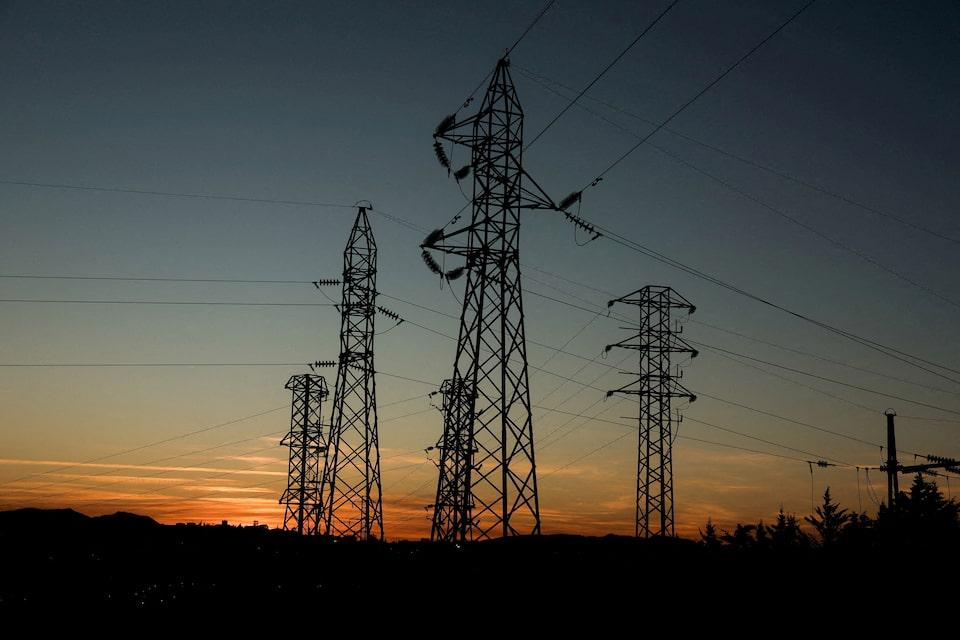
EU wind and solar growth outpace network upgrades EU grid infrastructure is ageing, more links needed More energy storage needed to maintain grid stability LONDON, May 5 (Reuters) - Europe's ageing power grid and lack of energy storage capacity will require trillions of dollars in investments to cope with rising green energy output, increasing electricity demand and to avoid blackouts. A week ago, Spain and Portugal lost power in their worst blackout. Authorities are investigating the cause, but whatever the findings, analysts and industry representatives say infrastructure investment is essential. Sign up here. "The blackout was a wake-up call. It showed that the need to modernise and reinforce Europe’s electricity grid is urgent and unavoidable," Kristina Ruby, secretary general at Eurelectric, Europe's electricity industry association, said. The European Union's power grid mostly dates back to the last century and half the lines are over 40 years old. Rising low-carbon energy production and booming demand from data centres and electric vehicles require an overhaul of the grids that also need digital protection to withstand cyber attacks. While global investment in renewables has nearly doubled since 2010, investment in grids has barely changed at around $300 billion a year. The amount needs to double by 2030 to over $600 billion a year to cover the necessary overhauls, according to the International Energy Agency. Spain has asked its own investigators and European Union regulators to investigate last Monday's outage. While the underlying issues have yet to become clear, grid operator Red Electrica (REDE.MC) , opens new tab said two separate incidents had triggered the massive power loss. It follows an acceleration in renewable energy use, especially in Spain, after Russia's invasion invasion of Ukraine in February 2022 and the resulting disruption of oil and gas supplies focused EU efforts on reducing dependence on fossil fuel. The share of renewables rose to 47% in the EU's power mix last year from 34% in 2019, while fossil fuels dropped to 29% from 39%, data from think tank Ember showed. Spain plans to phase out coal and nuclear power. Renewable generation hit a record high at 56% of Spain's power mix in 2024. Wind and solar projects are relatively quick to build compared with grids, which can take more than a decade. Part of the problem is the huge sums and complexity of improving a grid over a large distance. The European Commission has estimated Europe needs to invest $2.0-2.3 trillion in grids by 2050. Last year, European firms invested 80 billion euros ($90.5 billion) in grids, up from 50-70 billion in previous years, analysts at Bruegel said while adding investments may need to rise to 100 billion. INTER-STATE CONNECTIONS Spain and Portugal's power systems are among those in Europe that lack connections to other grids that can provide back up. Spain needs more links to France and Morocco, said José Luis Domínguez-García from Spain's energy research centre IREC in Catalunya. Spain has only 5% of connections outside the Iberian Peninsula, he added. As some other countries also lag, the European Commission has a target to increase interconnection to 15% by 2030, from a previous goal of 10%, meaning each EU member country should be able to import at least 15% of its power production capacity from neighbouring countries. Spain will reinforce connections with France, including a new link via the Bay of Biscay that will double the interconnection capacity between the two countries, Spain's grid Red Electrica said on Tuesday. NEED FOR BACK UP As solar and wind generation grows, the challenges go beyond upgrading grids to the need for back-up generation. Solar and wind farms generate direct current power, while traditional gas or nuclear plants generate alternating current. DC power is converted to AC in inverters to standard 50 Hertz frequency for European grids and use in homes and businesses. If power generation drops, the grid requires back-up AC power to prevent the frequency from dropping. In the event frequency drops, automatic safety mechanisms disconnect some generation to prevent overheating, damage to transformers or transmission lines. If too many plants drop off at the same time, the system can experience a blackout. Before last week's outage, Spain had suffered power glitches and industry officials had repeatedly warned of grid instability. Spain's energy officials have also said the country's plans to shut down all seven of its nuclear reactors by 2035 could put power supply at risk. Portugal has only two back-up plants - a gas and a hydro plant - able to quickly respond if the grid needs more power, Portugal's Prime Minister Luis Montenegro said on Tuesday, adding the country wants more. In Britain, a blackout in 2019 cut power to a million customers, when a lightning strike and a second, unrelated incident lowered the frequency of the grid. Since then, the country has invested to expand battery storage and had around 5 gigawatts of capacity installed at the end of last year, according to industry association RenewableUK. It can help balance the grid in the same way as power plants. Europe has 10.8 gigawatts of battery storage and it will grow to 50 GW by 2030 - much less than the required 200 GW, according to the European Association for Storage of Energy. In Ireland, Siemens Energy has built the world's largest flywheel, which can also operate as power storage and help to stabilise the grid. https://www.reuters.com/sustainability/climate-energy/eu-power-grid-needs-trillion-dollar-upgrade-avert-spain-style-blackouts-2025-05-05/
2025-05-05 11:10
TAIPEI, May 5 (Reuters) - A 5.9 magnitude earthquake struck in the sea off the east coast of Taiwan on Monday, the island's weather administration said, with no immediate reports of damage. The quake briefly shook buildings in the capital, Taipei. The quake, some 30 km (18.6 miles) offshore, had a depth of 6.6 km (4.1 miles), the weather administration said. Sign up here. Taiwan lies near the junction of two tectonic plates and is prone to earthquakes. More than 100 people were killed in a quake in southern Taiwan in 2016, while a 7.3 magnitude quake killed more than 2,000 people in 1999. https://www.reuters.com/world/asia-pacific/taiwan-rattled-by-quake-off-east-coast-no-immediate-reports-damage-2025-05-05/