2025-05-01 11:34
May 1 (Reuters) - U.S. refiner HF Sinclair (DINO.N) , opens new tab posted a smaller-than-expected loss in the first quarter on Thursday, supported by sequential improvement in refining margins. The 3-2-1 crack spread , a key indicator of U.S. refining margins, rebounded in early 2025 from multi-year lows as nationwide refinery maintenance tightened fuel supply. Sign up here. But the margins have since been under pressure due to broader macroeconomic headwinds stemming from the sweeping tariffs and an intense trade war between the U.S. and China — factors that could weigh on demand for refined products such as gasoline, diesel and jet fuel. Refiners process crude oil into gasoline, diesel, jet fuel and other products. HF Sinclair's throughput, or the total crude processed, during the first quarter rose to 646,580 barrels per day from 643,300 bpd a year earlier. Refinery utilization averaged 89.4%, compared to the firm's own forecast of 91%. The company said its adjusted refinery margins were $9.12 per produced barrel, 28% lower than a year earlier but still above the $6.68 per barrel during the fourth quarter. Core profit in the marketing segment, however, jumped 80%, helped by higher margins. At its midstream segment, adjusted core profit rose 8%, driven by higher pipeline revenue. The Dallas, Texas-based company posted an adjusted loss of 27 cents per share during the January-March quarter, compared with analysts' average estimate of a 44-cent-per-share loss, according to data compiled by LSEG. HF Sinclair's results echo those of bigger rivals such as Valero Energy (VLO.N) , opens new tab and Phillips 66 (PSX.N) , opens new tab, which also reported quarterly losses last week on weak margins. https://www.reuters.com/business/energy/us-refiner-hf-sinclair-posts-smaller-than-expected-loss-first-quarter-2025-05-01/
2025-05-01 11:14
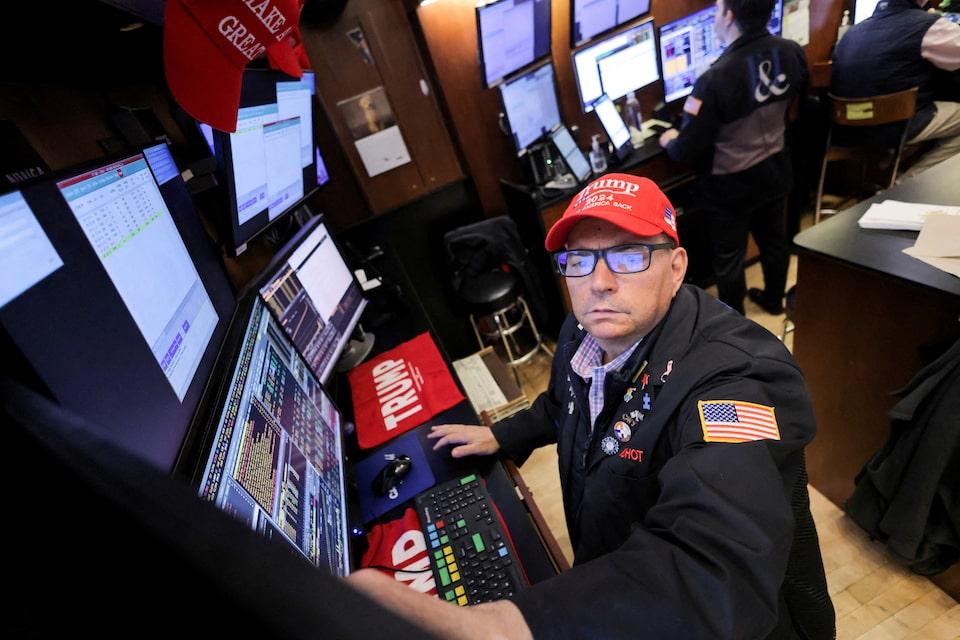
LONDON, May 1 (Reuters) - What matters in U.S. and global markets today By Mike Dolan , opens new tab, Editor-At-Large, Financial Industry and Financial Markets Sign up here. Big Tech looks to have calmed Wall Street nerves overnight, helping deflect attention from the U.S. economy's tariff-skewed first quarterly contraction in three years. In today's column, I explain why the euro zone's outperformance against the U.S. in the first quarter may be more than just a flash in the pan. Now onto the market news. Today's market minute * Ukraine and the U.S. on Wednesday signed a deal heavily promoted by U.S. President Donald Trump that will give the United States preferential access to new Ukrainian minerals deals and fund investment in Ukraine's reconstruction. * Microsoft forecast on Wednesday stronger-than-expected quarterly growth for its cloud-computing business Azure after blowout results in the latest quarter, calming investor worries in an uncertain economy and lifting its shares 7% after hours. * A sliding yen helped push the dollar higher on Thursday as the Bank of Japan lowered growth forecasts in light of U.S. tariffs and left rates on hold , opens new tab. * Saudi Arabian officials are briefing allies and industry experts to say the kingdom is unwilling to prop up the oil market with further supply cuts and can handle a prolonged period of low prices, five sources with knowledge of the talks said. * The Trump administration expects to conclude initial tariff deals with some U.S. trading partners within weeks, but negotiations with India are not "finish-line close" and no official talks with China are under way, U.S. Trade Representative Jamieson Greer said on Wednesday. Tech tonic for stalled economy Impressive results from U.S. megacaps Microsoft (MSFT.O) , opens new tab and Meta (META.O) , opens new tab lifted their shares by 8% and 5%, respectively, ahead of Thursday's bell, with positive news on cloud computing and artificial intelligence, themes that have recently been overshadowed by tariff news. Following last week's beat from Alphabet (GOOGL.O) , opens new tab and with Apple and Amazon (AMZN.O) , opens new tab due to report late on Thursday, the tech earnings picture has brightened amid the trade war fog, and given a shot in the arm to the wider market. Nasdaq and S&P 500 futures are up 1-1.5% ahead of today's bell as a result. The Nasdaq (.IXIC) , opens new tab, though still down 10% for the year to date, has clawed back all its losses since President Donald Trump's April 2 tariff announcement. The S&P500 (.SPX) , opens new tab and 'Magnificent Seven' megacap ETFs on Thursday are likely to have also regained the ground lost after "Liberation Day". Fittingly on "International Workers Day", which closed most of Europe's markets on Thursday, attention is zooming back in on the employment situation and how it is unfolding as the second quarter gets under way. After a miss on April private sector payrolls from the ADP update on Wednesday, April layoff data and weekly jobless claims are next on the slate before the overall jobs report is released tomorrow. April manufacturing surveys from ISM will also be watched closely for signs of any tariff-related fallout. Amid the blizzard of economic and corporate reports on Wednesday, the focus was on the negative U.S. GDP print for the first quarter, something that was almost unthinkable at the start of the year. While the 0.3% contraction was below consensus forecasts for an equally modest expansion, the result was clearly distorted by import stockpiling ahead of tariffs. And it was slightly better than many updated 1Q growth forecasts put out just before the release. Import surge aside, much of the attention was on the more resilient consumption and production readings, though there is debate about the extent to which these were also flattered by pre-tariff stockpiling. Some correction of these trade-related distortions is expected in the current quarter, but it remains to be seen how much the actual tariff moves affected behaviour last month or what impact they will have moving forward. Trump blamed the first quarter GDP hit on distortions and hangovers from the previous administration, even though those distortions were driven mostly by his tariff plans. However, improving news on trade talks has continued to leak out. A social media account affiliated with Chinese state media claimed the United States had approached China seeking talks over Trump's 145% bilateral tariffs, potentially signalling Beijing's openness to negotiations. And there was some progress on the geopolitical front too as Ukraine and the U.S. finally signed a deal that gives the United States preferential access to new Ukrainian minerals deals and funds investment in Ukraine's reconstruction. But the combination of a GDP miss, softer jobs numbers and a benign core inflation reading for March has encouraged Federal Reserve easing bets. Futures are now pricing in just over 100 basis points of rate cuts by yearend, starting about midyear. As a result, U.S. Treasury yields , have slipped back further to three-week lows. U.S. crude oil prices have also fallen further toward four-year lows around $57 per barrel. The dollar (.DXY) , opens new tab has crept higher to touch its best level since mid-April, with Japan's yen falling back sharply as the Bank of Japan left its key interest rates unchanged on Thursday. Make sure you check out today's column, which looks at the contrasting fortunes of U.S. and euro zone GDP during the first quarter and considers whether Europe's rare outperformance will prove durable. Today's events to watch * US April layoffs (7:30EDT), weekly jobless claims (8:30EDT), April manufacturing surveys from S&P Global (0945EDT) and ISM (10:00EDT), March construction spending (10:00EDT) * May 1 Labor Day holidays across much of Europe and parts of Asia * U.S. corporate earnings: Apple, Amazon, Eli Lilly, Amgen, Moderna, Airbnb, Ameren, AIG, KKR, Estee Lauder, Mastercard, McDonalds, Howmet, Huntington Ingalls, Mohawk, Hubbell, Hershey, Intercontinental Exchange, Kellanova, Eversource, AMETEK, Biogen, CVS, Consolidated Edison, Linde The opinions expressed here are those of the author, a columnist for Reuters https://www.reuters.com/markets/us/global-markets-view-usa-2025-05-01/
2025-05-01 11:10
Forecasts Y570 bln net profit for FY25/26 Sets aside Y40 bln financial buffer amid U.S. tariffs Still considering all options for Ambatovy nickel project TOKYO, May 1 (Reuters) - Japanese trading house Sumitomo Corp (8053.T) , opens new tab on Thursday forecast a record net profit of 570 billion yen ($4 billion) for the current fiscal year and set aside a financial buffer to hedge against the potential negative impact of U.S. tariffs. Sumitomo posted 562 billion yen in net profit for the year ended in March, up 45.4% from a year earlier and beating analysts' expectations of 554.2 billion yen, on strong non-mineral resources performance in segments including real estate. Sign up here. Warren Buffett's Berkshire Hathaway (BRKa.N) , opens new tab is a large minority shareholder in Sumitomo and other Japanese trading houses and has recently been increasing its ownership. Sumitomo allocated a loss buffer of 40 billion yen, adding that while the direct impact of U.S. tariffs will likely be limited, "a certain degree of indirect impact may arise." Sumitomo plans to increase its annual dividend to 140 yen for the year ending next March, up from 130 yen now, and to buy back up to 2.9% of its shares worth 80 billion yen. It forecasts nickel output at its Ambatovy project in Madagascar at around 30,000 metric tons this year, up from under 30,000 tones last year, as a number of issues, including a pipeline, are being resolved. Production was suspended in February for a detailed inspection of the pipeline that broke last September. With the cause identified and maintenance complete, operations will resume once safety is confirmed, CEO Shingo Ueno told a news conference. "We will work to stabilize production and review the project's medium-term business plan," he said. "Also, we'll continue to keep all options on the table to reach a decision to ensure the best outcome for stakeholders," he said, without elaborating. Sumitomo, which owns a 54.2% stake in the project companies, has struggled to stabilise production and boost profitability at Ambatovy. It has been reviewing all possible options for the project's future since last May. ($1 = 143.7500 yen) https://www.reuters.com/markets/asia/japans-sumitomo-corp-annual-net-profit-up-45-beats-forecasts-2025-05-01/

2025-05-01 10:56
TSX ends 0.2% lower at 24,795.55 Materials sector loses 2.4% as gold falls Bombardier declines 9.4% after revenue miss Energy adds 0.9% as oil rallies May 1 (Reuters) - Canada's main stock index ended lower on Thursday as gold mining shares fell, but the index stayed in reach of a recent four-week high as investors weighed prospects of fiscal spending and welcomed recent calming of global trade tensions. The Toronto Stock Exchange's S&P/TSX composite index (.GSPTSE) , opens new tab ended down 46.13 points, or 0.2%, at 24,795.55. On Tuesday, it posted its highest closing level in four weeks at 24,874.48. Sign up here. U.S. stocks rose after strong results from megacaps Microsoft (MSFT.O) , opens new tab and Meta (META.O) , opens new tab eased concerns about artificial intelligence spending. Investor sentiment has improved in recent weeks after U.S. President Donald Trump put on pause sweeping global tariffs. "There's a bit of optimism in the air, particularly coming from the macro side, just with the election, (and) the tone seems to have changed significantly from President Trump," said Ben Jang, a portfolio manager at Nicola Wealth. "Likely we're going to see legislation passed fairly quickly, almost preemptively, to help support the Canadian economy." Canadian manufacturing activity contracted in April at the steepest rate since shortly after the start of the COVID-19 pandemic as the uncertain nature of U.S. trade policy weighed on production and new orders. Prime Minister Mark Carney's Liberal Party, which retained power in the Canadian general election on Monday, has promised to cut taxes and increase spending on housing and infrastructure. The materials group, which includes metal mining shares, fell 2.4% as unwinding of safe-haven bets led to gold dropping to a two-week low. Shares of Bombardier Inc (BBDb.TO) , opens new tab lost 9.4% after the business jet manufacturer reported first-quarter revenue that fell slightly short of investor expectations. The technology sector rose 0.7%, helped by a gain of nearly 5% for the shares of electronics firm Celestica (CLS.TO) , opens new tab. Energy was up 0.9% as the price of oil settled 1.8% higher at $59.24 a barrel. https://www.reuters.com/markets/europe/tsx-futures-fall-us-economic-woes-weigh-commodities-2025-05-01/
2025-05-01 10:31
World Liberty Financial unveiled USD1 stablecoin in March To be used for $2 bln MGX investment in Binance, WLF co-founder says Use highlights World Liberty's growing clout in crypto industry May 1 (Reuters) - A stablecoin launched by Donald Trump's World Liberty Financial crypto venture is being used by an Abu Dhabi investment firm for its $2 billion investment in crypto exchange Binance, one of World Liberty's co-founders said on Thursday. It's the latest in a series of Trump family crypto-related ventures, including a "meme coin" launched in January, that have drawn criticism from government ethics experts and political opponents over potential conflicts of interest. Sign up here. World Liberty, which aims to allow people to access financial services without intermediaries like banks, said in March it would launch USD1, a dollar-pegged stablecoin backed by U.S. Treasuries, dollars and other cash equivalents. Speaking at a crypto conference in Dubai, Zach Witkoff, a co-founder of World Liberty, said USD1 would be used to close the $2 billion investment by Abu Dhabi-based MGX into Binance, the world's biggest crypto exchange. "We are excited to announce today that USD1 has been selected as the official stablecoin to close MGX's $2 billion investment in Binance," said Witkoff, who is a son of Trump's special envoy to the Middle East, Steve Witkoff. Democratic Senator Elizabeth Warren sharply criticized the venture and pending U.S. legislation on stablecoins before the Republican-controlled Senate. A fund "backed by a foreign government just announced it will make a $2 billion deal using Donald Trump’s stablecoins," said Warren, a member of the U.S. Senate Banking Committee. "Meanwhile, the Senate is gearing up to pass the 'GENIUS' Act - stablecoin legislation that will make it easier for the President and his family to line their own pockets. This is corruption and no senator should support it.” The White House and World Liberty Financial did not respond immediately to requests for comment. The use of USD1 in the deal highlights World Liberty's growing clout in the global crypto industry, and its ties to Binance. USD1 is issued on Binance's blockchain. Stablecoins are an increasingly lucrative cog in global crypto trading. Their issuers typically profit by earning interest from the Treasuries and other assets that underpin them. The value of USD1 in circulation reached about $2.1 billion on Wednesday, according to CoinMarketCap data, making it one of the fastest-growing stablecoins. The identity of its major holders, however, remains unclear. An anonymous cryptocurrency wallet that holds $2 billion worth of USD1 received the funds between April 16 and 29, according to data from crypto research firm Arkham. Reuters could not ascertain the owner of this wallet. Binance founder and former CEO Changpeng Zhao, who was incarcerated in the United States last year after pleading guilty to violating U.S. laws against money laundering, met Zach Witkoff and two other World Liberty co-founders in Abu Dhabi, according to a photo posted on social media site X on Sunday. "It was great to see our friends," in Abu Dhabi, posted Zhao in response , opens new tab to the photo, tagging Witkoff. Zhao, who in 2023 stepped down from his role at Binance as part of a $4.3 billion settlement with the U.S. over the illicit finance charges, remains a major shareholder of Binance. TRON INTEGRATION Separately, Zach Witkoff announced that USD1 would be integrated into Tron, the blockchain of Hong Kong-based crypto entrepreneur Justin Sun. Sun is the biggest known investor in World Liberty and an adviser to the venture, according to his social media posts, having poured at least $75 million into the project. Sun was fighting a U.S. securities fraud lawsuit at the time of his first investment in World Liberty. The U.S. Securities and Exchange Commission in February paused its case against him, citing public interest. Sun moderated the panel on which Witkoff spoke on Thursday, with Trump's son Eric Trump also on stage. The U.S. president, who campaigned on promises to be a "crypto president," has pledged to overhaul federal rules on crypto. Trump handed over management of his assets to his children before returning to the White House and he will have no role in day-to-day decision-making, his company has said. https://www.reuters.com/world/middle-east/wlfs-zach-witkoff-usd1-selected-official-stablecoin-mgx-investment-binance-2025-05-01/

2025-05-01 10:16
May 1 (Reuters) - Specialty chemicals company Itaconix (ITXI.L) , opens new tab said on Thursday it would implement selective price increases and look at cutting supply chain costs to offset the impacts of proposed U.S. tariffs, which are expected to raise production expenses. The developer of sustainable, bio-based polymers also said euro currency swings from the ongoing trade war and production shifts by various companies to the United States are boosting its revenues in Europe and the U.S. Sign up here. Overall, Itaconix reaffirmed its expectations for 2025. WHY IS IT IMPORTANT? Itaconix said it sources five raw materials from Asia, with two exempt from current tariffs, two facing less than 25% net tariff and one subject to a levy of more than 100% but used in small amounts. However, any impact from the import of raw materials was expected to take several months, Itaconix added, as the company had last year invested in securing inventory of finished and raw goods to meet demand. CONTEXT Companies across the world are evaluating the implications of a global trade war initiated by U.S. President Donald Trump's tariffs on various sectors and countries, which have also intensified concerns of a potential recession. According to its latest annual report, Itaconix is exposed to trade relations between the U.S., China, Canada and Europe through imports of itaconic acid from China, and sales of its products to Europe and Canada. The company has one production facility in North America, and holds some finished goods and raw materials at an off-site warehouse there, and another in Europe. KEY QUOTE "I believe we are in a net position to continue making gains in the midst of uncertain trade developments," says CEO John R. Shaw. https://www.reuters.com/world/china/bio-polymer-maker-itaconix-hike-some-prices-cut-costs-mitigate-tariff-hit-2025-05-01/