2025-04-25 04:32
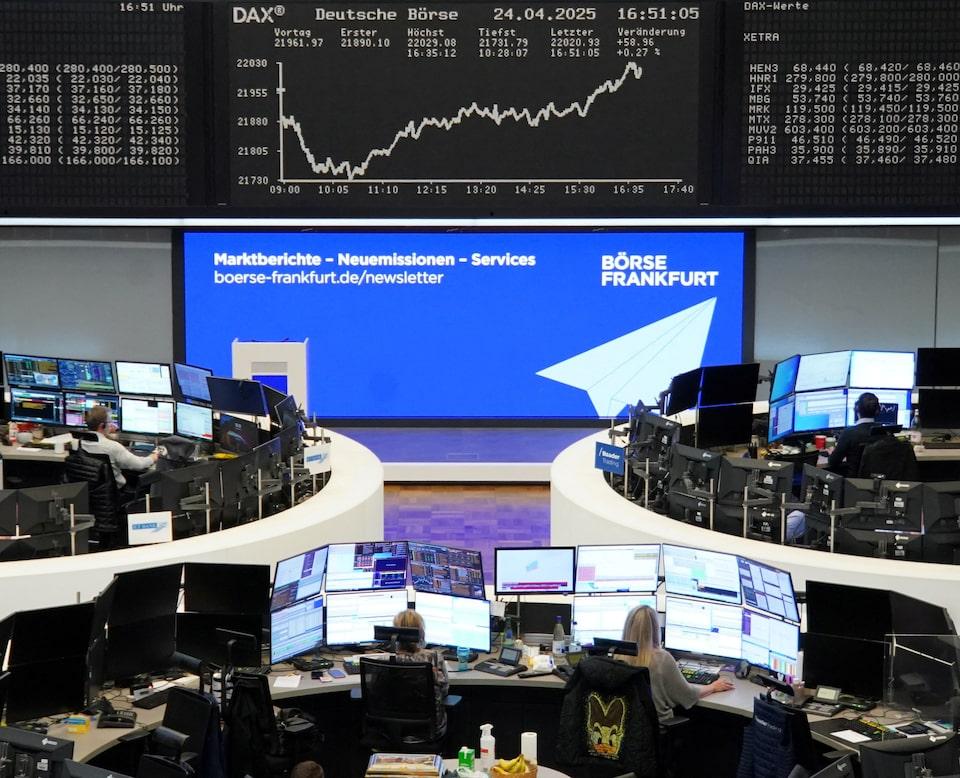
A look at the day ahead in European and global markets from Rocky Swift As U.S. President Donald Trump's trade war with China devolves into a "he said, Xi said" back-and-forth over whether the countries are actually talking, the markets for now are shifting their attention to some upbeat corporate results. Sign up here. Futures trade pointed to a higher open on European stock markets, adding to a second straight weekly gain as the shock wears off from Trump's April 2 "Liberation Day" tariff announcement. The whiplash effects are likely far from over but markets seem to be accepting them as the new normal. Google parent Alphabet (GOOGL.O) , opens new tab and packaged snacks maker Nestle beat sales estimates while pharmaceuticals heavyweight Merck posted higher profits. Shares in Asia latched onto the positive news, with Japan's Nikkei (.N225) , opens new tab rising more than 2% and MSCI's broad index of ex-Japan shares (.MIAPJ0000PUS) , opens new tab climbing more than 1%. The U.S. dollar , which is trading more like a risk asset in the new upside-down world, rose sharply against the Swiss franc and euro in Asia trading. U.S. stock futures are signalling a continued rally. With the bulk of Trump's sweeping tariffs suspended for 90 days, expectations have mounted that major trading partners will cut trade deals one-by-one with the U.S., but none have yet emerged. Negotiations between Japan and the U.S. have yet to produce anything concrete. Trump said on Thursday that trade talks are happening with China, which a Chinese Foreign Ministry spokesperson later rejected as "false news". China's government, however, is considering suspending its 125% tariff on some U.S. imports, Bloomberg News reported on Thursday. Chinese authorities may remove the additional levies for medical equipment and some industrial chemicals including ethane, the report said, citing people familiar with the matter. On the earnings front, forecasts have been cut or withdrawn by a growing number of companies, including Japanese industrial robot maker Fanuc (6954.T) , opens new tab, Procter & Gamble (PG.N) , opens new tab, PepsiCo (PEP.O) , opens new tab, Chipotle Mexican Grill (CMG.N) , opens new tab, and American Airlines (AAL.O) , opens new tab, signalling possible trouble ahead. Meanwhile, the Russia-Ukraine war rages on with at least 12 killed in Kyiv in a missile and drone attack that prompted Trump to post "Vladimir, STOP!" on social media. The earnings and economic data calendars are relatively light today, following a raft of mostly pessimistic sentiment readings for euro zone countries this week. France reports on the business climate for April and Britain on retail sales for March, while Swedish defence firm SAAB (SAABb.ST) , opens new tab reports first-quarter results. Key developments that could influence markets on Friday: -- Canada retail sales for February -- US earnings: AbbVie, Phillips 66, Schlumberger -- University of Michigan final survey for April Trying to keep up with the latest tariff news? Our new daily news digest offers a rundown of the top market-moving headlines impacting global trade. Sign up for Tariff Watch here. https://www.reuters.com/markets/europe/global-markets-view-europe-2025-04-25/
2025-04-25 03:13
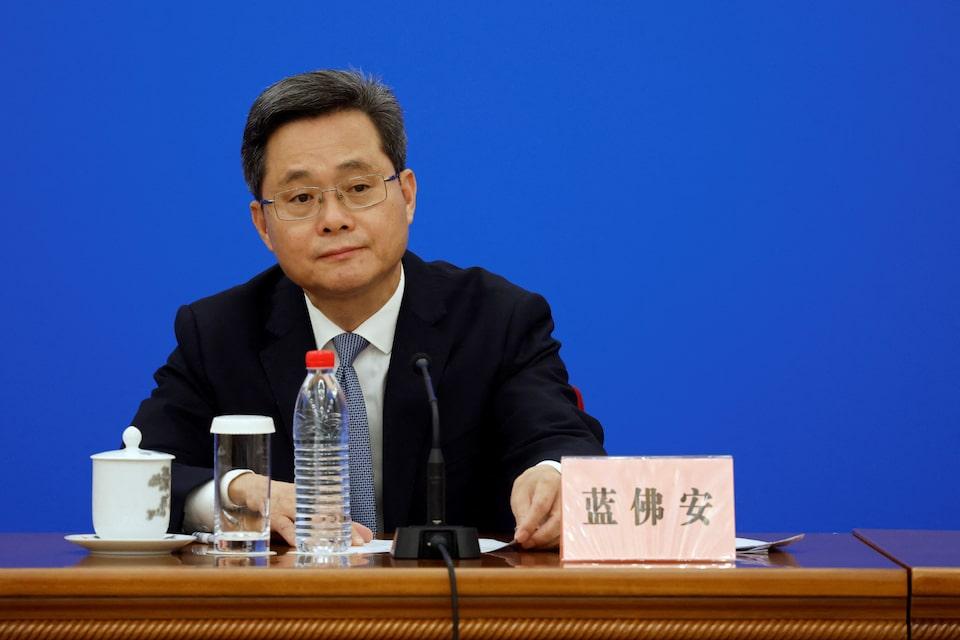
BEIJING, April 25 (Reuters) - China warned a G20 meeting that world economic growth was "insufficient" as tariff and trade wars exacerbated economic and financial instability and sapped growth momentum, its finance ministry and central bank said. Speaking at the group's meeting in Washington, Finance Minister Lan Foan called on all parties to strengthen multilateral cooperation, saying that China supported dialogue and consultation "on equal footing" to settle trade and tariff disputes. Sign up here. Meanwhile, People's Bank of China Governor Pan Gongsheng said that economic fragmentation and trade tensions had disrupted supply chains, weakening the momentum of global economic growth, the central bank said in a separate readout on Friday. Pan also told the meeting, which took place on Wednesday and Thursday, that the world's major economies should strengthen their participation in international macroeconomic and financial policy coordination. Other participants at the finance ministers and central bank governors meeting also flagged the significant increase in risks to global growth from trade tensions, tighter financing conditions and long-term structural challenges, according to the PBOC statement. They also called for strengthening dialogue and policy coordination, the statement said without referring to the United States. The Group of 20 major economies were meeting in the wake of U.S. President Donald Trump's announcement of hefty tariffs on imports that have triggered turmoil in financial markets and prompted the International Monetary Fund to cut its growth forecasts for most countries around the world. While Trump later put some of the tariffs on hold, he raised China levies to 145%, and maintained a universal import tariff of 10% as well as 25% duties on cars, steel and aluminium. The U.S. indicated talks were taking place with China on tariffs but Beijing on Thursday denied that, demanding the U.S. drop the levies. Lan also urged for better implementation of the debt treatment mechanism under the G20's Common Framework, and said all parties should pool more resources for Africa's development and strengthen Africa's capacity-building. The finance ministry said Lan held bilateral meetings and exchanges with representatives from countries and organisations including South Africa, the European Commission, Pakistan, Germany, South Korea, Indonesia, Britain, Japan and the World Bank. The meetings were mainly to discuss the macroeconomic situation, key issues of the G20 fiscal channels and bilateral cooperation, the readout said. https://www.reuters.com/markets/asia/china-finance-minister-tells-g20-world-economic-growth-insufficient-2025-04-25/
2025-04-25 02:59
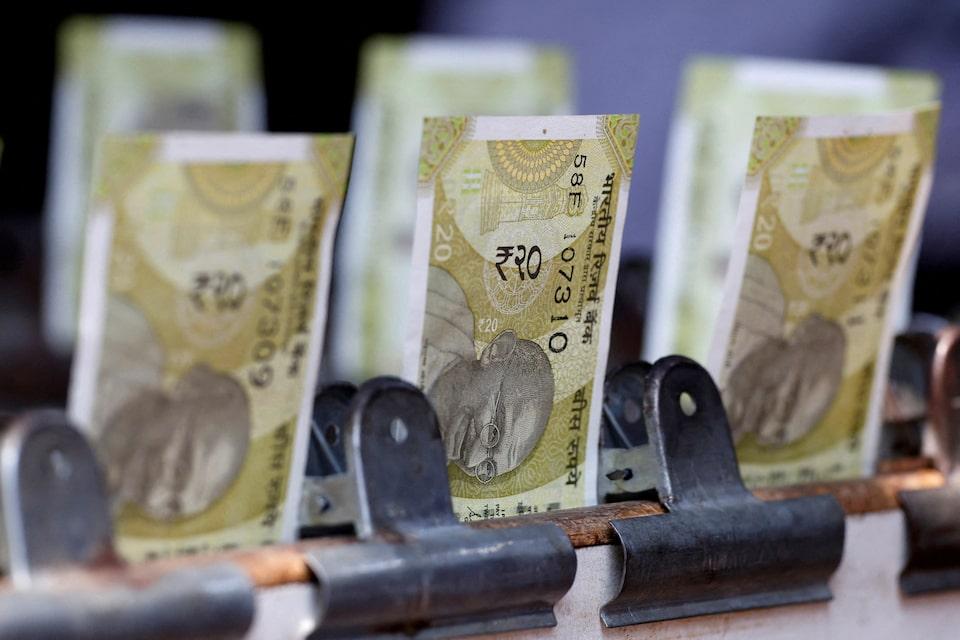
MUMBAI, April 25 (Reuters) - The Indian rupee is likely to sidestep the regional downtrend on Friday, with support coming from the encouraging intraday reversal seen in the previous session. The 1-month non-deliverable forward indicated that the rupee will open slightly higher-to-flat against the U.S. dollar from the close of 85.26 in the previous session. Sign up here. The rupee witnessed a notable intraday swing on Thursday, dropping to 85.66 before clawing back losses to settle around 85.25. The decline past 85.66 was linked to importer-driven dollar demand for immediate payments and positioning adjustments. With momentum favourable for the rupee, flows supportive, and a broader risk-on mood, the Indian currency "should do well", a currency trader at a bank said. Foreign investors have returned to Indian equities, lending support to the rupee. A de-escalatory tone from President Donald Trump—on both U.S. tariffs and the Federal Reserve’s independence—has buoyed risk sentiment, aiding foreign inflows. ASIAN CURRENCIES STRUGGLE Most Asian currencies declined on Friday, and the dollar index edged higher to 99.60. The region’s currencies continue to deal with a volatile dollar, fuelled by ongoing tariff and Fed-related headlines. The dollar index fell 1% on Monday after Trump threatened to fire Fed Chair Powell, and surged next day when he clarified he wouldn’t replace Powell and hinted at trade war de-escalation with China. On the China front, investors are grappling with conflicting signals. Beijing stated on Thursday that no trade talks had taken place with Washington, while Trump later affirmed that direct negotiations are ongoing. The dollar's direction will be heavily influenced by news on U.S. tariffs, which, in turn, depends on the outlook for U.S. assets, analysts said. Recent optimism on trade has provided support for U.S. assets. Investors are looking for confirmation of a more optimistic view on U.S. assets to justify buying the dollar, ING Bank noted. KEY INDICATORS: ** One-month non-deliverable rupee forward at 85.40; onshore one-month forward premium at 18 paise ** Dollar index up at 99.6 ** Brent crude futures up 0.3% at $66.7 per barrel ** Ten-year U.S. note yield at 4.31% ** As per NSDL data, foreign investors bought a net $464.4mln worth of Indian shares on Apr. 23 ** NSDL data shows foreign investors sold a net $29mln worth of Indian bonds on Apr. 23 https://www.reuters.com/world/india/rupee-ride-positive-momentum-unlikely-follow-asian-peers-lower-2025-04-25/
2025-04-25 00:41
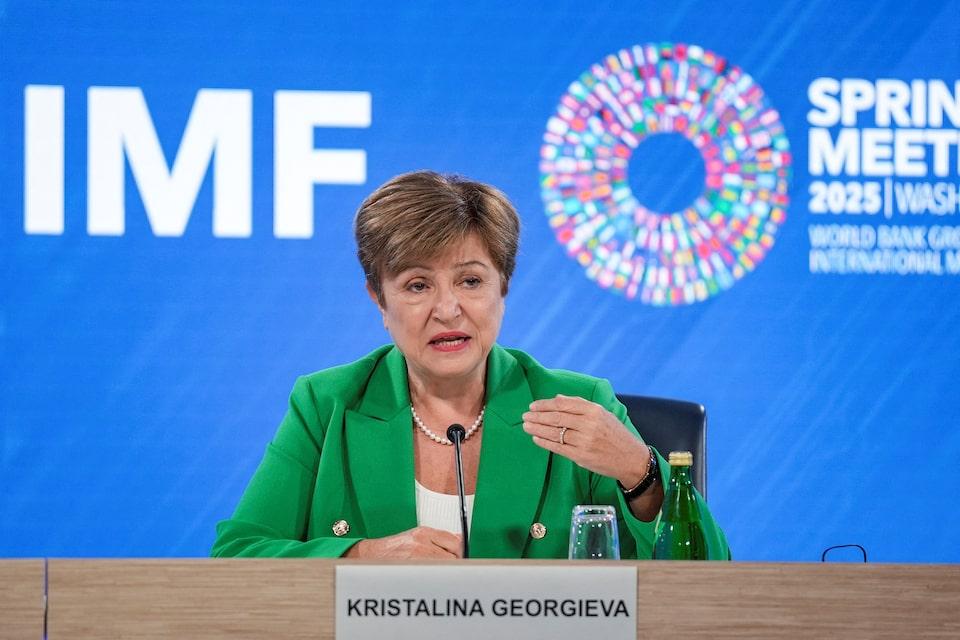
IMF to discuss US policy prescriptions with members, Georgieva says US Treasury chief Bessent says IMF has strayed from core mission Countries facing climate risks need IMF support, Georgieva says WASHINGTON, April 24 (Reuters) - The International Monetary Fund will stay "laser focused" on preventing balance of payments crises and incorporate the Trump administration's concerns into its policies but will keep supporting countries affected by climate change, IMF Managing Director Kristalina Georgieva said on Thursday. Georgieva said in a press conference during IMF and World Bank spring meetings that the directives from U.S. Treasury Secretary Scott Bessent would be discussed with representatives of the multilateral crisis lender's 190 members. Sign up here. She also said she welcomed Bessent's expression of U.S. support for the IMF. Bessent on Wednesday called for the IMF and the World Bank to refocus on their core missions of macroeconomic stability and development, saying they had strayed too far into issues such as climate change, gender and inclusion that have reduced their effectiveness. The U.S. Treasury chief's prescriptions were in line with the Trump administration's efforts to reverse the Biden administration's policies on climate and gender issues and also included a call for a broadening of the World Bank's energy lending to fossil fuels and nuclear power. Bessent, who controls the dominant U.S. shareholding in both institutions, also said Georgieva and World Bank President Ajay Banga needed to earn the Trump administration's trust by implementing "back-to-basics" policies. Georgieva said climate change impacts macroeconomic policy in some cases. "People think that we have climate experts. We don't. That's not our job," she said of the IMF. "Our job is to say, 'Okay, if you are Dominica and a hurricane can wipe out the equivalent of 200% of your GDP, what are reasonable policies put in place?'" Asked whether the IMF would rethink the Resilience and Sustainability Trust financing facility that it launched in 2022 to help countries deal with climate change, pandemics and other chronic challenges, Georgieva said this lending was a "really small" portion of the IMF's total financing. The IMF also is a membership organization, and its members ultimately will decide its policies, she added. She said she agreed with Bessent's call for the two Bretton Woods institutions to be cost-efficient, saying that in real, inflation-adjusted terms, the IMF's budget had not changed in 20 years, adding: "I really like to run a tight ship." TARIFF CHALLENGES But Georgieva made clear that the IMF's top priority is the daunting macroeconomic stability challenge posed by the highest U.S. tariffs in more than a century, which prompted the IMF to slash its 2025 growth outlook earlier this week. "Simply put, the world economy is facing a new and major test and it faces it with policy buffers depleted by the shocks of recent years." Although many private-sector economists are predicting higher chances of a U.S. recession , opens new tab, Georgieva insisted that the IMF's view of a 37% probability was accurate. "We don't see either in the labor market or in indicators for the functioning of the economy, such a dramatic block of economic activities that would drag growth in the United States all the way to below zero," she said. Still, the IMF chief said countries needed to respond to the trade challenge by pursuing fiscal and economic reforms aimed at faster growth, including streamlining regulation and fostering innovation and productivity gains. She called on the major trading countries to resolve tariff tensions swiftly to ease "off-the-charts" uncertainty that is paralyzing investment and consumer spending. "All countries should seize this moment to lower their trade barriers, both tariff and non-tariff," Georgieva said. She called on China to shift its growth model to more consumer spending, urged the U.S. to reduce its fiscal deficits and said the European Union should complete its common market reforms, including unifying its banking and capital markets sectors. https://www.reuters.com/sustainability/climate-energy/imf-stay-focused-stability-support-countries-climate-change-georgieva-says-2025-04-24/
2025-04-25 00:38
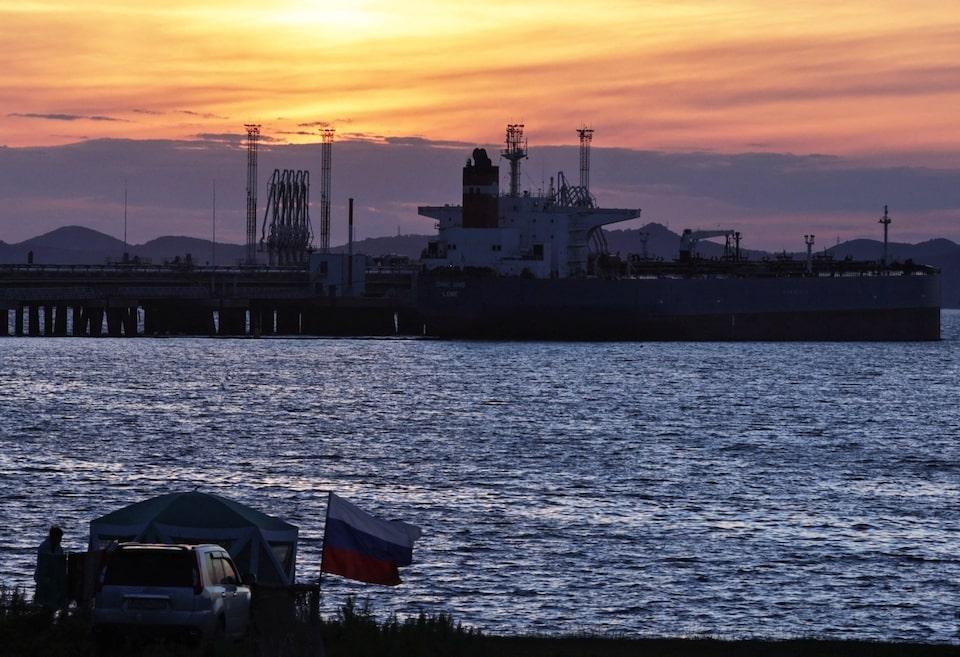
Brent, WTI erase earlier gains following tariff uncertainty Both contracts set for weekly declines OPEC+ to consider another accelerated oil output increase for June LONDON, April 25 (Reuters) - Oil prices fell on Friday and were set for a weekly decline of over 3% on the back of oversupply concerns and uncertainty around tariff talks between the United States and China. Brent crude futures were down 82 cents to $65.73 a barrel at 1215 GMT, falling 3.3% over the week. Sign up here. U.S. West Texas Intermediate crude was down 81 cents to $61.98 a barrel, a decline of 4.2% for the week. "... Prices are down as concerns over oversupply from OPEC+ persist, while the demand outlook remains uncertain amid ongoing trade tensions. A stronger U.S. dollar has also added pressure to crude prices," LSEG senior analyst Anh Pham said. Oil erased earlier gains after a spokesperson from China's foreign ministry said China and the U.S. were not having any consultations or negotiations on tariffs. That contradicted earlier comments by U.S. President Donald Trump, who said on Thursday trade talks between the U.S. and China were underway. "Traders now view further (crude price) gains as unlikely in the short term due to the continued trade war among top global consumers and speculation that OPEC+ may accelerate production hikes from June," Saxo Bank analyst Ole Hansen said. China has exempted some U.S. imports from its 125% tariffs and is asking firms to identify critical goods they need levy-free, according to businesses notified, in the clearest sign yet of Beijing's concerns about the trade war's economic fallout. China hiked its tariffs after Trump announced higher levies on Chinese goods. Oil prices tumbled earlier this month to four-year lows after the tariffs sparked concern about global demand and a selloff in financial markets. Worries are growing about excess supply. Several OPEC+ members have suggested the group accelerate oil output increases for a second month in June, Reuters reported earlier this week. The U.S. and Russia are moving in the right direction to end the war in Ukraine, but some specific elements of a deal remain to be agreed, Russian Foreign Minister Sergey Lavrov said in an interview with CBS News. A halt to Russia's war in Ukraine and the easing of sanctions could allow more Russian oil to flow to global markets. Russia, a member of the OPEC+ group that includes the Organization of the Petroleum Exporting Countries, is one of the world's biggest oil producers along with the U.S. and Saudi Arabia. https://www.reuters.com/markets/commodities/oil-prices-set-weekly-loss-potential-more-global-supply-2025-04-25/
2025-04-24 23:57
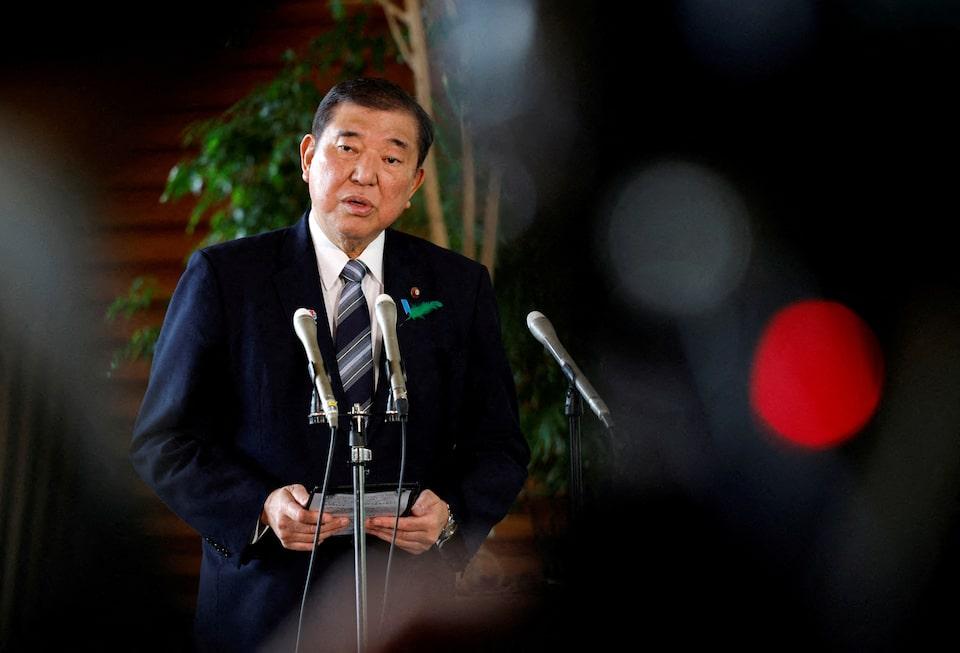
TOKYO, April 25 (Reuters) - Japan's Prime Minister Shigeru Ishiba on Friday said the government has compiled an emergency economic package to alleviate any impact on industries and households from new U.S. import tariffs. The package includes support for corporate financing as well as subsidies to lower gasoline prices by 10 yen ($0.07) a litre and partially cover electricity bills for three months from July, a government document showed. Sign up here. To help small and mid-sized companies more vulnerable to economic swings, a larger scope of firms will be eligible for low-interest loans extended by government-backed banks. "I have instructed cabinet members to make the utmost efforts to aid firms and households that have been worried about tariff impact," Ishiba said at a tariff task force meeting. Tariffs could have a significant effect on industries that support the economy such as automobiles and steel, he said. The government will consider additional measures to boost domestic consumption depending on the impact of U.S. tariffs on Japan's massive automotive industry. Friday's package could be financed by a reserve fund, eliminating the need to compile an extra budget, said economy minister Ryosei Akazawa. U.S. President Donald Trump on April 2 introduced a 25% tariff on car and truck imports. He also announced a 24% tariff on all Japanese goods, later cutting that to 10% for 90 days. Akazawa, who serves as Japan's top trade negotiator, will visit Washington next week for a second round of trade talks. The Nikkei business daily reported on Thursday that Japan is considering increasing soybean imports from the U.S. as part of negotiations. Hiroshi Moriyama, a ruling Liberal Democratic Party heavyweight, told reporters on Friday evening that increasing soybean and corn imports from the U.S. would be possible as Japan has limited capacity to produce them domestically. But Moriyama, the party's secretary general, stressed that farm products should not be sacrificed in the tariff negotiations with the United States, in apparent protest against a reported plan to expand rice imports from the U.S. He and some other LDP lawmakers submitted a request to Agriculture Minister Taku Eto that farm products should not be used as a bargaining chip to win concessions over tariffs on autos and other industrial products. ($1 = 142.8400 yen) https://www.reuters.com/en/japan-decides-economic-package-help-ease-tariff-pain-pm-ishiba-says-2025-04-24/