2026-02-10 11:38
Feb 10 (Reuters) - Indian explorer Oil India (OILI.NS) , opens new tab reported a fall in third-quarter profit on Tuesday as lower realisations squeezed margins, despite higher fuel demand. The state-owned firm's standalone profit, which excludes earnings from joint ventures and overseas operations, fell 33.8% to 8.08 billion rupees ($89.2 million) for the quarter ended December 31. Sign up here. Oil India's crude oil price realisation - the price at which it sells products - fell to $62.84 per barrel from $73.82 per barrel a year earlier, tracking a decline in global crude prices. Brent crude dropped more than 9% during the October-December quarter. The fall in crude prices dragged down overall revenue, while costs climbed, squeezing margins. Oil India's operating margin contracted to 13.58% from 30.65% a year earlier. Revenue from operations fell 6.2% to 49.16 billion rupees, with revenue from Oil India's crude oil segment - its largest - dropping 10.7%. Its natural gas segment's revenue, however, grew 3.2%. The firm's total expenses rose 16.4% to 45.15 billion rupees. Meanwhile, fuel consumption in India, the world's third-largest consumer and importer of oil, rebounded 5.5% and 5.3% year-on-year in November and December, respectively, after a 0.4% drop in October, according to data from Petroleum Planning and Analysis Cell. Oil India approved a second interim dividend of seven rupees per share for the current financial year. ($1 = 90.5530 Indian rupees) https://www.reuters.com/business/energy/oil-indias-quarterly-profit-declines-lower-crude-realisations-2026-02-10/

2026-02-10 11:33
Feb 10 - What matters in U.S. and global markets today By Mike Dolan , opens new tab, Editor-At-Large, Finance and Markets Sign up here. The dollar is back on the slide this week, even as some confidence returns to the broader stocks universe, with tech shares rallying and MSCI's all-country index jumping to new records. I’ll get into that and more below. But first, check out my latest column on the one key signal being clouded by 2026's chaotic news flow. And listen to the latest episode of the Morning Bid daily podcast. Subscribe to hear Reuters journalists discuss the biggest news in markets and finance seven days a week. YEN LIFT, DOLLAR DRIFT Three factors seem to be weighing on the greenback once again - a post-election surge in the yen, accelerating gains in China's yuan to near three-year highs, and some market trepidation about a weak U.S. employment report tomorrow. The yen's bounceback appears to be a case of 'sell the rumor, buy the fact' surrounding Prime Ministers Sanae Takaichi's fiscal plans. The currency had been floundering for months, but now it seems more comfortable with the growth and interest rate implications of fresh stimulus alongside a more stable political horizon. The yuan surge comes ahead of the Lunar New Year holidays next week, and is likely being supported by reports that Chinese regulators have warned local banks and investors about over-concentrated holdings of U.S. Treasury bonds and the dollar. The U.S. currency is at its lowest point since May 2023, having fallen almost 6% against the renminbi over the past year. The other big focus yesterday was the bounceback in U.S. mega-cap tech stocks after last week’s wobble over news of capex plans totalling more than $650 billion for 2026. Some of that will, of course, be debt-financed. Alphabet announced on Monday that it would raise another $15 billion in high-grade bonds. This follows Oracle’s announcement of a new debt sale last week. The five major AI hyperscalers issued $121 billion in U.S. bonds last year, compared with an average of $28 billion per year in the previous four years. Meantime, President Trump's administration plans to spare tech giants such as Amazon, Google and Microsoft from upcoming tariffs on chips as the hyperscalers build out their AI data centers, according to the Financial Times , opens new tab. Elsewhere, UK markets had a nervy day on Monday as drama intensified around Prime Minister Keir Starmer’s appointment of Epstein-linked Lord Peter Mandelson as U.S. ambassador in 2025. But the ruling Labour Party backed Starmer late on Monday, calming both sterling and gilts. Back on Wall Street, Wednesday's January employment report is coming into view, with White House economic adviser Kevin Hassett saying on Monday that people "shouldn't panic" if they see weak numbers. Before that, though, the December retail sales report will take center stage today. Chart of the day China's yuan surged to its strongest in nearly three years against the dollar, underpinned by heavy corporate demand for the local currency ahead of China's biggest festival. But the move was also spurred by reports on Monday that Chinese regulators have advised financial institutions to trim holdings of U.S. Treasuries because of concerns over concentration risk and market volatility. Today's events to watch * U.S. December retail sales, Q4 employment costs, December import costs * U.S. 3-year note auction * New York Fed releases Q4 2025 Household Debt and Credit Report * Dallas Fed President Lorie Logan and Cleveland Fed President Beth Hammack both speak * U.S. corporate earnings: Cloudflare, Coca-Cola, Ford, Hasbro, S&P Global, Spotify Want to receive the Morning Bid in your inbox every weekday morning? Sign up for the newsletter here. You can find ROI on the Reuters website , opens new tab, and you can follow us on LinkedIn , opens new tab and X. , opens new tab Opinions expressed are those of the author. They do not reflect the views of Reuters News, which, under the Trust Principles , opens new tab, is committed to integrity, independence, and freedom from bias. https://www.reuters.com/business/finance/global-markets-view-usa-2026-02-10/

2026-02-10 11:12
U.S. tariffs, strong peso pressure Colombian flower industry margins Colombian flower sector faces potential layoffs, closures by July Valentine's Day on Saturday challenges flower-delivery traditions BOGOTA, Feb 10 (Reuters) - Millions of Colombian roses arrived in the U.S. just in time for Valentine's Day, but growing economic challenges are threatening to wilt the romance for the world's second-largest flower exporter. Colombia, which trails only the Netherlands in global exports, shipped approximately 65,000 tons of fresh-cut blooms between January 15 and February 9. The Valentine's Day season typically accounts for 20% of annual sales for a sector that serves as the primary supplier to the U.S. market, according to industry group Asocolflores. Sign up here. But the holiday rush is being overshadowed by a 10% U.S. tariff imposed last April as part of President Donald Trump's broader trade measures. The U.S. accounts for about 80% of Colombia's flower exports. Growers are also battling a peso that has strengthened almost 12% against the dollar over the past year and a 23% rise in minimum wage, factors that are eroding competitiveness and squeezing margins. "We are in very adverse, very complicated situations," said Jose Antonio Restrepo, manager of Ayure SAS Eclipse Flowers near Bogota. Without a shift in economic conditions, he warned, the industry could face widespread layoffs and farm closures by July. Flower cultivation is the country's most labor-intensive agricultural sector, providing formal employment for roughly 240,000 workers across 10,500 hectares, or nearly 26,000 acres. Flower growers face another unlikely challenge this year: Valentine's Day falls on a Saturday. "It's preferable that Valentine's Day falls on a weekday because people are accustomed to sending flowers to offices as a surprise," explained Augusto Solano, president of Asocolflores. On the packing floor at Ayure SAS Eclipse Flowers, the mood was more upbeat. Susana Vega, who was wrapping a bundle of roses, said the holiday still brings a sense of purpose. "It's an immense joy (...), knowing that we're bringing happiness to someone," Vega said. "To a woman, to a mother, and that we're also benefiting ourselves." https://www.reuters.com/world/americas/tariffs-threaten-colombian-flower-industry-amid-valentines-day-rush-2026-02-10/

2026-02-10 11:12
Indexes: Dow up 0.10%, S&P 500 off 0.33%, Nasdaq down 0.59% US retail sales unexpectedly flat in December Investors await U.S. payrolls report Spotify, Marriott rally after bullish forecasts Coca-Cola dips after missing Q4 revenue expectations Feb 10 (Reuters) - The S&P 500 and the Nasdaq closed lower on Tuesday while the Dow edged up to its third record close in a row, as investors digested disappointing retail sales figures and waited for a key labor market report. The S&P 500 communication services sector (.SPLRCL) , opens new tab was the market's weakest sector, weighed down by Alphabet (GOOGL.O) , opens new tab shares, which fell 1.8% after Google's parent said it sold bonds worth $20 billion. Sign up here. The announcement played in to investor worries about the amount of money technology companies say they must spend to support the artificial-intelligence boom, with Amazon (AMZN.O) , opens new tab, Alphabet, Meta (META.O) , opens new tab and Microsoft (MSFT.O) , opens new tab collectively set to spend hundreds of billions in 2026 as they race for AI dominance. Meanwhile, U.S. retail sales unexpectedly stalled in December as households scaled back spending on vehicles and other big-ticket items, suggesting a slower growth path for consumer spending and the economy heading into the new year. The flat reading compared with economists' estimates for 0.4% growth. Trader hopes edged up for a more dovish Federal Reserve with the probability of a one-notch April rate cut up to 36.9% from 32.2% on Monday, according to CME Group's , opens new tab FedWatch tool. Markets still expect, however, that the central bank will keep rates on hold until June, when President Donald Trump's Fed chair nominee, Kevin Warsh, would take charge if approved by the U.S. Senate. Mark Luschini, chief investment strategist at Janney Montgomery Scott, described the disappointing retail data as "bad news is good news," particularly for rate-sensitive industry indexes such as utilities (.SPLRCU) , opens new tab and real estate (.SPLRCR) , opens new tab, which were leading the benchmark's sector gainers. But the strategist pointed to caution ahead of the delayed but closely watched nonfarm payrolls report, due on Wednesday. "In anticipation of the jobs report, nobody wants to get too far above their risk budget in the event the number does cause some consternation," said Luschini. Potentially adding some angst was White House economic adviser Kevin Hassett's comment on Monday that U.S. job gains could be lower in the coming months because of slower labor force growth and higher productivity due to AI gains. The Dow Jones Industrial Average (.DJI) , opens new tab rose 52.27 points, or 0.10%, to 50,188.14, after hitting an intraday record high earlier in the day. The S&P 500 (.SPX) , opens new tab lost 23.01 points, or 0.33%, to 6,941.81 and the Nasdaq Composite (.IXIC) , opens new tab lost 136.20 points, or 0.59%, to 23,102.47. With the S&P 500 narrowly missing a return to its late January record close on Monday, Janney's Luschini said: "When a security or an index reapproaches a high level again there's often some hesitation, some contention that has to take place before it can break through that peak again." Gains of more than 2% in stocks such as Walt Disney (DIS.N) , opens new tab and Home Depot (HD.N) , opens new tab helped push up the blue-chip Dow, countering declines in shares including Coca-Cola (KO.N) , opens new tab, which finished down 1.5% after missing Wall Street estimates for fourth-quarter revenue. In other individual stocks, Datadog (DDOG.O) , opens new tab jumped 13.7% and led S&P 500 percentage gainers on the day after the cloud-based monitoring and analytics platform beat quarterly estimates. In the consumer discretionary (.SPLRCD) , opens new tab sector, Marriott (MAR.O) , opens new tab closed up 8.5% for its biggest daily gain since April after also hitting a record high. The hotel chain projected a 35% jump in fees from co-branded credit cards, as affluent travelers splurge on luxury vacations. Shares of S&P Global (SPGI.N) , opens new tab slumped 9.7%, making it the biggest loser in the S&P 500 after forecasting 2026 profit below analysts' estimates. Peers Moody's (MCO.N) , opens new tab and MSCI (MSCI.N) , opens new tab also fell. Spotify (SPOT.N) , opens new tab shares soared 14.7% after the audio-streaming platform forecast first-quarter earnings above expectations, benefiting from strong user growth and price hikes. Advancing issues outnumbered decliners by a 1.47-to-1 ratio on the NYSE where there were 795 new highs and 65 new lows. On the Nasdaq, 2,276 stocks rose and 2,447 fell as declining issues outnumbered advancers by a 1.08-to-1 ratio. The S&P 500 posted 72 new 52-week highs and 11 new lows while the Nasdaq Composite recorded 105 new highs and 107 new lows. On U.S. exchanges, 17.89 billion shares changed hands compared with the 20.68 billion-share moving average for the last 20 sessions. https://www.reuters.com/world/asia-pacific/us-stock-futures-pause-after-tech-rebound-upcoming-data-focus-2026-02-10/

2026-02-10 11:10
Feb 10 (Reuters) - Industrial materials maker DuPont (DD.N) , opens new tab forecast full-year net sales and adjusted profit above analysts' expectations after it beat fourth-quarter earnings estimates on Tuesday, helped by higher sales in its healthcare segment and by business restructuring. Shares of the company rose 4.6% in premarket trading. Sign up here. The company has undergone a strategic reorganization as it attempts to streamline operations, as escalating production costs in Europe and increasingly stringent environmental regulations have compelled the global chemicals industry to reassess strategies. Last year, DuPont said it would sell its heat-resistant fiber business, Aramids, which houses brands such as body armor maker Kevlar, to peer Arclin for $1.8 billion. The company's board also greenlit the previously announced separation of its electronics business, Qnity Electronics, a segment that includes semiconductor technologies and interconnect solutions, in 2025. Net sales at its healthcare and water technologies segment rose 4% to $821 million in the reported quarter, compared with a year ago, driven by growth in medical packaging and medical devices, as well as strength in industrial water markets. Quarterly net sales at its diversified industrials segment fell 3% to $872 million as ongoing weakness in construction, printing and packaging markets weighed on results. The Wilmington, Delaware-based company expects adjusted profit to be between $2.25 and $2.30 per share in 2026, compared with analysts' average estimate of $2.17 per share, according to data compiled by LSEG. It forecast net sales in 2026 to be between $7.08 billion and $7.14 billion, the midpoint of which is above analysts expectations of $7.06 billion. "Our full year net sales guidance assumes about 3% organic growth and a currency tailwind of about 1% versus last year," said CFO Antonella Franzen. On an adjusted basis, the company posted a profit of 46 cents per share for the three months ended December 31, compared with analysts' estimate of 43 cents per share. https://www.reuters.com/sustainability/boards-policy-regulation/dupont-forecasts-strong-2026-profit-healthcare-gains-restructuring-2026-02-10/

2026-02-10 11:10
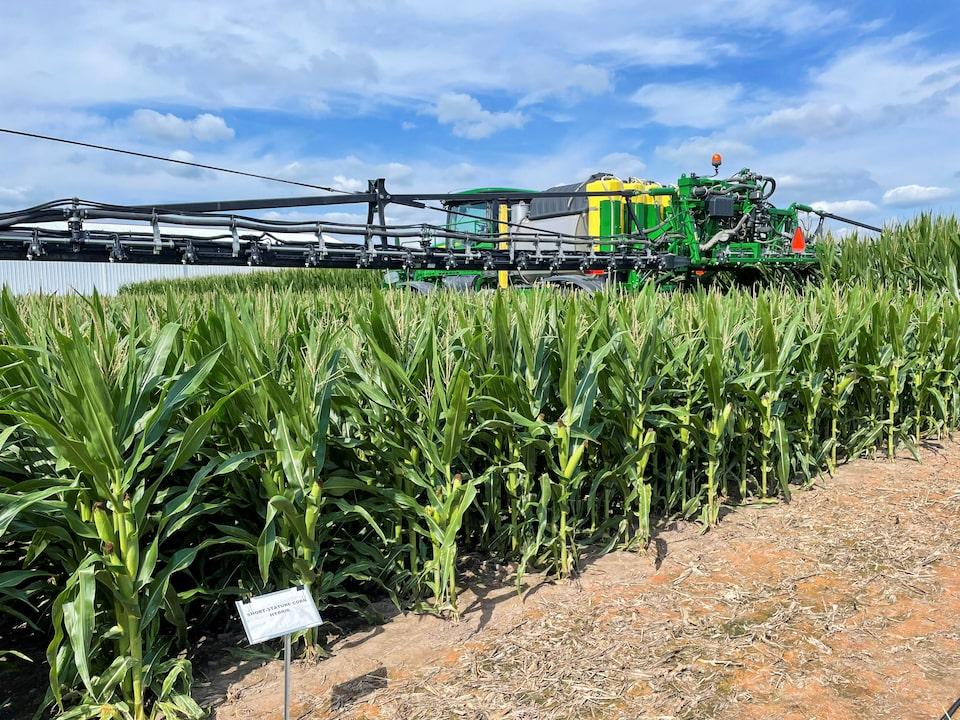
USDA launches review after unprecedented acreage estimate increases Staffing cuts hindered data processing, former official says Farmers' reluctance to participate in surveys complicates estimates CHICAGO, Feb 10 (Reuters) - The U.S. Department of Agriculture, long the world's gold standard for crop estimates, faces mounting doubts about the reliability of its data from farmers, grain traders and economists following deep staff losses and a sharp upward revision in how many acres of corn were harvested. Farmers, traders and food manufacturers everywhere closely follow monthly USDA reports on production, supplies and demand so they can anticipate prices and inventories. Sign up here. Thousands of employees left USDA last year as part of President Donald Trump's drive to shrink the federal government, and experts worry the shrinking staff hobbled the agency's ability to produce accurate and timely data. USDA's final estimates in January for how many corn acres farmers planted and harvested in 2025 represented unprecedented increases from initial estimates in June. Already-low grain prices sank more than 5%, at a time when growers were struggling to make money. USDA data last month "appeared to reflect an agency in disarray," said Arlan Suderman, chief commodities economist for consultancy StoneX, citing changes to acres and other estimates. The revisions prompted USDA's National Agricultural Statistics Service, which releases acreage estimates, to launch an internal review, said Lance Honig, a top NASS official. At the Farm Service Agency, another USDA branch, staffing reductions hampered employees from processing data on plantings last summer and feeding it to the statistics service, said Spiro Stefanou, a former acting USDA deputy undersecretary who resigned last fall. This delayed the statistics service from receiving a complete picture of acreage, he said. "NASS had less information to go on," Stefanou said. "That was going to make their estimates less reliable." Last summer, Trump fired a top Labor Department official following a weak scorecard of the U.S. job market, stoking concerns about the quality of federal government data. MASSIVE CROP ADJUSTMENTS Corn, America's largest crop, is used to feed millions of farm animals, produce ethanol and sweeten foods including ketchup and ice cream. Last month, farmers and analysts largely expected USDA would hardly adjust its estimate for harvested acres, already the largest since the 1930s. Instead, USDA hiked it to 91.3 million acres, up 1.3% from the previous estimate and 5.2% higher than in June. "All of a sudden we had acres popping up all over the place," said longtime analyst Sid Love. Smaller revisions are common, often in the form of decreases, as poor weather can reduce acres that farmers harvest. Over the last 15 years, harvested acreage estimates on average slipped about 0.7% from June to January, according to a Reuters analysis. Last month's increase unexpectedly raised USDA's corn production estimate and sank futures prices by 5.4%. INTERNAL REVIEW USDA based June acreage estimates on surveys of nearly 68,000 farmers, who have grown increasingly reluctant to participate , opens new tab. It used the results to estimate harvested acres until surveying farmers again in December and then published the updated results in January, Honig said. As part of its review, USDA will confirm its procedures worked as they should, Honig said. The agency is also exploring options for improving harvested acreage estimates, most likely without more farmer surveys, he said. In January, it made sense to increase the number of acres harvested for grain because poor weather had not hindered farmers, Honig said. Also, plantings were larger than previous years, and the number of acres harvested for silage, a form of livestock feed made from the whole corn plant, stays relatively unchanged annually, he said. The USDA in June estimated that farmers planted 95.2 million acres, up 5% from the previous year. At the time, plantings were nearly complete, raising confidence in the estimate among traders and farmers. Many farmers delayed crop sales due to low grain prices and did not know that plantings were even larger than they thought. USDA raised its estimate by more than 2% in August, lowering corn prices 3%, and again in September. By January, USDA estimated plantings were 98.8 million acres, up 3.8% from its initial estimate. Some farmers said they did not understand why USDA could not produce a better assessment in June. "Given the turmoil and turnover at the USDA at the time, there were already concerns about data quality, with the miss from June to final doing everything to reinforce those fears," said Angie Setzer, partner at advisory firm Consus Ag Consulting. "A swing of this size from June to final plantings has never happened before, making many feel it is more difficult to adequately manage risk." STAFFING CUTS HAMPER AGENCY Honig said it was not clear why USDA's initial plantings estimate fell short. In August and September, when USDA mostly increased the plantings estimate, the statistics service incorporated Farm Service Agency data as part of its typical procedures. Farmers are required to report plantings to the Farm Service Agency to be eligible for loan and revenue programs that cover a vast majority of acres. In the first half of last year, Farm Service Agency lost about 24% of its employees while the statistics service lost 34% as USDA employees resigned, retired and were terminated, according to government data , opens new tab. With fewer workers, Farm Service Agency focused on providing money to farmers, its primary function, not on processing and reporting plantings data to be incorporated into acreage estimates, said Stefanou, former administrator of USDA's Economic Research Service. "It's the cascading effect of the deferred resignation program," he said. Honig said FSA reported and processed plantings data a little slower but that he could not speak to the reason or about staffing in general. Analysts said farmers' reluctance to respond to surveys and last year's increased plantings may have also made it difficult to estimate acres. For Bill Lapp, president of consultancy Advanced Economic Solutions, USDA needs to do better. "They blew the coverage here on this one." https://www.reuters.com/business/usdas-reputation-suffers-after-massive-revisions-us-corn-acres-2026-02-10/