2025-04-17 05:30
MUMBAI, April 17 (Reuters) - The Indian rupee rose on Thursday, aided by dollar inflows that helped it extend its winning run to a fourth consecutive session, while dollar-rupee forward premiums eased after Federal Reserve Chair Powell signalled a cautious approach to rate cuts. The rupee was up 0.2% at 85.5225 as of 10:50 a.m. IST, while its regional peers were slightly lower on the day. Sign up here. Foreign banks were spotted offering dollars in early trade, likely on behalf of custodial clients, a trader at a state-run bank said. While overseas investors have been net sellers of Indian equities so far in April, inflows have picked up over the last couple of sessions, helping the rupee, traders said. Indian benchmark equity indexes, the Sensex (.BSESN) , opens new tab and Nifty 50 (.NSEI) , opens new tab, were marginally down on Thursday. They have largely outperformed regional peers since the announcement of U.S. tariffs on wagers that the domestically-oriented economy will be relatively less impacted by trade shifts. For the rupee, a decisive break above the 85.50 level could open the path toward 85 in the near term, said Amit Pabari, managing director at FX advisory firm CR Forex. Meanwhile, dollar-rupee forward premiums were a tad lower after Fed Chair Jerome Powell's comments on Wednesday tempered hopes of quick rate cuts by the central bank. The one-year implied yield was down 4 basis points at 2.19%. "For the time being, we are well positioned to wait for greater clarity before considering any adjustments to our policy stance," Powell said, while noting that tariffs could lead to a situation where prices rise along with weakness in the labour market. The odds of a Fed rate cut in June declined to about 65% from 72% before Powell's comments. https://www.reuters.com/markets/currencies/inflows-help-rupee-cling-winning-streak-forward-premiums-slip-2025-04-17/
2025-04-17 05:18
HONG KONG, April 17 (Reuters) - RBC BlueBay Asset Management has opened short positions on the U.S. dollar, betting on the end of U.S. exceptionalism as President Donald Trump's trade war threatens to destroy decades of trust and credibility in the currency. The dollar has been falling on concerns over the impact Trump's trade tariffs will have on the economy, consumer incomes and markets, and as investors pull money out of U.S. stocks, signalling doubts over its "exceptionalism" or status as the bedrock of the global financial system. Sign up here. An index of the dollar's value against six other major currencies is down 4% in April and on track for its worst month since 2022. "At the beginning of last week, we were selling dollars," said Mark Dowding, chief investment officer for RBC BlueBay's fixed income team, who oversees over $133 billion in assets globally, in an interview. "There is a loss of credibility in U.S. policy making," he said, adding Trump's tariff policies "didn't feel like it had been very well thought through." BlueBay was long the dollar at the beginning of the year but closed that position in the middle of the first quarter and has now turned bearish. The fund is bullish on the Japanese yen and is betting the yen will rise to 135 per dollar, a rise of nearly 6% from current levels, given its undervaluation and as Japanese capital abroad returns home. Trump's back-and-forth tariff threats have caused wild price moves in U.S. equities, bonds and currencies, sparking a debate over whether the dollar and U.S. Treasuries can maintain their safe haven status. European and Japanese investors are looking more at domestic assets now rather than putting money in the United States, Dowding said, "We think it could end up bringing about a longer-term turning point for the value of the U.S. dollar." Dowding believes the Federal Reserve is unlikely to cut interest rates in the near term as tariffs could disrupt supply chains, creating shortages and driving inflation higher. "We continue to see volatility in Treasury prices," he said, adding he is waiting for a good entry point. "If the 10-year yield went down below 4.2%, I'd want to sell. If the yield went above 4.8%, I'd want to buy." Among other trades, he has started to buy inflation-linked bonds in the U.S. and Europe. "We think the inflation is going up to 4% in the U.S. this year," he said. https://www.reuters.com/markets/currencies/bluebay-sells-us-dollars-short-citing-low-investor-confidence-2025-04-17/
2025-04-17 05:01
April 18 - Due to the Easter holiday in many markets on Friday, April 18, there will be no GLOBAL MARKETS reports globally. Sign up here. https://www.reuters.com/markets/global-markets-wrapup-1-2025-04-17/
2025-04-17 04:37
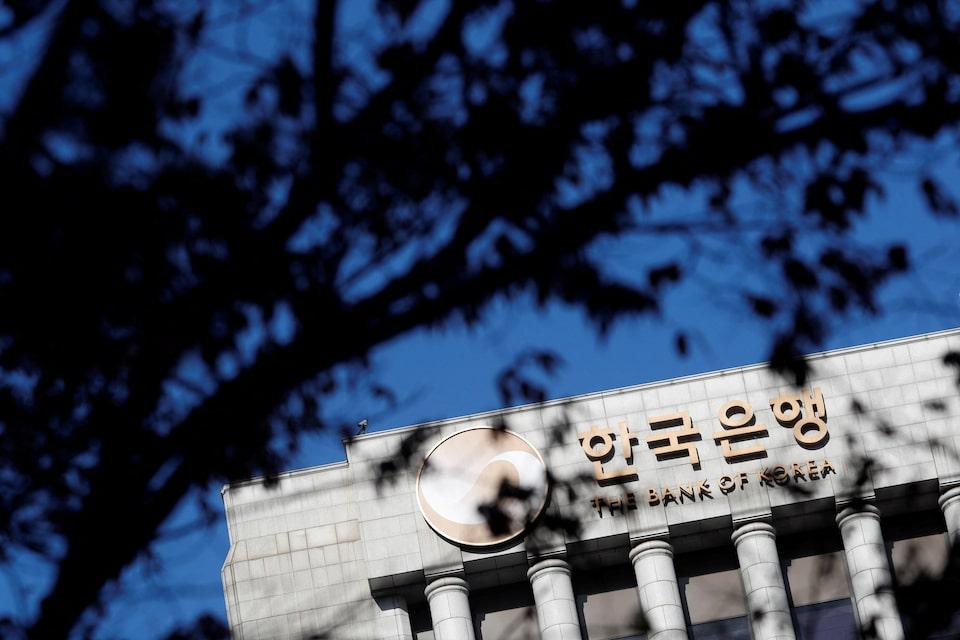
BOK signals rate cut in May and year ahead amid U.S. tariff risks Governor highlights economic uncertainties, board's openness to rate cuts Finance Minister warns of growth risks, plans extra budget spending SEOUL, April 17 (Reuters) - South Korea's central bank on Thursday signalled it would cut rates in May and left the door wide open to further monetary easing to cope with "significant" risks to the economy from U.S. President Donald Trump's sweeping tariff policy. After the Bank of Korea's seven-member board held the benchmark interest rate (KROCRT=ECI) , opens new tab at 2.75% as expected at its monetary policy review earlier in the day, Governor Rhee Chang-yong emphasised the BOK's readiness to respond to economic uncertainties. Sign up here. "Leaving me aside, all six board members are open to an interest rate cut when we look at the policy path for the three months ahead," Rhee said at a press conference. The governor's remarks highlight a rapidly changing global environment after the BOK's policy statement earlier warned of a possible economic contraction in the first quarter, largely due to the worst wildfires on record as well as domestic political turmoil. Much of the focus was on the global trade shock unleashed by the Trump administration. "The downside risks to growth have expanded significantly," Rhee told reporters, and "given that the intensity of the U.S. tariff policy and the responses of major countries are changing rapidly in the short term, we believe that the uncertainty about the future growth path is so great that it is difficult to even set a basic scenario." The BOK meeting comes hours after U.S. Federal Reserve chief Jerome Powell disappointed investors by pushing back on hopes he would act quickly to sooth investor fears, and as the Bank of Canada on Wednesday kept its policy rates steady amid the uncertainty around U.S. tariffs. "Given that the governor has mentioned about six board members' view on the policy rate, the BOK is likely to cut interest rates in May," said Paik Yoon-min, an analyst at Kyobo Securities. "Policy interest rates could reach 2.25% by the end of this year but could go even lower, if annual growth rate indeed falls below 1%." Analysts were already wagering the benchmark interest rate will be lowered to 2.25% by the end of the third quarter this year as shifting U.S. tariff policy fuels fears of a global recession and threaten to sharply curtail exports out of Asia's fourth-largest economy. The BOK has cut rates three times since its rate-cutting cycle started in October. EXTRA FISCAL STIMULUS Finance Minister Choi Sang-mok on Tuesday warned of significant downside risks to growth from tariffs and said the government will try to delay the implementation of reciprocal tariffs in negotiations with the United States. In broad U.S. trade action that has swept up several countries, South Korea was slapped with 25% reciprocal tariffs, which Trump has since paused for three months. The reprieve provided some relief to the Korean won which sank to a 16-year low on April 9, a level last seen when markets and policymakers were grappling with the global financial crisis. The won cut losses after Rhee's press conference and was quoted down 0.16% at 1,418.1 per dollar, while treasury bond futures turned lower and stocks extended gains. The government has plans to negotiate with Washington to lower tariffs and also draft an extra budget spending of 12 trillion won ($8.41 billion) to support the economy as it tries to navigate a political crisis and an uncertain global trade environment. South Korea holds presidential election on June 3, after former president Yoon Suk Yeol's impeachment stemming from a December martial law declaration was upheld. ($1 = 1,427.6000 won) https://www.reuters.com/markets/rates-bonds/south-korea-holds-rates-trump-tariffs-heighten-economic-risks-2025-04-17/
2025-04-17 04:31
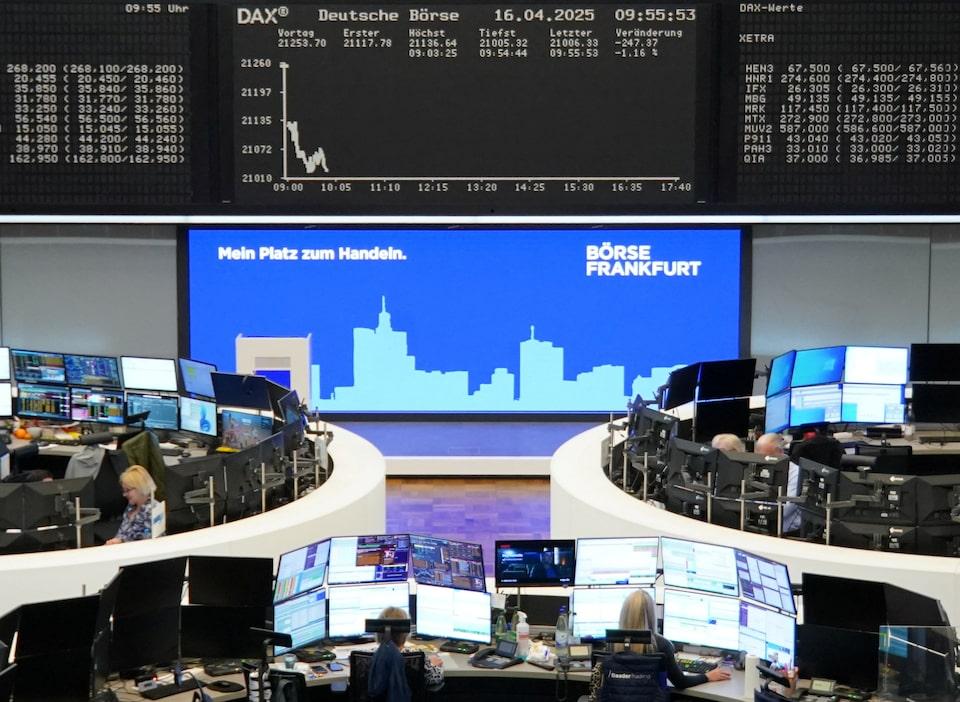
A look at the day ahead in European and global markets from Rocky Swift U.S. President Donald Trump unexpectedly gate-crashed tariff talks with Japan, and markets breathed a sigh of relief that it wasn't a disaster. Sign up here. Japan was the first major trading partner to negotiate directly with the United States, a test case for a reported 70-plus nations seeking better terms on sweeping tariffs Trump announced and then abruptly tabled this month. Trump declared "big progress" in the talks he joined with lead Japanese negotiator Ryosei Akazawa, who gave few details in his own readout to reporters just before the Nikkei (.N225) , opens new tab started trading in Tokyo, although he said foreign exchange had not been discussed in Washington. Nasdaq futures rose 0.6%, pointing to a recovery from Wednesday's 3% slide, while EUROSTOXX 50 futures dropped 0.3%, signalling a third-straight decline in the broad European gauge. The U.S. dollar edged higher against the euro and yen after the U.S. and Japan trade talks, but was still on course for a fourth-straight weekly decline. Safe-haven demand pushed gold to a new all-time high of $3,357.40 per ounce in Asia trading. U.S. Treasuries, whose status as a defensive asset has been badly shaken of late, held steady in Tokyo trading, with yields little changed. In Frankfurt today, the European Central Bank is expected to cut interest rates for the seventh time in a year to prop up an economy that has become all the more unsteady in the face of Trump's tariffs. In a relatively light earnings day ahead of Easter Weekend, British supermarket chain Sainsbury's (SBRY.L) , opens new tab will report annual results, with attention on whether it will follow industry leader Tesco (TSCO.L) , opens new tab in forecasting lower profits this year. Chip stocks will be in the spotlight again after a brutal session on Wednesday, in the wake of a warning from ASML (ASML.AS) , opens new tab as investors parse through the earnings forecast from industry bellwether TSMC (2330.TW) , opens new tab to gauge the health of the sector. In the U.S., American Express (AXP.N) , opens new tab, Blackstone (BX.N) , opens new tab, and Truist Financial (TFC.N) , opens new tab, will report first quarter results, after a string of relatively strong showings among American financial companies that have bucked the dour trend on Wall Street. Key developments that could influence markets on Thursday: -- Federal Reserve Bank of Philadelphia issues Manufacturing Business Outlook Survey for April. -- IMF Managing Director Kristalina Georgieva delivers remarks on the global economy. -- ECB holds monetary policy meeting in Frankfurt, followed by briefing by ECB President Christine Lagarde. Trying to keep up with the latest tariff news? Our new daily news digest offers a rundown of the top market-moving headlines impacting global trade. Sign up for Tariff Watch here. https://www.reuters.com/markets/europe/global-markets-view-europe-2025-04-17/
2025-04-17 03:51
Uncertainty on US tariff policy 'heightened sharply', Ueda says BOJ eyes more rate hikes but vigilant to US tariff fallout Board member Nakagawa warns of damage from excessive volatility TOKYO, April 17 (Reuters) - Bank of Japan policymakers on Thursday warned of heightening uncertainty over the fallout from U.S. President Donald Trump's tariffs, saying they could damage household confidence and hurt the country's fragile economy. The remarks came as Japan kicked off bilateral trade talks with the U.S. in Washington, which top negotiator Ryosei Akazawa said did not include the thorny topic of exchange rates. Sign up here. Speaking in parliament, BOJ Governor Kazuo Ueda said Trump's tariffs could affect Japan's economy through various channels such as trade activity and financial market volatility. When the BOJ raised interest rates in January, the U.S. economy was in good shape and financial markets were stable, Ueda said. "Recently, uncertainty surrounding U.S. policy, particularly that on tariffs, has heightened sharply," he told parliament. "We will scrutinise developments and their impact on Japan's economy without any pre-conception at each policy meeting." With real interest rates extremely low, the BOJ will continue to raise interest rates if the economy and prices move in line with its projections, the central bank chief said. "But we must be vigilant to the fact uncertainty surrounding each country's trade policy is heightening." While warning of the hit to growth from U.S. tariffs, Ueda said steady rises in rice and other food prices could lead to broad-based price gains that could heighten long-term inflation expectations. In a speech delivered on Thursday, BOJ board member Junko Nakagawa said uncertainty over U.S. tariff policy could hurt the economy not just through falling exports, but excessive market volatility. Nakagawa also warned of the risk of an overshoot in domestic inflation, saying that companies could hike prices and wages more than expected to pass on rising costs including for labour. On the other hand, the rising cost of living and uncertainty over Trump's tariffs could hurt household sentiment and consumption, she said. The remarks highlight the challenge BOJ policymakers face in compiling fresh quarterly growth and inflation forecasts at their next meeting on April 30-May 1. The BOJ is set to cut its economic growth forecasts at that policy meeting as Trump's tariffs heighten risks to a fragile, export-reliant recovery, sources have told Reuters. The central bank exited a decade-long massive stimulus programme last year and raised interest rates to 0.5% in January on the view Japan was on the cusp of sustainably achieving its 2% inflation target. https://www.reuters.com/markets/asia/bojs-ueda-says-us-tariff-uncertainty-heightening-sharply-2025-04-17/