2025-04-15 06:36
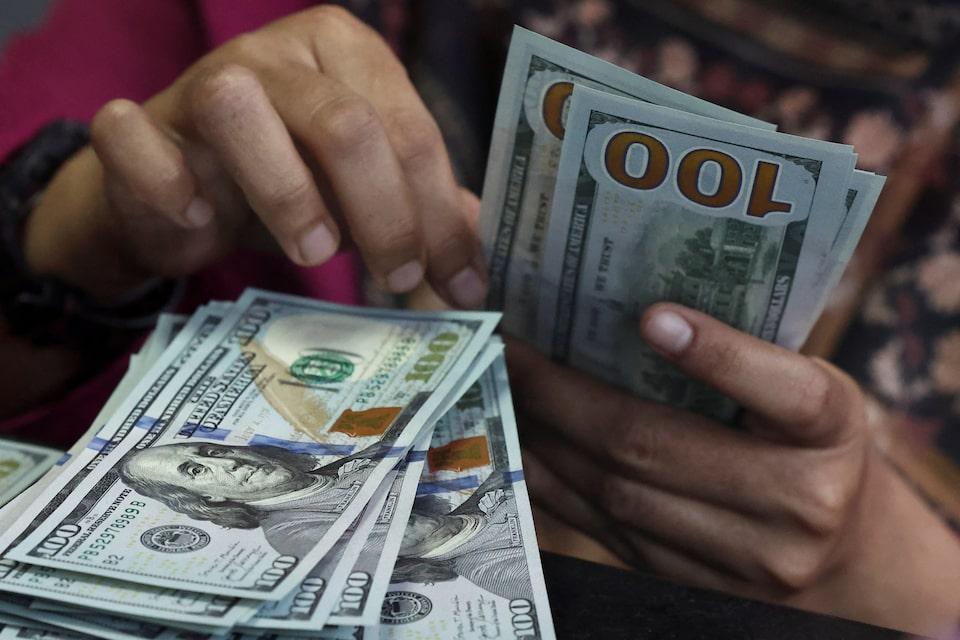
LONDON, April 15 (Reuters) - Global investors have slashed their holdings of U.S. stocks by a record amount in the past two months, a trend that is likely to continue given a record number of managers say they plan to keep cutting their exposure, BofA Global Research said on Tuesday. Respondents to BofA's monthly survey of fund managers were a net 36% underweight U.S. equities, the most in nearly two years, a number that has plunged by 53 percentage points since February, the biggest such fall on their records. Sign up here. A majority think a trade war that triggers global recession is the biggest risk for markets, according to the survey. U.S. President Donald Trump's aggressive tariff plans have sparked a selloff in U.S. assets, including stocks, the dollar and Treasury bonds. The market rebounded on Monday, but the broad-market S&P 500 index (.SPX) , opens new tab is still down about 8% so far this year. BofA polled 164 investors with $386 billion of assets under management. There were further signs of nervousness in the survey, particularly about U.S assets. A net 42% of investors said they expected a global recession, the most since June 2023 and the fourth-highest level in the past 20 years. In addition, 73% said they thought the theme of "U.S. exceptionalism" has peaked - the idea has powered markets in recent months - and relatedly 49% said they thought the most crowded trade in markets was now "long gold", displacing bets on U.S. tech giants for the first time in 24 months. A net 61% expect the U.S. dollar to depreciate over the next 12 months, the most since May 2006. The currency has tumbled sharply against most others in the past few weeks, with the euro, Japanese yen and Swiss franc all gaining sharply. https://www.reuters.com/business/finance/global-investors-dump-holdings-us-stocks-record-pace-bofa-survey-says-2025-04-15/
2025-04-15 06:29
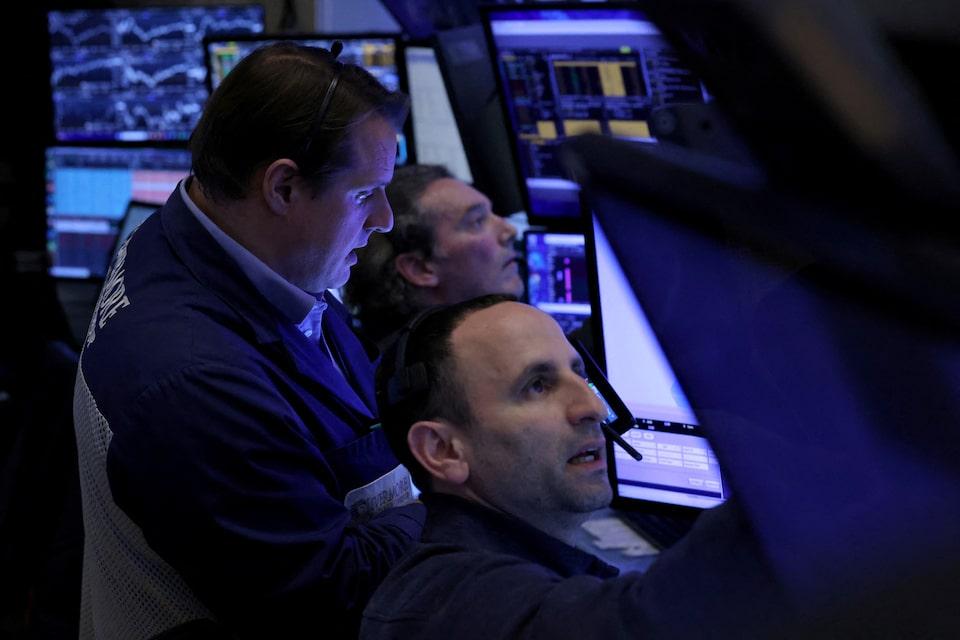
STOCKHOLM, April 15(Reuters) - Sweden's government said on Tuesday it will raise spending by around 11.5 billion Swedish crowns ($1.18 billion) this year, to support an economic recovery under threat from global trade turmoil. Sweden's economy has struggled over the last couple of years but had been expected to pick up speed this year. Growth prospects have dimmed, however, in the face of new U.S. tariffs, putting rate cuts by the Riksbank back on the agenda. Sign up here. "The U.S. decision on significantly raised tariffs has caused concern ... However, Sweden is on stable economic ground and able to take further action should the need arise," Finance Minister Elisabeth Svantesson said in a statement. Svantesson had already warned economic growth would be negatively affected by uncertainty surrounding the effects of tariffs announced by U.S. President Donald Trump. Measures in the spring budget included a tax break for home renovations, plus extra money for schools, road maintenance and prisons. The extra cash injection comes on top of a huge boost in spending following Russia's invasion of Ukraine as the government scrambles to rearm after decades in which the military has been downsized. The military budget is set to rise to around 3.5% of GDP by 2030, while the latest package of support for Ukraine will bring Sweden's total commitment to around 80 billion crowns. Sweden also plans a fleet of new nuclear reactors at a cost of around 300 billion crowns as well as increases in spending on other key infrastructure to support phasing-out the use of fossil fuels from transport and industry. While many countries in Europe face tough spending choices, Sweden's state finances are in robust shape. Sweden's government debt was around 31% of GDP against an average of about 88% across the EU, according to the latest Eurostat figures. ($1 = 9.7551 Swedish crowns) https://www.reuters.com/markets/europe/swedish-spring-budget-pledges-12-bln-extra-spending-2025-04-15/

2025-04-15 06:07
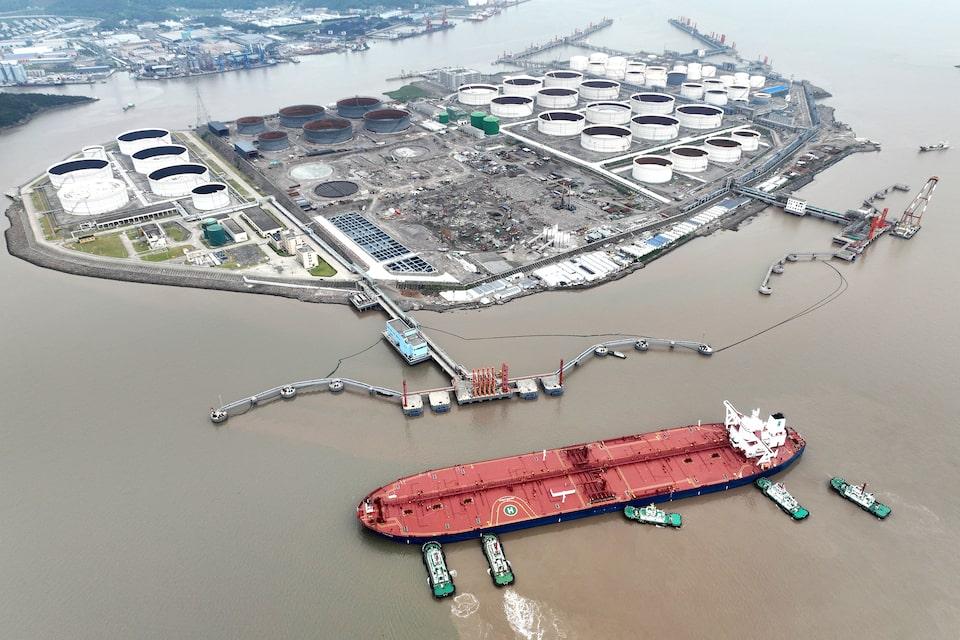
Oil price drop seen hitting exporters disproportionately Angola faced a margin call after bond market rout Nigeria's carry trade stops being attractive on oil fall Gulf exporters likely to weather pressure better thanks to reserves, lower debt NAIROBI/LAGOS, April 15 (Reuters) - A steep drop in crude oil prices largely due to U.S. President Donald Trump's tariffs will squeeze budgets of emerging market oil exporters, analysts said, while the potential economic slowdown could also curb any benefits for importers. Concerns about the impact of a tit-for-tat trade war on global growth and demand for oil sent Brent crude prices plummeting by more than 20% within a week to a four-year low after Trump announced his sweeping tariffs on April 2. Sign up here. Prices have since recovered some ground to around $66 per barrel from below $60. Turkey, India, Pakistan, Morocco and much of emerging Europe relying on oil imports are set to see some benefits from lower prices of crude. But oil exporting states including Gulf countries, Nigeria, Angola, Venezuela and to some degree Brazil, Colombia and Mexico will feel the pain of losing a chunk of hard-currency revenues, investors said. "Losers will be hit relatively harder than the upside seen in importing countries," said Thomas Haugaard, portfolio manager for emerging market debt at Janus Henderson Investors. "Oil exports often contribute considerably to public finances which will spill over into credit risk premiums." Current oil prices are well below the average budget assumptions of $69 across main oil exporters' year-ahead projections, as calculated by Morgan Stanley, flagging Angola and Bahrain as the countries most sensitive. Angola is already feeling the pinch. It had to pay $200 million last week after JPMorgan issued a margin call on the southern African nation's $1 billion total return swap, the finance ministry said. The total return swap is a loan issued by the lender last December, backed by Angola's dollar bonds. "The current context has affected the commodities market and emerging market Eurobonds, including the trading level of Angolan Eurobonds, and has triggered a margin call. Angola fulfilled its obligation on time and in cash," the ministry told Reuters on Monday. Angola opted for the collateralised loan to manage liabilities at a time when its Eurobond market access faced uncertainties due to high external debts to a range of foreign creditors including China and other commercial lenders. Like other so-called frontier issuers, average yields on Angola's dollar bonds have surged to double digits in the selloff of risky assets following the U.S. tariffs. The International Monetary Fund classifies Angola's debt as being at risk of high debt distress, but the Angolan government said the country's debt trajectory remains solid and on a stable path. SOME DEBT TRADES UNRAVEL The drop in the price of crude is also undoing frontier markets debt trades that had held up for at least a year, JPMorgan said in a research note. It cited the Nigerian carry trade, which involved investing in the oil exporter's Treasury bills on bets the naira currency will not depreciate quickly against the dollar. Investors now risk incurring losses if the lower crude price hits the naira. "The central bank has had to increase its dollar sales interventions in order to avoid convertibility risks and limit a disorderly move," JPMorgan said in a note to investors. A sustained drop in the price of oil could undermine recent progress on economic reforms, and even reverse progress, said analysts. Oil accounts for about 90% of Nigeria's exports and crude earnings were set to fund 56% of this year's budget. The government forecast oil at $75 a barrel in the 2024 budget but has been forced to change its plan. "We are going back to the drawing board to look at our budget all over again," Finance Minister Wale Edun told reporters last week. Gulf oil producers like Saudi Arabia and the United Arab Emirates could weather the storm better given higher reserve levels, relatively low debt and some strides in economic diversification, economists said. Still, a drop in revenue could complicate their ability to spend on new projects, including de facto OPEC leader Saudi Arabia. On paper, emerging market oil importers should enjoy benefits from lower import bills, improved current account deficits and a positive impact on inflation pressures - but they also face risks. "The lower oil price outlook is positive for oil importers, albeit unlikely to counterbalance the significant headwinds from the trade war and the significant downside risks," said Monica Malik, chief economist at Abu Dhabi Commercial Bank. https://www.reuters.com/markets/commodities/oil-price-drop-turns-up-heat-emerging-market-crude-exporters-2025-04-15/
2025-04-15 05:56
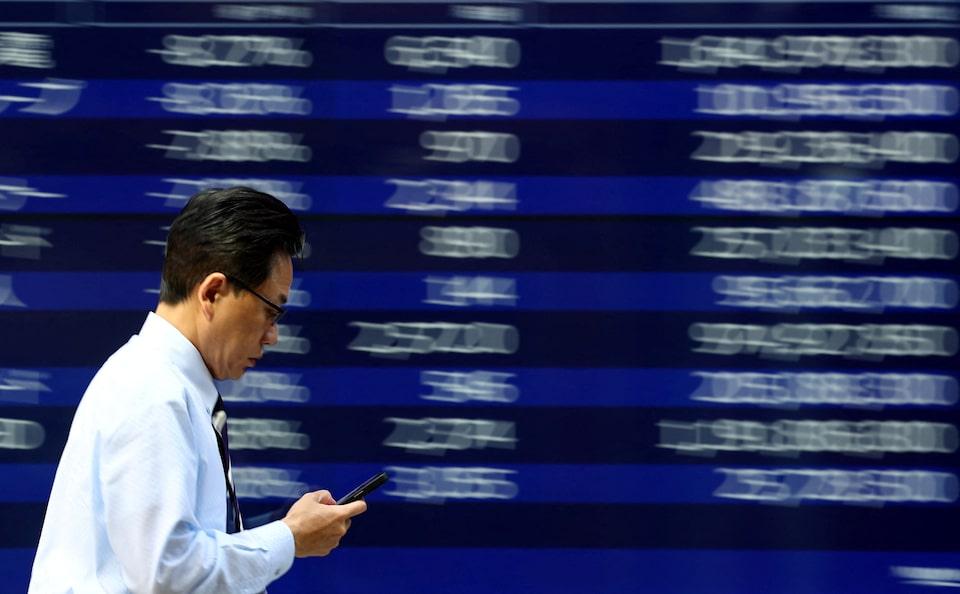
Wall St stocks dip; U.S. banks report strong profits Europe, Asia shares rise U.S. Treasuries, dollar tick back up Trump touts autos tariff modification Oil prices flat, gold up BOSTON/LONDON, April 15 (Reuters) - Some trade policy relief and strong bank earnings were not enough to keep Wall Street from pushing U.S. stocks down slightly on Tuesday, although U.S. government bonds and the dollar regained some ground after sharp declines last week. U.S. President Donald Trump on Monday said he was considering a modification to the 25% tariffs imposed on foreign auto and auto parts imports from Mexico, Canada and other places. Sign up here. That followed the move late on Friday to exempt smartphones, computers and some other electronics from Trump's "reciprocal" tariffs. White House press secretary Karoline Leavitt said on Tuesday that Trump is open to making a trade deal with China but Beijing should make the first move. The main U.S. stock indexes ticked lower on Tuesday, even as Bank of America (BAC.N) , opens new tab, Citigroup (C.N) , opens new tab and Wells Fargo (WFC.N) , opens new tab gained after the trio of banking giants posted strong profits for the first quarter. The Dow Jones Industrial Average (.DJI) , opens new tab fell about 0.4%, the S&P 500 (.SPX) , opens new tab dipped about 0.2%, and the Nasdaq Composite (.IXIC) , opens new tab was virtually flat. "The market is eerily calm," investment strategist Louis Navellier wrote in a note on Tuesday. "It's a bit unnerving after the rollercoaster ride we've been on since the tariff tantrum began." Outside the U.S., investors took whatever good news they could get after the recent heavy selling across markets and pushed shares higher. The pan-European STOXX 600 (.STOXX) , opens new tab index rose 1.6% on Tuesday, led by the autos and parts sector whose gauge (.SXAP) , opens new tab jumped about 2.3%. In Asia, MSCI's broadest index of Asia-Pacific shares outside Japan (.MIAPJ0000PUS) , opens new tab gained 1%. Japan's Nikkei (.N225) , opens new tab rose 0.8%, with shares of auto companies like Toyota (7203.T) , opens new tab and auto parts maker Denso (6902.T) , opens new tab among the top gainers. Analysts remained cautious, however, as uncertainty over Trump's trade policies, and his constant back-and-forth on tariffs, continued to cast a cloud over markets and the global economic outlook. Darrell Cronk, president of the Wells Fargo Investment Institute, wrote in a note on Tuesday that the "final tariff menu remains unsettled" and will decide if there is a recession or not. "We should expect volatility to remain high, but last week proved the power of markets to push the administration not to break the financial system," Cronk added. "Hence, we should have a floor for equities and a ceiling for rates." BOND YIELDS STEADY U.S. Treasuries added to Monday's gains on Tuesday after a manic selloff last week that led to the largest weekly increase in borrowing costs in decades. Bond yields move inversely to prices. The benchmark 10-year yield fell about 3 basis points to 4.333%, having fallen nearly 13 basis points in the previous session. Federal Reserve Governor Christopher Waller said on Monday that the Trump administration's tariff policies were a major shock to the U.S. economy that could lead the Fed to cut rates to head off recession even if inflation remained high. Atlanta Fed Bank President Raphael Bostic, meanwhile, suggested the U.S. central bank should stay on hold until there is more clarity. Markets are now pricing in about 85 bps worth of monetary policy easing by the end of the year, with most expecting the Fed to hold rates next month. The dollar gained slightly on Tuesday, but still traded near a three-year low against the euro and a six-month trough against the yen, as investors trying to make sense of the constant changes to remained wary of U.S. assets. The dollar index , which measures the greenback against a basket of currencies including the yen and the euro, ticked up 0.3% on the day. "The U.S. exceptionalism narrative that had previously underpinned the surge in U.S. equity markets over the past couple of years, and boosted the dollar, has lost much of its shine," said Jonas Goltermann, deputy chief markets economist at Capital Economics. Oil prices were little changed, slipping 0.3%, as investors tried to figure how much the U.S.-China trade war could reduce global economic growth and oil demand. Brent crude futures settled 21 cents lower at $64.67 per barrel, while U.S. West Texas Intermediate (WTI) crude fell 20 cents to end at $61.33. Gold prices rose 0.7% to $3,232 an ounce, helped by safe-haven demand, while the overall weaker dollar also lent support. https://www.reuters.com/markets/global-markets-wrapup-1-2025-04-15/
2025-04-15 05:44
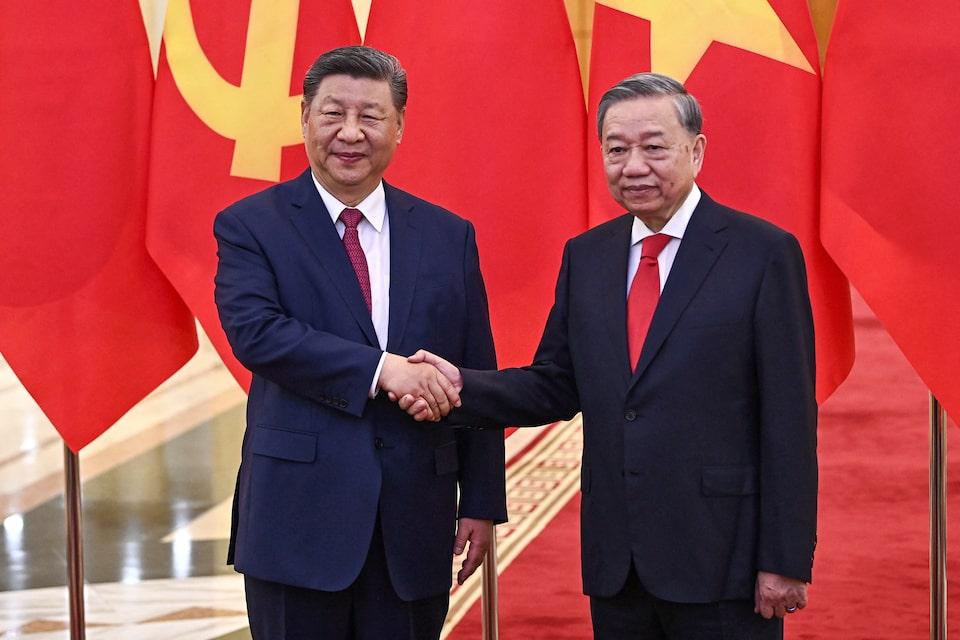
Railways agreement signed during Xi's visit to Hanoi on Monday China to conduct feasibility studies for two rail lines Xi asked Vietnam to preserve supply chains amid tariff chaos HANOI, April 15 (Reuters) - China and Vietnam took initial steps during Chinese President Xi Jinping's visit to Hanoi this week to develop new rail links, as they agreed to conduct feasibility studies for two lines, according to one of the agreements reviewed by Reuters. The two neighbours have long been discussing plans to upgrade two railways that were built by the French more than a century ago, and develop a third direct link along their adjoining coast. Sign up here. Amid growing concerns over U.S. tariffs, Xi urged Vietnam on Monday to strengthen supply chains, in which components made in China are often assembled in northern Vietnam before being exported. Vietnam's top leader To Lam said on Monday the building of the three railways was "the highest priority" in infrastructure cooperation between the two countries and encouraged China to offer concessional loans. They agreed China will carry out feasibility studies for two of the planned rail links, at a cost of 9.95 million yuan ($1.36 million), according to the two-page cooperation document, dated April 14, seen by Reuters. The studies will take place within 12 months from the selection of the contractor to conduct the work, according to the document, which provided no deadline to complete the selection process. The agreement concerns a railway connecting southern China's Guangxi region to Vietnam's capital Hanoi, and another new line that would link the port cities of Shenzhen and Haiphong. There is already a railway line from Nanning in Guangxi to Hanoi but passengers and goods currently have to swap trains at the border because the Vietnamese gauge - dating from French colonial times - is incompatible with China's modern high-speed tracks. Mistrust between the two Communist-run countries, which fought a brief border war in the late 1970s and often clash over the disputed South China Sea, has long hampered progress on rail links, but in recent months economic considerations appear to have prevailed over security concerns. A third railway linking Vietnam's northern coast to Kunming in China will begin construction this year, the Vietnamese parliament said in February, estimating the section through Vietnam would cost $8.3 billion and be partly covered with loans from China. The Vietnamese part of the line also dates back to the French colonial period. There has been no loan announcement so far during Xi's visit, which will end on Tuesday after the launch of what is listed as a "Vietnam-China Railway Cooperation". Reuters could not establish what that cooperation entails and whether it adds new commitments. https://www.reuters.com/world/asia-pacific/china-vietnam-assess-viability-new-railways-document-shows-2025-04-15/
2025-04-15 05:17
Dollar gains on euro, yen Investors await clarity on U.S. tariffs ECB expected to cut rates by 25 bps this week NEW YORK, April 15 (Reuters) - The dollar rose against the euro and yen on Tuesday, showing tentative signs of recovery following a sharp selloff that saw the dollar index tumble more than 3% last week. Investors nonetheless remain cautious on concerns about the impact of U.S. President Donald Trump's trade tariffs on the U.S. economy. Sign up here. Rapid shifts in tariff announcements have reduced faith in U.S. policymakers and led investors to seek calmer waters outside of the United States, which last week sent Treasury yields sharply higher and dented the appeal of the greenback. "The dollar has been primarily driven by asset flows rather than traditional short-term drivers such as rate differentials," said Vassili Serebriakov, FX and macro strategist at UBS, adding that "it does appear that the market is driven by a rethink of U.S. exceptionalism." Factors driving the move away from the U.S. include "the slowdown in the U.S. economy, uncertainty about tariffs, broader U.S. policy uncertainty, improved sentiment towards Europe, rotations out of U.S. tax, things like that," Serebriakov said. Data on Tuesday showed that U.S. import prices unexpectedly fell in March, pulled down by decreasing costs for energy products, the latest indication that inflation was subsiding before Trump's sweeping tariffs came into effect. Trading this week has so far been relatively calm but investors remain cautious as they wait on further tariff clarity. "Last week was all about deleveraging, liquidation, and asset re-allocation out of U.S. assets. This week's tone is calmer in what is a holiday-shortened week," said Prashant Newnaha, senior Asia-Pacific rates strategist at TD Securities. Most U.S. markets will be closed for this week's Good Friday holiday though foreign exchange will remain open. The euro was last down 0.70% on the day at $1.127, after last week reaching a three-year high at $1.1473. Euro/dollar is one of the most overvalued currency pairs, showing that the single currency is acting as "the preferred channel for loss of confidence in the dollar," ING analysts Francesco Pesole and Benjamin Schroeder said in a note. The shift from U.S. to European assets, combined with the diminished safe-haven appeal of the dollar, may continue to justify the euro's overvaluation, they added. German investor morale in April posted its strongest decline since Russia invaded Ukraine in 2022 due to uncertainty unleashed by U.S. tariffs, data showed on Tuesday. Euro zone banks also curbed firms' access to credit last quarter and expect to keep tightening credit standards due to increasing concerns about the economic outlook, the European Central Bank's lending survey showed. The ECB is expected to cut rates by 25 basis points when it concludes its two-day meeting on Thursday. The dollar gained 0.12% against the Japanese yen to 143.16 yen per dollar, not far off Friday's six-month low of 142.05. Japan will seek full removal of additional tariffs imposed by Trump, its top negotiator, Ryosei Akazawa, said on Tuesday, ahead of his scheduled three-day visit to Washington. The dollar gained 0.91% to 0.822 Swiss francs after slumping to a 10-year low against the Swiss currency last week. Sterling was up 0.15% at $1.3209 after earlier reaching $1.3252, the highest since October 3. The Australian dollar rose 0.32% to $0.6345 and the New Zealand dollar rose 0.39% to $0.5899 and earlier reached $0.5943, its highest since November 13. In cryptocurrencies, bitcoin fell 0.52% to $84,436. https://www.reuters.com/markets/currencies/dollar-steady-traders-grapple-with-tariff-uncertainty-volatility-2025-04-15/