2025-04-14 05:27
Dollar flat against euro, dips on yen Greenback struggles to gain from oversold technical levels Traders remain nervous over erratic tariff implementation NEW YORK, April 14 (Reuters) - The dollar was flat against the euro on Monday after a bruising week last week sent it to a three-year low against the single currency and left it oversold by some technical metrics. The greenback fell against the yen, meanwhile, as U.S. President Donald Trump’s erratic implementation of tariffs damages confidence in the world's reserve currency. Sign up here. The dollar has decoupled from U.S. Treasury yields, which last week rose even as the dollar fell. That has raised speculation that investors are moving investments out of the country as they worry about the longevity and impact of trade levies. “The policy-making is so chaotic that it's tough to think beyond the next 24 hours in terms of where the policy rates might be or where the economy is headed,” said Adam Button, chief currency analyst at ForexLive. “The uncertainty is now at an intolerable level for most businesses in international trade and the question is how quickly that hits the consumer in the real economy. Right now, the market is taking a dim view on future U.S. growth and that has come through most clearly in the currency market,” Button said. The Trump administration's tariff policies are a major shock to the U.S. economy that could lead the Federal Reserve to cut interest rates to head off a recession even if inflation remains high, Fed Governor Christopher Waller said on Monday. Americans’ expectations for near-term inflation in March hit the highest level since the autumn of 2023, amid a souring in the public’s assessment of their personal finances and hiring prospects, a report from the New York Fed said on Monday. The euro was little changed on the day at $1.1359. It reached $1.1473 on Friday, the highest since February 2022. Against the Japanese yen , the dollar weakened 0.39% to 142.93. It fell to 142.05 on Friday, the lowest since September. The dollar underwent a four standard-deviation decline over the past week, Bilal Hafeez, CEO at Macro Hive, said on Monday in a note. “Normally, this would point to a likely rebound. But if we are witnessing a structural regime change, similar to the early 1970s breakdown of Bretton Woods, then all bets are off.” Trump on Sunday said he would be announcing the tariff rate on imported semiconductors over the next week, adding that there would be flexibility with some companies in the sector. The White House on Friday granted an exclusion from steep tariffs for smartphones, computers and certain other electronics imported largely from China. U.S. Commerce Secretary Howard Lutnick said on Sunday, however, that they would face separate new duties along with semiconductors within the next two months. "Markets right now are trading the uncertainty, and that has not been helped over the weekend by the contradictory stories coming out of the U.S. administration," said Nick Rees, head of macro research at Monex Europe. "That really skews risks for the time being towards further dollar weakness as markets try to avoid some of this uncertainty by hiding basically anywhere that isn't in the U.S." Trump on Monday also suggested he might grant exemptions on auto-related levies already in place. Japanese Prime Minister Shigeru Ishiba said his country does not plan to make big concessions and will not rush to reach a deal in upcoming tariff negotiations with Trump's administration. Japanese Economy Minister Ryosei Akazawa also said that foreign exchange issues would be dealt with between Finance Minister Katsunobu Kato and U.S. Treasury Secretary Scott Bessent. Against the Swiss franc , the dollar weakened 0.18% to 0.814 francs. Sterling gained 0.88% to $1.3195. The Australian dollar was up 0.84% at $0.6338 extending its more than 4% gain from last week. The offshore yuan fell 0.35% to 7.307 per dollar. It struck a record low last week as the trade war between the United States and China intensified. Data showed China's exports rose sharply in March after factories rushed out shipments before the latest U.S. tariffs took effect. In cryptocurrencies, bitcoin gained 1.90% to $85,066. https://www.reuters.com/markets/currencies/battered-dollar-steadies-investors-brace-more-tariff-volatility-2025-04-14/
2025-04-14 04:39
April 14 (Reuters) - A look at the day ahead in European and global markets from Wayne Cole So the "reciprocal" tariffs are off smartphones and some electronics, but maybe only for a while as they could get their own special tariff once the White House has completed a study of the global supply chain. Or something. Sign up here. Indeed, Trump on Sunday told reporters tariffs on semiconductors would be announced over the next week and a decision on phones made "soon". Essentially more of the same chaos. How anyone running a company can decide on long-term investments in such conditions is a mystery, which has limited the boost to Wall Street futures for the moment. The S&P 500 was up around 0.8% and the Nasdaq 1.2%, though you would have to assume Apple shares, at least, will benefit in the near term. European stock futures have actually performed better, perhaps on speculation that President Trump will blink on other levies, too. Or it could be investors are buying Europe now that U.S. exceptionalism and "exorbitant privilege" - the dollar's status as the world's reserve currency - are under such threat. The dollar is certainly feeling unloved, falling back under 143.00 yen and extending last week's 5% slide on the Swiss franc. The euro is knocking on $1.1400 again and even the high-beta Aussie and kiwi are up, a sure sign the dollar's safe-haven status is in jeopardy. Apparently, Japanese officials are gearing up for trade negotiations with the United States that will likely touch on currency policy, with some officials privately bracing for Washington to call on Tokyo to prop up the yen. Should the White House actively start talking the dollar down, it will spook those offshore investors with unhedged positions in U.S. assets - which is most of them. At least Treasuries are steadier, though they show little sign of reversing last week's astonishing 50-basis-point jump in longer-term yields. If sustained, that's a material tightening in financial conditions and a deadweight for the housing market, adding another reason for the Fed to ease even if inflation is heading higher. It will be interesting to see if the New York Fed survey of inflation expectations due later on Monday shows the same kind of spike seen in the University of Michigan numbers. Retail sales data for March on Wednesday could be strong as consumers rushed to buy autos and other goods before the tariffs go into effect. Fed Chair Powell also has a chance to provide his outlook on Wednesday at the Economic Club of Chicago, where the Q&A should be lively. Markets imply a 20% chance of a May rate cut, rising to almost 80% for June. Some 80 basis points of easing are priced in for the year, though that was up around 130 basis points this time last week. Key developments that could influence markets on Monday: - NY Fed inflation expectations survey - Fed speakers include Waller, Barkin, Harker and Bostic https://www.reuters.com/markets/europe/global-markets-view-europe-2025-04-14/
2025-04-14 02:37
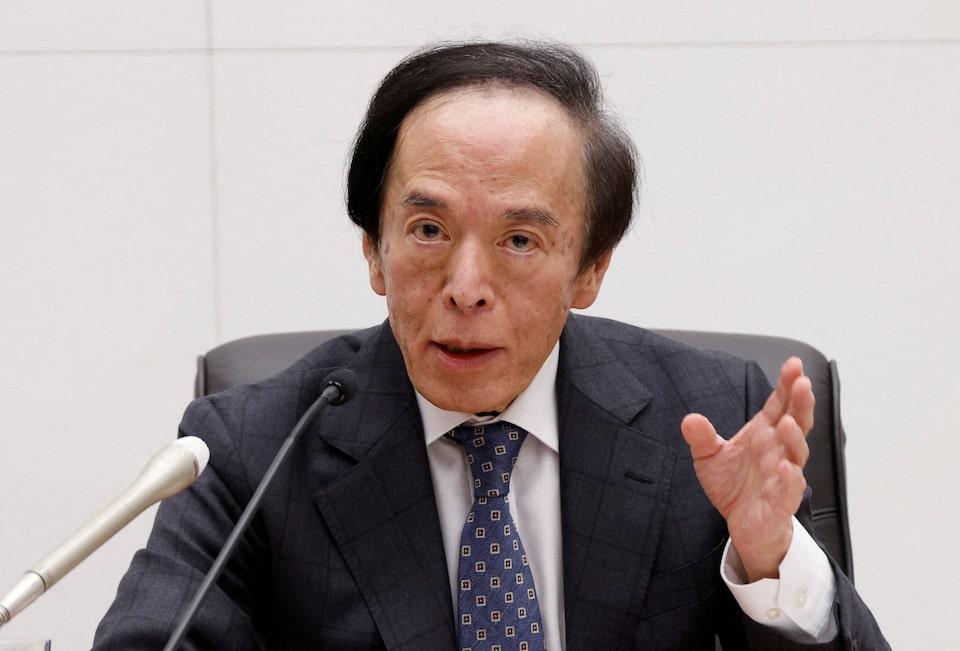
TOKYO, April 14 (Reuters) - Bank of Japan Governor Kazuo Ueda said on Monday global and domestic economic uncertainty has increased sharply due to U.S. tariff policy. "U.S. tariffs will likely put downward pressure on global and Japanese economies through various channels," Ueda told parliament. Sign up here. "The BOJ will guide monetary policy appropriately from the standpoint of sustainably achieving its 2% inflation target, while scrutinising economic, price and financial developments without any pre-conception," Ueda said. https://www.reuters.com/markets/asia/boj-ueda-warns-heightened-uncertainty-us-tariff-policy-2025-04-14/
2025-04-14 02:28
April 14 (Reuters) - Goldman Sachs expects oil prices to decline through the end of this year and next year because of the rising risk of a recession and higher supply from the OPEC+ group. The bank expects Brent and WTI oil prices to edge down, averaging $63 and $59 a barrel, respectively, for the remainder of 2025, and $58 and $55 in 2026. Sign up here. Given the weak growth outlook amid a global trade war, the bank expects that oil demand will rise by only 300,000 barrels per day (bpd) between the end of last year and the end of 2025. The bank has cut its global demand growth forecasts for the fourth quarter of 2026 by 900,000 barrels-per-day since mid-March due to an escalating trade war between the U.S. and China. Beijing increased its tariffs on U.S. imports to 125% on Friday, hitting back against President Donald Trump's decision to raise duties on Chinese goods and raising the stakes in a trade war that threatens to upend global supply chains. The Wall Street brokerage forecasts that despite the market already accounting for some future inventory builds, large surpluses of 800,000 bpd in 2025 and 1.4 million bpd in 2026 will continue to exert downward pressure on oil prices. In a scenario of a global economic slowdown or a complete reversal of the 2.2 million bpd of voluntary cuts by the Organization of the Petroleum Exporting Countries and allies, together called OPEC+, Brent oil prices could likely fall into the $40 range in 2026, and potentially drop below $40 in an extreme combined scenario, the bank said. Brent crude futures slipped to trade around $64.72 a barrel as of 0155 GMT on Monday, while WTI futures were at $61.44. Goldman Sachs also lowered its U.S. shale supply forecast for the fourth quarter of 2026 by 500,000 bpd. https://www.reuters.com/markets/commodities/goldman-sachs-expects-oil-prices-decline-through-2026-2025-04-14/

2025-04-14 01:48
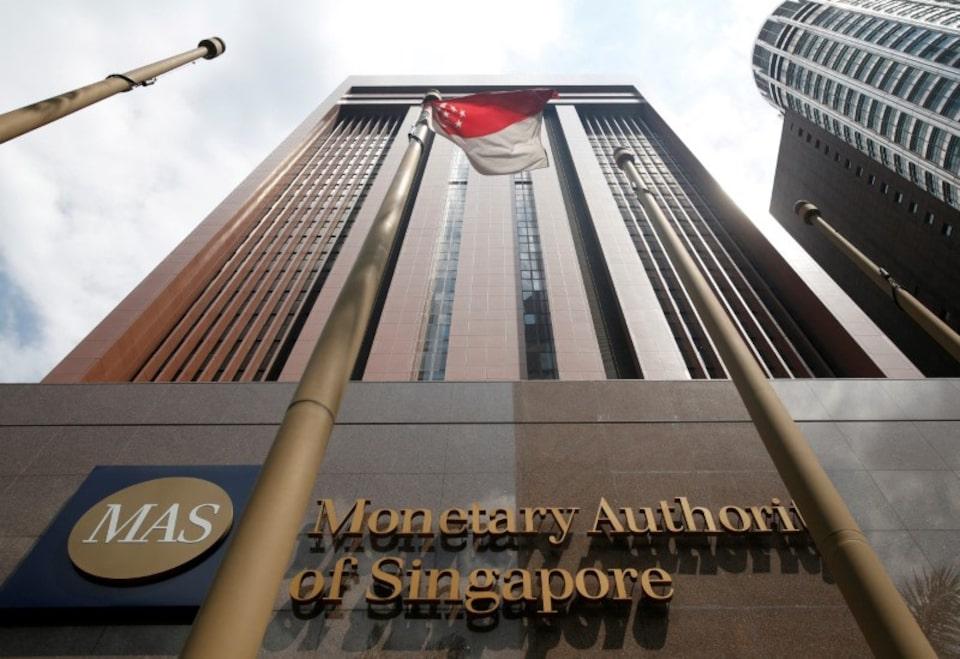
MAS says S$NEER rate of appreciation will be reduced slightly Global trade and growth prospects dimmed in early April: MAS GDP growth downgraded to 0–2% in 2025 from 1%-3% Core inflation forecast to average 0.5%–1.5% in 2025, down from 1.0%–2.0% SINGAPORE, April 14 (Reuters) - Singapore's central bank loosened its monetary policy for the second time this year on Monday, saying prospects for global growth and trade have dimmed amid U.S. tariffs, and the trade ministry cut its growth forecast for the city-state. The government downgraded Singapore's 2025 growth forecast to 0% to 2% from 1% to 3% previously, citing a significantly weaker external demand outlook after advance data showed GDP contracted a seasonally adjusted 0.8% in the first quarter. Sign up here. Singapore, among the world's most open economies, is often seen as a bellwether for global growth as its international trade dwarfs its domestic economy. The Monetary Authority of Singapore (MAS) said it would slightly reduce the prevailing rate of appreciation of its exchange rate-based policy band known as the Nominal Effective Exchange Rate, or S$NEER. The width and the level at which the band is centred were unchanged, it said. The central bank said exporting countries hit by tariffs will face weaker demand and pressure to lower prices for their output, meanwhile global financial conditions have tightened as asset markets start repricing risks in the global economy. "These factors will exert widespread and potentially reinforcing drags on production, trade and investments in Singapore's major trading partners," the MAS said. "A more abrupt or persistent weakening in global trade will have significant ramifications on Singapore’s trade-related sectors, and in turn, the broader economy," the MAS said. Economists said they would not rule out another easing in the second half of the year if economic conditions deteriorate, given the central bank's dovish rhetoric. AMMUNITION IN THE POCKET OCBC economist Selena Ling said MAS was still allowing the S$NEER to appreciate to "leave some ammunition in the pocket" and not over-react "since a lot of the external uncertainties are tariff induced and the flip-flop announcements continue, so the eventual magnitude of the hit on growth and inflation remains elusive". DBS economist Philip Wee said the central bank was "monitoring the significant global trade risks but has not concluded that it would result in a global recession". From a year earlier, the economy expanded 3.8% in the first quarter, slowing from an expansion of 5.0% in the fourth quarter and 4.4% in 2024. Maybank economist Chua Hak Bin said further easing in the second half to a neutral bias was possible, in the event of a technical recession, but he was "penciling in a slowdown, not a recession at this stage". "We maintain our GDP growth forecast at 2.1%, slightly above MTI’s new range of 0%-2%," he added. On Monday, the central bank adjusted its core and headline inflation forecasts for 2025 to 0.5% to 1.5% from a previous 1% to 2% and 1.5 to 2.5%, respectively. The Singapore dollar reversed earlier losses to trade higher after the policy decision. Analysts polled by Reuters had widely expected the MAS to loosen monetary policy by reducing the slope of the band in which it allows the S$NEER to trade. Instead of interest rates, the MAS manages monetary policy by letting the local dollar rise or fall against the currencies of its main trading partners within the S$NEER. https://www.reuters.com/markets/asia/singapore-central-bank-eases-monetary-policy-as-us-tariffs-threaten-growth-2025-04-14/
2025-04-14 00:32
US stocks post modest gains as tariffs delayed on some electronics Tech stocks outperform in Europe and Asia, Apple shares jump Dollar dips, Treasury yields ease Oil prices tick up BOSTON/LONDON, April 14 (Reuters) - U.S. shares gained on Monday, while the dollar dipped, after the White House exempted smartphones and computers from U.S. tariffs but President Donald Trump said semiconductor levies were likely. The Dow Jones Industrial Average (.DJI) , opens new tab and the S&P 500 (.SPX) , opens new tab both gained about 0.8%. The Nasdaq Composite (.IXIC) , opens new tab added about 0.6%, boosted by technology shares including Apple, whose stock gained around 2% (AAPL.O) , opens new tab. The S&P 500 rallied 5.7% last week, but is still down around 8% in 2025. Sign up here. On the face of it, the exemption of 20 product types accounting for 23% of U.S. imports from China was a boon to manufacturers. But the technology tariff news gave only a modicum of help to U.S. government bonds trying to recover from the bruising they suffered last week, and the dollar lost ground once more as the off-again, on-again trade policy gyrations left investors confused and analysts bearish on the long run. The 90-day pause on broad tariffs and further concessions over the weekend "lessen the near-term probability of a recession," Morgan Stanley U.S. equity strategists wrote in a note on Monday. Still, they noted that the back-and-forth on policy is still likely to exacerbate uncertainty for businesses and consumers. "The equity market will likely remain in a wide trading range with high volatility until we have more certainty on the depth of the growth slowdown and the timing of a recovery," they wrote. The relative optimism was felt in Europe and Asia as well, outperforming also because they missed the tail end of the bounce on Wall Street on Friday. Europe's broad STOXX 600 index rose about 2.7%, (.STOXX) , opens new tab having lost 2% last week, and MSCI's broadest index of Asia-Pacific shares outside Japan (.MIAPJ0000PUS) , opens new tab gained 1.6% after shedding more than 4% last week. MSCI's gauge of stocks across the globe (.MIWD00000PUS) , opens new tab rose 1.25%. Tech firms and the broader supply chain were the biggest gainers in Europe, after companies in Apple's supply chain surged in Asia. The market also has more earnings to weather this week. Goldman Sachs (GS.N) , opens new tab on Monday said profit rose 15% in the first quarter, fueled by stock traders who capitalized on volatile markets, sending its shares up about 2%. Bank of America (BAC.N) , opens new tab, Citigroup (C.N) , opens new tab and chipmaker TSMC (2330.TW) , opens new tab are due to report later in the week. In terms of economic data, March numbers showed a 12.4% jump in Chinese exports as firms rushed in orders ahead of Trump's tariffs. On the docket this week are U.S. retail sales and Chinese gross domestic product, while Federal Reserve Chair Jerome Powell speaks on the economic outlook on Wednesday, when he will almost certainly be quizzed on the prospect of rate cuts and the recent stress in the Treasury market. NOT SO SAFE Fear the U.S. Treasury market would lose its global preeminence abated slightly, with the 10-year yield falling after last week's epic surge. The 10-year yield was last down about 11 basis points at 4.382% . Last week's rise in yields came alongside a fall in the dollar. The slide continued on Monday, with the dollar index down 0.2% The recent declines can be explained by overseas investors flooding out of U.S. assets to move back home, though some are asking broader questions. "Any sustained environment of a lower U.S. dollar, lower bond prices, and lower equity prices suggests to us capital outflow from U.S. assets," Wells Fargo Investment Institute strategists wrote in a note on Monday. "We believe it reflects evaporating U.S. growth exceptionalism and reduced attraction at the margin for dollar assets for reserve purposes amid erratic U.S. decision-making." Japanese officials are gearing up for trade negotiations with the United States that will likely touch on currency policy, with some officials privately bracing for Washington to call on Tokyo to prop up the yen. On Monday, the dollar fell against the yen again , down 0.26% to 143.13, after hitting a six-month low at 142.05 last week. The euro was little changed at $1.148 , still near a three-year top of $1.1474 hit last week. The European Central Bank meets on Thursday and is considered certain to cut rates by a quarter point to 2.25%. In commodity markets, spot gold fell about 0.75% to $3,212, although global uncertainty has proven a windfall to gold prices which surged to all-time peaks at $3,245 an ounce. Oil prices settled slightly higher on Monday on the electronic tariff exemptions and data showing a sharp rebound in China's crude imports in March. But gains were limited by concerns that the trade war could weaken global economic growth and dent fuel demand. https://www.reuters.com/markets/global-markets-wrapup-1-2025-04-14/