2025-04-10 12:26
Chinese petchem makers set to cut output Russia plans Pacific LPG terminal, but lacks infrastrcuture MOSCOW, April 10 (Reuters) - Russia's exporters of liquefied petroleum gas are unlikely to be able to provide enough LPG to make up for U.S. supplies disrupted by tariffs, traders said on Thursday, citing a lack of infrastructure. Industry insiders said that Chinese petrochemical makers that buy U.S. LPG worth $11 billion annually are poised to cut output or shut for maintenance in the coming weeks as retaliatory tariffs on U.S. imports drive up costs. Sign up here. LPG, or propane and butane, is mainly used as fuel for cars, heating and to produce other petrochemicals. Russia is one of the world's five biggest producers, but its exports of LPG to China are by rail and trucks. Its lack of an LPG sea terminal in the region restricts its ability to significantly increase shipments east in the near future. Russia is expected to complete the construction of an LPG sea terminal at the Pacific port of Sovetskaya Gavan by the end of this year after repeated delays for reasons including lack of funds and uncertainties over production. According to data from industry sources, Russia's LPG exports to China via railways last year reached around 300,000 metric tons, or around 9% of Russia's total LPG exports. That compares with China's seaborne LPG imports of around 35 million tons last year. According to LSEG data, the U.S. accounted for 56.3% of the total supplies to China, followed by United Arab Emirates (10.6%), Iran (9.8%), Qatar (7%), Saudi Arabia (3.9%), Oman (2.9%) and Kuwait (2.7%). Last year, China bought a record 17.3 million tons of U.S. propane, or 550,000 barrels per day, 60% of China's total imports of the gas liquid. https://www.reuters.com/business/energy/russia-lacks-infrastructure-replace-us-lpg-china-2025-04-10/

2025-04-10 12:15
BRUSSELS, April 10 (Reuters) - European Union countries are projected to install a record amount of renewable energy capacity this year, European Commission projections showed, although parts of the sector warned cuts to government support could hamper this growth. EU countries are expected to add 89 gigawatts of new renewable energy capacity in 2025, including 70GW of solar and 19GW of wind, according to Commission projections shared with Reuters. The projections are based on industry data. Sign up here. That would be a record high for annual deployment of both wind and solar. The EU installed 65.5GW of new solar in 2024 and 12.9GW of wind capacity. A fast roll-out of renewable energy is needed for the EU to meet its climate goals, and to displace some gas consumption to help meet the bloc's aim to phase out Russian gas imports by 2027. However, renewables firms are facing headwinds including years-long delays to receive permits. Industry association SolarPower Europe said it may revise downwards its projections for 2025, after France outlined plans in February to cut feed-in-tariff support for rooftop solar panels. "Some big markets have taken significant steps back since the beginning of the year," the group's CEO Walburga Hemetsberger said. "It is looking less and less likely we'll hit 70GW this year." The growth of solar power installations in Europe slumped to 4% last year, having jumped by more than 50% the year before. The EU needs to install roughly 70GW of new solar capacity each year to meet its 2030 green goals. Top wind power developer Orsted has warned the industry in Europe is grappling with higher costs and supply chain disruptions. Industry group WindEurope said in February it expected the EU to add 17.4GW of new wind capacity this year - a 35% increase on last year's new installations. https://www.reuters.com/sustainability/boards-policy-regulation/eu-expects-add-record-renewable-capacity-2025-industry-sees-headwinds-2025-04-10/
2025-04-10 12:06
HAMBURG, April 10 (Reuters) - Freight shipping costs on the Rhine river in Germany surged this week as water levels fell further, compelling vessels to sail less than half full, commodity traders said on Thursday. Freight deliveries were still taking place, with loads divided among more vessels, which increases costs for cargo owners. But rain is at last forecast for next week, which could raise river levels, they said. Sign up here. Prices for a tanker freighter sailing from Rotterdam to Karlsruhe rose to about 80 euros ($88.58) a tonne of cargo from 46 euros last week and 34 euros in late March, traders said. Extreme lack of rain in March and April mean low water is hampering shipping on all the river south of Duisburg and Cologne, including the chokepoint of Kaub, traders said. Shallow water means vessel operators impose surcharges on freight rates to compensate for vessels not sailing fully loaded, increasing costs for cargo owners. Consignments must be shipped by several vessels instead of one, also raising costs. “You now need several vessels instead of one to deliver consignments which is more expensive and vessel owners charge more to compensate for the smaller loads,” one grain trader said. “At last, substantial rain is forecast next week, but we will have to see just how much actually falls.” Repeated rain is forecast in south German river catchment areas from Saturday until Thursday. Germany's transport ministry said this week the shallow Rhine was not regarded as an extreme low water event and it hoped mid-April rain would bring improvements. The Rhine is an important shipping route for commodities including grains, minerals, ores, coal and oil products like heating oil. German companies faced supply bottlenecks and production problems in summer 2022 after a drought and heat wave led to unusually low water levels on the Rhine. https://www.reuters.com/business/autos-transportation/rhine-shipping-costs-germany-rise-river-level-falls-rain-forecast-2025-04-10/

2025-04-10 11:59
LAUNCESTON, Australia, April 10 (Reuters) - Amid the market carnage and turmoil created by U.S. President Donald Trump's chaotic global tariff roll out and retreat, there are likely some clear trends that will emerge. One of these is that countries seeking to cut a deal with Trump will try to purchase more U.S. goods in order to lower their trade surpluses with the United States. Sign up here. The problem is that for many countries there is little that they want from the United States in terms of manufactured goods, and even relative success stories like Boeing aircraft serve to highlight the paucity of competitive U.S. goods. But there is one area where countries can try and up their imports from the United States, and that's energy commodities such as crude oil, liquefied natural gas (LNG) and coal. The obvious problem is that if every country wanting to cut a deal with Trump commits to buying more U.S. energy, the United States will very soon run out of capacity to supply the demand. This means that early movers may actually be the ones who secure energy supplies from the United States, and may gain some leverage in talks with the Trump administration. Japan and South Korea are two such countries that may well try to buy more U.S. energy. Both are major importers of crude, LNG and coal, both have wide trade surpluses with the United States and both are traditional U.S. allies, although whether this counts for anything with Trump remains uncertain. But even if Japan and South Korea pivot to buying U.S. energy, will it make much difference to their trade balance with the United States? Japan imported 12.44 million barrels of U.S. crude in 2024, which was about 1.6% of its total imports of 794.9 million barrels, according to data compiled by commodity analysts Kpler. Assuming an average price of $70 a barrel for its imports, it means Japan spent $870.8 million on U.S. crude in 2024. What would be the highest share of U.S. crude Japan could buy, given that it has long-term deals with its major suppliers like Saudi Arabia and the United Arab Emirates? Japan also has to ensure that the grades of crude it purchases are suitable for processing in its refineries, and this will also be a limiting factor for U.S. imports. If Japan was able to ramp up its purchases of U.S. crude to 10% of its total imports, this would amount to about 80 million barrels a year, which at the current price of around $60 for U.S. West Texas Intermediate would cost about $4.8 billion. Japan's trade surplus with the United States was $68 billion in 2024, so even massively increasing imports of U.S. crude would only have a small impact. LNG, COAL What about doing the same with LNG? Japan imported 6.5 million tons of U.S. LNG in 2024, or about 9.6% of its total of 67.43 million tons, according to Kpler. Given the fairly large share of U.S. LNG already in Japan's imports, it would be hard to significantly increase it. But for argument's sake, assume Japan can increase its share of U.S. LNG in its imports to 30%, or about 13.5 million tons. At the current spot price of Asian LNG of $13 per million British thermal units, this would be worth about $9.13 billion, up from an assumed value of about $4.39 billion in 2024. Again, this would help cut the trade surplus with the United States, but not dramatically. Coal offers another avenue, with Japan importing 4.37 million tons from the United States in 2024, or about 2.8% of its total of 153.73 million. But importing coal from the United States involves higher costs than Japan's current top suppliers of Australia and Indonesia, given the longer shipping distances from the U.S. east coast. There is also capacity constraints on U.S. coal exports, so its questionable as to how much more could realistically be supplied. Japan also mainly buys metallurgical coal from the United States, and it would be challenging from a supply perspective to ramp up imports of this grade, meaning that any increase would largely be thermal coal. If Japan could increase its share of U.S. coal to 10% of its imports, this would be worth about $1.5 billion, based on a thermal coal price of $100 a ton, in other words a tiny part of the overall trade surplus with the United States. Overall, even if countries like Japan ramped up their imports of U.S. energy commodities, it would make only a small dent in their trade surplus with the United States. And U.S. energy exporters would also rapidly run out of capacity if several major importers all try the same tactic simultaneously. The views expressed here are those of the author, a columnist for Reuters. https://www.reuters.com/business/energy/want-cut-your-trade-surplus-with-trump-crude-lng-coal-can-help-bit-russell-2025-04-10/
2025-04-10 11:55
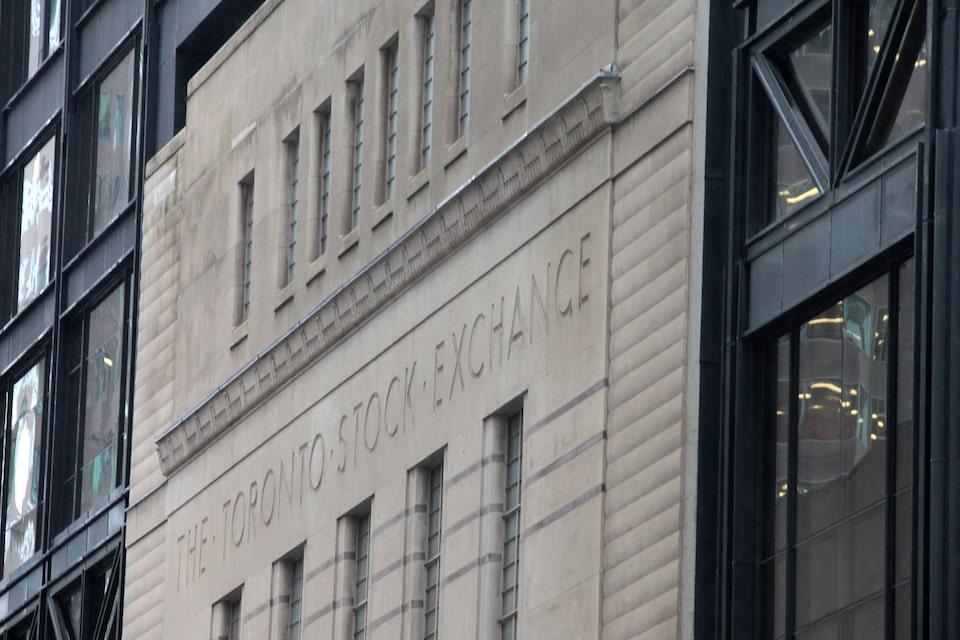
TSX ends down 3% at 23,014.87 Tech falls 6.1%, with Shopify down 8.4% Energy tumbles 6.6%; oil settles 3.7% lower Mining shares rise as gold hits record high April 10 (Reuters) - Canada's main stock index gave back much of the previous day's sharp gains on Thursday as concern grew that the global trade war could derail economic growth, with energy and highflying technology stocks among the biggest decliners. The Toronto Stock Exchange's S&P/TSX composite index (.GSPTSE) , opens new tab ended down 712.16 points, or 3%, at 23,014.87, after posting on Wednesday its biggest advance since shortly after the start of the COVID-19 pandemic. Sign up here. Wall Street stocks also tumbled. The escalating U.S.-China face-off over tariffs dampened optimism over upbeat economic data and U.S.-Europe trade negotiations. Canadian Prime Minister Mark Carney said he would convene a meeting of top cabinet colleagues on Friday to discuss the economic threat posed by U.S. tariffs. The Toronto market's technology sector fell 6.1%, with e-commerce company Shopify Inc (SHOP.TO) , opens new tab down 8.4% and Constellation Software Inc (CSU.TO) , opens new tab ending 6.4% lower. "The stocks were priced for perfection and suddenly you get the tariffs in there and the highfliers are the ones that come down the most," said Lorne Steinberg, president, Lorne Steinberg Wealth Management Inc. Energy tumbled 6.6% as the price of oil settled 3.7% lower at $60.07 a barrel, while heavily weighted financials lost 3.7%. The consumer staples sector posted a more modest decline of 0.5%. It was helped by a gain of nearly 1% for the shares of grocery retailer Loblaw Companies Ltd (L.TO) , opens new tab. Grocery stores could benefit from the inflation that tariffs tend to generate so long as they can sustain the same percentage profit margin on their goods, Steinberg said. The materials group, which includes metal mining shares, was the only one of 10 major sectors to end higher. It was up 1.3% as copper prices climbed and gold , benefiting from safe-haven demand, surged to a record high. https://www.reuters.com/world/americas/tsx-futures-slip-after-rally-trumps-tariff-pause-2025-04-10/
2025-04-10 11:26
KUALA LUMPUR, April 10 (Reuters) - Malaysia's central bank will wait for the global situation on trade tariffs to settle before making policy recommendations or revising growth forecasts, its governor said on Thursday. With a tariff of 24% on goods shipped to the United States, Malaysia was among several Southeast Asian nations facing hefty U.S. levies before U.S. President Donald Trump announced a 90-day pause on their implementation. Sign up here. "Once we have greater clarity on the details of the tariffs announcement, that's when we are able to make more robust forecasts and assessments on the impact and potential growth of the economy this year," Bank Negara Malaysia Governor Abdul Rasheed Ghaffour told a press conference after a meeting of Southeast Asian finance ministers and central bank chiefs. Malaysia's central bank has forecast economic growth in 2025 to expand between 4.5% and 5.5%, but is currently reviewing the estimate due to global uncertainties and market volatility. Malaysia's economy grew 5.1% in 2024, picking up from the 3.6% growth in 2023, driven by strong domestic demand, record approved investments, and robust exports. Malaysia's government has said it will not take retaliatory measures and would instead negotiate with the U.S. for mutually beneficial solutions. Abdul Rasheed said volatility in the ringgit would remain and Malaysia will continue to encourage inflows from its exporters to boost the currency. The central bank will ensure the ringgit market remains orderly with no excessive volatility, Abdul Rasheed added. https://www.reuters.com/markets/asia/malaysia-await-tariffs-clarity-before-revising-outlook-central-bank-chief-says-2025-04-10/