2025-04-08 17:07
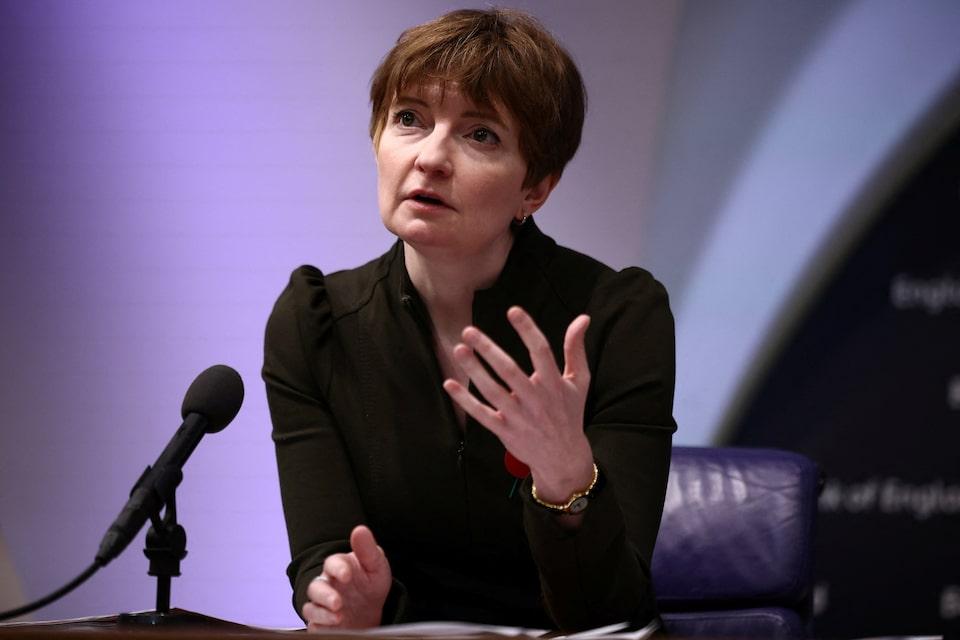
LONDON, April 8 (Reuters) - Bank of England Deputy Governor Clare Lombardelli said on Tuesday that it was still too soon to judge the inflation impact for Britain of U.S. President Donald Trump's tariffs amid ongoing responses from other countries. Growth was likely to be hurt by tariffs, while the BoE would look more closely at the inflation impact in the run-up to its May 8 interest rate decision, Lombardelli told a panel discussion hosted by the Resolution Foundation think tank. Sign up here. "On inflation, it depends a lot more on the circumstances of actually how other countries respond, how that feeds through to the UK," she said. "But we'll think about all that together for our next decision in May. I'll not take a position on that now." Financial markets think a quarter-point rate cut is a near certainty for the BoE in May and expect three rate cuts between now and the end of 2025, about one more than before last week's tariff announcements. https://www.reuters.com/markets/europe/boes-lombardelli-says-it-is-still-too-soon-judge-inflation-impact-us-tariffs-2025-04-08/
2025-04-08 16:33
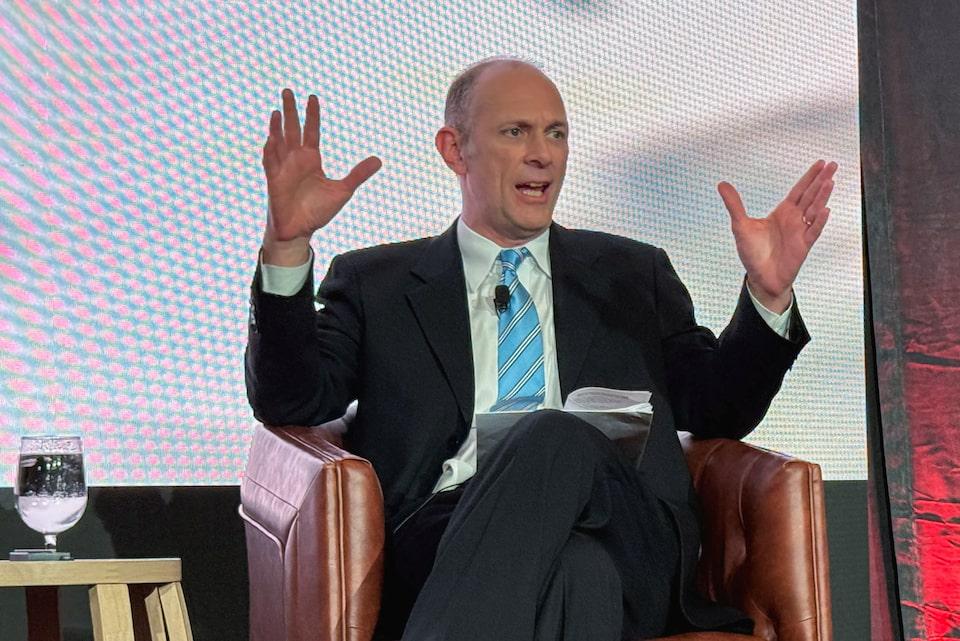
April 8 (Reuters) - Chicago Federal Reserve Bank President Austan Goolsbee said on Tuesday that U.S. President Donald Trump's announced tariffs are "way bigger" than had been modeled, and it's unclear how quickly or fully those higher costs will be passed on to consumers and to what degree businesses and consumers may react by hunkering down, slowing the economy. "We just lived through and learned what happens when inflation is raging out of control," Goolsbee said in an interview with Illinois Public Radio, in which he called tariffs a "negative supply shock" to which the Federal Reserve's response isn't necessarily clear. Sign up here. "The anxiety is this is just going to take us back to a thing we spent the last five years desperately trying to get away from," he said. https://www.reuters.com/markets/us/feds-goolsbee-way-bigger-than-expected-tariffs-pose-inflation-risks-2025-04-08/
2025-04-08 15:59
BRASILIA, April 8 (Reuters) - Brazilians are wagering up to 30 billion reais ($5.1 billion) per month on online betting, Brazilian central bank executive director Rogerio Lucca told lawmakers on Tuesday, revising a previous estimate of 20 billion reais made last year. Also speaking at a congressional inquiry into the sector, central bank governor Gabriel Galipolo said the Finance Ministry's betting and prizes secretariat now estimates that up to 94% of wagered amounts are returned as prizes, compared with the central bank's earlier assumption of 85%. Sign up here. Brazilians have fallen hard for online betting, which only became a regulated market in January despite being legalized since 2018. Bank studies show the gambling boom is straining household finances, curbing consumption, and driving some families into bankruptcy in Latin America's largest economy. Galipolo said the central bank began examining the issue after noticing a rise in household income without a corresponding increase in consumption or savings, suggesting that some resources could be flowing into gambling. "Within our mandate of financial and monetary stability, the central bank seeks to understand how demand is behaving and where income is going, so we can assess its impact on prices and on household indebtedness," Galipolo said. He noted that gamblers tend to have weaker credit scores, and banks now factor betting habits into credit risk assessments. A central bank study found five million Bolsa Familia recipients sent 3 billion reais to online gambling platforms via Pix payments last August - about 20% of the program's monthly budget, which is aimed at supporting Brazil's poorest households through direct cash transfers. Officials floated blocking recipients from using the funds for betting, but the measure has not been implemented. Galipolo said the government faces technical hurdles in tracking which funds came from the program. He added he is legally barred from disclosing Pix transaction details due to banking secrecy rules. ($1 = 5.9273 reais) https://www.reuters.com/world/americas/brazilians-wager-up-51-bln-month-online-betting-central-bank-says-2025-04-08/

2025-04-08 15:56
US Treasuries' term premium, a measure of risk, remains positive despite falling yields Some investors concerned about Trump's impact on U.S. creditworthiness Positive term premium could be a sign bond vigilantes stirring, despite rally in Treasuries NEW YORK, April 8 (Reuters) - The yield on the benchmark U.S. Treasury bond has fallen dramatically since President Donald Trump took office in January. But one measure of risk embedded in that number has remained positive, in a sign of investor nervousness. The term premium, a component of yields, is a measure of the compensation investors want for the risk of lending money for the life of a 10-year Treasury bond. It has stayed positive even as the yield on the 10-year has fallen about 50 basis points since Trump's inauguration. Sign up here. A theoretical measure, the term premium captures a variety of elements, including uncertainty about future monetary policy and the U.S. government's credit worthiness, investors and academics say. The measure of term premium - calculated by the New York Federal Reserve, based on a widely followed model - shows it turned steadily positive late last year, tracking Trump's rising popularity and eventual election win, after years of being in the red. With Trump now rewriting the terms of U.S. engagement with the rest of the world - starting trade wars and appearing to test the strength of U.S. institutions and the rule of law - seven investors and analysts said the risks to U.S. government's creditworthiness are increasing. Two separate market experts said the term premium on U.S. Treasuries was likely reflecting those risks. "There are questions around the stability of government functioning, uncertainty around the shape of the federal bureaucracy, and then ultimately questions increasingly around the rule of law and predictability," said Ronald Temple, chief market strategist for Lazard's financial advisory and asset management businesses. In a statement, White House spokesman Kush Desai said Trump's economic agenda will boost growth and reaffirm America's credibility, via reforms including tax cuts and slashing wasteful government spending. He did not address Reuters' question about the term premium. Supporters of Trump's administration have cited the sharp fall in Treasury yields as a sign of the debt market’s faith in his policies. But many investors say yields are being dragged lower by a deterioration in the U.S. economic outlook, which is causing interest rate expectations to drop. BOND VIGILANTES A persistently positive term premium could be an early sign that bond vigilantes - investors who may have the power to check Trump by making it punitively expensive for the U.S. government to borrow - are stirring in the background despite the recent rally in Treasuries. Some investors said they are getting nervous that the Trump administration's policy agenda is eroding the long-term attractiveness of U.S. assets. This could eventually make it harder for it to lower interest rates. "I think this is all net negative for U.S. growth in the long run, and it's a net negative for the U.S. as an investment destination," said Lazard's Temple. "Over time - not tomorrow - it raises the cost of capital for the U.S. government and for company and consumers in the country." To be sure, the stickiness in the term premium could point to a wide array of factors, which are hard to delineate. Benson Durham, head of global policy and asset allocation at Piper Sandler, a financial services firm, said given the Treasury market's outsized role in global finance, prices of U.S. government bonds tend to reflect drivers such as Treasury bonds' attractiveness versus stocks and investor expectations on fiscal deficits. But Durham added that the term premium would also capture rising political risks. POSITIVE RISK Amid a market rout last week, the New York Fed's model for the term premium has remained positive even as benchmark yields dropped, after Trump raised tariffs on imports to levels last seen in the early 1900s. On Thursday, when benchmark yields dropped 14 basis points, the term premium fell only 2 basis points. On Friday, when yields fell another 6 basis points, the term premium fell 6 basis points to 25 basis points, data shows. Emanuel Moench, a professor of financial and monetary economics at the Frankfurt School of Finance and Management, is one of three economists who created the model used by the New York Fed. In an interview, Moench said his framework provided "a statistical proxy of the risk in the Treasury market". Although it reflected policy risks, it could not disentangle the various factors weighing on bonds, he said. "If you can't really trust Treasuries as a safe-haven asset anymore," Moench said, it "should put upward pressure on the term premium." POLICY NERVOUSNESS More than half a dozen investors and analysts said the Trump administration’s policies across a wide range of issues, from governance to economics and foreign relations, were rankling them. Trump's attempt to remake the federal government and cut back on government spending, for example, while imposing massive tariffs on major U.S. trading partners, including its closest allies, has disrupted business and consumer confidence and raised the spectre of a recession. Its willingness to explore unconventional strategies to manage U.S. debt and eagerness to push through expensive tax cuts are also risks for bond investors, as it could worsen the country’s $36 trillion debt pile and its ability to service it, analysts have said. Its strong-arm approach to foreign countries, both allies and foes, has led to a search for alternatives to U.S. assets and the dollar, foreign bankers and officials have said. While investors said there is no alternative in the near term due to the size of the U.S. economy, the depth of its capital markets and the strength of its institutions, that might change over time. "Creditor countries that previously assumed they were part of the U.S. security umbrella ... own a lot of U.S. assets," said Matt Smith, a fund manager at British investment firm Ruffer. "If they begin to unwind those exposures, or merely hedge their currency risk, there could be a marked decline in both the dollar and U.S. risk assets." He cited countries like Japan, Korea, Taiwan, Singapore, and Germany. Ruffer, which oversees about $24 billion, had a low exposure to U.S. risk assets – and a near-zero weight to the U.S. dollar – in reflection of both high valuations and "regime change potential," Smith said, referring to possible changes in U.S. provision of security protections. RULE OF LAW The Trump administration’s other actions, such as its clashes with the judiciary, could over time erode confidence in U.S. institutional strength, a key pillar of foreign demand for U.S. assets, six analysts said. A source at a major credit ratings agency, who requested anonymity to speak more candidly, said they were closely following developments that could point to an erosion of the rule of law in the country, which is relevant to how ratings agencies assess institutional strength - a key component of their credit risk views. "There is investor concern that the administration is weakening institutional strength," said David Page, head of macro research at AXA Investment Management, an investment firm with nearly $1 trillion in assets under management. Page pointed to concerns that the administration was failing to comply with court orders and officials, including Trump, were verbally attacking judges. "A persistent change in the U.S.’ long-standing history of strong institutions would certainly risk a change in global asset allocation practice, which could have an impact on U.S. assets and the dollar," Page said. Mehill Marku, lead geopolitical analyst at PGIM Fixed Income, a New Jersey-headquartered investment firm with $837 billion in assets under management, said investors were also watching Trump's expansive interpretation of his powers as President, a legal doctrine called the "unitary executive" theory. "I'm sure investors are going to pay a lot more attention as we go forward in the so-called unitary presidency that clearly President Trump wants to establish, where everything goes through the White House," Marku said. "This is definitely a negative." Jeffrey Sherman, deputy chief investment officer at U.S. bond firm DoubleLine, said policy uncertainty could contribute to a deterioration of foreign investor sentiment that may eventually encourage a repatriation of capital. "Ultimately you get yourself into a place where people don't want to do business with you," Sherman said. "It takes a long time to build up positive sentiment, just like a relationship and trust, but you can destroy it very quickly." https://www.reuters.com/markets/rates-bonds/how-trumps-policy-risk-is-showing-treasury-bonds-2025-04-08/
2025-04-08 15:38
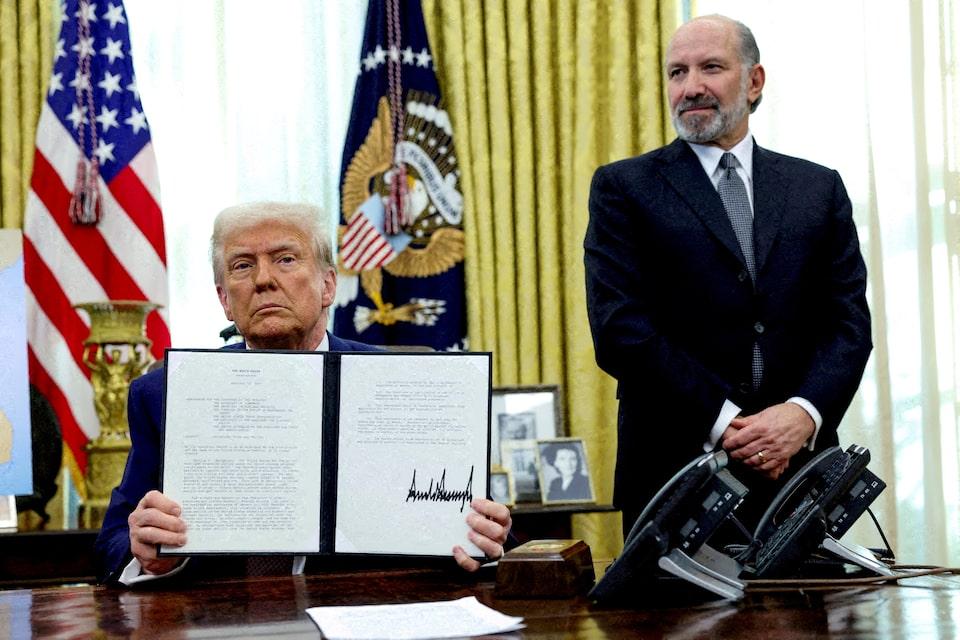
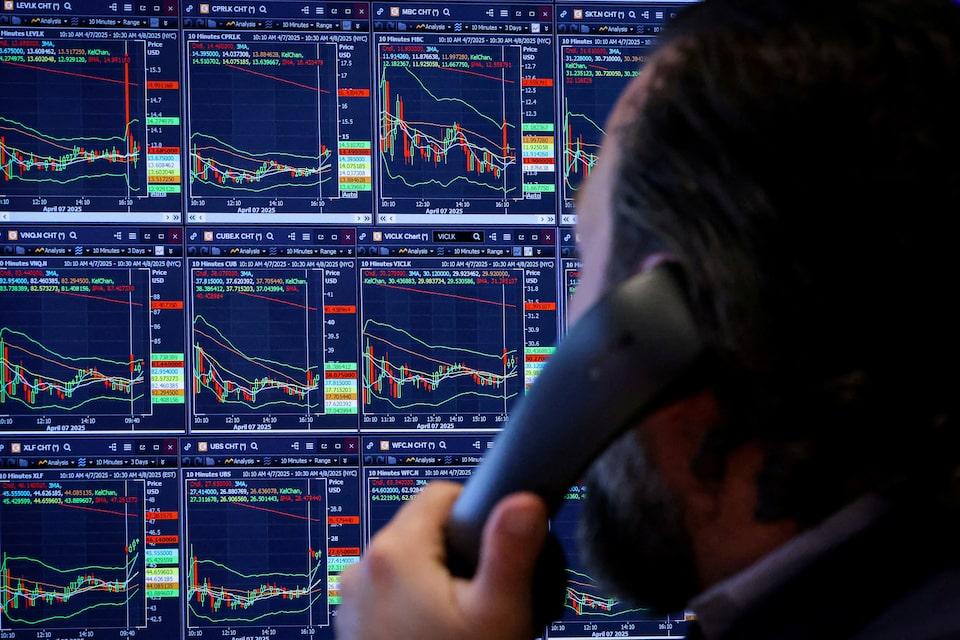
NEW YORK, April 8 (Reuters) - Short sellers targeting U.S. companies have gained $127 billion on paper from April 2 through Monday after President Donald Trump's plans for sweeping tariffs sparked a sharp selloff in stocks, according to data and analytics company Ortex Technologies. The data, for U.S. companies with market capitalization $1 billion and greater, showed short sellers' gains for 2025 through Monday at $189 billion. Sign up here. Short sellers aim to profit by selling borrowed shares and buying them back later at a lower price. These bearish investors profited since April 2 as Trump's plans for extensive tariffs against U.S. trading partners set off a plunge of roughly $5 trillion in market value for the S&P 500 index (.SPX) , opens new tab. Short interest for various stock indexes from around the globe increased rapidly from March 31 and peaked on April 4 before starting to drop, data from Ortex showed. Falling short interest typically indicates investors growing less bearish as well as profit-taking. "It seems fair to say that some short sellers seem to be looking to lock in their gains," Ortex cofounder Peter Hillerberg said. On Tuesday, the S&P 500 was up 2.8% in late morning trade. https://www.reuters.com/markets/us/wall-street-slide-nets-short-sellers-127-billion-2025-04-08/
2025-04-08 15:26
Gregory Bunn to leave US securities financing in New York HSBC securities financing to be absorbed in equities, fixed income A HSBC spokesperson declined to comment LONDON, April 8 (Reuters) - HSBC's (HSBA.L) , opens new tab head of securities financing for the Americas, Gregory Bunn, is leaving after two years in the post as the lender merges the unit into two others, a person with knowledge of the matter told Reuters. The restructuring was announced earlier this year when HSBC told staff that the bank would be winding down some equities businesses, including equity underwriting in Europe and the Americas. Sign up here. The London-based bank was one of a few on Wall Street to separately report the performance of its securities financing business, whose services include prime finance and repo products. The business will be absorbed by equities and fixed-income units after the restructuring, the person added. A spokesperson for HSBC declined to comment. Last year, securities financing recorded a surge of 36% in revenue compared to 2023 as the bank gained new clients in prime finance, according to the latest HSBC annual report. In December last year, the HSBC markets unit was combined into the corporate and institutional banking business. As result of the restructuring, Loic Lebrun, global head of prime finance, will report into Franck Lacour, who leads equities, while head of repo Jean-Michel Meyer will report into Mehmet Mazi, head of global debt markets, the person added. Under CEO Georges Elhedery, who took over last September, it has started a major overhaul and expects $1.8 billion in expenses by the end of next year. Before joining HSBC Bunn, who declined to comment for this article, spent almost two decades with Deutsche Bank, according to his LinkedIn profile. https://www.reuters.com/business/finance/hsbc-americas-head-securities-finance-leaves-amid-bank-restructuring-2025-04-08/