2025-04-08 08:35
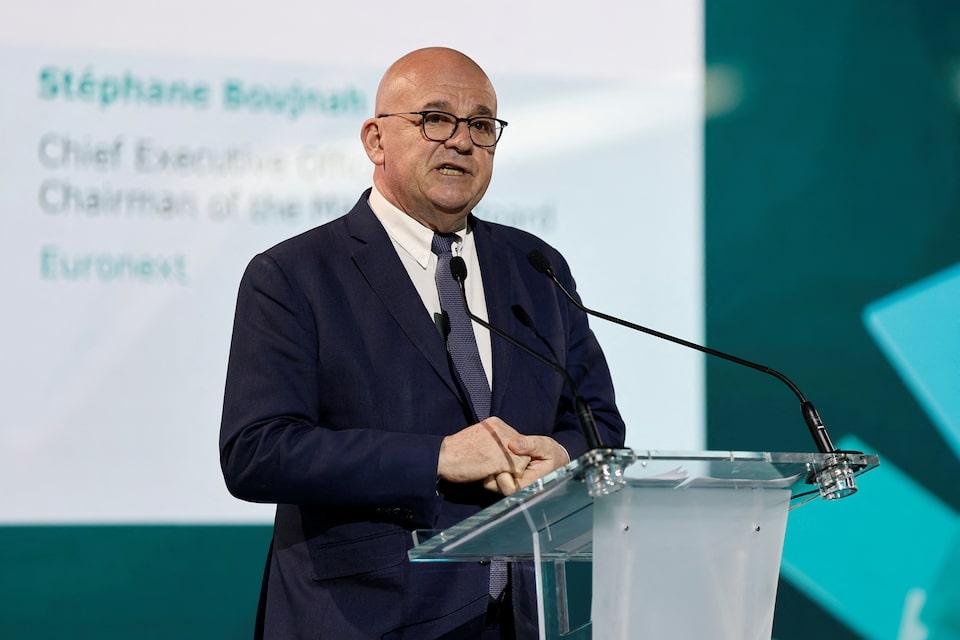
PARIS, April 8 (Reuters) - The United States is starting to resemble an emerging market more than a developed country, the head of pan-European stock exchange operator Euronext (ENX.PA) , opens new tab said on Tuesday as financial markets remained volatile after the imposition of sweeping U.S. tariffs. "Fear exists all over," Euronext CEO Stephane Boujnah told France Inter radio. "The country (United States) is unrecognisable and we are living in a transition period. There is a certain form of mourning, because the United States that we had known for the most part as a dominant nation resembled the values and institutions of Europe and now resembles more an emerging market." Sign up here. Boujnah said investors had been forced to grapple with uncertainty since U.S. President Donald Trump took office in January. "People ... have difficulty understanding the volatility of decisions that are made, so this worry is real, and it is a form of intimidation that diffuses in the system and is difficult to navigate," he said. Global financial markets are rotating assets and are trying to adapt to a United States that they do not recognise after Trump announced global tariffs on imports to the United States, Boujnah said. Trump has said the tariffs - a minimum of 10% for all U.S. imports, with targeted rates of up to 50% - would help the United States recapture an industrial base that he says has withered over decades of trade liberalization. Emerging markets often use tariffs to protect their industries while they try to develop. Boujnah said there was some good news in that oil prices and long-term rates were down, and that there were flows of money leaving the United States to be re-invested in Europe. European shares rose in early trading on Tuesday from 14-month lows after four straight sessions of heavy selling, although investors remained sensitive to tariff-related developments, a day after the European Commission proposed counter-tariffs of 25% on a range of U.S. goods. https://www.reuters.com/markets/us-is-starting-look-like-an-emerging-market-after-tariff-shock-euronext-ceo-says-2025-04-08/
2025-04-08 07:52
MOSCOW, April 8 (Reuters) - A sharp drop in global oil prices triggered by U.S. President Donald Trump's tariffs poses a risk to the Russian economy, the state TASS news agency cited Elvira Nabiullina, the governor of Russia's central bank, as saying on Tuesday. She was quoted as saying that the central bank was analysing the fallout, but as saying that a technical budget rule would smooth out the consequences for the budget. Sign up here. As of Monday, Brent and WTI had slumped 14% and 15% respectively following Trump's April 2 announcement of "reciprocal tariffs" on all imports. "You are absolutely right that the main channel of influence may be through changes in oil prices, specifically a decrease in oil prices," Nabiullina was quoted by TASS as telling members of the Russian lower house of parliament. "If such tariff wars, and we are seeing an escalation of tariff wars, continue, it usually leads to a decline in global trade, the global economy, and possibly even the demand for our energy resources," she said. The central bank said last week that U.S. tariff hikes may slow world economic growth and fuel inflation, while oil prices could be lower than forecast for several years as a result of reduced global demand. The central bank forecasts an average oil price of $65 per barrel in 2025 and of $60 per barrel in 2026. The central bank will review its forecasts at its next board meeting on April 25. https://www.reuters.com/markets/commodities/fall-oil-prices-poses-risk-russian-economy-tass-cites-central-bank-chief-2025-04-08/
2025-04-08 07:51
HONG KONG, April 8 (Reuters) - Hong Kong customs authorities last month seized a cargo of what they believe to be antimony ingots - one of several strategic minerals that China restricted exports of last year. Antimony is used as a flame retardant and in semiconductors and solar power equipment. It is also used in military applications such as ammunition, infrared missiles, nuclear weapons and night vision goggles. Sign up here. The 25,171.85 kg shipment was found on March 13 inside an outbound container at the city's cargo compound in the north of Hong Kong, near the mainland border, the Hong Kong Customs and Excise Department said in an April 2 statement. It was not clear where the shipment originated from or why it was seized. The ordinance under which it was seized can apply to the export of controlled items without a license. Hong Kong Customs did not immediately respond to a request for comment from Reuters. China produced almost half of the global supply of antimony in 2023 and prices have soared in the wake of its heavy export restrictions, which include a ban on exports to the United States in December amid an escalating trade and tech war with the world's biggest economy. About 3.9 million kg of wrought and unwrought antimony were exported from China last year, however shipments have all but stopped since September. The only export since then was a 20,000-kg cargo to Japan in January, according to Chinese customs data. Reuters reported last month China had exported no antimony to European Union countries since the controls. Prices there have surged by about 47% to $55,000-$62,000 per metric ton between December and March. https://www.reuters.com/markets/commodities/hong-kong-customs-seize-antimony-amid-chinas-export-controls-2025-04-08/
2025-04-08 07:51
South Africa's annual citrus exports to the U.S exceed $100 mln New tariff adds $4.50 cost to each citrus carton, growers say South Africa's is world's number 2 citrus exporter after Spain April 8 (Reuters) - Tariffs announced by U.S. President Donald Trump will hurt South African citrus farms and could potentially affect 35,000 jobs, a farmers' association said on Tuesday. Trump imposed a 31% tariff on U.S. imports from South Africa on April 2, when he announced a 10% baseline tariff on all imports and higher targeted duties on dozens of countries. Sign up here. South Africa, the world's second largest citrus exporter after Spain, ships between 5%-6% of its produce to the U.S., earning more than $100 million annually. The new tariff would place an additional $4.50 cost on each carton, making South Africa's fruit less competitive in the U.S. market, the Citrus Growers' Association of Southern Africa (CGA) said in a statement. Towns such as Citrusdal in the Western Cape, which are heavily dependent on citrus exports to the U.S., could be hit especially hard, CGA chairperson Gerrit van der Merwe said. "The severity and immediate nature of the impending tariffs could mean that towns like it now face either increased unemployment or maybe even total economic collapse," van der Merwe said. "There is immense anxiety in our communities." A total of 35,000 jobs are directly connected to South Africa's citrus exports, he added. With South African farmers starting to pack citrus destined for the U.S. market this week, growers have called on the government "to prioritise immediate negotiations with the U.S on tariff reductions or exemptions on citrus". Africa's most advanced economy has said it will not retaliate against the U.S., its second largest bilateral trading partner after China. Instead, South Africa says it will seek to negotiate exemptions and quota agreements. South Africa has also said Trump's tariffs effectively nullified the benefits African countries have enjoyed under the African Growth and Opportunity Act, which grants qualifying states duty-free access to the U.S. market. The 25-year-old trade initiative is set to expire in September. https://www.reuters.com/world/africa/us-tariffs-threaten-35000-citrus-jobs-south-africa-farmers-say-2025-04-08/
2025-04-08 07:41
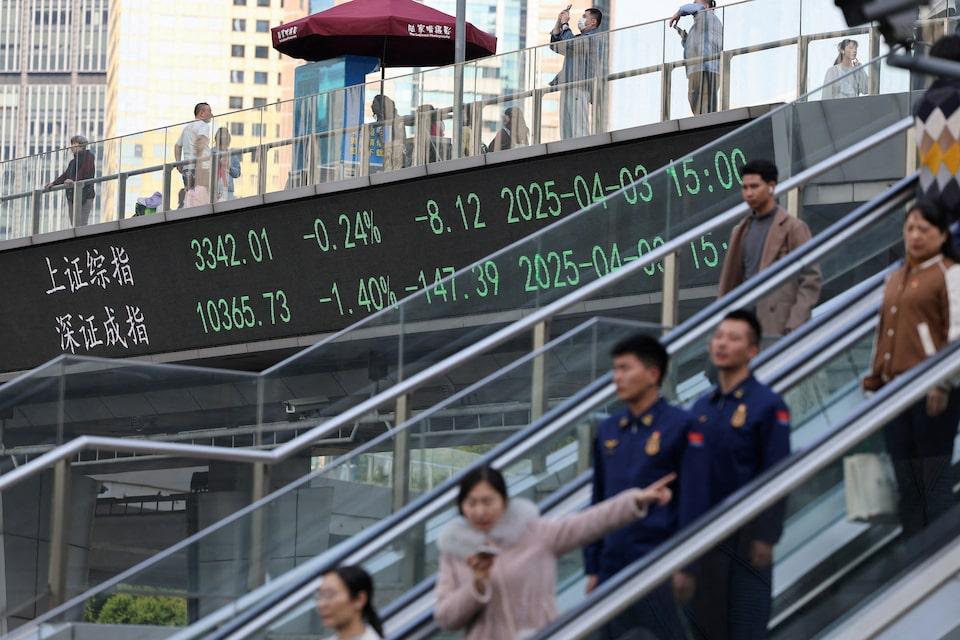
April 8 (Reuters) - Chinese agricultural stocks rose sharply on Tuesday as investors bet tariffs would limit U.S. agricultural imports and boost domestic producers, defying a broader market crash sparked by the escalating U.S.-China trade war. Shares of Dabeinong Tech (002385.SZ) , opens new tab, a seed and animal feed producer, rose 6.45% by 0424 GMT on Tuesday and shares of Wens Foodstuff (300498.SZ) , opens new tab, one of the country's largest pig breeders, were up 5.1%. Sign up here. Stocks of other key agricultural firms Wellhope Foods (603609.SS) , opens new tab and New Hope Liuhe (000876.SZ) , opens new tab rose by 6.3% and 2.45%, respectively. U.S. President Donald Trump's harsher-than-expected import levies, and China's response with tariffs of its own, has prompted a whirlwind of mixed tariff-related headlines that have whipped markets back and forth globally, wiping trillions of dollars in stock market value in just a few sessions. In contrast, Chinese agricultural stocks have advanced this month. A Hang Seng index of agricultural products stocks listed in mainland China (.HSCAAP) , opens new tab is up 8.6% in April. Yang Tingwu, vice general manager of asset manager Tongheng Investment, said China's retaliatory tariffs benefit domestic farm products, and the sector is also seen as strategically vital in the escalating trade war. "In the short term, fewer imported agriculture products is a boon to the domestic farming industry," said Yang, who bought agriculture stocks this week. "In the long term, China needs self-sufficiency in grain production in an intensifying rivalry with the U.S." After market close on Monday, China unveiled a 10-year strategy to boost domestic agriculture and create a more secure food supply by 2035. China retaliated against Trump's tariffs on Friday with extra levies of 34% on all U.S. goods, adding to 10%-15% tariffs it had imposed on U.S. agricultural goods in March. The combined rate threatens to all-but-end the agricultural trade between the two countries. https://www.reuters.com/markets/asia/china-agricultural-stocks-surge-amid-escalating-trade-war-with-us-2025-04-08/
2025-04-08 07:37
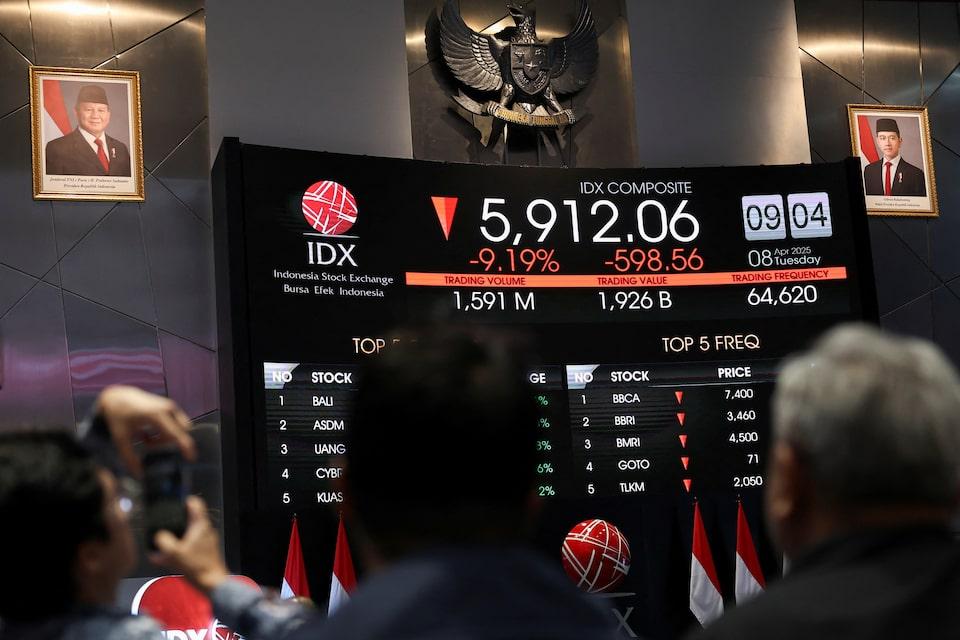
Stocks regain some losses after trading halt lifted Central bank has intervened aggressively to defend rupiah Bourse changes trading rules to anticipate stock selloff BI to weigh rate cut decision against FX weakness, analysts say JAKARTA, April 8 (Reuters) - Indonesia's stock market sank on Tuesday, prompting a 30-minute trading halt, while the rupiah fell to a record low as markets reopened after an extended holiday break and reacted to the global market turmoil caused by U.S. tariffs. The main index (.JKSE) , opens new tab fell 9.2% to its weakest since June 2021 in early trade. After the trading suspension was lifted, the index recouped some of its losses and was down 7.6% by 0704 GMT. Sign up here. The rupiah fell 1.8% to as low as 16,850 per dollar, surpassing its Asian Financial Crisis trough to its weakest on record, according to LSEG data. The central bank has and will continue to "intervene aggressively" in the spot foreign exchange, domestic non-deliverable forward (NDF) and bond markets, as well as in the offshore NDF market, to stabilise the rupiah, Fitra Jusdiman, a Bank Indonesia (BI) official said. However, some analysts predict further declines, even as the stock exchange modifies trading rules to prevent excessive selloffs. Ahead of Tuesday's market opening, the exchange tightened auto-rejection rules for share transactions. Now, if a stock falls by 15%, sell orders would be automatically rejected, compared with the previous trigger of a share price fall of between 20% and 35%. The bourse stated that a fall of 8% in the main index would trigger a 30-minute trading halt, expanded from 5% previously. Another 30-minute halt is triggered if the market then extended losses to 15%. A decline of more than 20% would result in trading being suspended for the rest of the day, which the bourse said would allow investors "liquidity space and opportunity" to process information. The previous trigger for such suspension was a 15% drop. "These are taken in anticipation of market conditions. We do not want to create panic, but we want domestic and foreign investors to have confidence that we give them enough room to transact after more than a week of break," IDX chief executive Iman Rachman told a press conference. Trading rules could be adjusted back when conditions return to normal, an IDX executive said. Oktavianus Audi, a vice president at brokerage Kiwoom Sekuritas, said the new auto-reject rules could provide some support for the stock index, but emphasised that the rule changes would only serve as short-term measures. "Basically, the concern in the market is caused by macroeconomic factors and Trump's tariff policy," he said. "So in our opinion, to ease market pressure we need strategic measures by the government to maintain the rupiah's stability, ensure economic growth remains above 5% and a strategic response to maintain Indonesia's trade surplus," Audi said. RATE CUTS? Fitra at BI said the central bank would continue its market stabilisation efforts to maintain market confidence while it monitors developments. Several economists expected more dovish moves by the U.S. Federal Reserve which may give BI space for bigger rate cuts, or bring them forward, to bolster growth. However, policymakers would have to weigh that against the impact on the rupiah. "Further one-sided weakness in the rupiah, due to global uncertainties and lingering lack of clarity on domestic issues, might push the markets to price out rate cuts this year," said DBS Bank economist Radhika Rao. Potential more Fed rate cuts, as well as low inflation domestically, would provide room for BI to cut rates, said Bank Danamon economist Hosianna Situmorang, adding that annual inflation in March was 1.03%, below the central bank's target range. Brokerage Mandiri Sekuritas, in a note to clients, said it expected less impact from tariffs on Indonesian equities compared with other markets due to its more domestically-driven economy. It predicted Jakarta could outperform other markets should there be any softening in the U.S. position on tariffs. Indonesian markets closed on March 27 for Eid al-Fitr holidays and are catching up with global market movements following the U.S. tariff announcement last week, which included a plan for a 32% tariff on Indonesian products. Markets were already under pressure before the break due to concerns over Indonesia's fiscal policy and growth prospects. Jakarta plans to pursue negotiations rather than retaliate against the U.S. tariffs, proposing to buy more U.S. products. https://www.reuters.com/markets/asia/indonesia-stock-exchange-says-20-fall-would-see-trade-suspended-day-2025-04-08/