2025-04-07 10:48
April 7 (Reuters) - The pound weakened against the dollar and the euro on Monday as investors shied away from risk-sensitive assets, as uncertainty grew around global trade policy and fears mounted of a recession triggered by U.S. President Donald Trump's tariffs. Global financial markets were delivered a significant blow on Monday after Trump warned foreign governments they would have to pay "a lot of money" to lift the levies that he called "medicine". Sign up here. Sterling fell to a new one-month low of $1.2825 and was last down 0.5% against the greenback. On Friday, it dropped roughly 1.5% - its biggest single-day drop since March 2023. Against the euro , the pound softened to 85.38 pence. It also weakened against traditional safe-haven currencies such as the Japanese yen and the Swiss franc. , Investors ramped up their bets on Monday for the Bank of England to cut interest rates. Markets have fully priced in a quarter-point rate cut by the BoE in May by 1013 GMT. The British currency had initially held up against the dollar when Trump's sweeping tariffs, including the 10% against Britain, were announced last week, as traders' immediate reaction was to sell the dollar. However, fears of a recession have led to a broader sell-off in global stock markets and sent investors scurrying to safe-haven assets. "I guess there was some hope over the weekend that maybe we would see this as part of the start of a negotiation, but the messages that we've so far seen suggest that the President Trump is comfortable with the market reaction and that he's going to continue on this course," said Richard Flax, chief investment officer at Moneyfarm. Britain softened demands on automakers to switch to production of electric vehicles on Monday, seeking to alleviate pressure on an industry left reeling from Trump's tariffs. https://www.reuters.com/markets/currencies/sterling-hits-one-month-low-investors-flee-safe-havens-2025-04-07/
2025-04-07 10:26
MUMBAI, April 7 (Reuters) - The Indian rupee logged its steepest one-day decline in nearly three months on Monday as concerns over U.S. President Donald Trump's sweeping tariff plans jolted global financial markets, dragging Asian currencies and stocks lower. The rupee closed at 85.8350 per U.S. dollar, down 0.7% on the day, its worst single-day fall since January 13. Sign up here. India's benchmark equity indexes, the BSE Sensex (.BSESN) , opens new tab and Nifty 50 (.NSEI) , opens new tab, ended about 3% lower each, their steepest one-day fall since June last year. The onshore Chinese yuan declined 0.4% to a near four-month low of 7.3181, propelling a slide of as much as 1% in Asian currencies. The yuan's decline and likely outflows from Indian stocks hurt the rupee, a salesperson at a large foreign bank said. The Reserve Bank of India may tolerate a steeper slide if China lets the yuan weaken to cushion the impact of U.S. tariffs, sources told Reuters. The all-around uncertainty has pushed up the rupee's near-tenor volatility expectations to the highest level since August 2023. China's retaliation to U.S. tariffs and little indication that the White House will back down has hurt risk assets globally, with European shares crashing to a 16-month-low and U.S. stock futures pointing to further pain for domestic equities. Speaking to reporters on Sunday, Trump indicated he was not concerned about losses that have wiped out trillions of dollars in value from world stock markets. "In FX markets, the ongoing carnage in equity markets continues to favour defensive positioning," ING Bank said in a note, referring to the recent gains seen in safe-haven currencies like the Japanese yen and Swiss franc. On the day, the dollar index also ticked higher by about 0.3% to 102.9 while growing wagers of rate cuts by the Federal Reserve drove U.S. bond yields lower. https://www.reuters.com/markets/currencies/tariff-spurred-market-rout-pushes-indian-rupee-worst-day-nearly-three-months-2025-04-07/
2025-04-07 10:07
BUENOS AIRES, April 7 (Reuters) - Argentina's mortgage market, for years almost non-existent due to spiraling triple-digit inflation and high borrowing costs, is starting to show signs of coming back to life under the pro-market reforms of libertarian President Javier Milei. Monthly new mortgages in Buenos Aires province, home to 40% of the country's population, hit the highest level since 2018 at the start of the year, data from the local college of notaries show. Numbers were up nearly 500% in February year-on-year. Sign up here. Milei, a bombastic economist who took office in late 2023, has shaken up the country with tough austerity and cost-cutting, which has helped bring down inflation, overturn a deep fiscal deficit, and boost confidence among investors and banks. "The conditions needed have been set up for the financial system to offer mortgages, with an initial push from public banks and then private banks," said Guillermo Longhi, president of the Buenos Aires province notaries body. The overall mortgage loan market, while still tiny due to the country's years of high inflation and currency intervention, has tripled in size to the equivalent of around $2.3 billion, central bank data shows, still well off a peak of $8.3 billion in 2018. Longhi said the government needed to ensure financial stability, keep bringing inflation down and boost confidence in exchange rate policy, currently tightly controlled. "The future of mortgage lending will be conditioned primarily by the evolution of key macroeconomic variables, such as inflation, the exchange rate, and overall economic stability," Longhi added. https://www.reuters.com/world/americas/argentinas-zombie-mortgage-market-is-coming-back-life-2025-04-07/
2025-04-07 09:37
TAIPEI, April 7 (Reuters) - Taiwan's central bank said on Monday that it will intervene if necessary to ensure the stability of the Taiwan dollar exchange rate and that it has "sufficient ability" to deal with fluctuations, following steep falls in global stock markets. Financial markets around the world have been impacted by fallout from U.S. President Donald Trump's decision last week to impose sweeping import tariffs. Sign up here. Taiwan's benchmark stock index (.TWII) , opens new tab plummeted almost 10% on Monday, though the Taiwan dollar gained slightly against the greenback. Taiwan's central bank said in a statement that it had prepared sufficient liquidity for foreign currency. During previous crises like the COVID pandemic, the central bank said that it stabilised the market through "flexible and effective monetary policies and foreign exchange management" allowing Taiwan to safely weather the turmoil. Speaking to reporters, Eugene Tsai, head of the bank's foreign exchange department, said that on Monday the bank had offered some liquidity in the foreign exchange market, and there were no "panicked" outflows. https://www.reuters.com/markets/currencies/taiwan-central-bank-says-it-will-intervene-if-needed-ensure-forex-stability-2025-04-07/
2025-04-07 07:20
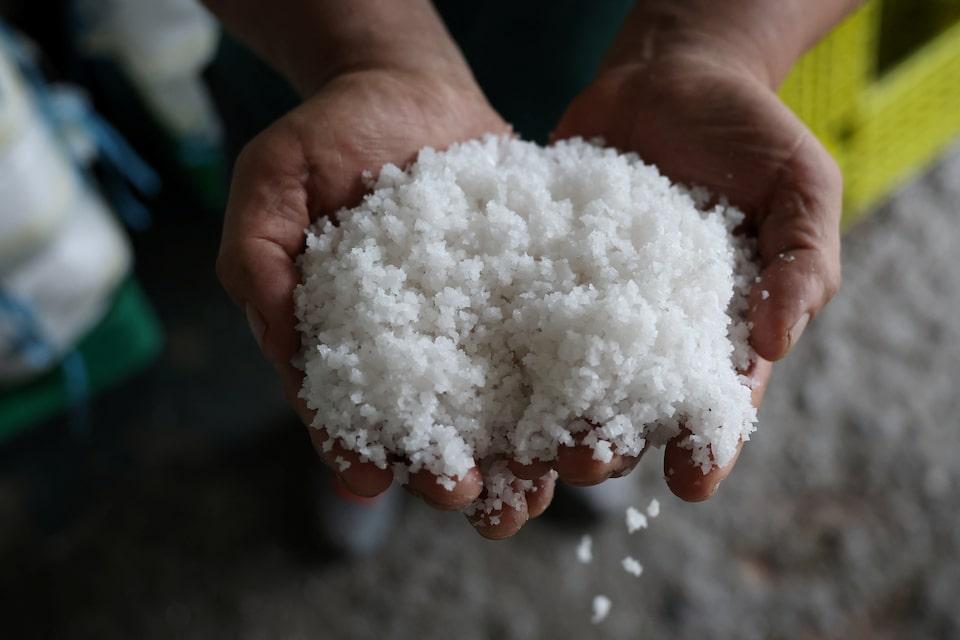
SEOUL, April 7 (Reuters) - South Korea said on Monday it will work to lift a U.S. ban on salt imports from the country's largest sea salt farm, disputing findings by the U.S. customs agency that forced labour appeared to be involved in salt production. U.S. Customs and Border Protection issued , opens new tab last week an order to detain products from Taepyung Salt Farm "based on information that reasonably indicates the use of forced labour", it said in a statement. Sign up here. South Korea's Ministry of Oceans and Fisheries said on Monday that the U.S. measure took place years after an activist organisation petitioned for the order in 2022. Since violations such as workers being paid inadequately at the salt farm in the southwest of the Korean peninsula came to light by 2021, the ministry has already enforced improvement measures and the products being exported to the United States are not produced by forced labour, the ministry said. The ministry was surveying the workforce of salt farms every year, expanding support for automation to reduce the need for labour as well as other measures, it said in a statement. South Korean ministries will pursue measures necessary to lift the U.S. order, and continue to promote the human rights of salt farm workers, it said. Taepyung Salt Farm said in a statement that past labour issues were related to a former tenant in 2021, who had been forcibly removed from the farm in 2023. As of 2025 it had signed consignment contracts with 25 tenants, who were producing salt in compliance with relevant labour laws, it said. The operations produce about 15,000 tonnes of salt a year, an official said. https://www.reuters.com/markets/commodities/south-korea-aims-lift-us-ban-sea-salt-imports-over-suspected-forced-labour-2025-04-07/
2025-04-07 07:18
Nine of 10 analysts expect an easing U.S. tariffs a threat to growth outlook Inflation at four-year low in February Singapore hit by Trump's 10% base tariffs SINGAPORE, April 7 (Reuters) - Singapore is expected to further ease monetary policy at next week's review, following a move in January, as U.S. tariffs against its trading partners cast a shadow over the outlook for the export-reliant city-state. The central bank manages monetary policy by targeting the Singapore dollar nominal effective exchange rate, known as the S$NEER, rather than interest rates. It adjusts policy via three levers: the slope, mid-point and width of the policy band. Sign up here. Nine out of 10 analysts polled by Reuters expect the Monetary Authority of Singapore to loosen policy at its April 14 review by reducing the slope of the band in which it allows the S$NEER to trade. Lee Yen Nee, risk analyst at Fitch Solutions unit BMI, expects the MAS to ease policy given the mounting risks to growth, including the imposition of tariffs by U.S. President Donald Trump. "The latest tariff announcement by the U.S. raises the risk of a global recession, which would be very negative for the Singapore economy given how trade-dependent it is," said Lee, estimating that tariffs could knock around 1 percentage point off Singapore's economic growth. Trade minister Gan Kim Yong has said Singapore was reviewing its economic forecasts because of the tariffs. Currently, GDP is forecast to grow between 1% and 3% in 2025, after growth of 4.4% last year. Maybank economists have cut their forecast for Singapore's GDP growth this year to 2.1% from 2.6%. HSBC economists also expect MAS to reduce the slope of the S$NEER, noting that inflation has undershot the central bank's forecast range of 1% to 2% so far this year. Core inflation fell to 0.6% in February, the lowest in nearly four years. The outlier of those polled was RHB group chief economist Barnabas Gan, who expects the MAS to hold monetary policy. He was reluctant to downgrade his growth forecast of about 2.8%, as growth still appeared to "be quite resilient". "We are still drawing hope that there may be some easing of tariff risks," he said, noting that at 10% Singapore had the lowest U.S. tariff rate across Southeast Asia. Gan said there could be an easing in the second half of the year. https://www.reuters.com/markets/asia/singapore-seen-easing-monetary-policy-tariffs-threaten-growth-2025-04-07/