2025-04-02 06:20
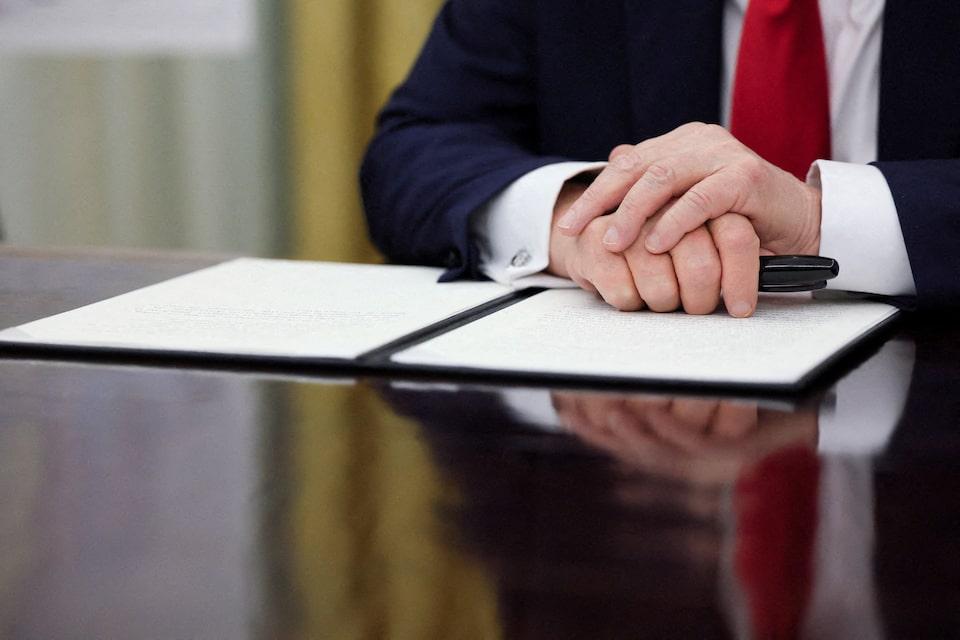
Dollar slips after tariff announcement Spot gold hit record high of $3,148.88 per ounce on Tuesday US private payrolls accelerate in March April 2 (Reuters) - Gold prices extended gains on Wednesday to hover near all-time highs, boosted by safe-haven inflows after U.S. President Donald Trump announces reciprocal tariffs that would escalate a trade war. Spot gold was up 0.6% at $3,129.46 an ounce at 04:53 p.m. EDT (2053 GMT). U.S. gold futures settled 0.6% higher at $3,166.20. Sign up here. "The reciprocal tariffs are much more aggressive than expected, which should lead to asset market selloffs and a lower dollar," said Tai Wong, an independent metals trader. "Gold's prospects are excellent here with $3,200 the new short-term target. There are plenty of unanswered questions and the sense that many things might be negotiable will make markets very volatile in the short term," he added. Trump said on Wednesday that he would impose a 10% baseline tariff on all imports to the United States and higher duties on some of the country's biggest trading partners, in a move that ratchets up a trade war that he kicked off on his return to the White House. Trump displayed a poster that listed reciprocal tariffs, including 34% on China and 20% on the European Union, as a response to duties put on U.S. goods. Gold, often used as a safe store of value during times of political and financial uncertainty, has risen more than $500 so far in 2025, and hit a record peak of $3,148.88 on Tuesday. "A breach of resistance at $3,147.41/$3,149.84 would bode well for a push to $3,200, and lend confidence to bullish outlooks that highlight $3,300 and $3,500," said Peter Grant, vice president and senior metals strategist at Zaner Metals. The dollar index (.DXY) , opens new tab slipped 0.4% following Trump's tariff announcement, making gold less expensive for other currency holders. Meanwhile, the ADP National Employment Report on Wednesday showed U.S. private payrolls growth accelerated in March. The biggest jobs data this week will come on Friday with the release of the monthly U.S. employment report. Among other metals, spot silver rose 0.7% to $33.99 per ounce, while platinum gained 0.7% to $986.18 and palladium was down 0.8% to $975.93. https://www.reuters.com/markets/commodities/gold-climbs-safe-haven-demand-ahead-us-reciprocal-tariffs-2025-04-02/

2025-04-02 06:08
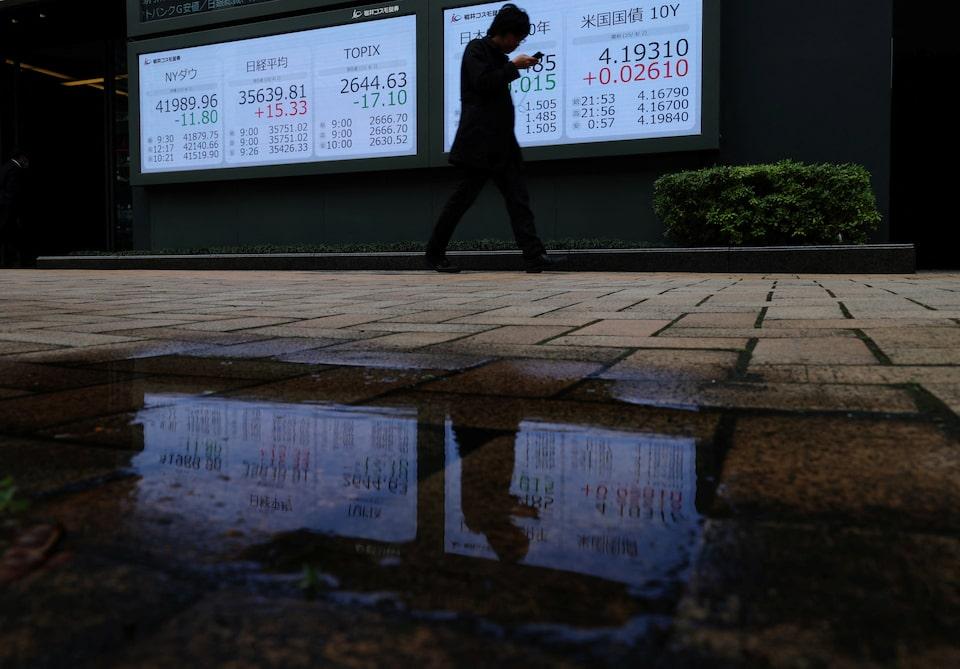
Nasdaq futures slide 3.3%; Nikkei down 3% Gold at record high, yen jumps, bonds rally Asia hit hard with new US tariffs SINGAPORE, April 3 (Reuters) - Stocks dived on Thursday and investors scrambled for the safety of bonds, gold and the yen, fearing new U.S. tariffs have intensified a trade war threatening to tip the world into recession. The dollar was swept to a six-month low, falling along with U.S. bond yields after President Donald Trump imposed tariffs that raise effective import taxes to the highest levels in a century. Sign up here. "This is a game-changer, not only for the U.S. economy but for the global economy," said Olu Sonola, head of U.S. economic research at Fitch Ratings. "Many countries will likely end up in a recession. You can throw most forecasts out the door if this tariff rate stays on for an extended period of time." Nasdaq futures dropped 3.2%, European futures were down nearly 2% and the Nikkei's 3% fall in Tokyo - touching eight-month lows - led heavy losses across Asia. Apple's (AAPL.O) , opens new tab market capitalisation fell by more than $240 billion as its shares slid 7% in after-hours trade. Nvidia's (NVDA.O) , opens new tab market cap dropped 5.6% or $153 billion. Benchmark 10-year U.S. Treasury yields fell more than 15 basis points to a five-month low of 4.04% and markets priced a higher chance of interest rate cuts even though the tariffs are likely to cause U.S. inflation to spike sharply. "You are going to have a supply-side shock via tariffs on the U.S. economy, on prices," said Tai Hui, Asia-Pacific chief market strategist at J.P. Morgan Asset Management. "And then (there's) the uncertainty when it comes to businesses and consumers, both of which could be problematic for growth." Trump announced a baseline 10% tariff on imports with far higher levies on some trading partners, particularly in Asia. China was hit with a 34% levy, Japan got 24%, Vietnam 46% and South Korea 25%. The European Union was hit with a 20% levy. According to Fitch Ratings, the effective U.S. import tax rate has shot up to 22% under Trump from just 2.5% in 2024, reaching levels last seen around 1910. Vietnamese stocks (.VNI) , opens new tab slumped 6%. CHINA FOCUS Ahead of promised countermeasures from China and Europe, investors were buying up safe havens and selling exposure to global growth. Oil, a proxy for economic activity, dropped more than 2% to put benchmark Brent futures at $73.28 a barrel. Australian shares and the Australian dollar fell. Gold hit a record high above $3,160 an ounce and Japan's yen jumped more than 1% to 147.29 per dollar as foreign exchange traders looked for safety outside the U.S. dollar. The euro rose 0.6% to $1.0912. China, for now, held its currency relatively steady, containing the yuan's drop to about 0.4% despite eye-watering total tariffs of above 50% on Chinese exports and the hit to Vietnam seen as shutting down a popular work-around route. China's big domestic economy and the hope of support from Beijing limited losses in Hong Kong stocks (.HSI) , opens new tab to about 1.5% and in Shanghai (.SSEC) , opens new tab to around 0.5%. "The key focus over the next few days should clearly be China," said Deutsche Bank strategist George Saravelos. "How willing will China be to wait for trade negotiations ... or to absorb this?," he said. "Or will it try to 'export' the shock ... via a devaluation of the yuan." https://www.reuters.com/markets/global-markets-wrapup-1pix-2025-04-02/
2025-04-02 06:08
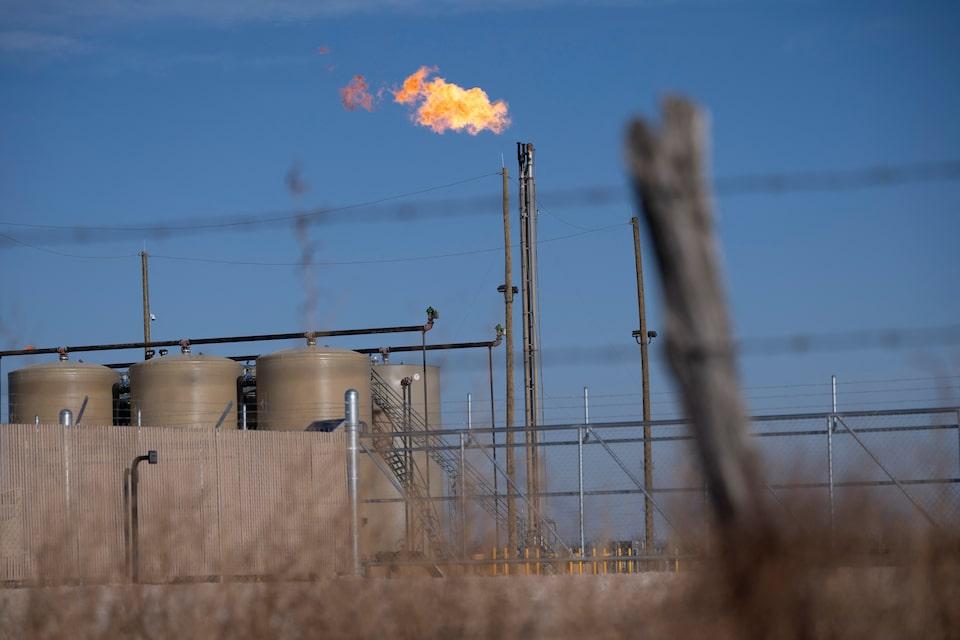
LITTLETON, Colorado, April 2 (Reuters) - U.S. natural gas prices are already up by around 80% from a year ago, but are due for a fresh jolt from the knock-on effects of the latest round of trade tariffs imposed by the U.S. government on goods entering the country. Regardless of how and when the new tariffs kick in, the U.S. gas market stands to be impacted as exports of gas in the form of LNG look set to become a bargaining chip in any ensuing trade maneuvers. Sign up here. For those nations looking to narrow their trade surplus with the U.S. or avoid being hit with future tariffs, commitments to scale up purchases of U.S. LNG are an effective means of speedily rebalancing the trade ledger in favour of the U.S. At the same time, countries impacted by new tariffs that are already regular buyers of U.S. LNG may threaten to cut those purchases as part of possible reprisals. That means that in any event, the U.S. gas market looks set to be buffeted by the impending trade turbulence, with gas exporters, utilities, households and businesses all likely to be impacted by the upcoming swings in gas trade volumes and prices. BIG STAKES The U.S. shipped out nearly 12 billion cubic feet of LNG per day in 2024, according to the U.S. Energy Information Administration, which cemented the U.S.' position as the top exporter of the fuel for the second year running. The LNG shipments brought in more than $30 billion, and so represented significant earnings for both the firms that shipped the gas and for the U.S. Treasury. The largest single market for U.S. LNG exports in 2024 was the Netherlands, which accounted for around 11% of total volumes, according to ship tracking data from Kpler. France, Japan, South Korea and India were the next largest buyers of U.S. LNG, while China, Turkey, Spain and the United Kingdom were also notable buyers. TIPPING THE BALANCE As the U.S. has run up trade deficits with nearly all of those countries, the administration of U.S. President Donald Trump is threatening to impose steep tariffs on the goods they sell to the U.S. And as all those countries are already notable buyers of U.S. LNG, it is likely that they will consider stepping up those purchases as part of any trade tactics designed at easing relations with the Trump administration. Other countries with steep trade surpluses with the U.S., including Vietnam, are also likely to mull increasing U.S. LNG imports as part of tariff negotiating efforts. PLAN B LNG is also likely to feature as part of any countermeasures deployed by nations who want to hit back at the U.S. for raising tariffs in the first place. China and several European nations including Germany have vowed to respond to the planned tariff hikes, and are likely to view LNG as a means to inflict revenue damage on the U.S. without risking too much self-harm in the process. Qatar, Australia and Malaysia all also supply LNG to global customers, and so will likely be able to replace any lost U.S. volumes at relatively short notice while U.S. LNG exporters may struggle to quickly find alternate buyers. GAS FLOW IMPACT Regardless of which way LNG export volumes trend in the wake of the latest U.S. tariff moves, the domestic natural gas market will feel the effects. If most U.S. trade partners opt to dial up LNG imports in an effort to close trade gaps, that will trigger more gas demand at LNG export terminals and tighter supplies for other gas users. That in turn will likely put fresh pressure on U.S. utilities which rely on natural gas for roughly 40% of electricity production. Several utilities have already cut gas use in favour of higher coal-fired power generation this year in response to the higher domestic gas prices. If gas prices climb further on the back of renewed strength in LNG exports, that may accelerate the uptake of coal instead of gas, and result in a swell in U.S. power emissions that could accelerate climate change. On the other hand, if most trade partners opt to cut U.S. LNG purchases as part of tariff reprisals, demand from LNG export terminals could drop and result in greater gas supplies for domestic users, and lower gas prices. Most likely, there will be a mixed response among trade partners in the LNG arena, with some nations dropping their LNG purchases while others increase them. Over time, those volume swings could offset each other and result in total LNG volumes being largely unaffected by the end of the year. But over the near term, sudden changes to LNG order flows will feed back into the domestic gas market and trigger potentially wild swings in available supplies and prices. For gas market participants, the trick will be to position themselves to exploit any advantageous price moves, and take cover during bouts of potentially damaging market action. The opinions expressed here are those of the author, a market analyst for Reuters. https://www.reuters.com/business/energy/us-natural-gas-prices-brace-impact-tariff-crossfire-maguire-2025-04-02/
2025-04-02 05:29
BEIJING, April 2 (Reuters) - China's embassy in Australia rejected reports linking the transit of a Chinese research vessel south of Australia with the country's upcoming federal elections, saying the vessel's passage had "nothing to do with China-Australia relations". The recent activities of the vessel are part of routine scientific research and the route was set in accordance with the international waterway, the embassy said in a statement , opens new tab on Wednesday, adding that it had kept close communication with the Australian side on the issue. Sign up here. https://www.reuters.com/world/asia-pacific/china-says-transit-research-vessel-not-linked-australian-elections-2025-04-02/

2025-04-02 05:28
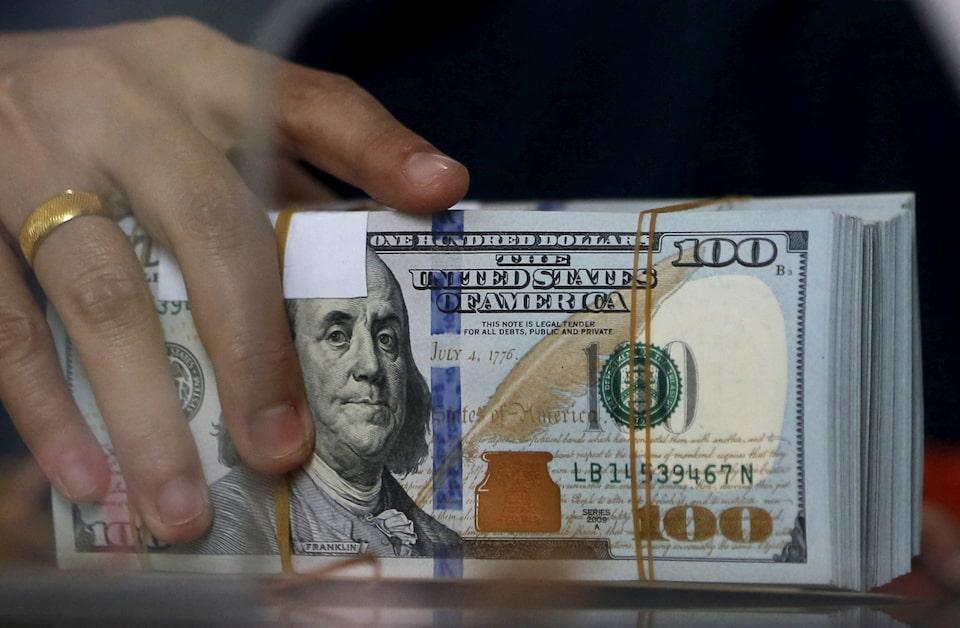
Trump to impose 10% baseline tariffs on all imports into US Trump tariffs not bad as feared -analyst Dollar dips amid worries about darkening US economic outlook Dollar reacts little to rise in US private payrolls NEW YORK, April 2 (Reuters) - The dollar slid against the yen, while the euro held gains against the greenback on Wednesday as U.S. President Donald Trump announced global reciprocal tariffs that look certain to escalate a trade war with global partners. Trump said he would impose a 10% baseline tariff on all imports to the United States and higher duties on some of the country's biggest trading partners. He held up a board showing the new rates charged on most countries, with tariffs ranging from 10% to as high as 49%. Sign up here. With a few exceptions, based on the charts Trump read out, the tariff rate being imposed by the U.S. on most countries was around half of what those countries charged. There were some exceptions in which the U.S. charged the exact rates that those countries charged, according to the chart. In late trading after Trump reiterated that the U.S. would impose 25% tariffs on foreign-made autos, the dollar turned 0.2% lower against the yen to 149.255 yen after trading higher for most of the session. The euro, meanwhile, initially surged, posting a more than 1% rise against the dollar, before retreating to trade 0.3% higher at $1.0828 . "What a roller coaster," said Helen Given, director of trading at Monex USA in Washington. "Hundred basis-point swings aren't something you see every day, even in the choppy trading that's characterized this administration, but as the dust is settling it looks like markets are taking this announcement, particularly the country-specific measures, as 'not the worst-case scenario." Against major currencies, the yen partly regained its luster, remaining down the day against the euro, which remained 0.4% higher at 161.82 yen. Against the Mexican peso, the dollar was little changed at 20.18 . Versus the Canadian dollar, the greenback dipped 0.1% at C$1.421 . The Trump tariffs are "going to result in lots of tit-for-tat negotiations - what concessions can be made to get these down, whatever leverage the U.S. exerts to get other countries to do something to get these tariff levels down, whether it's defence considerations in Europe and/or Japan," said John Hardy, chief macro strategist at Saxo Bank in Copenhagen. "China, I suspect, sticks. So the Chinese response could be quite interesting." Meanwhile, worries about the impact of an escalating global trade war on the world's largest economy and a slew of weaker-than-expected U.S. data have stoked recession fears and in turn undermined the dollar this year. Given nervousness about the tariff announcement, the dollar reacted little to data showing U.S. private payrolls increased more than expected in March. Private payrolls rose by 155,000 last month after an upwardly revised 84,000 rise in February, according to the ADP National Employment Report. There was also minimal reaction to a report indicating that factory orders rose 0.6% in February, after an upwardly revised 1.8% rebound in January. Economists polled by Reuters had forecast factory orders would climb 0.5% after a previously reported 1.7% advance in January. Canadian Prime Minister Mark Carney spoke with Mexican President Claudia Sheinbaum on Tuesday about Canada's plan to "fight unjustified trade actions" by the United States, the prime minister's office said. Bank of Japan Governor Kazuo Ueda, meanwhile, said on Wednesday that planned new U.S. tariffs could have a huge impact on world trade, warning of a possible hit to global growth. https://www.reuters.com/markets/currencies/dollar-steady-zero-hour-liberation-day-closes-2025-04-02/
2025-04-02 05:13
Wall Street indexes tumble; Europe shares slide Dollar sinks against rival currencies Bonds and yen surge on fear of recession NEW YORK/LONDON, April 3 (Reuters) - Global investors grappled on Thursday with rising chances of an economic downturn and a sprawling trade war, as they scrambled for safe-haven assets to buffer against fallout from U.S. President Donald Trump's sweeping tariffs. Markets were stunned late on Wednesday when Trump announced Washington's steepest trade barriers in more than 100 years. The move slammed stock markets and the dollar as investors sought safety in assets like bonds and the Japanese yen. Sign up here. "The size and scope of the tariffs announced exceeded even some of the most bearish forecasts," said Mona Mahajan, head of investment strategy at Edward Jones. "This is something that markets are starting to realize could have a meaningful impact on both economic growth and obviously inflation." S&P 500 companies lost a combined $2.4 trillion in stock market value, their biggest such one-day loss since the emerging coronavirus pandemic ripped through global markets on March 16, 2020. Investors turned their focus to how other countries would respond to Trump. Possibilities include negotiation, retaliation and steps to protect domestic industries. Investors said they were bracing for the increasing chance the world economy was moving toward a recession. Some said they were trying to tariff-proof their portfolios with assets that can ride out a recession and higher inflation or stocks of companies that rely less on international trade. Trump shrugged off the market slide and stood by his tariff decision. “I think it’s going very well,” he told reporters as he departed the White House for a long weekend in Florida. He predicted “markets are going to boom” eventually. For months, investors had thought Trump's tariffs would be relatively worse for economies and markets outside the U.S. Now investors are betting on severe damage to American assets, after Trump unveiled a 10% baseline levy on all U.S. imports and much higher duties imposed on some countries. Investors fled riskier assets on Thursday, with the S&P 500 index (.SPX) , opens new tab tumbling 4.8%, its biggest drop since June 2020. The Nasdaq Composite (.IXIC) , opens new tab dived about 6%, its biggest daily loss since March 2020. The Cboe Volatility Index (.VIX) , opens new tab, an options-based measure of investor anxiety, closed at its highest level since August 2024. The dollar weakened to six-month lows against Japan's yen and the Swiss franc, taking some of the safe-haven sheen off the greenback. As stocks plunged, global equity long-short hedge funds erased their gains for the year, Goldman Sachs said. On Wall Street, the biggest drags were from highly valued megacap investor favorites. Apple (AAPL.O) , opens new tab slumped over 9%, while artificial intelligence chip leader Nvidia (NVDA.O) , opens new tab sank nearly 8%. Shares of U.S. banks tumbled to multi-month lows on fears Trump's tariffs would result in a recession and a slowdown in consumer spending that could hurt earnings. Fed funds futures rallied as investors priced in more interest rate cuts by the Federal Reserve this year. Investors bought up U.S. Treasuries, with benchmark 10-year yields falling to just above 4%, their lowest level since mid-October. "Coming into this year, there was this assumption that this administration would be brilliant for the U.S. economy and difficult for the rest of the world," said Hugh Gimber, global market strategist at J.P. Morgan Asset Management in London. "It's increasingly evident this policy mix in the U.S. is more difficult for the U.S. itself." The Trump administration has said the base 10% tariffs will go into effect on April 5 and the higher rates on April 9. Tariffs of 25% on vehicle imports took effect at midnight. The new levies include a 34% tariff on imports from China, 46% on Vietnam, 24% on Japan and 20% on Europe. Retaliation against Trump's tariffs is likely, said Justin Onuekwusi, chief investment officer at St James's Place, "but it's clear countries will think about how to retaliate in a politically astute way." "Significant retaliation could lead to a tariff 'spiral of doom' that could be the growth shock that drags us into recession." Trump's tariffs also hit markets outside the U.S., although to a lesser extent. European shares fell with the STOXX 600 (.STOXX) , opens new tab down 2.6%. The euro was up 1.7% against the dollar. European Union chief Ursula von der Leyen described the tariffs as a major blow to the world economy and said the 27-member bloc was prepared to respond with countermeasures. In China, which had braced for tariffs and where most revenue is earned locally, selling in stocks and the currency was also more contained. "Investors are clearly concerned about retaliation by other governments that could lead to a global recession," Oliver Pursche, senior vice president at Wealthspire Advisors in New York. "But we've also learned just over the last couple of months... on-and-off again tariffs are not unusual for (Trump). So we'll have to see how long the tariffs stay in place.” Even before Thursday's selloff, tariff jitters had hit markets hard. In mid-March the S&P 500 confirmed a correction, a drop of 10% from a recent high. With Thursday's dive, the index ended down over 12% below its February record high. "People were talking earlier about whether clarity would boost the market," said Jeanette Garretty, chief economist at Robertson Stephens. "But now you have clarity, and no one likes what they see." https://www.reuters.com/markets/wealth/global-markets-tariffs-graphic-pix-2025-04-02/