2025-03-24 03:52
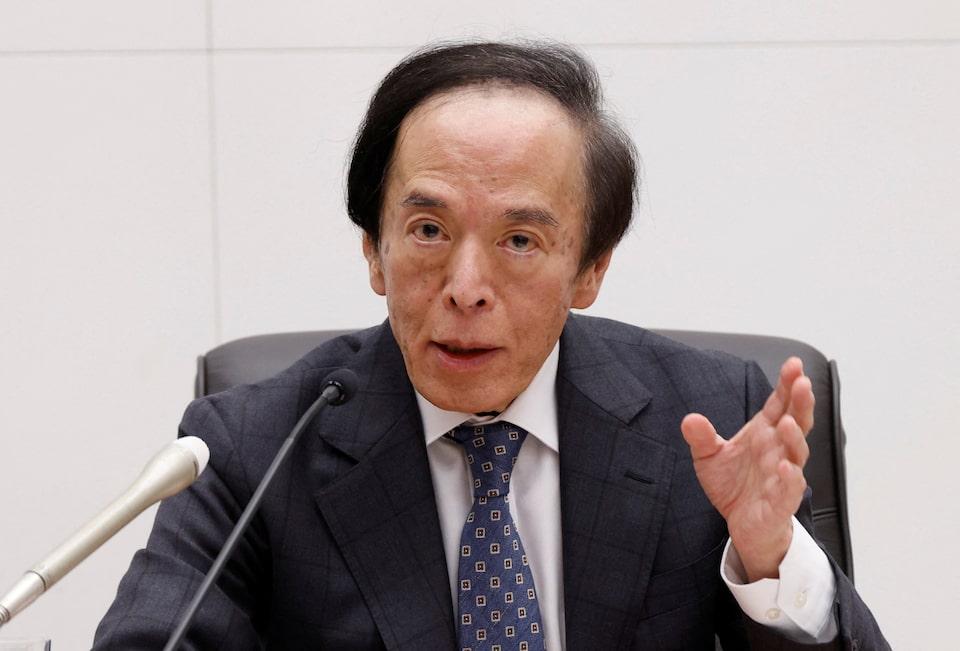
TOKYO, March 24 (Reuters) - Bank of Japan Governor Kazuo Ueda said on Monday the central bank will continue to raise interest rates if its underlying inflation target is likely to be achieved, despite potential losses on its government bond holdings. "We have said that we will continue adjusting the degree of monetary easing if underlying inflation is likely to approach 2%," Ueda said in parliament when asked about the impact of losses on the BOJ's huge holdings of Japanese government bonds. Sign up here. "Our policy objectives are to achieve price stability, and the pursuit of our policies would not be disturbed by considerations for the BOJ's finances," he added. The BOJ in December released estimates on how future interest rate hikes could affect its earnings, which showed it expects to suffer red ink of up to around 2 trillion yen ($13.3 billion) if short-term borrowing costs were to go up to 2%. In the six months to September last year, the central bank's bond holdings incurred record valuation losses of 13.66 trillion yen, while its holdings of exchange-traded funds gained paper profits of 33.07 trillion yen. Asked about the impact of a stock market plunge on the BOJ's ETF holdings, Ueda said a 1,000 point decline in Japan's benchmark 225-issue Nikkei share average would cause valuation loss of about 1.8 trillion yen. Last week, the BOJ kept interest rates steady and warned of heightening global economic uncertainty, suggesting the timing of further rate hikes will depend largely on the fallout from potentially higher U.S. tariffs. But Ueda also said at that time that rising food costs and stronger-than-expected wage growth could push up underlying inflation, highlighting the central bank's attention to mounting domestic price pressures. ($1 = 149.89 yen) https://www.reuters.com/markets/rates-bonds/boj-says-raise-rates-if-price-target-be-achieved-despite-losses-jgbs-2025-03-24/
2025-03-24 03:00
MUMBAI, March 24 (Reuters) - The Indian rupee, following last week's rally, may not react much at the open on Monday to the decline in the Chinese yuan and other Asian currencies. The 1-month non-deliverable forward indicated that the rupee will open little changed to the U.S. dollar from 85.9725 in the previous session. Sign up here. The Indian currency rallied significantly last week, rising 1.2% amid inflows, resulting in its best weekly performance in two years. Foreign inflows into Indian equities exceeded $1 billion last week, a significant chunk of which took place on Thursday and Friday. Friday's data is preliminary. While the magnitude of the inflows is not exceptionally large in isolation, it represents a significant shift from prior weeks, a currency trader at a bank said. Foreign investors took out nearly $3.5 billion from Indian equities between March 3 and 14, which followed a $4 billion withdrawal in February. "There were probably other flows too last week and whether we have more of them will decide" if rupee manages to hold near the 86 level, the currency trader said. ASIA FX STRUGGLES Asian currencies kicked off the week on a weak note, down between 0.1% and 0.3%, while the dollar index was marginally higher. The offshore Chinese yuan dropped to 7.2650 to the U.S. dollar, the weakest level in two weeks. The near-term direction of Asian currencies hinges largely on what U.S. President Donald Trump does on tariffs next week. The next round of tariffs is due on April 2, when Trump said he will announce reciprocal levies on other countries. Meanwhile, Federal Reserve officials in a speech on Friday backed a cautious policy approach in light of economic uncertainty. KEY INDICATORS: ** One-month non-deliverable rupee forward at 86.26; onshore one-month forward premium at 26.5 paise ** Dollar index up at 104.08 ** Brent crude futures down 0.3% at $71.9 per barrel ** Ten-year U.S. note yield at 4.27% ** As per NSDL data, foreign investors bought a net $368.7 million worth of Indian shares on March 20 ** NSDL data shows foreign investors bought a net $9.5 million worth of Indian bonds on March 20 https://www.reuters.com/markets/currencies/rupee-may-not-respond-much-dip-asian-peers-focus-flows-2025-03-24/
2025-03-24 01:34
MUMBAI, March 24 (Reuters) - The Indian rupee's direction this week will be determined by the continuation of dollar inflows and the degree to which the central bank permits the currency to strengthen, while bond yields are expected to decline further. The rupee rallied 1.2% to 85.9725 per U.S. dollar last week, its best weekly performance in two years, on persistent inflows via foreign banks and the unwinding of short wagers on the currency. Sign up here. Inflows related to inter-company borrowings and repatriation of corporate profits are usual in March, the last month of the financial year. "Whether the flows will continue this week is what will decide if the rupee is able to sustain at the current level," a currency trader at a bank said. "And at some point, you would expect the Reserve Bank of India to step in to rebuild reserves and to reduce the size of its forward book." Anil Bhansali, head of treasury at Finrex Treasury Advisors, reckons it was possible that the rupee may extend its run higher to near 85.70-85.75 this week. He is advising his clients to hedge their near dollar term payables at that level. Traders will also keep a close eye on the dollar index and U.S. Treasury yields. The dollar index has been on a downtrend amid worries over a U.S. economic slowdown. The S&P flash U.S. services and manufacturing data due Monday will help investors gauge the health of the world's largest economy. Meanwhile, the benchmark 10-year bond yield ended at 6.6249% on Friday, down 7 basis points for the week, posting its biggest decline in four months. Traders expect the yield to trade in the range of 6.60%-6.65% this week. Bond yields fell last week, as stronger-than-expected demand for state debt, a surprise announcement from the RBI for a third debt purchase auction for this month, dovish Federal Reserve and a jump in the rupee aided sentiment. The RBI will buy bonds worth 500 billion rupees ($5.82 billion) on Tuesday. The central bank has already infused over 5.50 trillion rupees into the banking system through a combination of primary and secondary market bond purchases, FX swaps and early-April maturity repos. Sentiment has remained favourable after local retail inflation eased to 3.61% in February - the lowest since July 2024 - from 4.26% in January. Market participants have raised bets of yet another interest rate cut in April by the RBI. The authority had reduced rates by 25 basis points last month, which was its first cut in nearly five years. ICICI Securities Primary Dealership said changes in India's growth inflation mix have led to a change in the view to 75-100 basis points of policy of easing. "Assuming that the committee (Monetary Policy Committee) also firmly sees two more cuts with optionality of a third from hereon, there is a case to upgrade policy stance to convey that message to markets and also cement the change towards a new, easier liquidity regime." KEY EVENTS: ** India March HSBC Flash manufacturing, services and composite PMI - March 24, Monday (10:30 a.m. IST) U.S. ** March S&P Global Flash manufacturing, services and composite PMI - March 24, Monday (7:15 p.m. IST) ** March consumer confidence - March 25, Tuesday (7:30 p.m. IST) ** February new home sales - March 25, Tuesday (7:30 p.m. IST) ** February durable goods - March 26, Wednesday (6:00 p.m. IST) ** October-December GDP final - March 27, Thursday (6:00 p.m. IST) (Reuters poll 2.4%) ** Initial weekly jobless claims week to March 17 - March 27, Thursday (6:00 p.m. IST) ** February retail sales - March 28, Friday (12:30 a.m. IST) ** February personal consumption expenditure index, core PCE index - March 28, Friday (6:00 p.m. IST) ** March U Mich sentiment - March 28, Friday (7:30 p.m. IST) https://www.reuters.com/markets/currencies/indian-rupee-eyes-flows-rbi-bond-yields-seen-lower-last-week-fiscal-2025-2025-03-24/
2025-03-23 22:21
March 24 (Reuters) - Australia's Mineral Resources (MIN.AX) , opens new tab said on Monday it had resumed haulage operations on its Onslow Iron project in Western Australia following a pause after a road train accident last week. Operations resumed on March 21 following discussions with WorkSafe WA, part of the Department of Energy, Mines, Industry Regulation and Safety, about controls and risk mitigation. Sign up here. The previously announced works program to upgrade the haul road continues on schedule for completion in the first quarter of 2026, the miner said. The company's transhipper vessel, MinRes Rosily, also commenced operations at the Port of Ashburton on March 22, increasing the Onslow Iron project's transhipping capacity to 28 million tonnes per annum. Mineral Resources added that its Onslow Iron volume guidance for the fiscal year 2025 remained unchanged. https://www.reuters.com/markets/commodities/australias-mineral-resources-resumes-haulage-onslow-iron-project-2025-03-23/

2025-03-23 22:03
BAGHDAD, March 23 (Reuters) - Iraq’s Kurdistan region is producing 286,000 barrels of crude oil per day, Iraqi oil minister Hayan Abdel-Ghani told state television on Sunday, citing secondary sources. OPEC+ uses secondary sources to help monitor its output as a legacy of historic OPEC disputes about how much oil members were pumping and occasionally alters the list. Sign up here. Oil companies operating in Kurdistan and Iraq's oil ministry have failed to reach an agreement on resuming exports to Turkey, leaving the flow halted for a second year. The two-year standoff has halted flows from Iraqi Kurdistan in the north of the country to Turkey's Mediterranean port of Ceyhan. Abdul Ghani did not say when the exports might resume, but he said that talks with the Kurdish regional authorities were ongoing. https://www.reuters.com/world/middle-east/iraqs-kurdistan-crude-output-286000-bpd-oil-minister-says-2025-03-23/

2025-03-23 21:27
Offer pitched at 37% premium to AZEK's close on Friday Hardie CEO sees further consolidation in US building materials Hardie's Australian shares slide 15% March 24 (Reuters) - Fibre-cement maker James Hardie Industries (JHX.AX) , opens new tab said it will buy U.S. artificial decking maker AZEK (AZEK.N) , opens new tab for $8.75 billion, sending its shares tumbling amid analysts' concerns of overpaying for exposure to a sputtering U.S. housing market. The cool reaction to the buyout shows a sense of caution among investors about a firm widening its footprint in the U.S., where new housing stock is near a two-decade high and tariffs and an immigration crackdown under President Donald Trump are seen as likely to slow construction further. Sign up here. AZEK shareholders will get $26.45 in cash and 1.034 James Hardie shares for each AZEK share, bringing the total price to $56.88 per share, a 37.4% premium to the target's close on Friday. AZEK's board supports the offer, which would result in James Hardie and AZEK shareholders owning about 74% and 26% respectively, the companies said. AZEK makes composite decking, pergolas and other outdoor living products. James Hardie's Australian-listed shares fell 15% on Monday, while the S&P/ASX200 (.AXJO) , opens new tab was flat, as analysts worried the price was on a higher earnings multiple than other deals in the sector. The deal carried "a heavy premium and elevated multiple," said Morgan Stanley analysts. "We expect that the market will be skeptical of revenue synergy targets." The company said it expected to achieve at least $350 million worth of additional earnings once the deal was complete. It forecast $125 million of cost savings from the deal. Barrenjoey analysts said the premium meant "full synergy realisation as well as strong underlying growth for both businesses is needed to justify the transaction". The deal is the third in a year in the U.S. building products sector, including Beacon Roofing Supply (BECN.O) , opens new tab agreeing last week to an $11 billion buyout from QXO (QXO.N) , opens new tab. "There is a changing landscape in the U.S. building products industry," James Hardie CEO Aaron Erter told Reuters. "You have seen consolidation, and we believe that is only going to continue. We have set up a stronger company by joining with AZEK, being able to get on whatever a changing landscape gives us." Tariffs ordered by U.S. President Donald Trump plus labour shortages linked to his immigration crackdown are expected to push up costs while curtailing demand, economists say. A slump in sales of new homes meanwhile pushed inventory in January to the highest since 2007, government data showed, cooling demand for new building starts. Against that backdrop, shares of AZEK have slumped 23% from a record high close on December 11 of $54.76. The buyout equity value is 4% higher than that peak. The price tag includes AZEK's $386 million of net debt, James Hardie said. The combined company's shares will be listed on the New York Stock Exchange with its Australian chess depositary interest (CDI) listing remaining in place, it said in a statement. James Hardie was founded in Australia but is now headquartered in Ireland with its management team based in Chicago. The firm said it intends to fund the cash portion of the transaction through debt financing. https://www.reuters.com/markets/commodities/australias-james-hardie-acquire-us-based-azek-88-billion-deal-2025-03-23/