2025-03-19 23:10
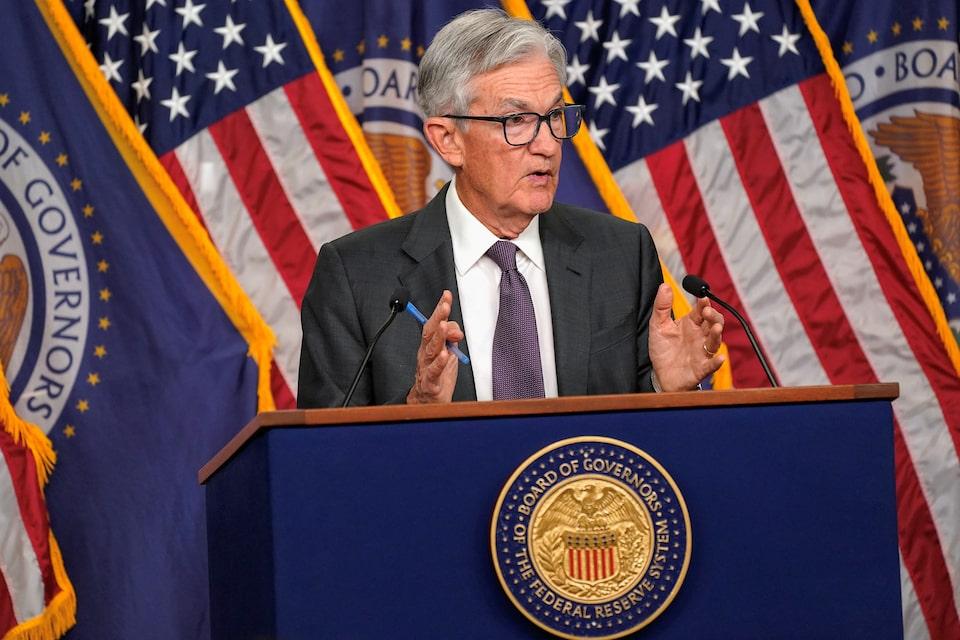
Fed keeps rates unchanged as widely expected Central bank to taper drawdown of its balance sheet Powell signals tariff impact tough to determine Indexes up: Dow 0.92%, S&P 500 1.08%, Nasdaq 1.41% NEW YORK, March 19 (Reuters) - U.S. stocks rallied on Wednesday after the Federal Reserve kept rates unchanged as widely expected, and the central bank and investors continue to gauge how President Donald Trump's tariff policies affect the economy and inflation. The central bank kept its benchmark overnight interest rate unchanged in the 4.25%-4.50% range, and indicated that two quarter-point interest-rate cuts were likely later this year, the same median forecast as three months ago. The Fed also forecast slower economic growth and higher inflation. Sign up here. Policymakers disagreed about the path forward, pointing to uncertainty among members about how to handle the effects of Trump's plans. The Fed also said it would reduce the pace of the drawdown of its still-massive balance sheet, as it faces challenges in assessing market liquidity during an ongoing impasse in the U.S. Congress over lifting the government’s borrowing limit. "Given growing worries around tariffs and how they could affect U.S. growth and inflation," Matthias Scheiber, head of the multi-asset solutions team at Allspring Global Investments in London said, the Fed "took a widely expected 'wait and see' approach on rates." Scheiber added: "For 2025, the interest rate market currently expects the Fed will cut rates to around 3.75% by year-end. A lot will depend on how the inflation-versus-growth trade-off develops—growth may continue weakening, and the Fed may need to cut rates more forcefully than expected." Traders still see the Fed lowering borrowing costs by at least two 25-basis point cuts by December, with a 62.2% chance for a cut of at least 25 basis points in June, according to data compiled by LSEG. The Dow Jones Industrial Average (.DJI) , opens new tab rose 383.32 points, or 0.92%, to 41,964.63, the S&P 500 (.SPX) , opens new tab gained 60.63 points, or 1.08%, to 5,675.29 and the Nasdaq Composite (.IXIC) , opens new tab gained 246.67 points, or 1.41%, to 17,750.79. Stocks extended gains further as Fed Chair Jerome Powell spoke, saying it was too early to determine whether to look through the impact U.S. tariffs would have on inflation, and difficult to assess how much of any price increases are attributable to the levies. "The market was primarily looking for anything that reduced the uncertainty, and I think simply that Powell was kind of maintaining the outlook there," said Russell Price, chief economist at Ameriprise Financial in Troy, Michigan. "Inflation expectations went up just a little bit, and their GDP numbers came down just a little bit, so the market's taking it as the Fed did not add to the overall uncertainty background that is currently pressuring stocks." The European Union will tighten steel import quotas to reduce inflows by a further 15% from April, a senior EU official said, in a move aimed at preventing cheap steel from flooding the European market after Washington imposed new tariffs. Boeing (BA.N) , opens new tab shares jumped 6.84% after the aircraft maker said it does not see a near-term impact from tariffs. Analysts have said markets are largely eyeing Trump's announcements regarding reciprocal trade barriers on April 2. Each of 11 S&P 500 sectors rose, led by a nearly 2% gain in consumer discretionary stocks (.SPLRCD) , opens new tab. U.S. stocks have come under selling pressure in recent weeks after a string of economic indicators signaled the economy and consumer sentiment may be cooling as trade policy concerns grow. Still, equities have shown signs of bottoming by registering gains in three of the past four sessions. Multiple companies have also lowered their profit outlooks, the latest being General Mills (GIS.N) , opens new tab. The Pillsbury owner lowered its annual sales outlook, sending its shares 2.05% lower. The benchmark S&P 500 index (.SPX) , opens new tab confirmed last week it was in correction following a 10% drop from its recent high. The tech-heavy Nasdaq (.IXIC) , opens new tab also confirmed a correction on March 6, while the blue-chip Dow is roughly more than 3% away from the correction threshold. Advancing issues outnumbered decliners for a 2.92-to-1 ratio on the NYSE and a 2.4-to-1 ratio on the Nasdaq. The S&P 500 posted seven new 52-week highs and one new low, while the Nasdaq Composite recorded 33 new highs and 114 new lows. Volume on U.S. exchanges was 13.53 billion shares, compared with the 16.34 billion average for the full session over the last 20 trading days. https://www.reuters.com/markets/us/futures-edge-higher-investors-await-fed-decision-2025-03-19/
2025-03-19 22:44
US gave Chevron until early April to wrap up in Venezuela Trump met with oil companies this week Wind down could be extended to 60 days or more Reversing the end of the license not part of talks now March 20 (Reuters) - U.S. President Donald Trump's administration is considering a plan to extend Chevron's (CVX.N) , opens new tab license to pump oil in Venezuela by at least 60 days, according to two people familiar with the matter. The administration had announced in February that it would scrap the U.S. company's license to operate in Venezuela, and gave it until early April to wrap up its business in the South American country. Sign up here. Chevron CEO Mike Wirth and other top U.S. oil company executives met with Trump at the White House on Wednesday to discuss issues facing the industry. The Wall Street Journal was first to report that the Trump administration was considering an extension to Chevron's license following the Wednesday meeting. A White House official told Reuters it had no new announcement to share on Chevron and that the White House does not comment on the specifics of the president's private meetings. A Chevron spokesperson also declined to comment on the specifics of the report but added in an emailed response to Reuters that company executives regularly hold meetings with government officials in Washington on issues related to its business in the United States and abroad. One of the sources told Reuters the administration was considering extending Chevron's license by 60 days and possibly more, but reversing the broader U.S. decision to ultimately end Chevron's license to operate in Venezuela was not being discussed. The other source told Reuters the administration was mulling an extension of at least 60 days, after which the U.S. could impose a system to further pressure Venezuela's oil industry. That system could include sanctions on ships delivering Venezuelan crude to China or elsewhere, or involve tariffs on countries that purchase Venezuelan oil. The sources asked not to be named because they were not authorized to speak publicly on the matter. U.S. sanctions on Venezuela are intended to pressure President Nicolas Maduro, who has been in power for more than a decade amid elections that observers say were marred by fraud. Washington has in recent years authorized some companies to maintain operations in Venezuela and export oil to certain markets, including the U.S., Europe and India, as exceptions to its sanction regime on the country's energy sector, first imposed in 2019. Since he took office in January, Trump has said the United States does not need Venezuela's oil, which last year represented about 3.5% of all U.S. crude imports or some 220,000 barrels per day. However, that flow has been a key means for Chevron to recover billions of dollars in pending debt in Venezuela. Trump has accused Maduro of failing to make progress on electoral reforms and migrant returns. Maduro and his government have always rejected sanctions by the United States and others, saying they are illegitimate measures that amount to an "economic war" designed to cripple Venezuela. He and his allies have cheered what they say is the country's resilience despite the measures, though they have historically blamed some economic hardships and shortages on sanctions. https://www.reuters.com/markets/commodities/chevron-ceo-wirth-seeks-more-time-wind-down-operations-venezuela-wsj-reports-2025-03-19/

2025-03-19 22:36
March 19 (Reuters) - Greenpeace must pay a Texas-based pipeline company nearly $667 million in damages for the environmental advocacy group’s role in 2016-2017 protests against the Dakota Access Pipeline in North Dakota, a jury said Wednesday. The verdict in North Dakota state court came after two days of deliberations in a trial where pipeline company Energy Transfer accused Greenpeace of paying protesters to disrupt construction of the pipeline unlawfully and spreading falsehoods about the controversial project, located near the Standing Rock Indian Reservation. Sign up here. The verdict included damages for defamation, trespassing and conspiracy. The jury awarded more than $400 million in punitive damages, which are intended to punish defendants for their conduct. Greenpeace denied wrongdoing and called the case an attack on free speech rights. The group’s lawyers said they would appeal Wednesday’s verdict. “We’re an advocacy group. We engage in peaceful protest,” said Greenpeace attorney Deepa Padmanabha, asserting that the group only played a minor role in the demonstrations. Energy Transfer lawyer Trey Cox said in a statement that Greenpeace’s “violent and destructive” protests were not legally protected speech. “Today, the jury delivered a resounding verdict, declaring Greenpeace’s actions wrong, unlawful, and unacceptable by societal standards. It is a day of reckoning and accountability for Greenpeace,” Cox said. Construction of the pipeline was met with fierce protests by environmental and tribal advocacy groups who said the project would poison local water supply and exacerbate climate change. The project began in 2016 and was completed the following year. The pipeline transports roughly 40% of the oil produced in North Dakota’s Bakken region. https://www.reuters.com/legal/greenpeace-must-pay-pipeline-company-nearly-667-million-over-standing-rock-2025-03-19/

2025-03-19 22:11
NEW YORK, March 19 (Reuters) - A small fire broke out at Phillips 66's (PSX.N) , opens new tab 139,000 barrel-per-day refinery in Los Angeles on Tuesday evening, the company said. "The source of the fire was quickly isolated and extinguished," a spokesperson said on Wednesday. Sign up here. The refinery's operation was not impacted and all personnel were accounted for, he added. The Houston-based refiner plans to shut its Los Angeles-area oil refinery by October this year. The refinery produces 85,000 barrels per day of gasoline and 65,000 barrels per day of diesel and jet fuel. https://www.reuters.com/business/energy/fire-reported-phillips-66s-los-angeles-refinery-2025-03-19/

2025-03-19 21:42
WASHINGTON, March 19 (Reuters) - U.S. Energy Secretary Chris Wright said the United States could step in to run Ukrainian power plants if that was helpful to ensure a ceasefire and bring peace to the war-torn country. U.S. President Donald Trump suggested to Ukrainian President Volodymyr Zelenskiy during a phone call on Wednesday that the U.S. could help run, and possibly own, Ukraine's nuclear power plants, according to a statement by the U.S. administration. Sign up here. Zelenskiy said Ukraine has begun talks with the U.S. about its possible involvement in restoring Europe's largest nuclear power plant, in Ukraine's Zaporizhzhia region, which has been shut down since Russian troops occupied it in 2022. Asked how that would work, Wright told Fox News, "We have immense technical expertise in the United States to run those plants. I don't think that requires boots on the ground." Wright said Trump and Secretary of State Marco Rubio were working to end the war in Ukraine. "How do we bring peace to Ukraine? How do we get this fighting to stop? Which takes both sides to lay down their arms? But if it was helpful to achieve that end, have the U.S. run nuclear power plants in Ukraine. No problem, we can do that." Wright told reporters earlier that the issue did not come up during a White House meeting hosted by Trump with U.S. oil executives. https://www.reuters.com/world/us/us-oil-ceos-trump-did-not-discuss-taking-over-ukraines-power-plants-energy-2025-03-19/

2025-03-19 21:02
ORLANDO, Florida, March 19 (Reuters) - TRADING DAY Parsing the Fed's new economic projections and 'dot plot' Sign up here. Wall Street rallied sharply and Treasury yields fell on Wednesday as investors bet that the Federal Reserve will look through rising price pressures and continue cutting interest rates this year, after new projections showed that officials now expect lower growth and higher inflation. While the median projection of two more rate cuts this year is still policymakers' base case, the underlying 'dot plot' forecasts shifted up closer towards only one. But not quite. Investors ignored that, however. They also ignored the growing "stagflation" risks and officials' admission that uncertainty is elevated. Instead, they seized on Chair Jerome Powell's belief that tariff-driven inflation will be "transitory" and largely confined to this year. I will dig deeper into the confusing signals sent by various measures of inflation expectations below. But first, here are the scores on the doors from Wednesday's trading around the world. Today's Key Market Moves. The Fed's decision to leave rates unchanged was widely expected. This left investors to take their cue from other aspects of what turned out to be a remarkable day that included: significant changes in the economic forecasts, underlying shifts in the "dot plot," Powell's resurrection of "transitory" to describe inflation, and the Fed saying it will slow the ongoing drawdown of its balance sheet. Before all that, Wall Street's big three indices were up between 0.3% and 0.6%, the dollar was up across the board and Treasury yields were up as much as 5 basis points across the curve. Much of that was paring back the previous day's moves that were marked by a widespread risk aversion among investors although, interestingly, gold didn't pull back and held onto the $3,000 an ounce area. But investors took Powell's stance to be extremely "dovish," and stocks leaped even higher, yields tumbled, the dollar cooled and gold marched on. It will be fascinating to see if markets reverse course on Thursday. There's certainly a case to make, given that both the growth and inflation outlooks deteriorated - stagflation is rarely a bullish environment for risk assets. What's more, relying on inflation being "transitory" hasn't always worked out well. Earlier on Wednesday, the Bank of Japan kept rates on hold as expected and, on balance, signaled that it will proceed cautiously on policy tightening due to heightened global economic and tariff uncertainty even though Governor Kazuo Ueda also said rising food costs and strong wage growth could push up inflation. Traders slightly trimmed their rate hike bets, and now put a very slim chance on the next move - and only hike this year - coming in October rather than September. On the geopolitical front, U.S. President Donald Trump and Ukrainian President Volodymyr Zelenskiy agreed on Wednesday to work together to end Russia's war with Ukraine, in what the White House described as a "fantastic" one-hour phone call. Muddled inflation expectations no help for Fed Keeping inflation expectations under control is arguably a central bank's most important job. But it is also one of the most challenging given that the picture painted by the surveys, models and market prices relied on by policymakers is, at best, unclear, and at worst, so muddled as to be barely useful at all. That's especially true today, and one more reason why the Federal Reserve is proceeding with caution. Consumer expectations can, understandably, be volatile. The layperson is unlikely to have a firm grasp on how global supply chains, commodity prices or monetary policy lags affect prices. They could therefore easily be influenced - or spooked - by news headlines and current conditions. Survey responses are thus often based more on emotion than economic analysis. This helps explain why the five-year inflation outlook in the University of Michigan's latest survey of consumers jumped to 3.9% in February. That's the highest since 1993, and was undoubtedly driven by legitimate fears about the impact U.S. President Donald Trump's tariffs could have on prices. Yet the New York Fed's February survey tells a very different story. It shows that the U.S. public's five-year inflation horizon was unchanged from January at 3.0%. Indeed, this report's five-year outlook has been stuck in a 2.5-3.0% range for more than two years. If that's not confusing enough, financial markets' long-term inflation outlook suggests there's no need to worry at all. Five-year/five-year forward breakevens, a measure of expected inflation over a five-year period starting in five years' time, have been trending lower in recent weeks and were last trading around 2.1%. That's the lowest in two years, significantly below current annual CPI inflation of 2.8%, and practically at the Fed's 2% target. This suggests investors believe tariff shocks will pass, the Fed will keep policy sufficiently tight to get inflation down, or growth will be weak. Or some combination of all three. TENUOUS LINK Given that consumer expectations, particularly over the shorter one-year and three-year horizons, are more volatile than market-based measures, how should policymakers make sense of these conflicting signals? A Cleveland Fed paper from October 2021 suggests they should be taken with a grain of salt. It found that the predictive relationship of a range of inflation expectation gauges was hit and miss. And much more miss than hit. Researchers found that consumers are particularly bad at predicting inflation. Again, this may be no real surprise given that people without a financial background often struggle to distinguish between the price level and the rate of price increases. Though, for what it's worth, the Cleveland Fed researchers found that financial markets' predictive power isn't that much better. Another 2021 paper by Fed staffer Jeremy Rudd went further, warning that the relationship between expected and actual inflation "has no compelling theoretical or empirical basis and could potentially result in serious policy errors." That's a troubling conclusion given the importance policymakers put on keeping inflation expectations anchored. But Fed Chair Jerome Powell doesn't seem worried. Speaking to reporters on Wednesday after Fed officials cut their GDP growth projections but raised the inflation outlook, he insisted that long-term expectations remain well-contained even if short-term ones are rising. The recent University of Michigan survey was an "outlier", but will still be factored into policymakers' thinking along with all the other indicators they look at. "We monitor inflation expectations very, very carefully, every source we can find. We do not take anything for granted," Powell said, adding that anchored inflation expectations are at "the very heart of our framework." What could move markets tomorrow? If you have more time to read today, here are a few articles I recommend to help you make sense of what happened in markets today. I'd love to hear from you, so please reach out to me with comments at [email protected]. You can also follow me at [@ReutersJamie and @reutersjamie.bsky.social.] Opinions expressed are those of the author. They do not reflect the views of Reuters News, which, under the Trust Principles , opens new tab, is committed to integrity, independence, and freedom from bias. Trading Day is also sent by email every weekday morning. Think your friend or colleague should know about us? Forward this newsletter to them. They can also sign up here. (This story has been corrected to say that the U.S. yield curve steepened, not flattened, in paragraph 8) https://www.reuters.com/markets/global-markets-trading-day-2025-03-19/