2025-03-11 11:59
QUETTA, Pakistan, March 11 (Reuters) - Separatist militants said they had taken hostages during an attack on a train carrying hundreds of people in southwestern Pakistan on Tuesday and threatened to kill them if their demands were not met. Officials from the provincial government and railways did not immediately confirm whether hostages had been taken. The train, which had been carrying about 400 passengers, was trapped inside a tunnel after the attack, in which it came under fire and the driver was wounded, police and railway officials said. Security forces said an explosion had been heard around the tunnel and that they were exchanging fire with the militants in a mountainous area. In a statement, the Baloch Liberation Army (BLA), a militant separatist group, said it had taken hostages from the train, including security forces. It threatened to execute the hostages if the security forces did not retreat. The Jaffar Express had been on its way from Quetta in Pakistan's southwestern Balochistan province to Peshawar in Khyber Pakhtunkhwa when it was fired on, railway officials said. Pakistan's interior minister, Mohsin Naqvi, condemned the attack and said the government would not make any concessions to "beasts who fire on innocent passengers". The Balochistan government has imposed emergency measures to deal with the situation, Rind said. A decades-old insurgency in Balochistan by separatist militant groups has led to frequent attacks against the government, army and Chinese interests in the region, pressing demands for a share in mineral-rich resources. The BLA seeks independence for Balochistan. It is the biggest of several ethnic insurgent groups that have battled the South Asian nation's government for decades, saying it unfairly exploits Balochistan's rich gas and mineral resources. Sign up here. https://www.reuters.com/world/asia-pacific/firing-passenger-train-pakistan-tv-channels-report-2025-03-11/

2025-03-11 11:44
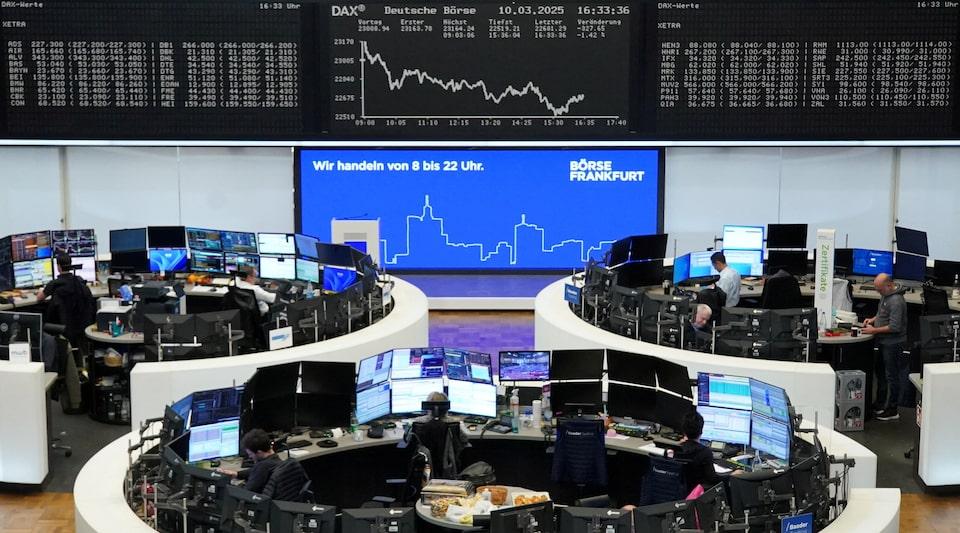
LONDON, March 11 (Reuters) - Hedge funds fleeing positions intensified towards the end of last week and may continue to dent European hedge fund managers' returns, a JPMorgan (JPM.N) , opens new tab note to clients seen by Reuters on Tuesday showed. Hedge funds unwound positions in single stocks on Friday at the largest amount in over two years, with some activity comparable to March 2020, when portfolio managers cut market exposure during the pandemic. European shares fell on Tuesday after Monday's sharp sell-off on U.S. growth concerns, and concerns about whether Germany's fiscal reforms might fail or be watered down. When equities are sold in large sizes this can push down stock prices and impact market values. When funds large and small crowd into the same positions, larger funds selling stocks in bulk can trigger other smaller funds to exit their positions to mitigate their losses, as well. "Smaller hedge fund managers face a precarious situation when large U.S. multi-strategy funds deleverage," said Bruno Schneller, managing director at Erlen Capital Management. Smaller managers often have less money to trade with and rely on more concentrated positions to generate returns. When bigger funds sell stocks in bulk, the ability to buy and sell quickly can dry up, especially for less liquid stocks, said Schneller. "Smaller managers are like dinghies in the wake of a supertanker—when the big funds shift course, the turbulence can capsize them. Their limited resources and flexibility make them particularly vulnerable to these cascading effects," said Schneller. Stock pickers and multi-strategy hedge funds trading different asset classes have been forced to let go of positions, said the JPMorgan note. European hedge fund managers with short positions against companies were also hurt by bigger funds buying back their short positions, the note added. Hedge funds also take short bets, wagering that asset prices will fall. But when they need to ditch these positions, they buy back the stock, which if buying is big enough, can elevate stock prices. The risk that too many people were crowded in certain trading positions had not completely eased, said the JPMorgan note. Stock pickers that JPMorgan tracks finished February roughly down 2.5% and were so far, 1.6% down for 2025. Multistrategy funds tracked by the bank were down on average 1.7% for February and 1.6% for 2025 so far. European markets are fragmented post-Brexit, with thinner trading volumes and less active participation from long-term investors, he added. "A deleveraging shock could ripple across borders, hitting smaller exchanges harder and potentially sparking a feedback loop of forced selling. Banks, already cautious amid monetary tightening, might pull back further, exacerbating the strain," said Schneller. Sign up here. https://www.reuters.com/markets/wealth/hedge-flow-hedge-funds-fleeing-positions-dents-european-stock-traders-say-2025-03-11/
2025-03-11 11:29
MILAN, March 11 (Reuters) - Italy's antitrust has conditionally approved the acquisition of 2i Rete Gas by domestic rival Italgas (IG.MI) , opens new tab, the largest gas distributor in Europe, the authority said on Tuesday. Italgas agreed in October to buy 2i Rete Gas for 5.3 billion euros ($5.8 billion), marking a significant move in the consolidation of the country's gas distribution sector. The antitrust body called on Italgas to implement several remedies, including the sale of part of its gas distribution business in Italy corresponding to 600,000 customers from a total of 12.3 million clients the combined entity with 2i Rete Gas would have reached in its home country. The group will have to complete the disposal by the end of October 2025. A number of Italian gas groups, including Ascopiave (ASCI.MI) , opens new tab, have said they would be interested in buying customers that Italgas would potentially sell to comply with antitrust requests. "Italgas will proceed with the closing of the transaction by the end of the first quarter," the company said in a separate statement. The group headed by Chief Executive Paolo Gallo will begun to integrate 2i Rete Gas in the second quarter, moving ahead of schedule, Italgas said, adding this will allow it to start rolling out 15.6 billion euros in planned investments under its 2024-2030 strategic plan. In the coming months, the two gas distribution groups will prioritise the integration of their corporate and information systems, the digitisation of the network and other actions to achieve initial synergies. They will also begun large-scale applications of artificial intelligence solutions. ($1 = 0.9189 euros) Sign up here. https://www.reuters.com/markets/europe/italys-antitrust-gives-conditional-approval-italgas-purchase-2i-rete-gas-2025-03-11/

2025-03-11 10:56
LONDON, March 11 (Reuters) - Britain will invest 1.8 billion pounds ($2.33 billion) in energy efficiency upgrades such as insulation, solar panels and heat pumps to help families in social housing save money and curb emissions, it said on Tuesday. The government has made reducing energy bills one of its major aims and is also seeking to reduce emissions to meet its 2050 net zero climate target. High wholesale gas prices, however, mean the country’s domestic energy price cap is set to rise for the third consecutive quarter in April and household energy debts have ballooned to almost 4 billion pounds. "At a time when many are experiencing high energy bills driven by the UK’s reliance on international gas markets, this funding... could now help households save hundreds of pounds a year," the Department for Energy Security and Net Zero said in a statement. The funding will be targeted towards low-income households and tenants living in social housing with up to 170,000 homes in England set to benefit. ($1 = 0.7738 pounds) Sign up here. https://www.reuters.com/world/uk/britain-invest-18-billion-pounds-home-energy-saving-upgrades-2025-03-11/

2025-03-11 10:36
Support office lease in savings drive spotlight Mauna Loa data used for CO2 monitoring since 1950s No immediate comment from Elon Musk's DOGE team LONDON, March 11 (Reuters) - The Trump administration is considering cancelling the lease of the support office for a renowned Hawaiian climate research station, sources said, raising fears for the future of key work tracking the impact of carbon emissions on global warming. The office is one of more than 20 rented by the U.S. National Oceanic and Atmospheric Administration that are proposed to have their leases ended under money-saving efforts by the Department of Government Efficiency led by billionaire Elon Musk. The online listing on the DOGE website mentions an NOAA office in Hilo, Hawaii and an estimate of how much would be saved by cancelling its lease - $150,692 a year. Staff, researchers and other sources gave details on the building's role as the main support office for the Mauna Loa Observatory about 50 km (30 miles) west of the town. The observatory, established in 1956 on the northern flank of the Mauna Loa volcano, is recognised as the birthplace of global carbon dioxide monitoring and maintains the world's longest record of measurements of atmospheric CO2. It was not immediately clear how far the lease cancellation plan has gone, and whether the office would be shut or moved. NOAA staff declined to comment publicly and their communications office did not respond to an emailed request for comment. DOGE did not respond to an emailed request for comment. "You need a Hilo office," said Ralph Keeling, a climate scientist at the Scripps Institution of Oceanography in California who conducts fieldwork at Mauna Loa. His father, Charles David Keeling, used Mauna Loa measurements to establish the famed Keeling Curve - a graph showing the accumulation of carbon dioxide in Earth's atmosphere from 1958 up to the present, charting an upward trajectory as humans continued to burn fossil fuels. Station staff in Hilo regularly travel between the town office to the volcanic peaks of Mauna Loa and Mauna Kea, Ralph Keeling said, collecting air samples in glass flasks which they ferry back to Hilo and ship to a NOAA laboratory in Boulder, Colorado, where scientists analyse greenhouse gas concentrations. Some scientists and politicians have accused the Trump administration of launching a wider assault on climate research, with the federal government clawing back climate funding and dismissing hundreds of workers from NOAA, the government agency that provides weather forecasts. Musk and his DOGE team have been tasked by Trump to slash the size and cost of the federal bureaucracy and have said they have focused on wasteful, unnecessary spending. "It would be terrible if this office was closed," atmospheric scientist Marc Alessi, a fellow with the Union of Concerned Scientists advocacy group, said. "Not only does it provide the measurement of CO2 that we so desperately need to track climate change, but it also informs climate model simulations." Others said the Trump administration had already made their work harder, after the White House froze , opens new tab credit cards held by agency employees for a 30-day period under DOGE'S "cost efficiency initiative". "It has already become very difficult to continue our global greenhouse gas monitoring network," an atmospheric scientist involved in NOAA's measurements said, asking not to be named. "It requires continuous shipping of sampling equipment black and forth all over the world. Suddenly, we cannot use our government-issued credit cards anymore ... It looks like our monitoring program will soon be dead," the scientist said. A former NOAA official, who asked not to be named, said the lease on the office was due to end on August 31. Sign up here. https://www.reuters.com/sustainability/climate-energy/trump-cuts-target-world-leading-greenhouse-gas-observatory-hawaii-2025-03-11/

2025-03-11 10:36
LONDON, March 11 (Reuters) - Morning Bid U.S. What matters in U.S. and global markets today By Mike Dolan , opens new tab, Editor-At-Large, Financial Industry and Financial Markets Wall St's withering stock selloff has now wiped out virtually all post-election gains and risks turning into a momentum-driven rout unless there's some change in the darkening economic picture or the uncertain U.S. government trade policy stance. While watching this jarring picture unfold in U.S. markets, I'm taking a look today at the European defense spending reboot and the extent to which it may seed another round of joint borrowing by European Union countries. Find this and more on the Wall Street rout below. Today's Market Minute The market's epic swoon The milestones in the U.S. market reversal piled up on Monday. The S&P 500's (.SPX) , opens new tab 2.7% plunge marked its worst day of the year, as it closed below its 200-day moving average for the first time since 2023. 'Big Tech' mega caps were battered, and the tech-heavy Nasdaq (.IXIC) , opens new tab clocked a 4% loss for the first time since 2022. The VIX 'fear index' .VIX of volatility hit its highest point since the yen-inspired explosion last August. In single stock moves, Tesla's (TSLA.O) , opens new tab 15% drop stood out. The auto giant has now lost more than 50% of its value since it peaked in December. Perhaps as worrying as the moves in equities was the disturbance in the credit market, with borrowing premia on high-yield U.S. corporate bonds (.MERH0A0) , opens new tab rising to the widest level versus U.S. Treasuries since September. There was no clear fresh trigger behind Monday's slide apart from ongoing trade tariff uncertainty and the softening jobs market, with President Donald Trump and administration officials acknowledging that an economic downturn was a risk in the first quarter. The New York Federal Reserve's latest consumer survey highlighted growing concerns about deteriorating household financial situations. And the percentage of those expecting unemployment to be higher a year from now rose to its highest level since September 2023. Even though the Fed has made it clear that interest rates are on hold for the foreseeable future, a dash for safety in Treasuries saw two year yields hit their lowest point since October, and traders nudged 2025 Fed easing bets up to 85 basis points. The dollar (.DXY) , opens new tab also slipped again on Tuesday to another 2025 low. As major investment banks downgraded previously 'overweight' U.S. equity recommendations, anxiety spread around the world. The MSCI's all-country stock index is now negative for the year, too. However, stock futures (.ESc1) , opens new tab and overseas bourses (.CSI300) , opens new tab, (.STOXXE) , opens new tab steadied early on Tuesday with small gains. Let's now take deeper look at some potentially game-changing shifts happening in Europe. The dawn of euro defence bonds? The European Union's latest joint borrowing plan is likely just a fraction of what will be needed to defend the continent, causing some to ask whether the dawn of defence bonds will be the next big expansion of EU-wide borrowing. For global investors seeking to rebalance their investment portfolios beyond an increasingly isolationist United States, development of a liquid AAA-rated supranational sovereign debt pool in Europe is now intriguing. Further development of joint EU borrowing beyond the novel post-pandemic "Next Generation" recovery funds - earmarked to be just over 800 billion euros ($866.88 billion) in total - would push the size of this pool far beyond 1 trillion euros, near the scale of domestic government debt heavyweights in Germany, Italy and France. European leaders last week backed plans to spend more on defence and stand by Ukraine in a world upended by President Donald Trump's reshaping of U.S. military and trade alliances. But the proposed 150 billion euros of jointly borrowed EU loans seemed shy of estimates for what would be needed in common funding. "Von der Leyen's 150 billion euros in loans are a first step but unlikely to be enough," said Carsten Nickel, deputy research director at advisory firm Teneo, referring to European Commission President Ursula von der Leyen. Nickel reckons parallel loosening of euro budget rules to allow greater defence spending would only get the continent so far, as military spending would still be competing with other domestic priorities. What's more, Eastern European countries might baulk at having to shoulder greater defence responsibilities to protect the whole bloc solely due to their proximity to Russia. They might therefore demand joint funding to share the burden. Joint borrowing could also be the cheaper path. Although benchmark AAA yields on existing 10-year EU-wide debt climbed over the past week to more than 3.1%, the cost of EU-backed funds remains lower than in the majority of the EU, aside from Germany, the Netherlands and the Nordic EU countries. NUCLEAR UMBRELLA Intriguingly, Nickel also connects the pressure for shared EU defence spending with France's proposal last week to provide a "nuclear umbrella" for EU security. "French nuclear protection would likely come at a financial and political cost for its beneficiaries, especially Germany," he wrote. "This could hand (French President Emmanuel) Macron the opportunity to demand joint EU borrowing in return, at the very least for military purposes – a major political win that might also sell well at home." This move could also provide the new German government the cover it needs to cast aside any remaining objections to joint borrowing. And if the urgency displayed in Berlin last week to up its own defence budget is any indication, another sizeable expansion of joint EU bonds may well be in the works. Just how much is the only real question. The EU sees 500 billion euros of investments as needed over the next decade. But raising defence spending to 3% of output would require nearly 200 billion euros per year on top of that. The Bruegel think tank , opens new tab in Brussels reckons the new reality means an increase in annual defence spending by 250 billion euros to some 3.5% of GDP in the short term, and they suggested half be funded at the EU level. That would see around 625 billion of new jointly-issued EU bonds sold by 2030. The Centre for European Reform , opens new tab said last month that bond issuance for defence was feasible and had many upsides. In particular, they noted that a 500 billion euro fund at current yields would generate an annual interest bill of less than 20 billion euros. "Since everyone would be on the hook to repay the debt, it could also reduce countries free-riding on the defense capabilities of rapidly ramping-up peers like Poland," it said. What's more, European debt piles, on aggregate, are far lower than those in the United States and Japan, so the AAA-rating for EU defence bonds may look more secure. The expansion of EU joint borrowing could offer solace to nervy global investors, even as the military imperatives driving it keep many on edge. And if another round of debt ceiling wrangling stateside sees the U.S. sovereign rating under renewed pressure, alternatives may look even more attractive. Chart of the day Even though many investors expected Donald Trump's election win in November to unleash another equity market boom with tax cuts and deregulation, the megacaps that have led market skywards over the past few years have now reversed all their post-election gains. Tesla remains the standout in this regard, losing more than 50% from its December peak. Today's events to watch Opinions expressed are those of the author. They do not reflect the views of Reuters News, which, under the Trust Principles , opens new tab, is committed to integrity, independence, and freedom from bias. ($1 = 0.9228 euros) Sign up here. https://www.reuters.com/markets/us/global-markets-view-usa-2025-03-11/