2025-03-09 23:59
Stocks fall as investors look for safer assets US Treasury yields drop, crude oil settles down $1 Nasdaq suffers biggest one-day pct loss since Sept 2022 NEW YORK/LONDON, March 10 (Reuters) - Stocks slumped globally on Monday, while U.S. bond yields dropped as investor worries about the potential economic slowdown were exacerbated after President Donald Trump did not rule out a recession resulting from his tariffs. MSCI's global stock index fell more than 2% for its biggest one-day drop since August while Nasdaq led Wall Street losses, ending down 4% for its steepest percentage loss since Sept 2022. Investors had started seeking safety as early as Sunday when Trump in a Fox News interview talked about a "period of transition" while declining to predict whether his tariffs on China, Canada and Mexico would result in a U.S. recession. Market strategists pointed to the comments as a key reason for Monday's cautious mood among investors. "The Trump administration seems a little more accepting of the idea that they're OK with the market falling, and they're potentially even OK with a recession in order to exact their broader goals," said Ross Mayfield, investment strategist at Baird in Louisville, Kentucky. "I think that's a big wake-up call for Wall Street. There had been a sense that President Trump kind of measured his success on stock market performance. There was even somewhat of a 'Trump put' so to speak. And I think we're seeing that's not the case, so the market is starting to reflect that reality." The S&P 500 (.SPX) , opens new tab fell 155.64 points, or 2.70%, to 5,614.56 for its lowest closing level since September and its biggest daily percentage decline since December. The Nasdaq Composite (.IXIC) , opens new tab fell 727.90 points, or 4.00%, to 17,468.32, for its lowest close since September also. The Dow Jones Industrial Average (.DJI) , opens new tab fell 890.01 points, or 2.08%, to 41,911.71, for its lowest close since November 4, the day before Trump's election as president. MSCI's gauge of stocks across the globe (.MIWD00000PUS) , opens new tab fell 19.37 points, or 2.27%, to 832.73 after touching its lowest level since January 13. Earlier, the pan-European STOXX 600 (.STOXX) , opens new tab index had ended down 1.29%. In fixed income, yields fell with U.S. government bonds in demand after the Trump interview cut into investor confidence. “If the occupant in the White House is himself not terribly optimistic about short-term growth expectations, why should the market be optimistic about it?” said Will Compernolle, macro strategist at FHN Financial. The 2-year note yield, which typically moves in step with interest rate expectations for the Federal Reserve, fell 10.4 basis points to 3.898%, from 4.002% late on Friday, on track for their largest daily drop since September. The yield on benchmark U.S. 10-year notes fell 9.3 basis points to 4.225% while the 30-year bond yield fell 6.9 basis points to 4.548%. In currencies, investors looked for safety. Against the Japanese yen , the dollar weakened 0.5% to 147.29. However, the euro was down 0.06% at $1.0826 and Sterling weakened 0.45% to $1.2862. Oil prices sank as tariff uncertainty kept investors on edge along with rising output from OPEC+ producers, although potential sanctions on Iranian oil exports limited losses. U.S. crude settled down 1.51% or $1.01 at $66.03 a barrel while Brent settled at $69.28 per barrel, down $1.08 or 1.53%. Gold prices fell as profit-taking countered support from safe-haven demand fueled by geopolitical uncertainty, with focus also on the U.S. inflation data later this week. Spot gold fell 0.86% to $2,885.63 an ounce. U.S. gold futures fell 0.76% to $2,882.70 an ounce. Copper declined 1.25% to $9,493.00 a tonne. In cryptocurrencies, bitcoin fell 4.88% to $79,028.58 after touching its lowest level since November. Sign up here. https://www.reuters.com/markets/global-markets-wrapup-1-2025-03-10/

2025-03-09 23:06
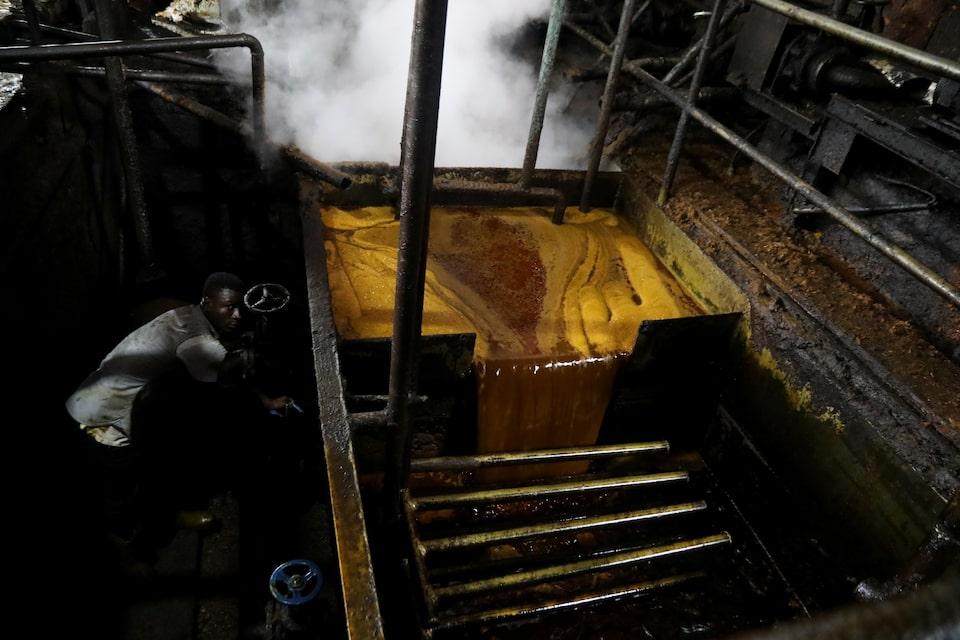
Palm oil production growth plummets to 1% from 7% Indonesia boosts biodiesel consumption, curbs exports Palm oil prices surge past soyoil amid tight supplies Biofuel demand to drive up vegoil prices KUALA LUMPUR/JAKARTA, March 10 (Reuters) - Prices of cooking oil could be buoyed up for years by stagnating production and a biodiesel push in top producer Indonesia that are making traditionally cheap palm oil costlier, eliminating an advantage that also curbed prices of rival oils. Used in everything from cakes and frying fats to cosmetics and cleaning products, palm oil makes up more than half of global vegetable oil shipments and is especially popular among consumers in emerging markets, led by India. After decades of cheap palm oil, thanks to booming output and a battle for market share, output is slowing and Indonesia is using more to make biodiesel, respected industry analyst Dorab Mistry said. "Those days of $400-per-ton discounts are gone," added Mistry, a director of Indian consumer goods company Godrej International. "Palm oil won't be that cheap again as long as Indonesia keeps prioritising biodiesel." Indonesia increased the mandatory mix of palm oil in biodiesel to 40% this year, and is studying moving to 50% in 2026, as well as a 3% blend for jet fuel next year, as it seeks to curb fuel imports. The biodiesel push will reduce Indonesia's exports to just 20 million metric tons in 2030, down a third from 29.5 million in 2024, estimates Eddy Martono, chairman of the southeast Asian nation's largest palm oil association, GAPKI. Jakarta's biodiesel mandate, coupled with lower production because of floods in neighbouring Malaysia, has already lifted palm oil prices above rival soyoil, prompting buyers to cut purchases. In India, the largest buyer of vegetable oils, crude palm oil (CPO) has commanded a premium over crude soybean oil for the past six months, sometimes exceeding $100 per ton. As recently as late 2022, palm oil traded at discounts of more than $400. Indians were paying $1,185 a ton for crude palm oil last week, up from less than $500 in 2019. Higher vegetable oil prices could complicate governments' efforts to rein in inflation, whether in palm oil-reliant nations or those dependent on rival soybean, sunflower, and rapeseed oils. STUNTED GROWTH Palm oil production, dominated by Indonesia and Malaysia, nearly doubled every decade from 1980 to 2020, fuelling criticism over deforestation to add plantations. During that time, average annual production growth of more than 7% was roughly in line with demand. But Malaysia's palm oil production stagnated more than a decade ago because of lack of space for new plantations and slow replanting, while deforestation concerns have slowed growth in Indonesia. Even in Indonesia, replanting by smallholders, who generate 40% of its supply, remains sluggish. As a result, global production growth has slowed to 1% annually over the past four years. In the current decade, production growth is likely to average 1.3 million tons a year, said analyst Thomas Mielke, executive director of Hamburg-based forecaster Oil World, less than half the average of 2.9 million in the decade to 2020. Production could lose even more momentum from the impact of labour shortages, ageing plantations and the spread of Ganoderma fungus, which is hurting yields, Mielke said. REPLANTING RELUCTANCE Oil palms, which start losing productivity after 20 years, need to be replaced after 25 years, with new trees taking three to four years to yield fruit, rendering land unproductive until then and making farmers reluctant to replant. Malaysia replanted 114,000 hectares (282,000 acres), or just 2% of total planted area in 2024, against a target of 4% to 5%, Plantation Minister Johari Abdul Ghani said in February. In Indonesia, slow replanting has brought lower yields amid as plantations get older, said GAPKI official Fadhil Hasan. Its yields of crude palm oil fell 11.4% to 3.42 tons per hectare in a decade. While countries from Colombia and Ecuador to Ivory Coast and Nigeria have boosted palm oil output, industry officials say growth among newer players falls short of rising demand, particularly for biofuel. Both Mistry and Mielke called for Indonesia to resume issuing new permits for palm oil plantations, a practice it halted in 2018. "If Indonesia keeps the moratorium on new planting, there will be periodic shortages and spells of very high palm oil prices," said Mistry. The restricted production that resulted would inflict higher prices on 3 billion to 4 billion consumers in the developing world, he added. Demand is already softening in key markets thanks to rising prices, and even industrial buyers are seeking alternatives, SD Guthrie International (SDGU.KL) , opens new tab CEO Shariman Alwani Mohamed Nordin told an industry conference in February. Still, palm oil consumption will keep surging, fuelled by demand from chemicals and biofuel, industry officials say. "We see huge demand increase happening for palm oil and with the limited land, we feel, there would be demand and supply imbalance," said Harish Harlani, vice-president at P&G Chemicals. Higher palm oil prices could ripple out to boost those of rival oils as demand shifts, said Sanjeev Asthana, CEO of India's Patanjali Foods Ltd (PAFO.NS) , opens new tab. "As buyers switch to soy and sunflower, their prices shoot up too," he added. "Plus, there's only so much of those oils available, so they can't completely take palm oil's place." Sign up here. https://www.reuters.com/markets/commodities/end-cheap-palm-oil-output-stalls-biodiesel-demand-surges-2025-03-09/
2025-03-09 23:01
March 10 (Reuters) - Mining conglomerate BHP (BHP.AX) , opens new tab has taken a right to acquire a 75% stake in Australia's Cobre's (CBE.AX) , opens new tab Kitlanya projects in Botswana in exchange for $25 million in funding for exploration activities, the copper explorer said on Monday. The deal follows Cobre's selection in BHP's Xplor program in January last year in which the smaller rival received $500,000 to accelerate exploration plans in its Kalahari copper projects in the African nation. The agreement sees at least $5 million of committed funding to be paid to Cobre within two years of its commencement date, with a planned budget of $7 million for exploration expenditure starting next month. "The partnership with BHP will provide us with the funding and support necessary to implement a technology-driven work programme designed to discover the Tier 1 deposits we believe may be hosted in our Kitlanya East and West projects," Cobre Chief Executive Adam Woolridge said. Sign up here. https://www.reuters.com/markets/commodities/bhp-earns-right-take-75-stake-cobres-botswana-projects-2025-03-09/
2025-03-09 22:45
Veterans Department to start mass layoffs as early as June Sweeping spending restrictions being felt across government Second round of cuts at NOAA would reduce agency headcount by 20% this year WASHINGTON, March 9 (Reuters) - The U.S. government agency that provides weather forecasts is planning another round of mass layoffs as part of President Donald Trump's plan to thin the ranks of the U.S. civil service, a person familiar with the plan said on Sunday. The planned layoffs of 1,029 workers at the National Oceanic and Atmospheric Administration follow 1,300 who have already been fired from the agency, which also conducts climate research and other scientific tasks. The two rounds of layoffs and a buyout program will shrink the agency's headcount by roughly 20% since the start of the year. The planned cuts were first reported by the New York Times and CBS. All U.S. government agencies have been ordered to come up with layoff plans by March 13 as part of President Donald Trump's unprecedented campaign to overhaul the government. Scientists and researchers have been warning that layoffs at NOAA will put American lives at risk and stifle crucial climate research. Layoff plans at other agencies have raised alarms as well. Veterans groups, Democrats and some Republicans warn that healthcare and other services for veterans could be compromised by planned reductions at the politically sensitive Department of Veterans Affairs, which is seeking to cut more than 80,000 workers. The agency will begin those layoffs as early as June, according to a memo reviewed by Reuters. The VA responded to a request for comment by sending a link to VA Secretary Doug Collins' recent opinion piece , opens new tab in The Hill in which he defended the cuts as "thorough and thoughtful." The cost-cutting campaign by Trump and his adviser Elon Musk, the world's richest person, in its first phase has already pushed more than 100,000 people out of the 2.3 million-member federal civilian workforce. Agencies including the VA - which provides healthcare and other services to roughly 15.8 million U.S. veterans - are planning a second wave of cuts. Even by the standard of Musk-driven cuts elsewhere, the scale of the layoffs at the VA is particularly deep and will hit a department that looks after a group that typically garners wide bipartisan support in the U.S., its military veterans. While there is bipartisan agreement that the federal government needs to be more efficient, Musk's campaign has drawn criticism. Some 57% of respondents to a Reuters/Ipsos poll last week said they oppose the idea of firing tens of thousands of federal workers. Federal workers are facing sharp restrictions on spending, including weeks-long bans on purchasing basic office supplies. At U.S. Citizenship and Immigration Services, at least some workers were ordered to stop using government "purchase cards" used to buy equipment and pay for other expenses for 30 days, with limits reduced to $1, according to an agency email reviewed by Reuters. The Department of Homeland Security, which oversees immigration, did not immediately respond to a request for comment. Sign up here. https://www.reuters.com/world/us/memo-says-mass-layoffs-veterans-affairs-will-begin-early-june-2025-03-09/

2025-03-09 22:28
March 9 (Reuters) - Bitcoin, the world's largest cryptocurrency by market value, was down by around 5.47% at $81,555 at 2216 GMT on Sunday. Ether, the second largest cryptocurrency, was down 5.4% at $2,024.68 at 2222 GMT on Sunday. Sign up here. https://www.reuters.com/technology/bitcoin-down-547-8155467-2025-03-09/

2025-03-09 21:03
NAPERVILLE, Illinois, March 9 (Reuters) - An imminent trade war between the United States and its two largest agricultural trading partners sent bullish Chicago corn speculators running for the hills last week. But very few bears were made of the ordeal. On Thursday, U.S. tariffs against most Mexican and Canadian goods were postponed until April. However, the levies had gone into effect on Tuesday and the market reaction was harsh, especially with Mexico the top destination for U.S. corn. Most-active CBOT corn futures plunged 8.6% in the week ended March 4, their biggest such downturn since mid-2023. Money managers during the week slashed their net long in CBOT corn futures and options to 219,752 contracts from 337,454 a week prior. Weekly net corn selling near 118,000 contracts was the second-largest ever, behind the 147,000 contracts sold during the week ended February 28, 2023. But last week's reduction in gross longs, which exceeded 100,000 contracts, was by far a record. On average, funds' biggest net selling weeks in corn are somewhat evenly split between exiting longs and new short positions. An unusually low 11% of last week's move owed to new gross shorts, suggesting that the selloff was more risk-off in nature rather than a genuinely bearish vote. In the periphery of the week's events, the U.S. Department of Agriculture predicted strong 2025 U.S. corn plantings and thus a recovery in domestic supplies, though that had been largely expected. South American corn crop outlooks have also recently improved. But accessible global corn supplies are historically thin, especially in Brazil where stocks are the lightest in over two decades. Demand has persevered in the meantime, pushing investors to build their bullish corn stance after forging a record bearish one last year. SOYBEANS AND WHEAT Speculators were also hefty net sellers in wheat and the soy complex during the week ended March 4, but unlike in corn, new short positions drove these moves. Money managers ditched their net long in CBOT soybean futures and options, flipping to a net short of 35,487 contracts versus a net long of 8,209 in the prior week. Funds' bullish stint in beans lasted just seven weeks, and net selling in the latest week was the strongest since last June. Most-active CBOT soybeans fell nearly 5% through March 4, while soymeal eased 3% and soyoil plunged 7%. Funds erased much of their net long in CBOT soybean oil futures and options, which dropped to 9,669 contracts from 43,052 a week earlier. Their net short in soybean meal futures and options reached a 10-week high of 85,344 contracts versus 63,193 in the week before, almost entirely the result of new gross shorts. In CBOT wheat futures and options, the entrance of new gross shorts was the heaviest for any week since 2017. Money managers also added a handful of gross longs, though the net short grew to 82,399 contracts from 67,614 a week earlier. So far this year, funds' bearish wheat bets and bullish corn bets have been historically out of sync, though last week's epic corn selloff pulled things closer to normal territory. However, corn futures rallied nearly 4% over the last three sessions with the delay of U.S. tariffs on Mexico and Canada. Other gains were as follows: soybeans 2.6%, wheat 2.7%, soymeal 3.7% and soyoil 1.4%. This week, the trade will be watching for the U.S. Department of Agriculture's monthly supply and demand report due on Tuesday. Large changes are not anticipated, though the agency could factor tariff impacts into its estimates if deemed necessary. Karen Braun is a market analyst for Reuters. Views expressed above are her own. Sign up here. https://www.reuters.com/markets/us/spooked-by-tariffs-funds-purge-bullish-corn-bets-near-record-fashion-braun-2025-03-09/