2025-03-03 12:35
A look at the day ahead in U.S. and global markets from Mike Dolan. We've revamped Morning Bid U.S. to offer you more in-depth markets analysis and commentary. Mike Dolan will help you make sense of the key trends shaping global markets each day. World markets are entering March with Friday's alarming Oval Office row reverberating on both sides of the Atlantic, raising more questions about increasingly unpredictable geopolitics just as investors are also turning anxious about a potential economic slowdown. Tuesday's U.S. tariff deadline, labor market updates and China's National People's Congress will all jockey for attention this week. But I'll delve into the European Central Bank's likely interest rate cut on Thursday for today's spotlight. TODAY'S MARKET MINUTE ECB MAY FEAR STUMBLING INTO STIMULUS Few doubt the European Central Bank will cut interest rates again this Thursday, but there are fears in the ECB ranks that easing much further after that may see it inadvertently stumble into stimulative territory before inflation has been licked. And pity the poor central banker trying to work it out. Much like its peers around the world, the ECB is due to review policy again and issue a series of long-term forecasts even though it barely knows what the economic or political backdrop will be next month. Uncertainty about potential U.S. tariffs, the identity of the new German government, the fate of Ukraine and a likely new public spending boost to re-arm the continent are all fogging up ECB eyeglasses considerably. As it would probably admit itself, staff forecasts at this juncture are little more than a finger in the wind. Further complicating things is the fact that several critical macroeconomic inputs used to assess the ECB's inflation outlook have been swinging back and forth wildly this year. Take European natural gas prices . From the middle of January, they rocketed about 30% higher, only to reverse all that by the middle of last month. As Rabobank economists note, the ECB likely sealed its new macroeconomic projections when gas prices were at a peak in the middle of February - embedding gains of some 140% year-on-year as opposed to 85% now. R-STAR WARS The macro mist simply forces the central bank to seek other lodestars to guide its policy deliberations, and hence its recent obsession with the much-maligned and nebulous 'neutral' interest rate concept. So-called R*, the interest rate present when an economy is at full employment with stable inflation, is highly dependent on model assumption and impossible to identify in real time. But this theoretical figure at least offers policymakers some idea of whether existing policy is restrictive or stimulative. There's little doubt among ECB members that current rates are now above that neutral rate and still 'restrictive', which is why there is likely to be agreement on another cut this week. But the hawks among them may make a stout defense for more caution from April onwards, pointing to the slipperiness of R*. Helpful or not, ECB economists , opens new tab last month took another stab at capturing this elusive beast and put the policy rate associated with the real R* in a 1.75%-2.25% range. The centrepoint of that is roughly where most policymakers had assumed R* to be. But the range is quite important for financial markets, as the two ends of the range represent the difference between four more cuts or just two from today's 2.75% deposit rate. ECB board hawk Isabel Schnabel's , opens new tab typically detailed and data-packed speech in London last week laid out a case for being wary of excessive easing due to the elusiveness of the enigmatic R*. The gist of her talk was that incoming lending data had cast doubt on how tight ECB policy actually is, meaning continual easing to address structural GDP weakness may be misguided. And she concluded that uncertainty about just how high R* had risen of late meant there was a risk that the central bank would unintentionally lapse into stimulative monetary policy. "The fact that growth remains subdued cannot and should not be taken as evidence that policy is restrictive." Even though Schnabel believes R* is still below levels seen before the banking crash 17 years ago, she said it had increased "appreciably" since before the pandemic and again since the 2022 Ukraine invasion - perhaps more than market prices suggest. That, she said, was related to geopolitical supply shocks, rising public debt and withdrawal of central banks from bond markets as they reduced their balance sheets. If she's right, then the ECB may need to tread very carefully after this next cut. Especially if she's correct that higher public debt is a significant factor in the R* debate, as there's little doubt that's about to ratchet higher if Europe truly does re-arm. The doves will fight back, of course, but the central banking battle lines are being drawn. CHART OF THE DAY After a sweep of soft U.S. economic indicators in February, the Atlanta Federal Reserve's closely watched "GDPNow" model updated on Friday to show an alarming 1.48% contraction of the economy. This was partly driven by a widening U.S. trade deficit, likely reflecting firms frontloading imports to beat planned tariff rises. But it's the first negative GDP print from the model since the Fed's rapid interest rate rises in 2022. While imports and weather-related distortions mean some may dismiss this red flag, waning business and consumer confidence - and the very real impact of tariffs hikes and government job cuts - should keep this signal on market radars. TODAY'S EVENTS TO WATCH Opinions expressed are those of the author. They do not reflect the views of Reuters News, which, under the Trust Principles , opens new tab, is committed to integrity, independence, and freedom from bias. Sign up here. https://www.reuters.com/markets/us/global-markets-view-usa-2025-03-03/

2025-03-03 12:22
HONG KONG, March 3 (Reuters) - China's customs on Monday announced that it would suspend the import of beef products from six factories in Brazil, Argentina, Uruguay. China's commerce ministry has launched an investigation into beef imports in December, as the world's biggest meat importer and consumer grapples with an over-supplied market that has sent domestic prices to multi-year lows. Sign up here. https://www.reuters.com/markets/commodities/chinas-customs-suspends-import-beef-products-brazil-argentina-uruguay-2025-03-03/
2025-03-03 12:15
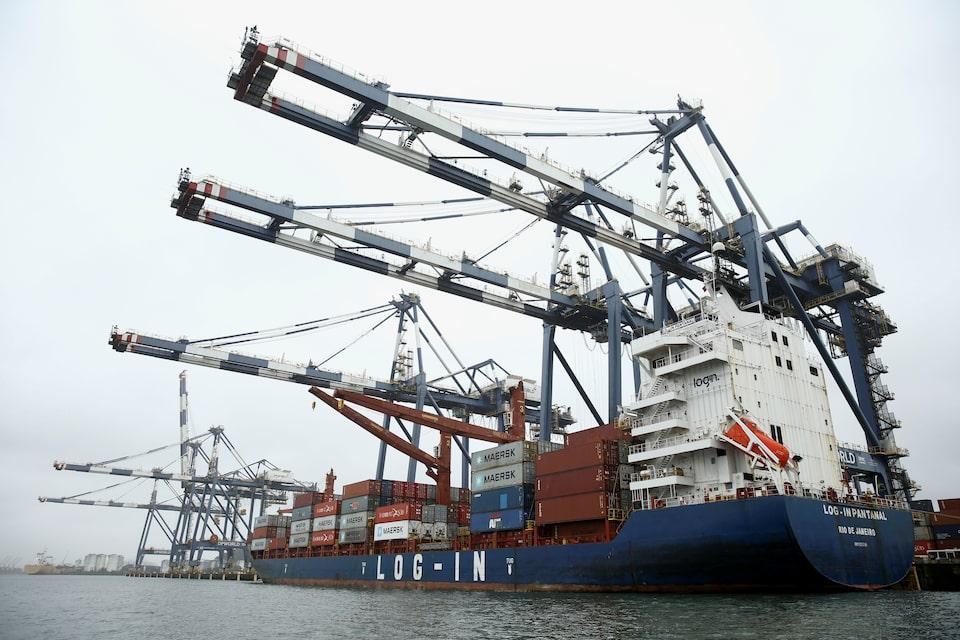
South America's exports to China driven by commodities boom China is welcomed as a pragmatic partner ready to do business Even Trump ally Milei sees trade with China as crucial for Argentina BUENOS AIRES/BRASILIA/BEIJING/WASHINGTON, March 3 (Reuters) - Argentina's libertarian President Javier Milei came to office in late 2023 slamming China as a communist "assassin" and threatening to weaken ties with the Asian nation. Instead, exports to China including soy and lithium jumped 15% in his first year. The pragmatic U-turn by a natural U.S. ally underscores a challenge for President Donald Trump in resource-rich South America, where booming commerce in recent years has boosted China's influence. Trump is looking to shake up global trade and get partners to promote U.S. interests using threats and trade tariffs. He has already pushed for concessions from Colombia, Panama and Mexico, while Brazil is in the crosshairs of new trade tariffs on steel. Proposed 25% tariffs on Mexican and Canadian goods are due to take effect on Tuesday, with an extra 10% duty on Chinese goods. But around South America, half a dozen officials, diplomats and trade experts said that China's huge and growing trade lead dulled the impact of Trump's measures - a warning sign of the potential limits more broadly of a punitive approach in a world where the United States has a growing number of economic rivals. A senior Brazilian diplomat close to leftist President Luiz Inácio 'Lula' da Silva said Brazil's economy was not dependent on the United States, citing the country's $30 billion trade surplus with China last year as far more economically important. He said Trump's trade tariff threats - coming after years of "neglect" from the United States - would push countries to look for less risky alternatives like China, Europe or the BRICS group including Brazil, Russia, India, China and South Africa. Beijing, meanwhile, was "a pragmatic partner," and the Chinese "come here to do business." Driven by commodities giants Brazil, Chile, Peru and Argentina, South America's exports to China have more than doubled in the past decade, while shipments to the United States have only inched up, a Reuters analysis of trade data show. That's made China's huge market invaluable for regional leaders grappling with slow growth and high indebtedness, and strengthened Beijing's soft power in the region, even with governments not ideologically aligned. 'BULLY IN THE NEIGHBORHOOD' U.S. Secretary of State Marco Rubio in comments in late January dismissed the risk of pushing South American countries like Colombia more towards China as "absurd", pointing to quick wins the administration has scored. Tariff threats brought Mexico to the negotiation table on trade and to commit troops to reinforce the border, while a pledge to take the key Panama Canal trade route by force got that country to exit China's Belt and Road infrastructure plan. Colombia and the United States struck a deal after a block on deportation flights took the pair to the brink of a trade war. Ryan Berg, a director at bipartisan Washington think-tank the Center for Strategic and International Studies, said Trump was actually giving Latin America more attention, with Spanish-speaking Rubio going there on his first overseas trip. But a balance between neglect and threat was needed. The U.S. State Department did not immediately respond to a Reuters request for comment. Congressman Raja Krishnamoorthi, Democratic ranking member of the House select committee on China, told Reuters Washington should avoid becoming "the bully in the neighborhood." "Because, you know what happens to bullies. People stand up to bullies," he said. "And they do so in ways that could be very detrimental to our long-term national security interests." BOOMING COMMODITIES EXPORTS Across South America, China's trade lead has widened, driven by grains and key electrification metals copper and lithium. Washington remains ahead in Central America, but its lead has been trimmed. A decade ago, copper giant Peru's largest trade partner was the United States. Now it is China, by far. The Asian country gobbles up Peru's supply of copper and has built a massive port on the country's coast to turbo-charge bilateral trade. "The impact for Peru would be minimal," said Peru's former economy minister José Arista referring to potential U.S. trade tariffs. He cited Peru's free trade agreement with the United States and the make-up of the Andean country's exports. Even in Argentina where libertarian Milei is a staunch U.S. ally, China's draw is clear. China is the top market for Argentine soybeans and beef, while it bought almost a third of the country's lithium exports last year. A close adviser to Milei said late last year that the South American country had no problem working with China if it was in Argentina's best interests. Colombia does have far closer trade ties with the United States but elevated diplomatic relations with China to a "strategic partnership" at the end of 2023. Panama, meanwhile, saw exports to China surge far above those to the United States between 2021-2023 before a key copper mine closure led to a sharp drop off last year. Tensions are still simmering with United States over the canal. 'A GIFT TO THE CHINESE' China has natural advantages as a trade partner for South America, despite the historical closeness and cultural overlap between the United States and its southern neighbors. The relationship is not clouded by challenges over migration flows, crime or narcotics, while China's developmental stage means it naturally needs more of the commodities South America has to offer. The Chinese foreign ministry, in a rare rebuke of Washington's policies in the region after Rubio's Latin America trip, issued a statement criticizing the United States for sowing "discord" between China and Latin American countries and pointed to an "irreversible" trend in deeper cooperation between the region and China. Li Xing, a professor at the Guangdong Institute for International Strategies, said Trump's tough approach would benefit China as it would make countries hedge their bets "The moment there is chaos among (U.S.) allies, that's good for China," he told Reuters. Sign up here. https://www.reuters.com/world/chinas-trade-dominance-south-america-tempers-trumps-influence-2025-03-03/
2025-03-03 12:11
March 3 (Reuters) - Saudi Aramco (2222.SE) , opens new tab and Algeria's Sonatrach have cut March's official selling prices (OSPs) for liquefied petroleum gas (LPG) by 0.9-3.2% from the previous month because of lower oil prices and weak global LPG demand, traders said on Monday. Aramco's March OSP for propane was cut by $20 to $615 a metric ton while butane prices were dropped by $20 to $605 a ton , the traders said. Propane and butane are types of LPG with different boiling points. LPG is used mainly as fuel for cars and heating as well as a feedstock for other petrochemicals. Sonatrach cut its March OSP for propane by $5 to $560 a ton and for butane by $15 to $585 a ton , traders said. Aramco's OSPs are used as a reference for contracts to supply LPG from the Middle East to the Asia-Pacific region. Sonatrach's OSPs are used as benchmarks for the Mediterranean and Black Sea region, including Turkey. Sign up here. https://www.reuters.com/business/energy/sonatrach-saudi-aramco-cut-march-lpg-prices-by-1-3-2025-03-03/

2025-03-03 12:00
WARSAW/GDANSK, March 3 (Reuters) - Polish refiner Orlen (PKN.WA) , opens new tab and Norway's Equinor (EQNR.OL) , opens new tab signed on Monday a memorandum of understanding (MoU) on the development of carbon capture and storage (CCS) projects. The documents were signed by Irene Rummelhoff - Executive Vice President at Equinor, and Wieslaw Prugar, Orlen management board member in charge of upstream. Under the memorandum, Orlen and Equinor will jointly identify potential carbon dioxide storage sites in Poland, considering both onshore areas and the Polish sector of the Baltic Sea, Orlen said in a statement. "We hope we can jointly develop a CCS value chain", Rummelhoff told a news briefing in Warsaw, adding, "We believe there are geological formations suitable for carbon dioxide storage, and we eagerly await Polish regulations on CCS storage." "We have a lot of potential in carbon dioxide storage. We could jointly work on the Norwegian Continental Shelf but also in Poland." said Prugar. In its new strategy, Orlen has said that it aims to reach the capacity to capture, transport, and store 4 million metric tons of carbon dioxide annually by 2035. Sign up here. https://www.reuters.com/business/energy/orlen-equinor-agree-develop-carbon-capture-projects-2025-03-03/

2025-03-03 11:56
LONDON, March 3 (Reuters) - British homebuyers borrowed the most in new mortgages since September 2022 in January, while approvals for new lending dropped less than expected ahead of the end of a tax break on property purchases, according to Bank of England data on Monday. Net mortgage lending rose to 4.207 billion pounds ($5.31 billion) in January from 3.343 billion in December, the highest since September 2022 when the economic plans of former prime minister Liz Truss sparked turmoil in bond and mortgage markets. January's lending was well above economists' expectations in a Reuters poll for 3.55 billion pounds of new lending. Mortgage approvals for house purchase - a leading indicator for lending - dropped to 66,189 from 66,505 in December, a smaller decline than the fall to 65,650 expected in a poll. The end this month of a temporary reduction in stamp duty land tax for first-time home buyers and for buyers of less expensive houses is likely to have boosted activity. "Lower mortgage interest rates, rising real wages and a rush to beat changes to Stamp Duty in April supported net new mortgage approvals for house purchase in January," Rob Wood, chief UK economist at Pantheon Macroeconomics, said. "But the rush to beat stamp duty changes seems to have peaked, so approvals will likely slow in the next few months." Some measures of Britain's housing market, including house price data from mortgage lender Nationwide and the Royal Institution of Chartered Surveyors, have shown house prices picking up. Other BoE data released at the same time chimed with official retail sales figures that had pointed to a pick-up in consumer demand in January against a subdued broader backdrop. The BoE's data showed annual consumer credit growth slowed to 6.4% in January from 6.5% in December, the lowest since May 2022. But consumer credit jumped in cash terms by a net 1.740 billion pounds in January from 1.062 billion pounds in December - the biggest increase in a year and above the Reuters poll consensus for a 1.2 billion pound rise. ($1 = 0.7928 pounds) Sign up here. https://www.reuters.com/world/uk/uk-net-mortgage-borrowing-rises-by-most-since-september-2022-2025-03-03/