2025-02-14 00:12
BENGALURU, Feb 14 (Reuters) - Easing inflation has opened the door for the Reserve Bank of Australia to begin an anticipated brief series of interest rate cuts, starting with a quarter point reduction to 4.10% on Tuesday, according to most economists in a Reuters poll. This would be the RBA's first rate cut in over four years, joining a rate-cutting cycle other major central banks started last year and that the U.S. Federal Reserve has already put on pause over inflation concerns. Inflation in Australia fell to 2.4% last quarter, well within the RBA's 2-3% target band, nudging several economists to bring forward their rate cut expectations from the April-June quarter to February 18. A slight dip in economic growth and easing inflation lessens the need for policymakers to maintain rates in restrictive territory for longer, economists say. While moderating inflation aligns with one part of the RBA's mandate, the strength in the labour market and steadfast wage inflation diminish the need for the RBA to move aggressively. A robust housing market is also in no need of lower rates. Over 90% of economists, 40 of 43, in the February 6-13 poll expected the RBA to cut its official cash rate (AUCBIR=ECI) , opens new tab by 25 basis points to 4.10% at the end of its two-day policy meeting on February 18. The remaining three predicted rates to stay unchanged. In a January poll, just over 40% had forecast the RBA to cut on Tuesday. Interest rate futures are pricing in a near-80% probability of that happening. "The prudent action for the RBA now would be to cut, but cut slowly and just see how data evolves through time. The worst thing they could possibly do is cut hard and then have to reverse. That's the clear risk case for them," said Craig Vardy, head of fixed income, BlackRock Australasia. All major local banks, ANZ, CBA, NAB, and Westpac expect a 25 basis point cut on Tuesday and predict 50-100 basis points of cumulative rate cuts this year. Over 75% of respondents who had a long-term view, 31 of 41, forecast another quarter-point cut in the April-June quarter, taking rates to 3.85%. According to median forecasts, the interest rate will drop to 3.60% by end-September. This is projected to be followed by an extended pause lasting until at least early 2026, resulting in a total of 75 basis points worth of rate cuts in this cycle. "They've pretty much got the green light to go from an inflation standpoint," said Vardy. "We think probably three rate cuts perhaps this year and the risk is we only get two. But getting towards a 3-1/2% nominal neutral level - that's probably where they'll end up." That was much less than the expected 250 and 150 basis points of rate cuts in total from the Reserve Bank of New Zealand and the U.S. Federal Reserve, respectively, since they started cutting last year. "If we've got a labour market that's maybe tightening and we've got consumer spending starting to pick up which points to a faster pace of economic growth, the RBA has to be really careful that they don't cut too far, too fast because then they perhaps run the risk of stimulating inflation again," said Ben Picton, senior strategist at Rabobank. Inflation is predicted to average 2.8% this year and the economy is forecast to grow 2.0%, according to a separate Reuters poll. (Other stories from the February Reuters global economic poll) Sign up here. https://www.reuters.com/markets/rba-deliver-first-rate-cut-short-series-february-18-2025-02-14/
2025-02-13 23:43
NAPERVILLE, Illinois, Feb 13 (Reuters) - Relative to demand, world corn stocks later this year are predicted to hit 11-year lows. But when considering corn supplies actually accessible to the global market, the milestone is closer to three decades. On-and-off grain importer China has an extraordinary amount of corn in storage, more than five times that of the United States, the No. 2 corn stockpiler. As such, China is sometimes excluded from world grain balances to obtain a more realistic view of available supplies. After subtracting China, estimates from the U.S. Department of Agriculture show 2024-25 world corn ending stocks at a 12-year low of about 87 million metric tons. Supplies are even tighter when measured against demand. In 2024-25, world corn stocks-to-use sans China is pegged at 7.8%, the lowest ratio since 1995-96. That compares with a four-year average of 9.2% and a 20-year average of 11%. Corn supplies in No. 2 exporter Brazil are predicted at the lowest levels in more than two decades, and Ukrainian and European Union stocks are the thinnest in over a decade. U.S. inventory is now seen as modest versus prior expectations for ample volumes. Things are still somewhat snug even when adding back China. USDA’s figures imply full world corn stocks-to-use in 2024-25 at 20.3%, the lowest since 2013-14. That compares with a decade average of 24.6% and a low within that period of 22.2%. Stocks-to-use throughout most of the 2000s and early 2010s was notably lower, usually below 15%. That might make the current situation appear a bit less extreme, but a glance at Chinese stocks perhaps explains the difference. CHINA CONUNDRUM In the mid-2000s, China accounted for around 30% of global corn ending stocks, though that surged in the early 2010s as the country incentivized increasing production. China’s share of global corn stocks has been above 60% over the last decade, and according to USDA will reach a 28-year high of 70% in 2024-25. In 2008, Beijing began a government corn stockpiling program, paying farmers above-market rates for their crops. This ended in 2016 amid sky-high costs for the government, which was keeping domestic prices well above global ones, unintentionally encouraging imports. China has continued to subsidize corn farmers and output has grown even further, hence the large stockpiles. Excluding China from global grain analyses might be controversial because the original premise lies in the country’s minimal involvement in global trade. Although it has backed off significantly this year, China has been the world’s No. 1 corn importer within the last five years. However, China’s corn imports in the last few years have accounted for about 7% of its annual corn consumption, extremely light versus other top importers. Nearly 100% of Japan and South Korea’s corn use comes from imports, and Mexico’s rate has climbed above 50%. This statistic plus China’s enormous share of world stocks defends the exclusion of China from global corn balance sheets, but its sometimes-importer status means that both calculations are worthwhile. U.S. STOCKPILES Corn stocks in the United States, the leading exporter, will be thinner than originally assumed. But the situation is not as rare as the global one. USDA figures peg 2024-25 U.S. corn stocks-to-use at 10.2%, below the year-ago 11.8% and the decade average of 12.5% but slightly above the levels of the early 2020s. In mid-2024, the 2024-25 ratio was forecast above 14%, but strong demand plus a smaller crop pared inventory. This helped propel large speculators into their currently massive bullish bets on Chicago corn futures. However, corn bulls know that U.S. farmers are ready and willing to boost supplies by planting a potentially huge area this spring. Although an inherently bearish force, plentiful corn supplies are what allow the United States to dominate the global export market and provide for customers like China, should it ever resume the interest. Karen Braun is a market analyst for Reuters. Views expressed above are her own. Sign up here. https://www.reuters.com/markets/commodities/effective-global-corn-supplies-heading-29-year-lows-braun-2025-02-13/
2025-02-13 23:37
Silveira calls U.S. ethanol tariff unreasonable Trump's plan could lead to higher tariffs by April BRASILIA/SAO PAULO, Feb 13 (Reuters) - Brazil's Energy and Mining Minister Alexandre Silveira said on Thursday that a potential U.S. tariff on Brazilian ethanol would be unreasonable, emphasizing that the two countries have historically negotiated ethanol and sugar trade together. His remarks came after U.S. President Donald Trump moved to scrap decades-old low tariff rates, raising them to match those of other countries. A White House fact sheet on the plan pointed to Brazil's ethanol tariffs as an example of unfair trade practices. "The U.S. tariff on ethanol is a mere 2.5%, yet Brazil charges U.S. ethanol exports an 18% tariff. As a result, in 2024, the U.S. imported over $200 million in ethanol from Brazil while exporting only $52 million in ethanol to Brazil," the document said on Thursday. Silveira argued that for Trump's plan to be fair and reciprocal, as the Republican advocates, the world's largest economy would need to eliminate import tariffs on Brazilian sugar. "The measure adopted by President Trump is unreasonable, as there is no mention of allowing greater Brazilian sugar exports to the U.S.," he said in a statement. Trump's announcement has no immediate impact but could result in higher tariffs for major trading partners by early April, sparking negotiations with dozens of countries to reduce tariffs and trade barriers. Brazilian Finance Minister Fernando Haddad said on Thursday he saw potential for tariff negotiations with the U.S. Brazil, one of the world's largest sugar producers, produced some 35 billion liters of ethanol in 2024, but exported less than 6%, of which only some 300 million liters went to U.S., a report from BTG Pactual showed. Meanwhile, Brazil imported 192 million liters of ethanol in 2024, 109 million of which came from the U.S., according to BTG Pactual, noting most of U.S. ethanol comes from corn, while sugar-based ethanol still holds the lead in Brazil. In the statement, Silveira argued the U.S. imposes a $360-per-tonne tariff on sugar imports outside preferential quotas, equating to an 81.2% tax considering current market prices - far higher than Brazil's 18% ethanol tariff. He noted U.S.-set sugar import quota for Brazil last harvest was 147,540 tonnes, or about 0.4% of total sugar exports from Latin America's largest economy. "For a long time now... Brazil has not been able to export sugar to the United States, except in small quotas, because their tariffs make exportation unfeasible," the head of Brazil sugar and ethanol lobby group Unica, Evandro Gussi, told Reuters. On the other hand, in a statement, U.S. Renewable Fuels Association, an ethanol trade group, thanked Trump "for his commitment to reestablishing a fair and reciprocal ethanol trading relationship with Brazil." Sign up here. https://www.reuters.com/markets/commodities/brazil-says-us-ethanol-tariff-would-be-unreasonable-calls-sugar-talks-2025-02-13/

2025-02-13 23:12
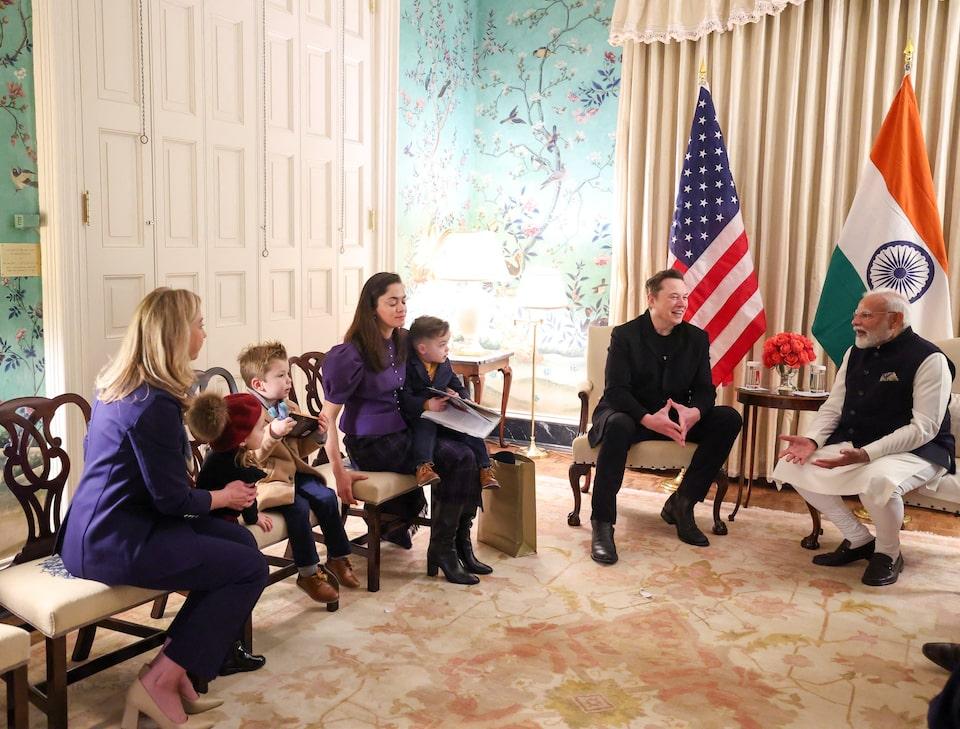
Feb 13 (Reuters) - Indian Prime Minister Narendra Modi met with Tesla (TSLA.O) , opens new tab CEO Elon Musk on Thursday in Washington where they discussed issues including space, mobility, technology and innovation, Modi said on X. "Their discussion also touched on opportunities to deepen cooperation in emerging technologies, entrepreneurship and good governance," India's foreign ministry said separately in a statement. On Wednesday, Reuters reported that Modi was slated to meet Musk, CEO and founder of SpaceX, during his trip this week to the United States, and Starlink's entry in the South Asian market could come up for discussion. SpaceX's Starlink has long wanted to launch in India and has in recent months clashed with billionaire Mukesh Ambani's company over how the country should grant spectrum for satellite services. India's government has sided with Musk that spectrum should be assigned and not auctioned, but Starlink's license application is still under review. India's looming decision on U.S.-based Starlink has shaken the country's domestic satellite internet sector and made its regulatory strategy on space-based communications a key issue in the country's push to stimulate commercial space activities and become a competitive force in the global space race. Musk, a "special government employee" helming a disruptive effort to rid federal agencies of excessive spending, often serves as a key link between heads of state and SpaceX, which has dominated the global space industry with its vast Starlink network and its Falcon 9 launches that much of the Western world uses for space access. Big decisions on technology and space matters have followed state visits by Modi in the past. India in 2023 signed the U.S. Artemis Accords - a set of guidelines for modern space and moon activities - following meetings in Washington between Modi and former U.S. president Joe Biden. Modi is also expected to meet U.S. President Donald Trump during his two-day U.S. visit, with discussions on trade and tariff concessions expected to be high on the agenda. He is, however, unlikely to meet other business CEOs during the trip, sources told Reuters on Wednesday. Musk's meeting with Modi drew the ire of some Democrats who say the billionaire executive's influential role in the Trump administration poses conflicts of interest. "Musk is effectively operating as the Secretary of State, and he is meeting with a key foreign leader not to ask for concessions that would benefit Americans, but for concessions that would make him rich," Democratic Senator Chris Murphy, a member of the Senate Foreign Relations Committee, said of Musk's Modi talks in a post on X. Given Musk's many powerful roles, it was unclear in what capacity he held his meeting with Modi. "I would imagine he met possibly, because you know he's running a company," Trump told reporters on Thursday. Asked if Modi was meeting with Musk as a CEO or a representative of the U.S. government, Trump said: "Well, he's meeting with me in a little while, so I'm going to ask him that question." Sign up here. https://www.reuters.com/world/indias-modi-holds-meeting-with-billionaire-tesla-ceo-musk-2025-02-13/
2025-02-13 23:04
Cyclone Zelia makes landfall Lashes coast with heavy rain and wind gusts up to 290 kph BHP, Rio Tinto, Fortescue pause port operations Iron ore futures prices rise on supply concerns SYDNEY, Feb 14 (Reuters) - Tropical Cyclone Zelia made landfall on Australia's west coast on Friday, the weather bureau said, lashing the world's largest iron ore hub with heavy rain and wind gusts up to 290 kph (180 mph). The eye of the storm crossed the coast east of Port Hedland just after 12 p.m. (0400 GMT) as a category five cyclone, the highest rating on the scale. It then moved south and weakened to a category four, sparing the town's population centre from its most destructive winds. "This is a very dangerous system that will cause significant impact and is causing impacts as we speak," Matthew Collopy, a forecaster with Australia's Bureau of Meteorology said. Cyclone Zelia is the most severe storm to hit the Pilbara coast since Cyclone Ilsa in April 2023. The bureau warned the system could bring record-breaking rainfall for the resource-rich region in the state of Western Australia, with up to 300 mm (11.8 inches) of rainfall expected in the next 24 hours and 500 mm over the next three days. Port Hedland's port, the world's biggest iron ore export point, closed on Wednesday, while the ports of Dampier and Varanus Island, a gathering and processing hub for oil and gas, were shut down on Thursday evening. Cape Lambert was also shut. Port Hedland is used by BHP Group (BHP.AX) , opens new tab, Fortescue (FMG.AX) , opens new tab and billionaire Gina Rinehart's Hancock Prospecting, while the Dampier and Cape Lambert ports ship iron ore from Rio Tinto (RIO.AX) , opens new tab. BHP and Fortescue said separately that their Port Hedland operations had been paused for safety and that teams had been instructed to shelter at home or at camp. Fortescue said it had also closed its Iron Bridge mining operations and cancelled non-essential travel to Pilbara sites. Rio said it had cleared its Cape Lambert and Dampier port operations and there were no longer any ships or trains operating at its ports, and reiterated an earlier statement that its first-quarter shipments would be affected by weather events. "The company is working to mitigate impacts and will provide operational updates as appropriate," Rio said in a statement. All three of Australia's iron ore miners are scheduled to report financial results next week. Iron ore futures prices rose on Friday and were on track for a weekly gain, supported by heightened concerns over the cyclone-led supply disruptions in Australia. Iron ore is the primary raw material used to make steel. Port Hedland's 15,000 residents, most of whom are mining company employees, have been advised to seek shelter indoors, while non-essential staff have been moved to safe locations. Some supermarkets have been closed, ABC News reported, after essential supplies ran out as people stocked up. Sign up here. https://www.reuters.com/business/environment/australia-iron-ore-ports-close-brace-category-5-cyclone-2025-02-13/

2025-02-13 22:49
WASHINGTON, Feb 13 (Reuters) - President Donald Trump on Thursday moved to tear up decades-old low U.S. tariff rates, raising them to match those of other countries and counteract other barriers to American goods to try to shrink a U.S. goods trade deficit that topped $1.2 trillion last year. The effort could lead to higher tariffs for major trading partners by early April and spark negotiations with dozens of countries aimed at lowering their tariffs and trade barriers. Here are the key elements of Trump's latest memorandum , opens new tab on "Reciprocal Trade and Tariffs". TARIFF MATCHING Trump ordered the Commerce Department and the U.S. Trade Representative's office, in consultation with the Treasury, the Department of Homeland Security to recalculate U.S. tariff rates for each country, product by product. It stands to be a massive undertaking, aiming rapidly to examine more than 17,000 import tariff product codes, potentially for each of the 186 countries that now enjoy Most-Favored Nation trading status with the U.S. For example, Brazil charges an 18% tariff on U.S. ethanol, while the U.S. allows Brazilian ethanol in largely duty free, according to the American Biofuels Association. Under Trump's plans, the U.S. rate could be raised to match Brazil's or the Brazilian rate could be lowered to the U.S. level. The European Union collects a 10% tariff on vehicle imports, four times the U.S. passenger car tariff rate of 2.5%, although the U.S. tariff on highly profitable pickup trucks is 25%. A White House official said that countries with large U.S. trade surpluses or especially "egregious" cases could be targeted first. China, Mexico, Vietnam, Ireland and Germany had the five largest goods trade surpluses with the U.S., according to the U.S. Census Bureau. India's tariff rates are the highest among the top 15 U.S. trading partners, according to the World Trade Organization, with a simple average 17% rate for all products compared to 3.3% for the U.S. NON-TARIFF BARRIER CALCULATIONS Trump's order also calls for agencies to calculate the cost of non-tariff barriers such as regulations that shut out U.S. goods; taxes he calls "unfair," such as the European Union's Value Added Tax; and the activities of state-owned firms in China that enjoy subsidies from Beijing. These costs will also be incorporated into new, higher tariff rates, and a White House official said these barriers were more significant than standard tariffs. The memo defines a non-tariff barrier as "any government-imposed measure or policy or non-monetary barrier that restricts, prevents, or impedes international trade in goods, including import policies, sanitary and phytosanitary measures, technical barriers to trade, government procurement, export subsidies, lack of intellectual property protection, digital trade barriers, and government-tolerated anticompetitive conduct of state-owned or private firms." The White House official also said foreign exchange rates also would be considered in the tariff calculations, because currencies that are undervalued against the dollar help to push up the U.S. trade deficit by making U.S. exports more expensive. TARIFF TIMELINE Commerce secretary nominee Howard Lutnick said Trump will be ready to move on the new tariffs by April 1, when the Commerce Department, USTR and the U.S. Treasury submit a series of reports on revamping U.S. trade policies to Trump. Trump's order calls on the Office of Management and Budget to report within 180 days on all fiscal impacts of the tariff actions on the finances of the federal government. The White House official said that Trump would not have to wait for that report to begin imposing tariffs, taking weeks not months, as the administration will examine tariffs on a country-specific basis, and there is a lot of existing data that will speed the process. Sign up here. https://www.reuters.com/world/whats-trumps-new-order-reciprocal-us-tariffs-2025-02-13/