2025-01-22 06:54
Dollar index touches fresh two-week low Traders await more detailed tariff plans ECB policymaker comments point to cut next week NEW YORK, Jan 22 (Reuters) - The dollar was little changed on Wednesday after earlier dipping to a new two-week low, as investors continued to await concrete announcements about U.S. President Donald Trump's tariff plans. Trump said late on Tuesday his administration was weighing imposing a 10% tariff on goods imported from China on Feb. 1, after he earlier said Mexico and Canada could face levies of around 25% by Feb. 1. He also promised duties on European imports, without elaborating further. After hitting a more than two-year high of 110.17 yen last week largely on anticipation of tariffs, the greenback has shown signs of an overcrowded trade reversing on the lack of firm plans from Trump. It was down about 1.2% on the week and in five of the previous seven sessions. "We were due for some sort of correction and the fact that we didn't get any big bang on tariffs day one kind of sparked that profit taking," said Brad Bechtel, global head of FX at Jefferies in New York. "The market didn't have a huge amount of tariff premium built in, it had a little bit and that's what's been taken out of the market now, but a lot of the move is really been more Fed expectations and interest rate differentials." ECB DECISION The dollar index , which measures the greenback against a basket of currencies, rose 0.01% to 108.14, after it early dipped to 107.75, its lowest since Jan. 6. The euro was down 0.08% at $1.0421. Multiple European Central Bank policymakers backed further rate cuts in comments on Wednesday, indicating a reduction next week is virtually locked in and further moves lower are likely to come even if the U.S. Federal Reserve takes a more deliberate approach. Markets are pricing in a roughly 96% chance for a cut of at least 25 basis points from the ECB at its policy meeting next week, according to LSEG data. Trump on Monday signed a broad trade memorandum, ordering federal agencies to complete comprehensive reviews of a range of trade issues by April 1, which many market participants believe will be a key date in revealing tariff plans. On Wednesday, Trump said he would add new tariffs to his sanctions threat against Russia if the country does not make a deal to end its war in Ukraine, adding they could also be applied to "other participating countries." The rouble was last up 0.25% against the greenback to 99.246 per dollar. Against the Japanese yen , the dollar strengthened 0.66% to 156.50. Markets are pricing in an 88.3% chance of a rate hike of at least 25 basis points at the Bank of Japan's meeting on Friday. Sterling weakened 0.22% to $1.2327. The Office for National Statistics said Britain ran a bigger-than-expected budget deficit in December, swelled by debt interest costs and a one-off purchase of military homes, highlighting fiscal pressure for finance minister Rachel Reeves. The Canadian dollar was down 0.33% to C$1.44 per dollar, falling to a near five-year low on Tuesday of C$1.4515 as data showing cooling inflation last month added pressure. Analysts at Deutsche Bank said they see the Canadian dollar to greenback as "one of the most under-priced FX crosses for an FX trade war." The Mexican peso strengthened 0.83% versus the dollar at 20.466. China's yuan weakened 0.15% against the greenback to 7.28 per dollar in offshore trading, after pushing to the strongest level since Dec. 11 on Tuesday. Sign up here. https://www.reuters.com/markets/currencies/dollar-drifts-lower-traders-ponder-trump-tariff-plans-2025-01-22/
2025-01-22 06:27
Enthusiasm over Trump's AI push fizzles out Chinese stocks get short-lived boost on Beijing's support Uncertainty over tariffs keeps currencies subdued SINGAPORE/NEW YORK, Jan 23 (Reuters) - Global stocks eased on Thursday, halting a rally sparked by U.S. President Donald Trump's mammoth spending plans for artificial intelligence infrastructure as some of that excitement fizzled out, though Chinese shares fared better on Beijing's support. Stock futures pointed to a negative open in Europe and the U.S., with EUROSTOXX 50 futures falling 0.23%. FTSE futures eased 0.3%. Nasdaq futures lost 0.17%, while S&P 500 futures slipped 0.09%. Trump's announcement of a $500 billion private-sector AI infrastructure investment plan from a venture involving Oracle (ORCL.N) , opens new tab, OpenAI and SoftBank (9984.T) , opens new tab late on Tuesday had initially turbocharged a rally in global share markets, which drew further support from upbeat earnings results. Those developments initially overshadowed concerns over Trump's plans for tariffs, sending the pan-European STOXX 600 (.STOXX) , opens new tab to a record high in the previous session along with Wall Street's S&P 500 (.SPX) , opens new tab. "Clearly, the path of least resistance continues to lead to the upside in the equity space, with participants ably shrugging off tariff-related uncertainties for now," said Michael Brown, senior research strategist at Pepperstone. "That said, next week brings a chunky slate of event risk, including the first FOMC decision of the year, as well as earnings from megacaps... It wouldn't be too surprising to see some equity longs trimmed into that bonanza." MSCI's broadest index of Asia-Pacific shares outside Japan (.MIAPJ0000PUS) , opens new tab was similarly on track to snap a seven-day winning streak on Thursday and was last 0.15% lower, after getting a brief lift earlier in the session on the back of Beijing's latest measures to shore up its crumbling stock market. China announced plans to channel hundreds of billions of yuan of investment from state-owned insurers into shares, just after Trump said he was proposing to slap a 10% punitive duty on Chinese imports. Chinese stocks surged more than 1% on the back of the news, though gave up some of those gains over the course of the trading session. The CSI300 blue-chip index (.CSI300) , opens new tab edged up 0.19%, while the Shanghai Composite Index (.SSEC) , opens new tab advanced 0.53%. Hong Kong's Hang Seng Index (.HSI) , opens new tab last traded 0.6% lower. "The persistent underperformance of China equities is a barometer of the country's fundamental economic difficulties, along with falling bond yields," said Alvin Tan, head of Asia FX strategy at RBC Capital Markets. "They point to the domestic difficulties. And U.S. tariffs will worsen the problem especially with China growing more reliant on net exports to power growth." Elsewhere, Japan's Nikkei (.N225) , opens new tab gained 0.8%. Shares of SoftBank (9984.T) , opens new tab jumped 5%, with the company having come under the spotlight due to the Stargate AI joint venture. The Information reported on Wednesday that OpenAI and Japanese conglomerate SoftBank will each commit $19 billion to fund the project. TARIFF THREATS Moves in currencies were largely subdued on Thursday after a volatile few sessions since Trump's return to the White House, owing to his plans around tariffs. Adding to his threats on Chinese imports, Trump also said Mexico and Canada could face levies of around 25% by Feb. 1. Similarly, he promised duties on European imports, without elaborating further. Still, investors cheered that tariffs had not been imposed immediately, which left the dollar broadly on the back foot. The U.S. dollar index , which measures the currency against six others, languished near a two-week low of 108.26. The euro was little changed at $1.0408, while sterling last bought $1.2318. China's yuan dipped slightly to 7.2812 per dollar in the onshore market. "The threat of tariffs continues to hang over markets, but the rapidly declining half life of headlines shows you the market is already numb to the shenanigans," said Brent Donnelly, president at Spectra Markets. Ahead of the Bank of Japan's policy decision on Friday, the dollar rose to a one-week high against the yen at 156.76. Markets have already fully priced in a 25-basis-point rate hike at the conclusion of the meeting. Norges Bank will announce its rate decision later on Thursday, where expectations are for Norway's central bank to stand pat. In commodities, oil prices eased, pressured in part by concerns over how Trump's proposed tariffs could affect global economic growth and demand for energy. Brent crude fell 0.41% to $78.68 a barrel, while U.S. crude slipped 0.45% to $75.10 per barrel. Spot gold was steady at $2,754.49 an ounce. Sign up here. https://www.reuters.com/markets/global-markets-wrapup-5-pix-2025-01-22/
2025-01-22 06:23
Barry Callebaut reports falling sales volume in Q1 Expects full-year volumes to also fall Shares rise premarket on EBIT outlook, transformation update Jan 22 (Reuters) - Chocolate maker and cocoa processor Barry Callebaut (BARN.S) , opens new tab reported a lower sales volume than expected for its first quarter on Wednesday, hit by delayed orders as its clients renegotiate product prices with retailers amid record high cocoa costs. The Switzerland-based group, which supplies chocolate for Unilever's (ULVR.L) , opens new tab soon-to-be-spun-off Magnum ice creams and Nestle's (NESN.S) , opens new tab KitKat bars, said its sales volume fell 2.7% to 565,000 tonnes in the quarter that ended on Nov. 30, below analysts' forecast of 568,000 tonnes in a company-provided consensus. The company said it expected the annual sales volume to fall by a low single-digit percentage, after previously forecasting flat cocoa sales volume for the year. It, however, reaffirmed its target for double-digit growth in recurring operating profit on a constant currency basis. Its shares were indicated up 3.2% at 0702 GMT premarket, as investors bought on the confirmed profit guidance and the on-track status of the company's "BC Next Level , opens new tab" transformation plan, Vontobel analyst Jean-Philippe Bertschy said. Cocoa trades in London at around 8,700 pounds ($10,738) per metric ton and analysts have said the chocolate industry is in for a rough 2025, faced with unprecedented cost of the raw material that will likely prompt further price increases in a teens percentage. "Continued challenging situation for Barry Callebaut," Bertschy said. The company also said it was issuing a bond worth 300 million Swiss francs ($331 million) to address the high costs and its ensured liquidity. Analysts at Baader Helvea said the effects of the cocoa price increases were starting to show in the results. "Maybe the category is not as volume resilient as management wanted investors to believe," they wrote in a note to clients, adding that soaring prices could make investors question long-term metrics of the business model post-transformation. ($1 = 0.8102 pounds) ($1 = 0.9063 Swiss francs) Sign up here. https://www.reuters.com/business/retail-consumer/barry-callebaut-posts-lower-volumes-amidst-soaring-cocoa-prices-2025-01-22/

2025-01-22 06:17
Jan 22 (Reuters) - France's TotalEnergies (TTEF.PA) , opens new tab has further delayed its $20 billion liquefied natural gas (LNG) project in Mozambique, citing ongoing security concerns, the Financial Times reported on Wednesday. The LNG project in the restive Cabo Delgado province has been on hold since 2021 when an Islamist insurgency threatened the site. Dozens of civilians were killed in the attacks in a nearby town, forcing Total to declare a force majeure and withdraw all staff from the construction site. The company told the FT that plans to restart the project by the end of 2024 have slipped after violence flared following October’s disputed presidential election, putting at risk a goal to begin production in 2029. Daniel Chapo of the long-ruling Frelimo party took office last week, following months of opposition protests against his disputed election victory in which civil society groups say more than 300 people have been killed. TotalEnergies didn't immediately respond to a Reuters' request for comment. "The priority is to restore peace and security in the Cabo Delgado and the lifting of the force majeure," TotalEnergies told FT. It needed "public services" and "normal life" to resume for the project to restart, the company added. Sign up here. https://www.reuters.com/business/energy/totalenergies-further-delays-20-bln-mozambique-lng-project-ft-reports-2025-01-22/
2025-01-22 06:06
LITTLETON, Colorado, Jan 22 (Reuters) - It may take more than a Sharpie pen and White House cheerleading to change natural gas output levels in the United States. President Donald Trump's sweeping measures aimed at maximising U.S. oil and gas production mark a U-turn in energy policy from President Joe Biden's term, and make it clear that Trump expects domestic fossil fuel production to rapidly rise. But even with faster permitting for exploration and sales, the new Trump administration may struggle to boost U.S. gas output without help from local and international prices. That's because historically weak gas prices for electricity generation, not restrictive former policies, were the main factor in suppressing U.S. gas production in 2024. If gas prices trend steadily higher in 2025, Trump's hopes for higher gas output will materialise and will help propel U.S. energy product exports to new heights. But higher gas prices would also go directly against Trump's aims to lower energy costs, which were a major factor behind his successful election. That presents a potential conundrum for Trump's energy advisers who must now somehow motivate higher gas output without triggering higher energy prices for consumers. HISTORIC DROP U.S. gas output from shale and tight gas wells - which account for over 75% of total U.S. natural gas supplies - fell in 2024 for the first time in over a decade as average prices for gas used in electricity generation dropped to historic lows. The power sector is by far the largest gas consumer in the U.S., and accounted for around 43% of total gas use in 2024, according to the U.S. Energy Information Administration (EIA). Average prices received by gas producers from power firms were $2.77 per thousand cubic feet (Mcf) in January to October 2024, EIA data shows. That compares to an annual average of $4.13 per Mcf from the same user base from 2013 through 2023, and means that some gas suppliers received 33% less for their gas in 2024 than they received over the previous decade from their top customer. For some high-cost gas producers, 2024's average prices were the lowest received this century aside from 2020 - when COVID-19 stifled total energy use sparking output cuts and cost reduction measures at several production sites. PRODUCTION TRENDS Going forward, all U.S. gas producers will be buoyed by the broad support for their sector shown by the new administration, but the shale sector will have the ultimate say over the scale of any output changes. Between 2013 and 2023, U.S. shale gas output jumped by 191% to roughly 35 trillion cubic feet. That explosive growth pace helped lift total U.S. gas supplies from all formations by 54% from 2013 to 2023, to 45.5 trillion cubic feet, according to EIA. However, that blistering expansion also chewed up large portions of the most easily recoverable reserves in major U.S. shale deposits, and means the cost of extracting the remaining reserves will likely creep higher. Further, over the same decade gas output from conventional gas wells and coalbed wells dropped by around 50%, while gas output from crude oil wells dropped by 16%. That means that without higher selling prices for the gas they produce, few gas producers of any formation type will be able to afford to lift production without incurring additional costs that could undermine their already thin margins. PRICE WOES The price pain for natural gas supplies is not just from the electricity sector, as the average prices received for LNG exports also dropped in 2024. LNG export prices averaged $6.22 per Mcf in January to October of 2024, down 18% from 2023 and down 50% from 2022, EIA data shows. Despite the lower average prices, U.S. LNG exports scaled a new record in 2024, expanding 1.1% on the year to just over 87 million metric tons, according to ship-tracking data from Kpler. However, the configuration of U.S. LNG export flows in 2024 changed significantly from the prior year, and included a nearly 20% drop to top market Europe and a 30% rise to buyers in Asia. Those swings in export volumes resulted in higher costs being incurred on voyages outside Europe, as the journey times to China and Japan are often over twice as long as to Europe. And when combined with the lower prices received for LNG exports, those higher costs further tightened margins for gas sellers despite the overall climb in LNG export volumes. In 2025, the Trump administration is expected to push for further growth in LNG exports to all regions, thanks in part to new expansions in LNG export capacity. But with both Europe's and China's economies dogged by growth issues, consumer demand for LNG on the ground may remain tepid, which may keep LNG export prices subdued. Steadily increasing electricity generation from renewables -which can produce power more cheaply than fossil fuels - may also serve to cap the prices that generation firms will be prepared to pay for natural gas. In turn, these lower LNG and power generation prices may dissuade gas producers from increasing production, even as the Trump administration urges expansion. The opinions expressed here are those of the author, a market analyst for Reuters. Sign up here. https://www.reuters.com/business/energy/boosting-gas-output-while-keeping-prices-low-tough-task-trump-maguire-2025-01-22/

2025-01-22 06:01
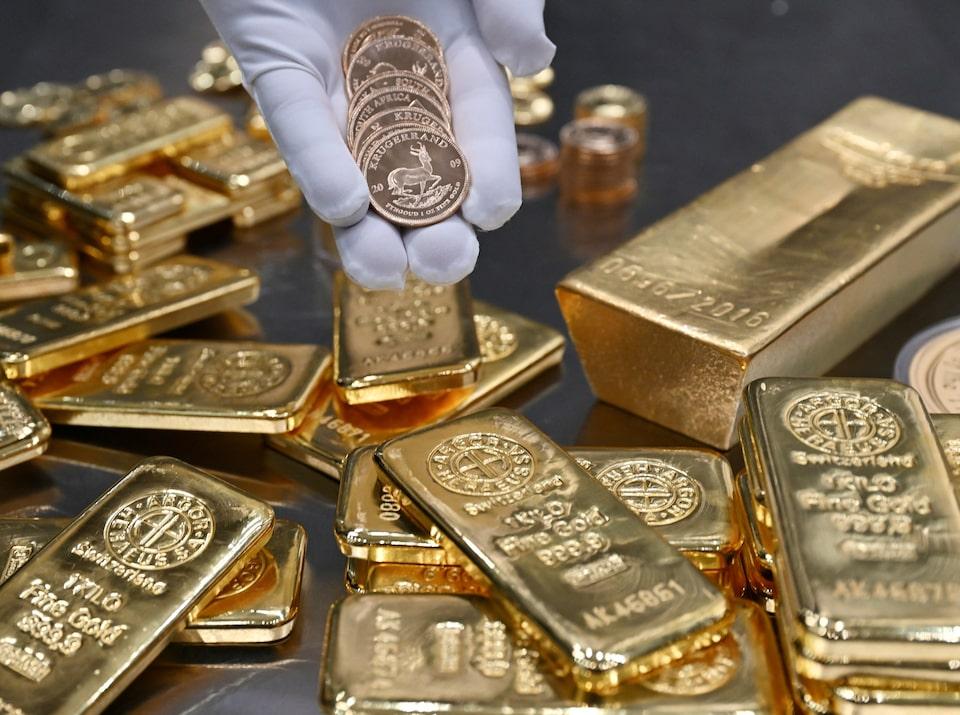
Gold hits highest since record high in October Silver scales close to one-month peak Palladium rises over 3% Jan 22 (Reuters) - Gold prices soared to near three-month highs on Wednesday, trading just below its record peak, fuelled by a soft dollar and lack of clarity around U.S. President Donald Trump's policy plans, which investors fear could trigger trade wars and elevate market volatility. Spot gold added 0.4% to $2,755.2 per ounce as of 02:29 p.m. ET (1629 GMT). Prices were at their highest since Oct. 31 when they hit their all-time high of $2,790.15. U.S. gold futures settled 0.4% higher at $2,770.90. The dollar index (.DXY) , opens new tab dipped to a more-than-three-week low earlier in the session, making greenback-priced bullion less expensive for holders of other currencies. "There are uncertainties with proposed tariffs and other things, and gold typically does well when there's a large or even a moderate amount of uncertainty in the market, it's a natural place where people gravitate to," said Ryan McIntyre, senior portfolio manager at Sprott Asset Management. Trump said his administration was discussing imposing a 10% tariff on goods imported from China on Feb. 1, the same day that he previously said Mexico and Canada could face levies of around 25%. Gold is often viewed as a haven during times of economic and geopolitical turmoil, but Trump's proposed policies are broadly regarded as inflationary, potentially compelling the U.S. Federal Reserve to sustain elevated interest rates for an extended period to rein in rising price pressures. Trump has not provided many details about his proposed tariffs, making investors question the aggressiveness of the move and the depth of its potential impacts. "(Trump) has been perhaps just a shade less hawkish on tariffs as feared, which helps — less/lower tariffs is taken to indicate lower inflation hence potential for more rate cuts," said Tai Wong, an independent metals trader. Spot silver was steady at $30.86, but hovered near a one-month high it hit on Jan. 16. Platinum rose 0.8% to $950.50 and palladium gained 3% to $987.41. Sign up here. https://www.reuters.com/markets/commodities/gold-jumps-11-week-peak-amid-trump-policy-uncertainty-soft-dollar-2025-01-22/