2024-11-28 06:42
H1 operating profit down 17.6% Expects operating profit to fall 15-18% in FY Shares in spirits maker have lost around two thirds YTD PARIS/LONDON, Nov 28(Reuters) - Remy Cointreau (RCOP.PA) , opens new tab on Thursday forecast a bigger-than-expected drop in full-year sales, citing a very slow recovery in the U.S. market, where inflation and the threat of tariffs have hit demand for spirits. The maker of Remy Martin cognac and Cointreau liqueur said it expects sales to decline by between 15% and 18% in its fiscal year ending in March, a bigger drop than the 10.6% forecast in an LSEG consensus of analysts. The French firm has been forced into repeated cuts in its guidance amid steep, persistent declines in cognac sales, causing its shares to tumble by around two thirds this year to their lowest since 2016. Remy in October abandoned hopes for a sales recovery this year amid ongoing problems in the United States in particular, where high interest rates and inflation have led stores to reduce spirits stock. Cost cuts, which helped cushion the blow to first-half operating profit, would continue in the second half of the year, the group said. Its first-half profit fell by 17.6% on an organic basis, versus a 20.6% decline expected by analysts. Apart from U.S. weakness, sales have also been slow in China due to a sluggish economy. The U.S. and Chinese markets drive the majority of cognac sales, which account for around 70% of Remy's revenue. Beijing has imposed steep tariffs on European Union brandy as part of tit-for-tat measures after the bloc voted for tariffs on Chinese-made electric vehicles. Remy has already said it will hike prices to offset the impact. Rival cognac maker Hennessy, owned by luxury goods firm (LVMH.PA) , opens new tab this week suspended a plan to bottle its brandy in China to avoid tariffs, after hundreds of workers went on strike to protest the move. U.S. President-elect Donald Trump's threatened , opens new tab universal tariffs of 10% on foreign products would deliver a further blow to Remy's U.S. business. ($1=0.9485 euros) Sign up here. https://www.reuters.com/business/retail-consumer/cost-cuts-help-remy-cointreau-limit-h1-profit-drop-2024-11-28/

2024-11-28 06:33
Renewed investor interest has supported gold - analyst Geopolitical risks remain elevated - analyst Markets see a 70% chance of a December US rate cut Nov 28 (Reuters) - Gold prices rose on Thursday as geopolitical uncertainty and trade war concerns boosted safe-haven demand, with low trading volumes expected as U.S. markets are closed for the Thanksgiving holiday. Spot gold was up 0.4% to $2,645.41 per ounce at 1205 GMT. U.S. gold futures were up 0.3% to $2,644.70. Bullion posted its deepest one-day decline in more than five months on Monday. Geopolitical risks remain elevated with ongoing war in Russia-Ukraine, and while an Israel-Hezbollah ceasefire is in force, Israel's contingencies for retaliation keep tensions alive, said Aneeka Gupta, director of macroeconomic research at WisdomTree. U.S. President-elect Donald Trump's pledge to hit Canada and Mexico with tariffs was also having an effect, she added. "It did increase a bit of concern on the possible repercussions from these two countries. So that continues to remain an important support factor for gold." However, Trump's tariff plans are also seen as potential drivers of inflation, which could prompt the U.S. Federal Reserve to slow its interest rate cutting, potentially limiting any further rally in non-yielding bullion. Data on Wednesday showed progress in lowering U.S. inflation appears to have stalled in the past months, suggesting the Fed may proceed cautiously with further rate cuts. Markets now see a 70% chance of a quarter-point rate cut in December. Gold tends to do well in a lower interest rate environment. Following a Republican clean sweep in the Nov. 5 U.S. election, bullion saw a sharp sell-off. "After that sell-off ... there has been some revived investor interest that has given some support, while weaker-handed holders were flushed out," said StoneX analyst Rhona O'Connell. "The market now is a bit more careful and prices probably will be range-bound with more downward bias going into the year-end," said Brian Lan, managing director at Singapore-based dealer GoldSilver Central. Spot silver was steady at $30.07 per ounce, platinum rose 0.4% to $930.75 and palladium gained 0.8% to $979.81. Sign up here. https://www.reuters.com/markets/commodities/gold-falls-dollar-strength-inflation-data-sparks-caution-fed-rate-cuts-2024-11-28/

2024-11-28 06:13
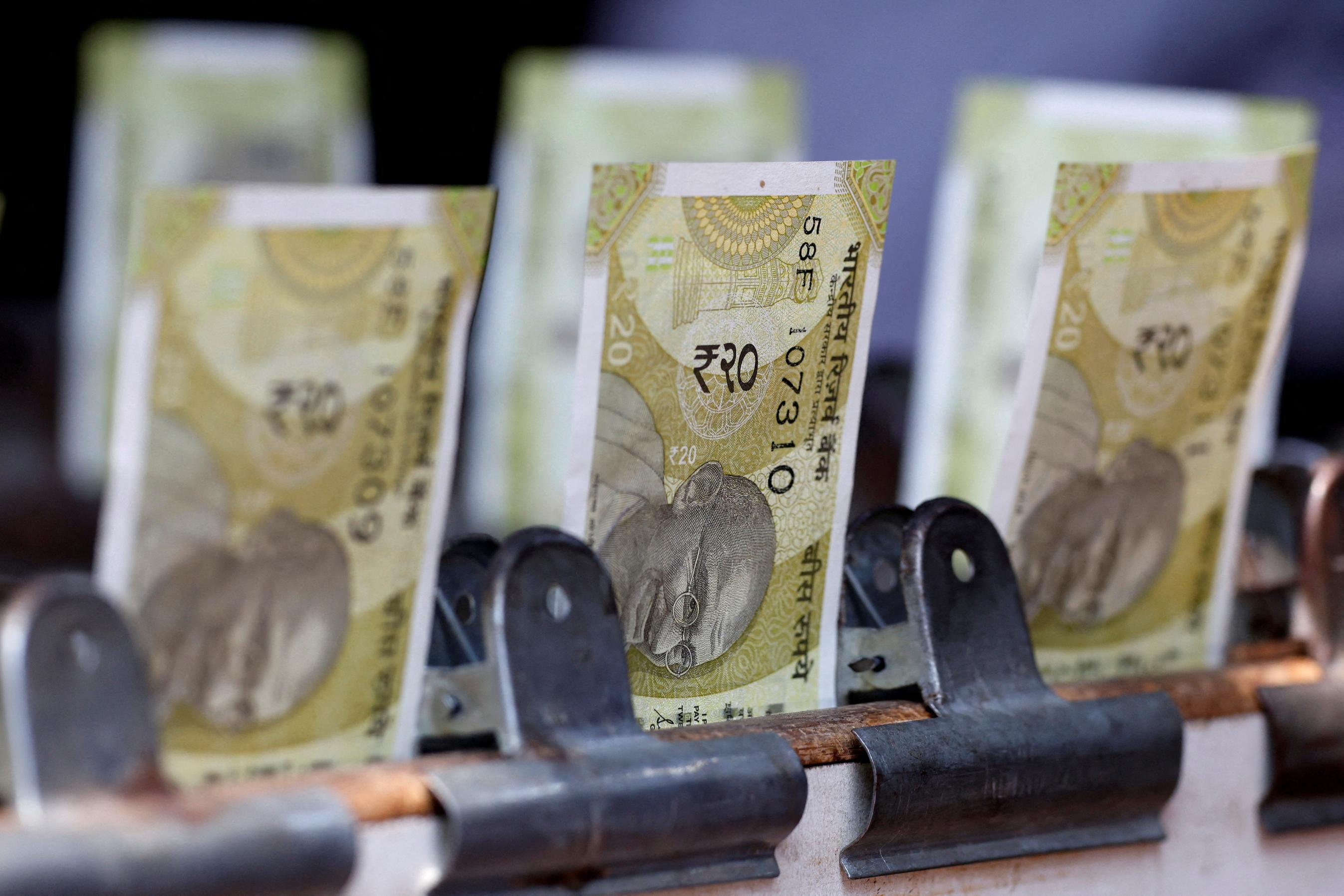
MUMBAI, Nov 28 (Reuters) - The Indian rupee was little changed on Thursday, as likely intervention by the Reserve Bank of India supported the currency amid pressure from dollar bids by importers and foreign banks. The rupee was at 84.4625 against the U.S. dollar at 11:20 a.m. IST, compared to its previous close of 84.4525. State-run banks were spotted selling dollars in early trading, most likely on behalf of the RBI, traders said. The central bank has frequently intervened in recent sessions to support the rupee near the psychologically important support level of 84.50. The rupee had weakened to a record low of 84.5075 last week. Dollar bids from foreign banks and importers weighed on the rupee, a trader at a private bank said. Other Asian currencies were mixed, while the dollar index trimmed losses after falling 0.7% on Wednesday. "Profit-taking sent the USD and U.S. bond yields lower," ahead of the U.S. Thanksgiving holiday on Thursday, DBS Bank said in a note. "We remain vigilant against more volatility, mindful that Trump is also unpredictable," the bank said, referring to the U.S. President-elect's recent comments about imposing tariffs on China, Canada and Mexico. Meanwhile, dollar-rupee far forward premiums rose, aided by the decline U.S. bond yields. The 1-year implied yield rose to 2.23%, its highest level in three weeks. Far forward premiums have "formed a range for now and the 1-year is likely to stay between 2.10%-2.40% unless there is a material shift in rate cut expectations," a trader at a state-run bank said. The RBI is widely expected to keep rates unchanged at its policy meeting next week, while investors are pricing in a near-70% chance of a U.S. rate cut in December. Sign up here. https://www.reuters.com/markets/currencies/rupee-flat-wedged-between-month-end-dollar-bids-likely-rbi-intervention-2024-11-28/
2024-11-28 06:12
NEW DELHI, Nov 28 (Reuters) - India's finance ministry is evaluating the relevance of windfall tax, a federal government source said on Thursday. Imposed in July 2022, the windfall tax is a special levy on domestic crude oil production, introduced after rising global crude prices, to capture revenue from windfall gains made by producers. In addition to the crude oil levy, the government also imposed special taxes on exports of diesel, petrol, and aviation turbine fuel. By the end of August, the windfall tax on domestically produced crude oil was reduced to 1,850 Indian rupees ($21.90)per tonne, eventually dropping to zero effective from Sept. 18. The windfall tax on export of diesel and aviation turbine fuel was also eliminated. The federal finance ministry is now looking at the collections from windfall tax and studying the crude price trend before taking a call on scrapping the levy, the source said. The federal finance ministry will evaluate scrapping windfall tax on domestic crude oil output, Tarun Kapoor, adviser to the Indian prime minister, said last month. The officials said after decline in global crude oil prices, there was little justification for maintaining the tax. ($1 = 84.4800 Indian rupees) Sign up here. https://www.reuters.com/world/india/indias-finance-ministry-evaluating-removal-windfall-tax-govt-source-says-2024-11-28/

2024-11-28 05:36
A look at the day ahead in European and global markets from Ankur Banerjee German inflation data and France's budget conundrum will take centre stage on Thursday as investors fret about the economic and political stability of the regional powerhouses while the spectre of U.S. tariffs looms large across Europe. With the U.S. markets closed for the Thanksgiving holiday, trading volumes were thin and market moves muted in Asia. Futures indicate European stock markets are due to open a little higher. The spotlight will be on French stocks after the country's main stock index (.FCHI) , opens new tab slid on Wednesday to its lowest level since early August, as budget wrangling threatened to upend the new government. French bonds also dropped sharply, driving the premium that the government pays for long-term borrowing to its highest since the euro zone debt crisis of 2012. Far-right leader Marine Le Pen has been threatening to topple France's coalition government in a no-confidence vote over a disagreement with Prime Minister Michel Barnier over the proposed budget, which contains measures to cut spending and raise taxes. Next door in Germany, where the collapse of the country's fractious ruling coalition earlier this month paved the way for snap elections in February, the focus will be on preliminary inflation data for November. Inflation is expected to remain elevated at 2.6% after a year-over-year rise in consumer prices of 2.4% in October, based on data harmonised for comparison with other European Union countries. A survey on Wednesday showed additional signs of trouble brewing for Europe's largest economy. German consumer sentiment looks set to tumble in the last month of the year as households, worried by reports of job cuts, grow pessimistic. Germany's government has forecast a 0.2% economic contraction in 2024, marking a second year of decline and cementing Germany's place as a laggard among its large euro zone peers. The political and economic turmoil in two of the region's biggest economies may leave investors pondering who really is the sick man of Europe. Key developments that could influence markets on Thursday: Economic events: euro zone consumer confidence and sentiment surveys for November; German preliminary inflation report for November Sign up here. https://www.reuters.com/markets/europe/global-markets-view-europe-2024-11-28/

2024-11-28 05:25
LAUNCESTON, Australia, Nov 28 (Reuters) - Asia's imports of crude oil ticked up slightly in November, led by a recovery by top importer China, but arrivals are still on track to be weaker this year than in 2023. The top crude-buying region is forecast to import 26.42 million barrels per day (bpd) in November, up marginally from October's 26.11 million bpd and 26.24 million bpd in September, according to data compiled by LSEG Oil Research. The ongoing run of soft monthly imports in Asia is likely to weigh on OPEC+'s deliberations this weekend, with the market expecting that the exporter group will once again delay its planned increases in output. Despite the small November rise, Asia's crude imports are still likely to fall in 2024, confounding forecasts of increasing demand made by groups such as the Organization of the Petroleum Exporting Countries and the International Energy Agency. For the first 11 months of the year, Asia's crude imports were 26.52 million bpd, down 370,000 bpd from the 26.89 million bpd tracked by LSEG for the same period in 2023. The decline in imports stands in contrast to OPEC's most recent forecast for Asia's oil demand to expand by 1.04 million bpd in 2024 from the previous year. The exporter group's November market report said China would increase its demand by 450,000 bpd, while the continent's second-biggest importer India would see a rise of 250,000 bpd and the rest of Asia kicking in with 340,000 bpd. OPEC has been cutting its forecasts for Asia's oil demand growth every month since July, when its report estimated Asia's demand would expand by 1.34 million bpd in 2024. The main reduction in OPEC's forecasts has been in China, where the group has gone from expecting 2024 demand to lift by 760,000 bpd in the July report, to forecasting a gain of 450,000 bpd by November. While China's November crude imports are expected by LSEG to come in at a three-month high of 11.62 million bpd, the world's top importer is still on track to record lower arrivals this year. For the first 10 months of 2024 China's crude imports were 10.94 million bpd, down 3.7%, or 420,000 bpd from the same period in 2023, according to calculations based on customs data. While OPEC and other forecasters are gradually catching up to the reality of China's weak crude imports, the market pricing has reflected the dynamic for some time. STEADY PRICES Global benchmark Brent futures have been trending weaker since reaching the high so far this year of $92.18 a barrel on April 12. They dropped to a 33-month low of $69.19 a barrel on Sept. 10 and have traded largely sideways since then, ending at $72.83 on Wednesday. When there have been spikes higher in the price, it's usually been driven by reports of escalating geopolitical tensions in the Middle East and between Russia and Ukraine, rather than by any shift in the supply-demand fundamentals. It's those fundamentals that will be front of mind for members of the OPEC+ group when they hold a meeting on Dec. 1. The group, which brings together OPEC and allies including Russia, is expected to again delay a planned increase in output. OPEC+, which pumps about half the world's oil, had planned to gradually roll back oil production cuts with small increases over many months in 2024 and 2025. But the soft demand in Asia, and especially in China, has put the kibosh on those plans and analysts now expect any increase in output only to happen after the first quarter of next year. The views expressed here are those of the author, a columnist for Reuters. Sign up here. https://www.reuters.com/business/energy/asias-november-crude-oil-imports-nudge-higher-still-heading-annual-fall-russell-2024-11-28/