2024-11-18 07:49
HANOI, Nov 18 (Reuters) - Coal-fired power plants in Vietnam are expected to operate at high levels next year to meet the country's rising demand for electricity, the government said on Monday. Most of the coal-fired power plants will operate for 6,400-6,500 hours in the year, the government said in a statement, adding that power consumption was forecast to rise 11% to 14% next year. The regional manufacturing hub has been seeking to boost its use of renewable energy sources, but regulatory hurdles put its offshore wind and LNG power targets at risk while coal maintains a prominent role in its power mix. Coal-fired power plants accounted for 48.7% of Vietnam's total electricity output of 256.7 billion kilowatt hours in the first 10 months of this year, according to data from state utility EVN. "The mobilisation rate of coal-fired power plants will remain high, especially in the northern area," the government said. All coal power plants must be ready with coal supplies plans by the end of this year, it said. Sign up here. https://www.reuters.com/business/energy/vietnam-says-its-coal-fired-power-plants-operate-high-levels-next-year-2024-11-18/

2024-11-18 07:46
MOSCOW, Nov 18 (Reuters) - Russian gas exports through Ukraine to Europe - the main transit route for the gas to the EU - were stable on Monday, according to Kremlin-controlled energy company Gazprom (GAZP.MM) , opens new tab, despite the company cutting off gas supplies to Austria's OMV (OMVV.VI) , opens new tab. Gazprom said it would send 42.4 million cubic metres (mcm) of gas to Europe via Ukraine on Monday, the same volume as on Sunday. Russia, which before the Ukraine war was the biggest single supplier of gas to Europe, has lost most of its buyers on the continent as the EU tries to cut its dependence on Russian energy. Nominations, or requests, for gas flows into Slovakia from Ukraine were little changed from previous days on Monday while nominations for flows leaving Slovakia were also stable, data from transmission system operator Eustream showed. Nominations for flows to Austria from Slovakia were steady versus weekend levels, or around 17% below November's average levels before Russia halted gas supplies to Austria's OMV (OMVV.VI) , opens new tab. Nominations to the Czech Republic from Slovakia were also roughly in line with levels from previous days. Gazprom on Saturday halted supplies to OMV after the Austrian company threatened to impound some of the Russian state firm's gas as compensation for an arbitration it had won over a contractual dispute. Austria had been receiving 17 mcm per day before the cut-off, and those volumes are now finding new buyers in Europe who stepped in to snap up unsold gas, companies and sources said and data showed. Russian gas is still being sold in significant volumes to Slovakia and Hungary, as well as to the Czech Republic which does not have a direct contract. Smaller volumes are going to Italy and Serbia. Ukraine has said it will not extend a gas transit deal with Russia once a five-year agreement expires at the end of the year. Sign up here. https://www.reuters.com/business/energy/russias-gas-flows-europe-via-ukraine-stable-amid-austria-dispute-2024-11-18/
2024-11-18 07:36
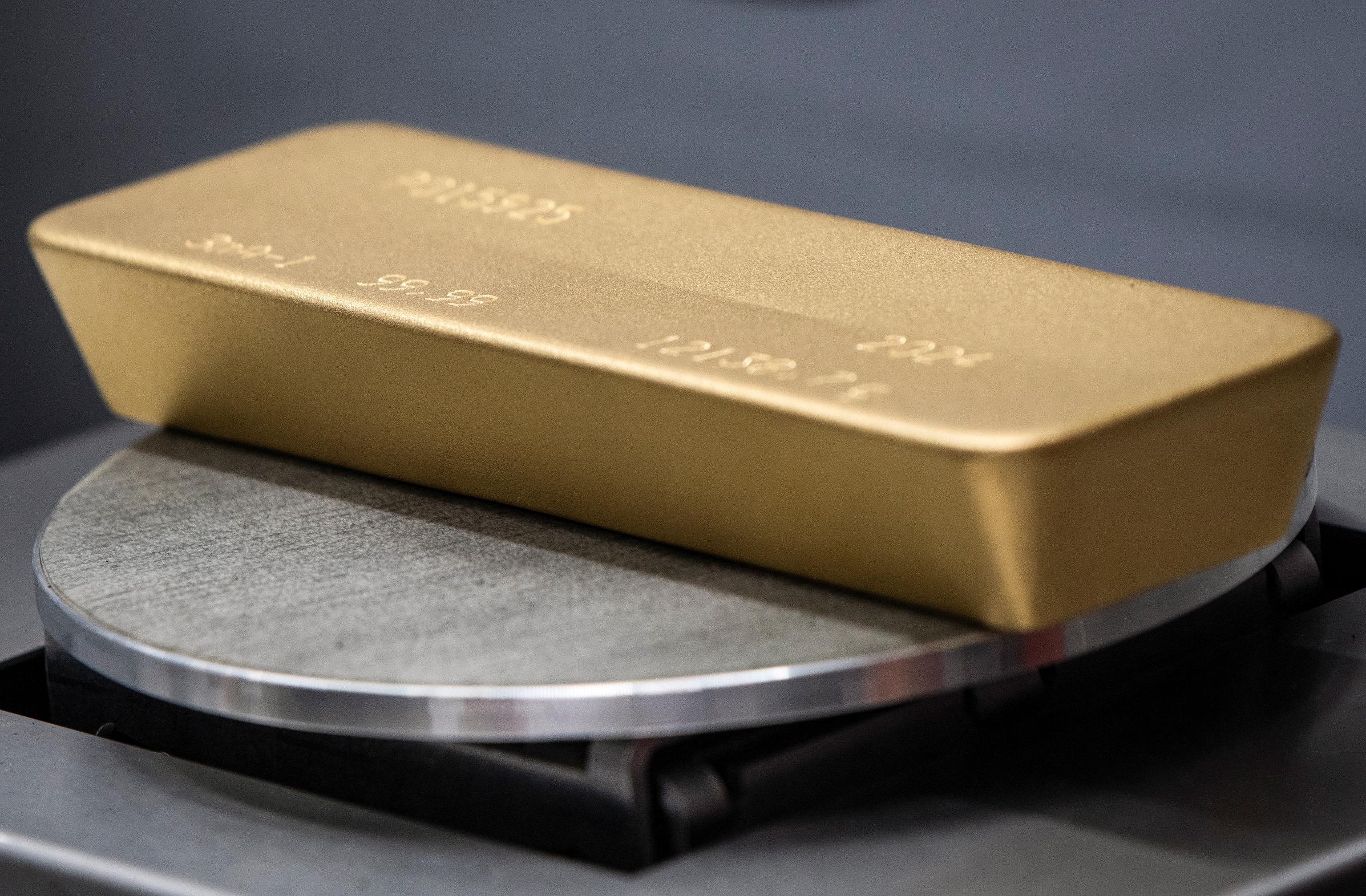
Gold rises nearly 2%, off two-month low hit Thursday Gold technically wants to get back near $2,700 -analyst Several US Fed officials due to speak this week Palladium jumps more than 5% Nov 18 (Reuters) - Gold prices soared on Monday, after six days of losses, as the U.S. dollar's surge stalled and heightened uncertainty over the Russia-Ukraine conflict rekindled safe-haven demand. Spot gold jumped 1.8% to $2,608.19 per ounce by 01:44 p.m. ET (1844 GMT), moving away from a two-month low on Thursday. U.S. gold futures settled 1.7% up at $2,614.60. "Part of it is (President) Biden's announcement of long-range missiles for Ukraine to reach deeper into Russian territory. I think some of it is prompting safe-haven demand for gold," said Daniel Pavilonis, senior market strategist at RJO Futures. Gold, which is considered a safe investment during economic and geopolitical turmoil, posted its steepest weekly drop in more than three years last week as President-elect Trump's proposed tariffs are seen as potential drivers of inflation, which could prompt the Fed to slow its rate-cutting pace. This in turn boosted the dollar index to trade at a one-year high on Thursday. However, the greenback fell 0.4% on Monday after rising 1.6% last week. A softer dollar makes gold more affordable for buyers using other currencies. "Whether the Federal Reserve cuts or not, I think gold technically looks like it wants to get back near that $2,700 level," Pavilonis said. The U.S. central bank is widely expected to deliver a third rate cut in December, although recent data showed progress in bringing inflation back to its 2% target has stalled. At least seven Fed officials are scheduled to speak this week. Higher interest rates, which make non-yielding assets like gold less appealing, could further pressure the metal. "Bulls' next upside (gold) price objective is to produce a close above solid resistance at $2,650," said Kinesis Money. Spot silver rose 2.8% to $31.05 per ounce, platinum added 2.8% at $964.87 and palladium climbed 5.3% to $1,001.29. Sign up here. https://www.reuters.com/markets/commodities/gold-gains-1-dollar-rally-stalls-2024-11-18/
2024-11-18 07:15
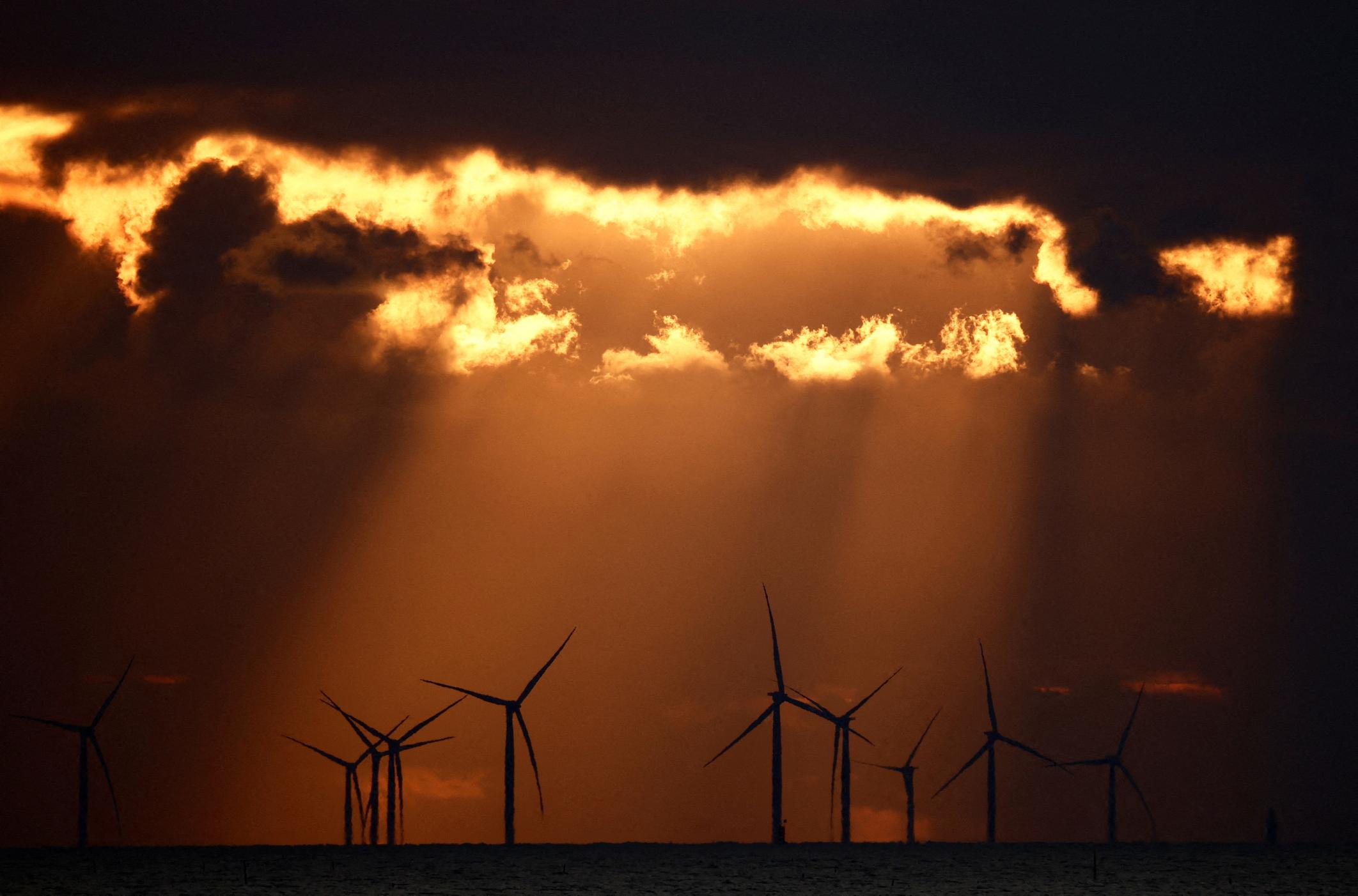
Soaring costs, project delays and limited investment put targets out of reach Offshore wind seen as crucial to decarbonizing power industry Industry urges more government support Nov 18 (Reuters) - After a year of canceled projects, broken turbines, and abandoned lease sales, the global offshore wind industry no longer has much chance to hit the lofty targets set by governments in the U.S., Europe and elsewhere, marking a setback for efforts to fight climate change. The technology forms a big part of government strategies to advance renewable energy and decarbonize the global power industry because it can generate vast amounts of electricity near densely populated coastal regions. Missing targets by a wide margin will leave a gap that could be hard to fill. Reuters spoke to 12 offshore wind companies, industry researchers, trade associations, and government officials in six countries to come up with a global picture of the state of the industry and its outlook, and found soaring costs, project delays and limited supply chain investment were hobbling installations. “We’re pretty far away from these targets,” Soren Lassen, head of offshore wind research at energy research firm Wood Mackenzie, said in an interview. He said offshore wind farms now have a global average cost of $230 per megawatt-hour (MWh) – up 30% to 40% in the past two years and more than triple the average of $75/MWh for onshore facilities. That has companies retreating. BP last month said it was [USN:L8N3LS1MV TEXT:“considering selling a stake”] in its offshore wind business, and Equinor earlier this year abandoned investments [USN:L1N3KA0A4 TEXT:“in Vietnam”], [USN:L8N3KF1BK TEXT:“Spain and Portugal”]. Meanwhile GE Vernova (GEV.N) , opens new tab, one of the industry’s top turbine suppliers, is not taking new orders. “We do not foresee adding to (our) backlog without substantially different industry economics than what we see in the marketplace today,” GE Vernova CEO Scott Strazik said on a recent investor call. World governments had set a global target last year of tripling overall renewable energy use by 2030, something the International Renewable Energy Agency (IRENA) said would require offshore wind capacity to surge to 494 GW by the end of this decade, from 73 GW currently. IRENA Director-General Francesco La Camera told Reuters offshore wind is now projected to fall short of its target by a third. Estimates by three other prominent research firms project that the world will not reach 500 GW of offshore wind installations until after 2035. TRUMP EFFECT Governments in Europe, the Americas and Asia have sought to prop up the sector with national targets aimed at attracting deep-pocketed developers including major global energy companies Equinor (EQNR.OL) , opens new tab, Orsted (ORSTED.CO) , opens new tab, RWE (RWEG.DE) , opens new tab and Iberdrola (IBE.MC) , opens new tab. The United States, for example, set a goal in 2021 of 30 gigawatts of offshore wind by the end of this decade, but had less than 200 megawatts operating as of May of this year, according to the National Renewable Energy Laboratory. The outgoing administration of U.S. President Joe Biden issued permits for 15 GW of projects, held six lease sales on multiple coasts, and extended tax credits to the industry. But U.S. offshore wind has been roiled since last year by canceled projects and contracts, suspended government auctions, and a high-profile [USN:L4N3JF1TR TEXT:“construction accident”] at the country’s first major commercial project The industry [USN:L8N3MK0P9 TEXT:“is now worried”] that Biden’s replacement, President-elect Donald Trump, will follow through on an election campaign promise to dismantle the industry’s progress, possibly by withholding lease auctions. “Given the results of the U.S. elections, we see higher risks than before for the timely implementation of offshore wind projects there,” Michael Mueller, finance chief of German offshore project developer RWE, told journalists on an earnings call this month. Energy research firm Rystad said it expects the United States to reach less than half of its 2030 target. Representatives of the Biden administration and Trump’s transition team did not provide comment for this story. Carl Fleming, a partner at law firm McDermott Will & Emery who advises the White House on renewable energy policy, told Reuters the U.S. would struggle to miss its target regardless of who is in the White House, given market conditions. EUROPE ALSO FALLING SHORT In Europe, Petra Manuel, offshore wind analyst at Rystad, expects countries with the highest offshore wind targets - the United Kingdom, Germany and the Netherlands - to reach about 60% to 70% of their goals. Nations with less ambitious targets, including Belgium, Denmark and Ireland, are also expected to come up short, he said. Industry trade group WindEurope, meanwhile, said it expects the European Union to have 54 GW of offshore wind capacity by 2030, about half of the 120 GW North Sea countries [USN:L4N36O27G TEXT:“pledged”]. EU Energy Commissioner Kadri Simson told Reuters that delays in meeting targets could not be ruled out, but that none had been formally flagged by member states. Britain, the second-biggest offshore wind market after China, will also miss its goal of 60 GW by 2030, said Damien Zachlod, managing director of offshore wind developer EnBW Generation UK. The UK held its best-funded auction yet in September, adding 4.9 GW of new agreements. But future auctions will require far larger volumes to reach 60 GW on time, he said. “It will be very, very challenging and we won’t hit the target by 2030,” he said. A spokesperson for the UK government did not immediately provide comment. CHINA BUCKS THE TREND China, which became the global leader in offshore wind in 2022, is bucking the global trend. Beijing has supercharged its industry with subsidies and low financing costs. Most of the sector’s players are state-owned, and have access to locally-made offshore wind components. China accounted for more than half of 2023 offshore wind installations, with 6.3 GW, and the Global Wind Energy council trade group estimates the country will install 11 to 16 GW annually in the next two to three years. Sourcing cheap equipment from China would help reduce costs for developers in Europe, Japan and the United States, but governments there have sought to encourage local production to reduce reliance on Beijing. Elsewhere in Asia, nations including Vietnam, Japan, South Korea and Taiwan have sought to expand offshore wind but also face difficulties linked to soaring costs and regulatory uncertainty. Japan, for example, has set ambitions of building up to 45 GW of offshore wind capacity by 2040, up from less than 1 GW today. But the nation’s auctions to date have been small, and the industry is constrained by laws preventing non-Japanese vessels from operating in offshore wind areas. Rebecca Williams, deputy CEO of the Global Wind Energy Council trade group, acknowledged there is a risk the industry could miss its targets, but said hitting them is still possible with the right policies. “Of course, whenever there’s a target, there’s a risk that that target might not be met,” Williams said on the sidelines of the COP29 conference in Baku. “But the target is not the thing that’s going to get the turbines in the water.” Sign up here. https://www.reuters.com/sustainability/global-offshore-wind-industry-poised-miss-big-targets-obstacles-mount-2024-11-18/
2024-11-18 07:08
Post-election rally in stocks is fading Rising yields challenge stock market stability Policy uncertainty affects pharmaceutical and defense stocks Optimism persists due to strong earnings and growth NEW YORK, Nov 18 (Reuters) - A U.S. stock rally fueled by Donald Trump’s election victory is stumbling, as investors contend with everything from renewed inflation worries to uncertainty over the impact of the president-elect's policies. The S&P 500 fell 2% in the past week, erasing more than half its gains from a post-election surge fueled in part by optimism over the pro-growth policies that are a key part of Trump’s economic platform. Though the index remains near record highs and is up 23% this year, some of that enthusiasm has been tempered in recent days. Bets that some of Trump’s policies could spur a rebound in inflation and cloud the picture for further interest rate cuts helped push the benchmark U.S. 10-year yield to its highest level in more than five months on Friday, a potentially unwelcome development for stocks. Worries over Trump’s cabinet selections and plans for cutting bureaucratic excess have bruised the shares of pharmaceutical companies and government contractors. Meanwhile, Wall Street has little clarity on when, and to what extent, the president-elect will implement his agenda. While the market had rushed to price in the positive outcomes from Trump’s economic policies, “I'm skeptical that it's going to be that easy,” said Paul Nolte, senior wealth adviser and market strategist at Murphy & Sylvest Wealth Management. A Trump spokesperson did not immediately respond to a request for comment. Trump has previously said that his trade policies - which call for pricey tariffs on goods not only from rivals such as China but allies such as the European Union - would revitalize American manufacturing and yield enough revenue to ease concerns about ballooning the deficit or increasing inflation. EYES ON YIELDS Rising yields are one of the market’s chief concerns, because they offer investment competition for equities while raising the cost of capital for companies and consumers. The benchmark 10-year yield - which typically moves with interest rate expectations - has surged about 90 basis points since mid-September as investors curtailed bets on how deeply the Federal Reserve will cut borrowing costs in the face of robust growth that could stoke an inflationary rebound. Until recently, stocks may have been able to shrug off the rise in yields because it had been driven by stronger-than-expected economic data. But many of Trump’s policies - from tax cuts to tariffs - are seen as inflationary, and could keep yields climbing past the 4.5% level that some investors have flagged as a potential trigger for stock market unease. The yield touched 4.5% on Friday before settling lower. "If yields continue to trend up and they don't find their ceiling, I think it will become a problem because it will basically translate into a tighter monetary environment," said Irene Tunkel, chief U.S. equity strategist at BCA Research. Fed Chair Jerome Powell on Thursday said there was little need for policymakers to rush to cut rates, given solid economic growth and inflation above the central bank’s 2% target. The comments weighed on stocks and pushed bond yields higher. As yields have risen, the relative attractiveness of equities compared with U.S. government bonds, which are seen as risk-free if held to term, has dimmed by some measures. The equity risk premium, which compares the S&P 500 earnings yield against the 10-year Treasury yield, is at its lowest level since mid-2002, said Keith Lerner, co-chief investment officer at Truist Advisory Services. POLICY UNCERTAINTY Uncertainty over the timing and ultimate impact of Trump’s policies has also grown. Shares of Pfizer (PFE.N) , opens new tab, Moderna (MRNA.O) , opens new tab and other drugmakers fell at the end of last week after Trump picked vaccine skeptic Robert F. Kennedy Jr. to lead the Department of Health and Human Services. Defense and government contractor stocks including Leidos Holdings (LDOS.N) , opens new tab and General Dynamics (GD.N) , opens new tab also fell, as investors fretted about the fallout from a new government efficiency entity led by Tesla (TSLA.O) , opens new tab CEO Elon Musk. Kennedy, a cabinet pick, still has to be confirmed by Senate lawmakers, while the extent of any spending cuts stemming from the efficiency entity is unclear. Nevertheless, the uncertainty has pushed some investors to "sell first, ask questions later," said King Lip, chief strategist at BakerAvenue Wealth Management. Meanwhile, strategists at BofA Global Research said the risks to their forecast of 2.3% economic growth next year were “very large in either direction” given the lack of clarity over which aspects of Trump’s policies will be prioritized. Growth could shoot above 3% if the administration focused on fiscal easing and deregulation, the bank’s strategists wrote on Friday. But a hard pivot to tariffs could spark a trade war and eventually pull the economy into a recession, they said. Of course, some so-called Trump trades are still sporting huge gains. Shares of Tesla (TSLA.O) , opens new tab, which have risen on bets that Musk’s close association with the president-elect will benefit the company, are up 28% since Election Day. Bitcoin, lifted by hopes of crypto deregulation, was up over 30% as of late Friday. At the same time, stocks have tended to perform well at year-end, with the S&P 500 (.SPX) , opens new tab up an average of 3.3% in the last two months of presidential election years since 1952, according to Truist’s Lerner. That is cause for continued optimism, along with strong corporate earnings and a healthy growth backdrop, said Ross Mayfield, investment strategist at Baird Private Wealth Management. "There is a lot else working for the market," Mayfield said. Sign up here. https://www.reuters.com/markets/us/headwinds-hit-trump-fueled-rally-us-stocks-2024-11-18/

2024-11-18 07:03
BP cuts London hydrogen team, halts 18 projects Shell scales back low-carbon push Equinor reviews renewables operations, cuts projects LONDON, Nov 18 (Reuters) - Almost five years ago, BP (BP.L) , opens new tab embarked on an ambitious attempt to transform itself from an oil company into a business focused on low-carbon power. The British company is now trying to return to its roots as a big oil and gas player with a growth story to match rivals, revive its share price and allay investor concerns over future profits. Rivals Shell (SHEL.L) , opens new tab and Norway’s state-controlled Equinor (EQNR.OL) , opens new tab are also scaling back energy transition plans set out earlier this decade. Their change of direction reflects two major developments - the energy shock from Russia’s invasion of Ukraine and a drop in profitability for many renewables projects, particularly offshore wind, due to spiralling costs, supply chain issues and technical problems. BP CEO Murray Auchincloss plans to plough billions into new oil and gas developments, including in the U.S. Gulf Coast and the Middle East, as part of his drive to improve performance and boost returns. BP has also slowed down low-carbon operations, halting 18 early-stage potential hydrogen projects and announcing plans to sell wind and solar operations. It has recently cut its hydrogen team in London by more than half to 40 staff, company sources told Reuters. A BP spokesperson declined to comment on the layoffs. Shell CEO Wael Sawan has vowed to take a ruthless approach to improve its performance and returns and close a yawning valuation gap with larger U.S. rivals Exxon Mobil and Chevron. The company has [USN:L8N3BV4G1 TEXT:“scaled back”] low-carbon operations, including floating offshore wind and hydrogen projects, retreated from European and [USN:L8N3H41EJ TEXT:“Chinese power markets, ”]sold refineries and weakened a 2030 carbon reduction target. Shell is seeking buyers for Select Carbon, an Australian company it acquired in 2020 which specialises in developing farming projects used to offset carbon emissions, sources close to the company told Reuters. A Shell spokesperson declined to comment. SKILL SHORTAGE? Some BP employees wonder whether the company retains enough staff with the experience and skills necessary to reestablish itself as an oil and gas major. Employees peppered CEO Auchincloss with questions at an online town hall meeting in early October as he detailed some of his plans for turning the ship around, according to four employees on the call. He told them BP would and could develop new oil and gas production in a reversal of predecessor Bernard Looney’s strategy to build up renewable generation assets, reduce emissions and slowly cut oil and gas output targets. In conversations with Reuters, some employees said they doubted BP has enough reservoir engineers to jump-start oil and gas output growth after it let go of hundreds of the upstream division’s employees since 2020. The BP spokesperson declined to comment on the town hall discussion. Equinor, Europe’s main supplier of natural gas since 2022, has launched a review of its low-carbon business, named internally REN Adjust, which included scrapping several early stage projects to focus on more advanced offshore wind projects. When asked for comment Equinor said it was adapting to market realities. “The goal is to strengthen competitiveness and to compete effectively when the industry rebounds after the current down-cycle.” But the companies have not abandoned investments in low-carbon energy altogether. Rather, executives said, they are focusing on areas such as biofuels, which they feel confident can generate profit quickly. Shell, BP and Equinor also continue to develop some offshore wind projects already under way, and say they could invest further if the returns are competitive. They are also developing hydrogen projects to use mostly to lower the carbon footprint of their refining operations. “What we’re finding with our transition growth businesses is that we need to expect the same level of returns as we do from our historic businesses if we’re going to deploy material capital over time,” Auchincloss told Reuters on Oct. 29. France’s TotalEnergies (TTEF.PA) , opens new tab has become the outlier, continuously investing in low-carbon and strongly outpacing Shell and BP’s renewables capacity. BALANCING ACT The slowdown in the companies' energy transition plans coincides with warnings that the world is set to miss a U.N.-backed target to limit global warming to 1.5 degrees Celsius by the end of the century which is needed to avoid the catastrophic impact of climate change. It means companies will likely miss, or will have to revise down, emission reduction targets, said Accela Research analyst Rohan Bowater. And while industry executives focus on boosting near-term returns by spending more on oil and gas, the outlook for fossil fuel consumption is increasingly uncertain. The International Energy Agency said last month it expects global oil demand to peak by the end of the decade as electric vehicles sales grow. Investors remain sceptical about the European oil giants' ability to sustain profits. Their shares have underperformed U.S. rivals, even as climate-focused investors have lamented the shift from renewables. “To make transition plans stick, companies need the right incentives for management, a clear mandate from shareholders, and a focus on demonstrating value,” Bowater said. “BP, for instance, remains caught in the middle, struggling to balance low-carbon investment with shareholder expectations.” Sign up here. https://www.reuters.com/business/energy/european-oil-giants-step-back-renewables-path-2024-11-18/