2024-11-14 20:45
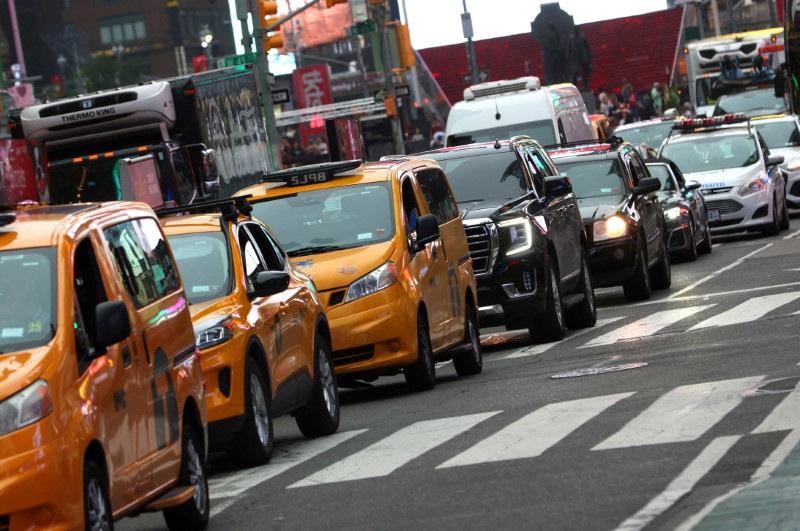
First US congestion charge set to begin in January New York racing to gain approval before Trump takes office Revised plan will cut base charge to $9 Nov 14 (Reuters) - New York plans to revive a $9 congestion mitigation charge for driving in Manhattan starting in January that the state indefinitely put on hold earlier this year, Governor Kathy Hochul said on Thursday. New York City's congestion pricing program, the first of its kind in the United States, was initially to have charged a toll of $15 during daytime hours for passenger vehicles driving in Manhattan south of 60th Street starting on June 30. Shortly before that date, however, Hochul put the plan on hold indefinitely, citing high inflation and a desire not to discourage commuters and tourists. But now, New York is racing to implement the charge before President-elect Donald Trump takes office. Trump said on Thursday he strongly disagreed with the decision to implement the fee. "It will put New York City at a disadvantage over competing cities and states, and businesses will flee," he said in a statement. London implemented a similar charge in 2003. Hochul said the new base charge for passenger vehicles will be $9, which is 40% less than initially announced. She said the toll is crucial to making new investment in subways and buses in New York, and that it will support $15 billion in debt financing for mass transit improvement. Trucks and buses will pay up to $21.60, and there will be 75% discounts for traveling at night. The fee will be charged once a day regardless of how many trips are made for car owners, while taxis will pay 75 cents per trip in the Manhattan zone and Uber (UBER.N) , opens new tab or Lyft (LYFT.O) , opens new tab vehicles reserved by app will pay $1.50 per trip. Hochul said the funding will help "begin to drive down gridlock and the emissions, as intended, and will deliver major environmental improvements." The Metropolitan Transportation Authority, which is used by around 6 million people daily, will vote on Monday to approve the charge. MTA has agreed not to hike the $9 base toll before 2028. The MTA has said congestion pricing would cut traffic by 17%, improve air quality, and increase mass transit use by 1% to 2%. In the aftermath of the delay, the MTA in June said it was putting $16.5 billion in capital projects on hold. A U.S. Transportation Department spokesperson said New York notified the Federal Highway Administration of updated plans to advance the project with a starting toll of $9 for passenger cars. The agency is finalizing the steps needed to complete an agreement to let the program take effect. A group of five New York Republicans in the U.S. House of Representatives this week urged Trump to kill the charge , opens new tab, asking him to end "this absurd congestion pricing cash grab." Some New Jersey Democrats also oppose the fee and vow to fight it. In 2019, state lawmakers approved the plan to help fund improvements in mass transit using tolls to manage traffic in New York City, the most congested of any American city. New York has said more than 900,000 vehicles enter the Manhattan Central Business District daily, which reduces travel speeds to around 7 miles (11 km) per hour on average. Sign up here. https://www.reuters.com/world/us/new-york-moving-revive-manhattan-congestion-charge-2024-11-14/
2024-11-14 20:42
MEXICO CITY, Nov 14 (Reuters) - The Bank of Mexico on Thursday lowered its benchmark interest rate by 25 basis points for a third straight meeting, underscoring progress on bringing down core inflation and signaling future rate cuts were possible. The five-member governing board of Banxico, as Mexico's central bank is known, voted unanimously to cut the key rate to 10.25%. Analysts polled by Reuters had overwhelmingly forecast the reduction, which comes a week after the Federal Reserve cut borrowing costs in the United States by a similar magnitude. In a statement announcing its decision, Banxico noted the inflation outlook has improved while the closely watched core inflation rate, considered a good indicator for price trends, is expected to keep decreasing. "Looking ahead, the Board expects that the inflationary environment will allow further reference rate adjustments," the statement said. In October, core inflation, which excludes volatile energy and food prices, slowed to 3.80% in the 12 months through October, down from 3.91% in September. Meanwhile, annual headline inflation rate ticked up to 4.76% in October, from 4.58% in September. Banxico targets headline inflation at 3%, plus or minus one percentage point. "The board left the door open to further interest rate cuts over the coming months, but officials will be keeping a close eye on the peso – especially if the incoming Trump administration steps up its threats to impose tariffs on Mexico," said Jason Tuvey, deputy chief emerging markets economist at Capital Economics. Mexico's peso currency has weakened sharply over the past six months, as a series of post-Mexican election reforms shook investor confidence in the country's legal system, and as Donald Trump's U.S. election victory last week fuels uncertainty over the future of the critical bilateral trade relationship. Alberto Ramos, head of Latin America research at Goldman Sachs, said the bank expects Banxico to deliver another 25-basis-point cut at its December meeting. However, Ramos said "the bar to accelerate the pace of cuts to 50 basis points is relatively high given prevailing domestic and external uncertainty, in particular around a number of issues in the U.S.-Mexico bilateral agenda," namely concerning tariffs. Banxico's board raised its forecast for average headline inflation in the fourth quarter, but still sees the rate converging to its target in the fourth quarter of 2025. Sign up here. https://www.reuters.com/markets/rates-bonds/bank-mexico-lowers-key-interest-rate-1025-2024-11-14/
2024-11-14 20:38
Biofuel D3 RINs fall to more than one-year low Proposed supply waiver follows petition from refiners' lobby Small 2024 D3 RIN shortfall likely, waiver credits unlikely - analyst NEW YORK, Nov 14 (Reuters) - Prices for cellulosic biofuel production credits fell to their lowest in over a year this week after the U.S. Environmental Protection Agency (EPA) proposed a partial waiver to its supply mandates for 2024, according to traders and market participants. The proposal, submitted for government approval on Tuesday, follows a petition , opens new tab by industry lobby group American Fuel & Petrochemicals Manufacturers on Nov. 1 arguing that EPA's supply mandates for this year were too high to meet. A similar petition by AFPM on last year's mandates was denied by the EPA. It comes amid an uncertain future for carbon credit markets after Donald Trump's victory in the U.S. presidential election this month, which made market participants bet that exemptions to renewable fuel mandates will become easier to attain. The EPA sets annual mandates for low-carbon alternatives to be added in the U.S. fuel mix. Mandates for this year required 1.09 billion gallons of biofuels made from cellulosic sources like leaves and stems, and 1.38 billion gallons in 2025. D3 Renewable Identification Numbers (RINs) tied to cellulosic biofuels fell from over $3 per gallon each to $2.70 each on Wednesday, and $2.68 each on Thursday, the lowest since October 2023, traders said. RINs are used by the EPA to track compliance with its mandates. Each gallon of renewable fuels generates a RIN, and suppliers who meet their targets can sell excess RINs to those falling short. Around 97% of D3 RINs are tied to the production of biogas, a renewable energy source derived from agricultural waste, according to estimates from AEGIS Hedging, a commodities trader advisory firm. Data on D3 RINs generated so far indicate a shortfall is likely in 2024, Zander Capozzola, vice president of renewable fuels at AEGIS told Reuters by phone. He cautioned the shortfall is unlikely to require as large an adjustment to EPA's mandates as the market reaction suggests. AFPM's petition had asked the EPA to issue cellulosic waiver credits, which are an alternative mode of compliance in lieu of RINs. "They will likely trim the volumes for 2024 a bit, but we see a low probability of waiver credits," Capozzola said. Mandates for 2025 are not yet expected to be altered, he said separately in a LinkedIn post , opens new tab. Sign up here. https://www.reuters.com/business/energy/credits-tied-biogas-slump-proposed-waiver-supply-mandates-2024-11-14/

2024-11-14 20:37
Pony seeks as much as $348 mln in IPO, private placements IPO follows robotaxi firm WeRide's Nasdaq debut in October Japan's Toyota, Chinese VC firm HongShan back Pony Pony has sought US listing for a long time Nov 14 (Reuters) - Pony AI is seeking a valuation of up to $4.48 billion in its U.S. initial public offering, it said on Thursday, as the Chinese self-driving firm moves ahead with its long-sought plan for a New York listing. Pony, founded in 2016 and backed by Japanese automaker Toyota (7203.T) , opens new tab, aims to raise up to $195 million by offering 15 million American Depositary Shares priced between $11 and $13 each. Self-driving firms are looking to raise capital as they seek to scale operations. Guangzhou-based Pony, whose fleet includes over 250 robotaxis and 190 robotrucks, will enter the U.S. stock market on the heels of rival WeRide's WRD.O Nasdaq debut in October. Two investors, including Chinese carmaker BAIC (1958.HK) , opens new tab, have indicated on buying shares worth $74.9 million in the IPO. Certain investors have also agreed to buy about $153.4 million worth of shares through concurrent private placements. Pony's proposed target is a climb-down from its $8.5 billion valuation in a 2022 funding round. In September, its board slashed the minimum IPO valuation to $4 billion from $8.5 billion and proceeds to $200 million from $425 million. "The same bull or bear thesis investors have about WeRide also applies to Pony AI," said Matt Kennedy, senior strategist at Renaissance Capital, a provider of pre-IPO research and IPO-focused ETFs. "A currently small and unprofitable company that is growing fast in what is expected to be an enormous market." Chinese companies are slowly pursuing New York flotation following a long hiatus after ride-hailing giant Didi Global was forced to delist its U.S. shares due to a clash with Beijing. The IPO comes after a 2021 attempt to go public through a $12 billion blank-check deal fell through as Beijing cracked down against Chinese technology companies. Beijing has since softened its stance and published rules last year to revive offshore listings. Zeekr's (ZK.N) , opens new tab $441 million May IPO is the biggest U.S. listing by a China-based company in 2024, LSEG data showed. ROCKY ROAD While some tout robotaxis as the future of mobility, analysts believe the industry faces a rocky road ahead. Safety concerns and regulatory roadblocks have slowed the technology's commercialization. Profitability is another hurdle as robotaxis require significant investments in research and development. Still, China has swiftly approved trials compared to the U.S. as authorities support economic goals. Meanwhile, the White House is expected to ban vehicles with China-developed systems on American roads due to national security concerns. Pony, which last year secured $100 million from Saudi Arabia's NEOM, is also backed by Canadian pension fund Ontario Teachers' and venture capital firm HongShan, formerly Sequoia China. Pony will list on the Nasdaq under the symbol "PONY". Goldman Sachs, BofA Securities, Deutsche Bank, Huatai Securities and Tiger Brokers are underwriting the IPO. Sign up here. https://www.reuters.com/business/autos-transportation/chinese-robotaxi-firm-pony-ai-seeks-up-45-bln-valuation-us-ipo-2024-11-14/

2024-11-14 20:30
Mersinger, Sommers and Sterling being considered for CFTC chair, sources say Trump's administration aims to end Biden's crypto crackdown and promote digital assets Transition team expected to decide on financial agency nominations after Treasury secretary pick WASHINGTON, Nov 14 (Reuters) - Officials on President-elect Donald Trump's transition team are considering current and former Commodity Futures Trading Commission officials for chair of the agency, according to four people with knowledge of the matter. While the derivatives market regulator has traditionally been seen as a junior player in financial policy, it is likely to play a more prominent role as Trump's Republican administration starts to overhaul cryptocurrency regulations next year. Among those under consideration for CFTC chair is Summer Mersinger, a Republican CFTC commissioner who has defended crypto firms in the face of enforcement actions and advocated for the agency to write rules of the road for the crypto industry, three of the people said. Mersinger is currently seen as the frontrunner, in part because she was a top aide to Republican Senator John Thune from 2004 to 2016, two said. Senate Republicans on Wednesday elected Thune to lead , opens new tab the chamber next year. Also in the mix for CFTC chair is former Republican CFTC commissioner Jill Sommers, who currently works at Washington consultancy Patomak Global Partners, and Josh Sterling, partner at law firm Milbank and a former CFTC official, three of the people said. The situation is fluid and the transition team is not expected to start deciding on financial agency nominations this week, said one of the above sources and a fourth person with knowledge of the matter. They added that those announcements will likely come after Trump chooses a Treasury secretary. The CFTC currently comprises five politically appointed commissioners: three Democrats and two Republicans. Caroline Pham, the other Republican CFTC commissioner, is also a possible contender and keen for the job, two of the people said. She has called for the agency to create a program to support the development of digital asset companies. Mersinger and Pham declined to comment through spokespeople on Thursday. Sterling, Sommers and a CFTC spokesperson also declined to comment. Politico first reported earlier on Thursday that the four were in the running. "President-Elect Trump is making decisions on who will serve in his second Administration. Those decisions will be announced when they are made," Karoline Leavitt, Trump transition spokeswoman, told Reuters via email. President Joe Biden's regulators have sued multiple crypto companies, arguing they are violating U.S. securities, derivatives trading and anti-money-laundering laws. Crypto companies say the rules are not appropriate for their industry, and have lobbied for Congress to create a new framework overseen by the CFTC. Trump courted crypto cash with promises to be a "crypto president," and the industry is pushing for his administration to make good on a raft of promised policies that would end that crackdown and promote the widespread adoption of digital assets. Transition team officials are discussing how to put those policies into action, and are taking advice from prominent crypto industry executives, two of the people said. Among them are former CFTC Chair Heath Tarbert, who is chief legal officer at stablecoin issuer Circle, and former Republican CFTC commissioner Brian Quintenz, who is head of policy for a16z crypto, the crypto venture funds of Andreessen Horowitz, the people said. Tarbert declined to comment through a Circle spokesperson. Quintenz did not immediately respond to a request for comment. Sign up here. https://www.reuters.com/world/us/trump-transition-team-considers-current-former-cftc-officials-agency-chair-2024-11-14/
2024-11-14 20:27
Positions could change on transgender, gun, vape cases Incoming U.S. solicitor general will be pivotal WASHINGTON, Nov 14 (Reuters) - Republican Donald Trump's return to the presidency is expected to precipitate a shift in the U.S. government's legal stance in major cases pending at the Supreme Court, including a closely watched dispute involving Tennessee's ban on gender-affirming medical care for transgender minors. After Trump succeeds Democrat Joe Biden on Jan. 20, other big cases in which the new administration could change positions include ones involving the largely untraceable firearms called "ghost guns," nuclear waste storage, flavored vape products and securities fraud, according to legal experts. Trump on Wednesday tapped Republican congressman Matt Gaetz as his nominee for attorney general. Trump has not yet announced his nominee for U.S. solicitor general, the Justice Department official who represents the government in Supreme Court cases. "I expect that the Trump solicitor general will change positions in major cases before the Supreme Court," said Erwin Chemerinsky, dean of the University of California, Berkeley Law School. "It happened in 2016 and it happened in 2020," Chemerinsky added, referring to transfers of power with a president of one party succeeding a president of the other. The expected changes in positions by the new incoming administration may be a closer ideological fit for the Supreme Court's 6-3 conservative majority, which includes three justices appointed by Trump. "I don't think that Trump administration switches will trouble this court too much. My guess is that most or all of the administration's switches will align with positions of a majority on the court, and that they'll be happy to have a solicitor general who puts those positions before them," University of Illinois Chicago law professor Steve Schwinn said. The Supreme Court on Dec. 4 is scheduled to hear arguments in the Biden administration's appeal of a lower court's decision upholding Tennessee's Republican-backed state law banning medical treatments including puberty blockers and hormones for minors experiencing gender dysphoria. That is the clinical diagnosis for significant distress resulting from an incongruence between a person's gender identity and sex assigned at birth. The Biden administration, which sued in an attempt to block the law, has argued that the ban discriminates against these adolescents based on their sex and transgender status, violating the U.S. Constitution's 14th Amendment equal protection guarantee. "One would not see a Trump administration seeking to advance arguments that would protect the interests of trans individuals and trans children," Georgetown University law professor Michele Goodwin said. "That seems very inconsistent with the line of discourse that's come from Trump during his time of running as a candidate and also inconsistent with his prior service in office." Trump's solicitor general also could reverse course on the Biden administration's positions in two cases defending regulatory agencies - appeals involving the Nuclear Regulatory Commission's authority to license nuclear waste storage facilities and the U.S. Food and Drug Administration's denials of various applications to sell flavored vape products. A U-turn also could come in the Biden administration's support for shareholders in cases involving separate private securities fraud lawsuits against chipmaker Nvidia (NVDA.O) , opens new tab and Meta's (META.O) , opens new tab Facebook social media platform. "I think the Trump administration will be like other Republican administrations, in that they're going to be less regulatory than a typical Democratic administration, and that could mean changing positions in cases in which they are on the other side from some regulated industry," Cornell Law School professor Michael Dorf said. 'NATURE OF DEMOCRACY' Such policy reversals at the Supreme Court are not uncommon when a Republican president succeeds a Democrat, and vice versa. "The nature of democracy is that differences in political opinions can be expressed in this way," said Deborah Widiss, an Indiana University law professor who has written about this dynamic. "As far as how the justices respond, I don't think that the mere fact of a switch should necessarily discredit the government's position. These are contested legal issues where there are arguments on both sides," Widiss added. After Trump took office for the first time in 2017, his administration departed from legal positions advanced at the Supreme Court under his Democratic predecessor Barack Obama on issues from labor unions to in-house judges at the Securities and Exchange Commission to election law, Widiss noted. Trump's first administration also rescinded a federal directive telling public schools to let transgender students use bathrooms matching their gender identity, prompting the Supreme Court to scrap plans to hear a case involving a transgender public school student in Virginia. After Biden defeated Trump in the 2020 election, his administration reversed course on some of his predecessor's actions, especially concerning immigration. This prompted the Supreme Court in 2021 to scrap scheduled arguments in Trump's appeals defending his restrictive asylum policy and his plan to shift military funds to pay for the U.S.-Mexico border wall. At the Biden administration's urging, the Supreme Court dismissed in 2021 litigation over another immigration measure devised under Trump that barred people deemed likely to need government benefits from legal permanent U.S. residency. Biden's administration issued a new rule in 2022. TRANSGENDER ARGUMENTS It remains to be seen how the Supreme Court would react to a Trump decision to reverse course in the Tennessee case. A group of transgender adolescents and their parents sued to challenge the law before the Justice Department did so. While the Supreme Court opted to hear only the administration's appeal, it allowed the lawyer for these original plaintiffs to join in the arguments. "Because of this, even if the incoming Trump administration announced a change in position, it seems unlikely that the case would be dismissed as moot," said David Gans, an attorney at the Constitutional Accountability Center liberal legal group. The justices on Oct. 8 heard the Biden administration's appeal defending its 2022 regulation targeting parts and kits for ghost guns in a challenge by manufacturers, gun owners and gun rights groups. During arguments, a majority of the justices seemed willing to uphold the regulation. If the Trump administration wants to "rescind the regulation, or they want to drop the appeal, they could decide that," Dorf said, "assuming the Supreme Court doesn't hand down a decision before the change in administration." Sign up here. https://www.reuters.com/legal/under-trump-us-government-legal-stance-poised-shift-supreme-court-2024-11-14/